
I was being seared in the desert, but not by an unforgiving sun. The ‘Gateway to Hell’ had opened.
In remote eastern Turkmenistan, when it was part of the Soviet Union, Russian geologists searching for oil accidentally opened a sinkhole that began releasing toxic levels of methane gas. To protect the adjacent village, they ignited the leak, expecting it to burn out quickly. That was 1971, and it’s still a raging inferno – becoming the country’s most famous tourist attraction.
Turkmenistan is an enigmatic, atavistic, one-of-a-kind destination that’s slapped with various nicknames and monikers such as the North Korea of Central Asia. Both are insular dictatorships, immersed in personality cults (portraits of the Turkmen president are everywhere), and the people live with many government-imposed limitations, including a blocked internet.
Unlike militaristic North Korea, however, Turkmenistan is peaceful and neutral (one of only four countries with neutrality status at the UN). Instead of depravity and starvation, the Turkmen ‒ who were welcoming and outwardly seemed happy ‒ enjoy a good standard of living, safe and clean streets, and are well dressed, fed and housed. Meanwhile, the country is slowly opening up: Tourism jumped from about 10,000 arrivals in 2019 to an expected 35,000 this year.
Entry And Travel Rules
There is a catch, however: Independent travel is not allowed. You must book a tour with a travel agency, and a guide must be with you at all times outside Ashgabat, the capital. Counter to some reports, getting a visa was actually fast and easy: my travel agency provided a Letter of Invitation, which I showed for a visa on arrival. Entrance formalities took just 10 minutes and were cordial; when the official stamped and handed back my passport, he loudly exclaimed, “Welcome.”
Once inside the country, I traveled unfettered, though my guide had to show my travel papers at airports and checkpoints. Only once in eight days did I have a minor issue: Taking photos in a market area in the city of Mary, a security official approached and demanded, politely, that I erase the images from my camera.
What I discovered was a Turkmenistan of fascinating surprises, including The City of the Future, The Gateway to Hell, ancient UNESCO archeological sites, the extraordinary natural formations of the Fire Fortress, and the most dinosaur footprints on the planet from the Jurassic period.
Ashgabat’s Surreal Skyline
Ashgabat, sometimes called The City of the Future, is a magic carpet ride. Nothing seems real.
Driving down the wide, multi-lane, upscale, tree-lined streets (with tree-lined center dividers) of the all-white city, you pass an endless array of pristine (as if construction was completed yesterday) museums, monuments, memorials, obelisks, government buildings and 563 white-marble-faced, high-rise apartment blocks (a Guinness World Record for the most marble buildings, one of Ashgabat’s many Guinness records), surrounded by meticulously maintained parks, fountains and a sea of street lights.
A City of World Records
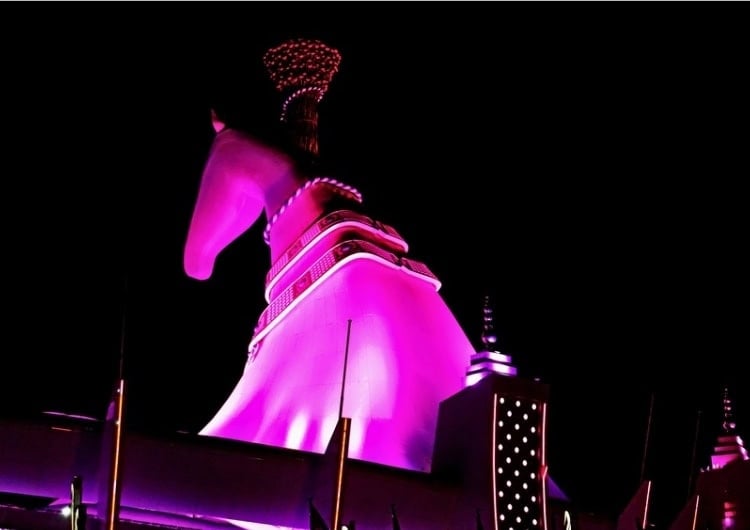
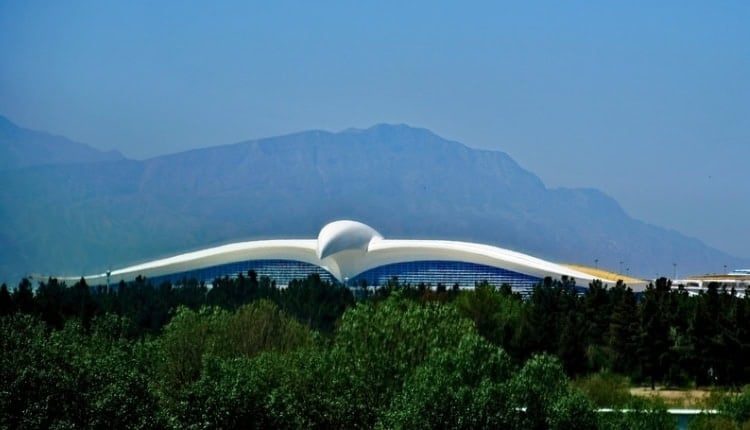
Many buildings are unique and innovative (garnering more Guinness World Records): the Olympic stadium is the largest building shaped like a horse (the national symbol); the giant Ferris Wheel is the world’s largest indoor one; the National Library is shaped like an open book; the ultra-modern airport is the largest building in the shape of a bird (an eagle).
The Las Vegas of Central Asia
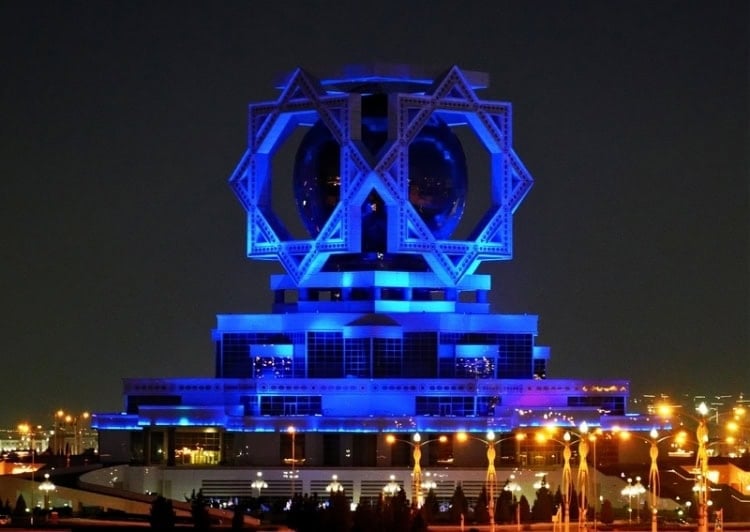
Every vehicle is white and new looking (there are a few in other light colors, but no dark cars are allowed). There are no street signs (except a minimal number of traffic signs), addresses, billboards or other advertising.
The entire city feels like one big luxury development complex. But there are no people around; no one walking the streets or in the beautiful parks; the National Library is not open to the public. The only place you see the residents are in the big shopping malls, where the restaurants are as well.
Ashgabat has also been called The Las Vegas of Central Asia: Though every building is white, at night the city explodes with color because every edifice is outlined and rimmed in lights. To differentiate among the white buildings, many have a random word or phrase in huge letters (such as “Land of Paradise” or “Bravery”) in neon lights on the roof.
Ashgabat may be written off as just the weirdest of cities but my guide, Jem, may have explained best that it’s all about projecting an image of success in the large, oil-and-gas-rich country with a population of just 6 million: “The many monuments and memorials built by our presidents are the face of the nation, and many were created with the goal of getting a Guinness World Record.”
Ancient UNESCO Treasures
Turkmenistan boasts three UNESCO World Heritage Sites – sprawling and engrossing archeological goldmines ‒ stemming from an ancient history of powerful civilizations and great empires brought down by legendary conquerors.
Nisa: Capital of the Parthian Empire
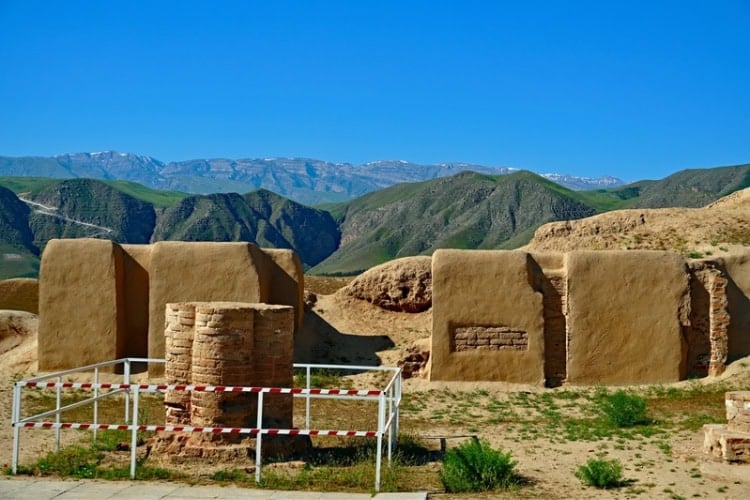
Nisa was the capital of the ancient Parthian Empire that became an important hub of trade and commerce on the Silk Road. At its height, Nisa dominated the lands from the Euphrates to present-day Pakistan. Its greatest claim to fame: it stymied Roman advancement into Central Asia, defeating an advancing Roman army, killing the emperor and, legend has it, sending his body back to Rome with the message: “You came for blood and we gave you blood.”
Mud bricks reinforced with straw were the major building material in the region, which does not wear the centuries well. As with many ruins here, most of the detail is gone at Nisa and only mounds and outlines remain. Some walls and columns have been rebuilt, however, presenting a clearer picture of its grand former self.
Kunya-Urgench: Crossroads of Empires
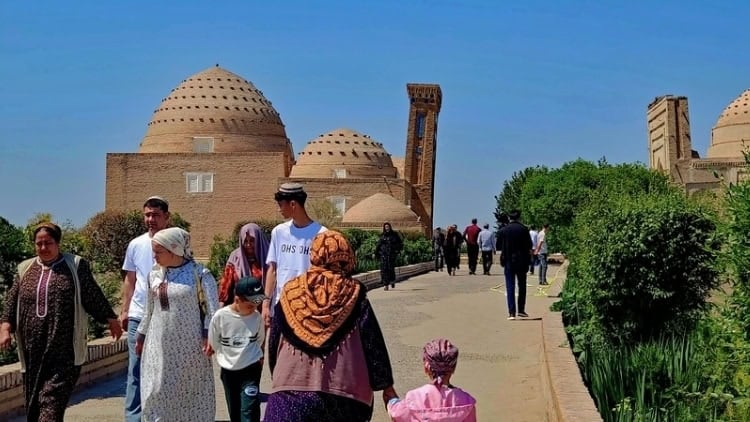
Kunya-Urgench is an extensive, partially rebuilt archeological zone dating from the 11th century dotted with historic mausoleums, city gateways, the remains of ancient fortresses and walls, Central Asia’s tallest minaret, and madrasas. Once the stronghold of the famed Achaemenid Empire, and also a major hub of the Silk Road, it was devastated by Genghis Khan in 1221, then by Tamerlane in 1388, and eventually abandoned.
A Handshake With an American
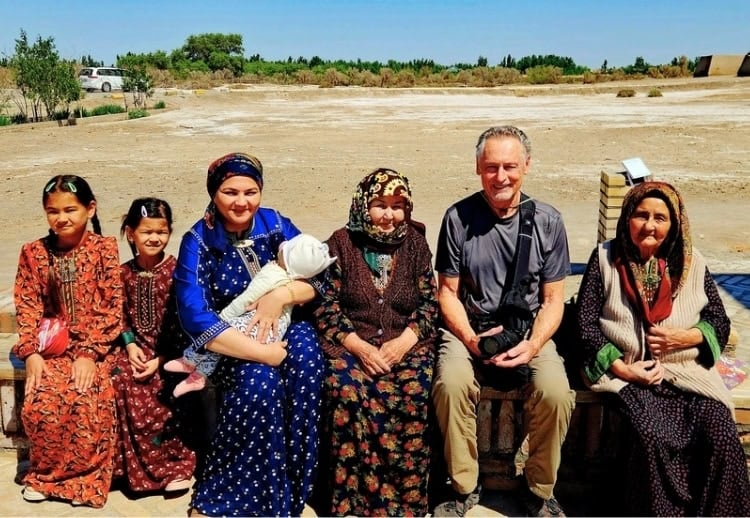
Muslim pilgrims descend on Kunya-Urgench to pray and present offerings of food at the mausoleums of saints, kings and commanders, hoping for their help with marriage, financial and other problems. A funny thing happened here: an elderly pilgrim, when she learned from my guide I was an American, excitedly asked if she could shake my hand and take a photo of me with her family. To laughs and smiles, she explained the photo was proof to show her friends she had shaken the hand of an American.
Merv: 4,000 Years of Civilization
The UNESCO site of Merv is another sprawling archeological park with the remains of many civilizations ‒ Muslim, Christian and Buddhist ‒ going back 4,000 years. Erk-Kala was a gargantuan fortress with 98-foot-high battlements built in the 3rd century BC, and surrounded by miles of defensive walls. Today, it resembles the caldera of a volcano, a vast ring of half-dissolved, forgotten bastions with a hill on one end that was a citadel. Also destroyed by the Golden Horde in 1221, it doesn’t take much imagination to conjure up the extraordinarily impressive stronghold it once was.
The Great Kyz Kala
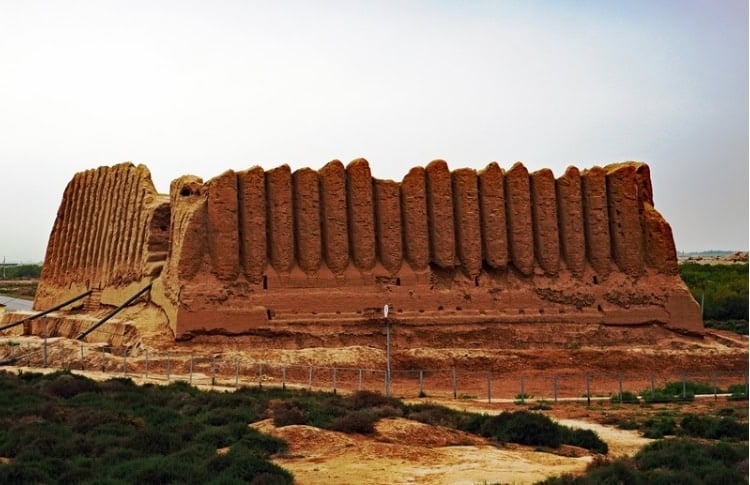
Imagination is not required at stunning The Great Kyz Kala, a premier example of a kushk, the imposing fortress-like palaces of the region. The formidable earthen structure, built possibly as early as the 6th century, towers above the dry plain with mostly intact rows of brawny, corrugated columns constructed atop a raised platform.
Koytendag Mountain Adventures
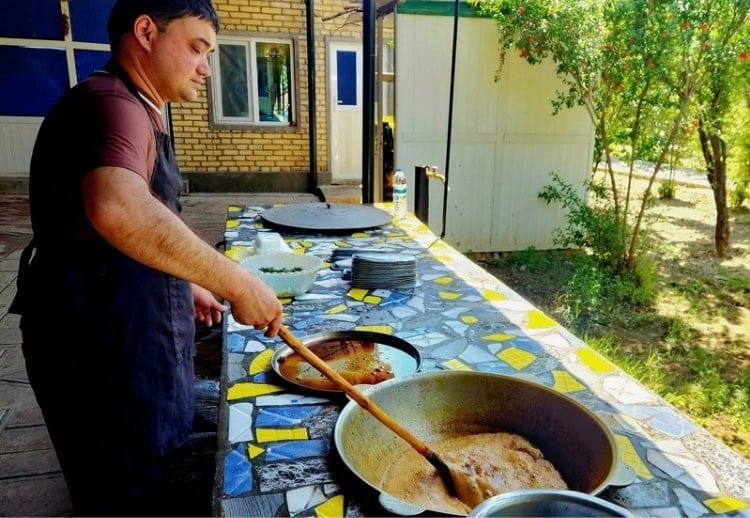
After delectable deep-fried catfish from the Amu Darya, the region’s main river, we set off from Kerki city to visit the Jurassic period. Traveling a broken, bone-rattling road, negotiating passport control points (increased security because the Afghan border was nearby), we ascended along deep gorges into the treeless Koytendag Mountains.
Walking With Dinosaurs
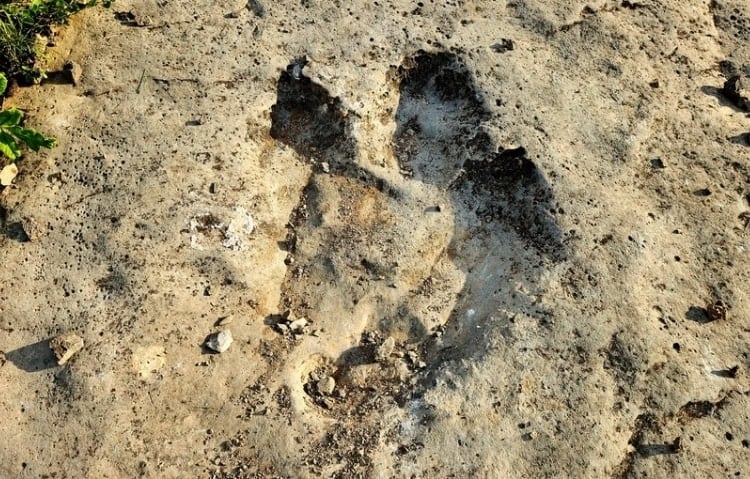
Driving past smooth slopes carpeted in green and interspersed with red hills laden with iron, we arrived at a verdant valley. After a short but almost vertical hike, shared with long-haired, munching goats, we walked in the footsteps of dinosaurs.
The Dinosaur Plateau
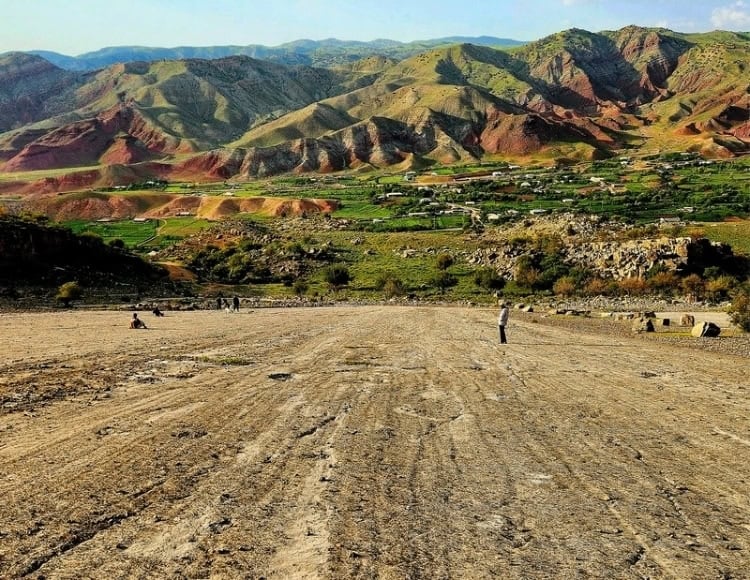
A steep limestone slab, extending several thousand feet straight up, was dotted with hundreds of fossilized, deep and distinct dinosaur footprints. The Dinosaur Plateau has the world’s largest collection of dinosaur tracks ‒ more than 2,500 ‒ believed to be from the Upper Jurassic period (140–150 million years ago), mainly from carnivorous Theropods as well as various smaller creatures.
It was a tingling, introspective moment of processing geological time and change, a stark reminder our current era is no more than a passing moment in the unfathomable saga of our planet.
We returned to the present by hiking to nearby Umbar-Dere Waterfall. Getting there was half the fun: the ‘path’ was actually a stream flowing from the cascade down a tight gorge between high rock walls. Hopping from rock to rock, we actually made it to the hard-crashing, 90-foot-high waterfall without soaking our shoes.
The Cave of the 40 Women
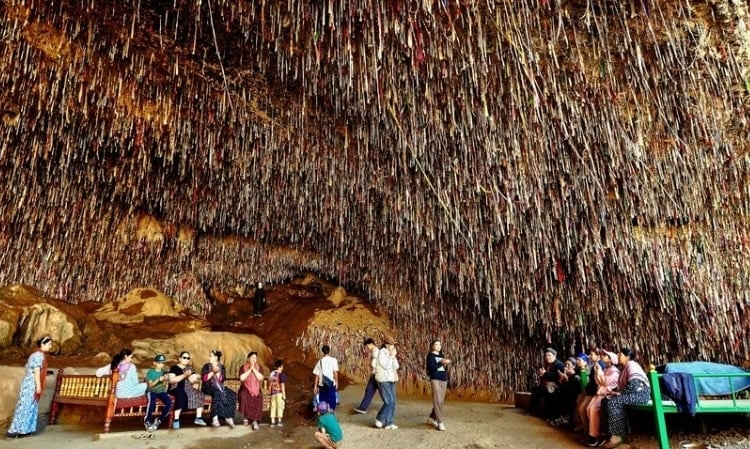
The Cave of the 40 Women is a spellbinding pilgrimage site tucked into a gorge. According to legend, Allah saved 40 women here from being ravished by a conquering army. Today, pilgrims descend on the cave carrying strips of material on which they’ve written wishes and requests of Allah. They dip the material in mud and hurl it towards the ceiling, hoping it will stick and thereby their prayers will be answered. The ceiling and walls were covered with tens of thousands of hanging strips of cloth.
Yangykala Canyon Wonders
Setting out from Turkmenbashi on the Caspian Sea, we crossed the fiefdoms of nomadic shepherds, at times their large flocks of goats or camels blocking our way on the sandy track. Then we suddenly arrived – seemingly on a distant planet.
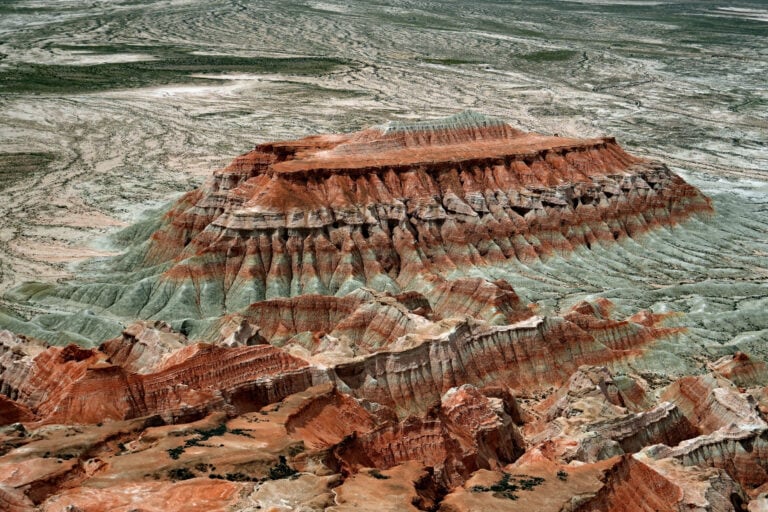
The phenomenon that is Yangykala Canyon is almost impossible to describe with the complexity, depth and intricacy of the rock shapes and formations, the massive scale, the palette of bold earth tones. Soaring cliffs composed of rows of cylindrical stone pillars gave way to striations of pink, green and orange landforms, plunging into a miasma of red and ecru sculptures.
And when we thought we couldn’t travel deeper into an unchartered galaxy, we caught sight of the Fortress of Fire, and I was stopped in my tracks in awe. The gargantuan red formation of amazing intricacy, facets and detail resembles an impregnable castle on a high promontory.
Once the floor of an ancient ocean, Yangykala was molded and shaped by water, rain and, I suspect, especially wind. The howling wind out there almost knocked me off my feet. I felt like I too was being sculpted by nature.
Darvaza Crater Nights
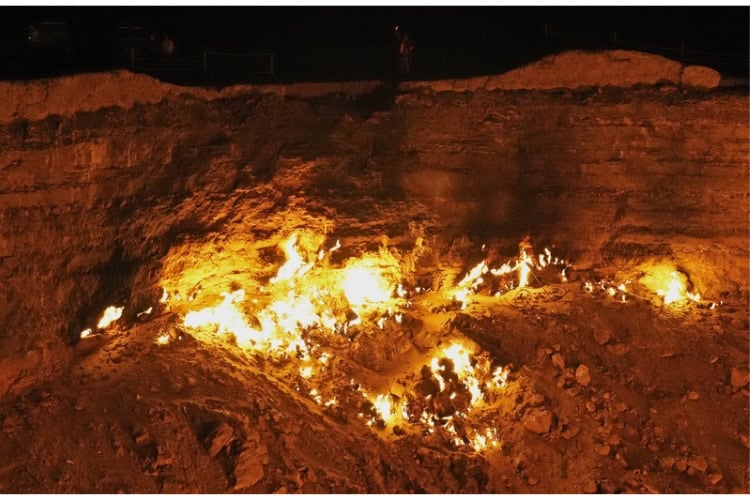
The Gateway to Hell is officially called the Darvaza Crater (Darvaza, the name of the adjacent village that was relocated, means gateway, hence the moniker Gateway to Hell). Rather than one huge fire, it’s clusters of small fires, burning continuously in a deep pit some 200 feet wide; the heat along the rim was intense. The glow from the burning gas emerged as the sky darkened, triangulating orange, yellow and red, creating a fiery show of color.
Sleeping Under the Stars
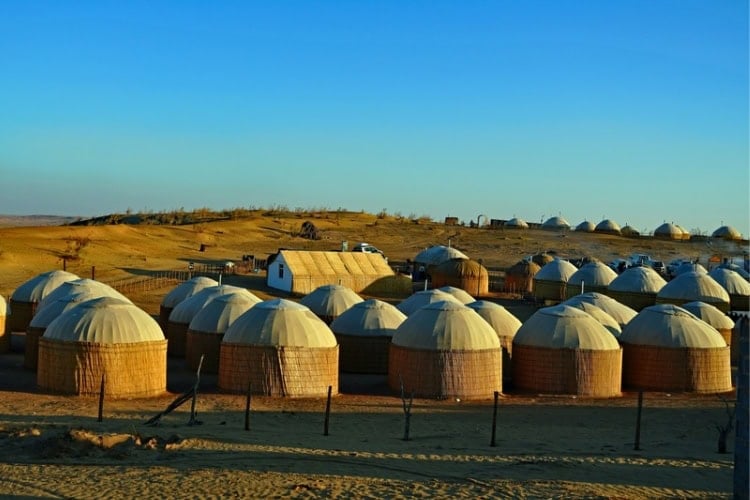
Laughter, exclamations of surprise and a cacophony of languages rang out in the night. It was an international gathering at the crater with more than 100 travelers from many countries. All stayed at one of the yurt camps that have sprung up catering to the tourists. The circular, tent-like yurts are the traditional dwellings of the nomadic people of Central Asia. Very basic with external communal bathroom facilities, the accommodations offer one modern convenience: a solar-panel-powered light.
Almost as dramatic as the fire pit were the heavens above: with no light pollution apart from the pit in this remote area of the Karakum Desert, there were more stars in the sky than humanly possible to count.
While the Darvaza Crater is Turkmenistan’s best-known attraction, its days could be numbered. According to Jem, as well as the findings from recent infrared imaging data, the fires are noticeably dimming. “When I first visited the Darvaza Crater in 2019, the flames were at their peak,” he said, “but the intensity has been less each time I’ve visited since.”
The Gateway to Hell could close as quickly and unexpectedly as it opened. So there’s no time like the present to plan an escape to Central Asia. Get it while it’s still hot.
Need a hand planning your trip? Here are the sites and services we rely on most, from booking tools to travel products we love.
Inspire your next adventure with our articles below:
- Bedouin Dreams: Finding Luxury Among the Shifting Sands of Tunisia’s Sahara
- Armenia: The Unexpected Birthplace of Wine and Why It Deserves a Spot on Your Travel List
Author Bio: Freelance travel/food writer and photographer Edward Placidi discovered his passion for exploring the world ‒ and sampling its foods ‒ as a teenager and has rambled to the far corners of the planet, leaving behind footprints in 141 countries (so far). He has contributed articles and photographs to scores of newspapers, magazines and websites. When not traveling, he is whipping up delicious dishes inspired by his Tuscan grandmother who taught him to cook, with as many ingredients as possible coming from his vegetable and herb garden.
Want to discover more hidden gems and helpful travel tips? Join our free newsletter for the latest travel secrets and travel articles.
We are reader-supported and may earn a commission on purchases made through links in this article.
Planning another trip soon? ✈️
Add GoWorldTravel.com as a preferred source on Google. Click the button below so our local guides, packing hacks, and hidden-gem itineraries always show up first when you search!
Add to Preferred Sources