
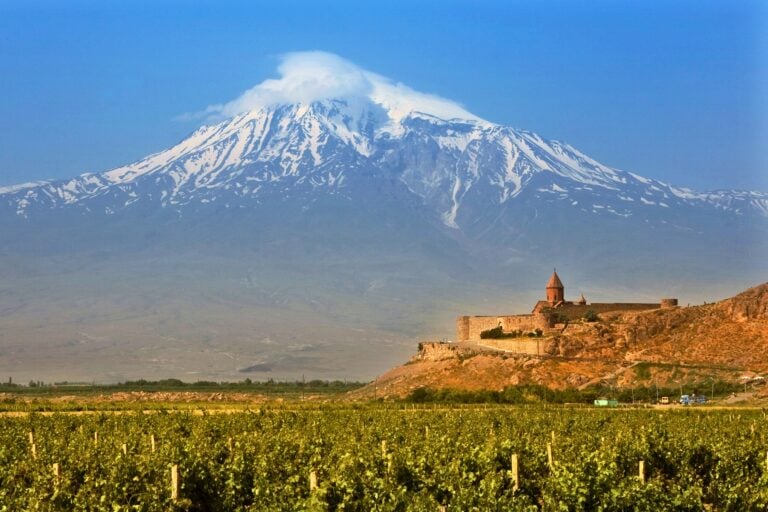
The sun seemed to shine with intention, spotlighting a table overflowing with cheeses, meats and the promise of unrushed conversation. Bottles of wine danced across the table as we all sampled them, savoring their variety while we soaked in views of the surrounding vineyard.
The real treasure was learning the art of living from Samvel, the property’s winemaker, whose mission is to live genuinely, slowly and joyfully. A man who takes fierce pride in sharing his wines, dares to experiment with production and teaches visitors how to listen to the story each bottle tells.
This is Armenia. Samvel’s essence beautifully characterizes Armenia itself, a nation that has faced eons of adversity and rebelled against it by finding joy in wine, food and one another.
Understanding Armenia

Armenia sits in the South Caucasus, an ancient region bridging Europe and Asia, home to three nations: Georgia, Armenia and Azerbaijan. Small in size but staggering in history, Armenia is a nation that has been plagued by war, conquest, and ever-shifting borders — and somehow, resiliently, still stands. And yet few know that this is where wine and Christianity were born.
Prefer audio? This story is also available as a podcast discussion – listen here.
The Oldest Wine Country You’ve Never Heard Of

Beneath the cliffs of southern Armenia sits the Areni-1 cave, home to the world’s oldest intact winery, dating back to 4100 BC. While Georgia, its neighbor, holds the earliest known traces of wine residues dating to around 6000 BC, the two countries together make the South Caucasus the undisputed birthplace of wine. Armenia, the smallest of the region’s three nations, is now entering a wine renaissance, though getting here wasn’t easy.
Despite spending millennia mastering the art of wine, the industry was hijacked during the Soviet Union’s rule from 1920 to 1991. The brutal realities of Stalinism brought sweeping restrictions, including a forced reassignment of agricultural identity; Georgia was handed winemaking, and Armenia was handed brandy.
To increase brandy production, much of Armenia’s native grape heritage was uprooted entirely, replaced with a single high-yielding white variety used purely for distillation. Decades of winemaking knowledge quietly eroded.
After the Soviet Union fell, Armenia slowly began reclaiming what was always theirs. Vineyards lay neglected through most of the 1990s, but by 1998, winemakers started returning to the land. By 2010, the Renaissance had real momentum. Today, there are over 150 wineries and counting. They’re not just catching up, they are actively redefining what Armenian wine can be.
And as I’d come to find out, it is remarkable, unique and absolutely worth the trip.
Wine Without Rules
France, Italy and Spain are considered the world’s top wine-producing nations, responsible for nearly half of global wine production. Their methods are strict, precise and centuries-old. And while the wine is excellent, somewhere along the way, some might say it got a little too serious, more concerned with tasting notes than the people across the table.
Armenia was forced into the unique position of losing its wine identity for decades and having to start completely over. What sounds like a tragedy turned into an unexpected freedom. It became a time to experiment, try new grapes, and be unafraid of making something weird. I visited seven wineries across the country, and not one of them felt like the others. What they did share was passion, pride and a total disregard for what France might think.
Van Ardi Winery

In the middle of the vast Armenian landscape in the ancient region of Aragatsotn, I was standing in a bell tower with the Mouradian daughters, who were patiently teaching me how to properly ring the bell for all the grapes to hear. Yes, the grapes. At Van Ardi Winery, the comfort and respect of the grapes takes priority, their belief being that it directly translates to the quality of the wine.
Founded by Varuzhan Mouradian, a CPA who uprooted his family from Los Angeles to continue his Armenian wine legacy, Van Ardi is the first boutique winery in Armenia and a key player in its renaissance. Though many discouraged him from growing the Areni grape in this province (it had never been done here before), he pushed forward anyway. It thrived.
The wine reflects that conviction. My favorite was the Kangun, a crisp, dry white with fruity notes and a name that means “resistant” in Armenian, a fitting word for a nation that has refused to bend. But the highlight was the family itself.
Varuzhan’s wife, Anahit, is the culinary force behind the property’s food offerings, and what she puts on the table (cheese platters, lavash rolls, seasonal salad and lamb stewed in wine) is as carefully considered as the wine beside it.
Their philosophy is simple and completely their own: the human touch is part of the terroir. No smoking, no cursing, no violence, no bad music. Nothing with negative vibration. Jazz, classical and Armenian compositions play in the production room and drift out through the vineyard year-round.
Plan your visit: Tours and tastings are available at vanardi.com. Reserve in advance. The food-and-wine pairing experience at Anahit’s kitchen is not to be missed.
Voskevaz Winery

Nothing prepares you for Voskevaz. Founded in 1932, Voskevaz is the oldest functioning winery in Armenia, though its architecture tells an entirely different story. Fantastical castles, cobblestone courtyards, arched entryways and carved dragon motifs stretch across a massive property that feels less like a winery and more like a magical medieval village.
But beneath the fairytale exterior lives a darker, more defiant history. During the Soviet era, when wine production was forbidden, the winemakers here continued in secret, underground. I descended into that tunnel and felt the energy instantly, captivated by preserved tools lining the walls, untouched and cobwebbed, the air thick with the remnants of the past. That spirit of stubborn defiance lives in every bottle.
Designed by one of the brothers who own and run the estate, the property is as intentional as the wine inside. Voskevaz works exclusively with indigenous Armenian grape varieties, aging in 130-year-old clay karases and rare Armenian oak barrels. Their kakhani wines, made by gently hanging grape bunches to dry and concentrate before fermentation, produce something intensely flavored and unlike anything I had tried before.
Plan your visit: voskevaz.am
Alluria Winery

Located just outside Yerevan near Etchmiadzin, Alluria Winery is where my perspective on wine permanently shifted. Sprawling vineyards, a pristine dining room and a setting beautiful enough to stop you in your tracks. But what sets Alluria apart is not its setting. It is what happens inside the bottle.
Alluria embraces experimentation wholeheartedly. They blend unexpected grapes, play with different barrels and are unafraid to try something strange. During one particularly cold blast, someone forgot to close the garage doors and the wine froze mid-fermentation. The freezing concentrated the sugars and intensified the flavors, producing something richer and more complex than what was intended. The result was a new texture, a new flavor and a new philosophy: happy accidents are welcome here.
Then there is Samvel, the winemaker and soul of the place. What stayed with me was the way he spoke about his wines. Every wine had a character, a story, a mood. A swaggering prince, commanding and unapologetic. A beautiful jazz musician, soft yet fearless, improvising with every note.
Plan your visit: alluria.wine
Continue the Wine Trail
Karas Winery

The largest and most established winery in the country, Karas was founded by an Argentine-Armenian family who returned to reclaim their roots. Sprawling vineyards, impeccable quality and a stunning setting in the shadow of Mount Ararat make it a worthy stop. The food spread is not to be missed.
Plan your visit: karaswines.com
Kataro Winery
A living archive of Armenian history, Kataro’s walls are lined with carpet motifs, dragon symbols and artifacts that tell the story of a civilization going back to the Bronze Age. And the wine is excellent.
Stork Winery
The smallest of them all. A true garagiste operation run out of a home in the village of Sasunik, named after the storks that migrate from Africa to Armenia each spring, nesting on telegraph poles in the countryside. Intimate, personal and completely charming.
Trinity Canyon Vineyards

Tucked into the Vayots Dzor highlands near the Areni cave, Trinity is Armenia’s first certified organic winery, founded by three friends who also happen to run one of Yerevan’s best restaurants. Laidback and family-spirited, it produces some of the finest whites in the country, particularly the Voskehat.
Plan your visit: trinitycv.com
If you happen to visit in October, plan your trip around the annual Areni Wine Festival, held in the same region. It’s a lively outdoor celebration of Armenian wine with music, food and dozens of producers pouring everything from bold reds to experimental fruit wines.
Beyond the Vineyards
While wine shines in Armenia, there is endless cultural, historical and natural beauty to explore during a visit. Between vineyard hopping, I recommend experiencing Armenia from the air, exploring pagan temples and the world’s oldest church, and indulging in its fabulous cuisine. In excess. That part is important.
A Different Kind of Flight

Soaring above Armenia’s landscapes was one of the most memorable parts of my trip. Sitting in the passenger seat of a small Cessna with a veteran pilot was something I never imagined I’d experience, but it gave me a rare bird’s-eye view, both literally and figuratively.
Vast, arid and ancient, carved hills and canyon country stretched endlessly below, a river cutting through a deep gorge. In the distance, Soviet-era buildings crumble quietly at the edges of Yerevan, remnants of an empire that shaped this country in ways still visible from above.
Pagan Temples and the World’s Oldest Church

Long before Armenia became the first nation to adopt Christianity in 301 AD, it was a pagan civilization with its own gods, rituals and sacred spaces. Garni, the only surviving pagan temple in the country, stands at the edge of a dramatic canyon, its Roman columns rising from the Armenian earth, both incongruous and magnificent. Beside it sits the ruin of a church, a quiet monument to centuries of religious collision between two worlds.
Then there is Etchmiadzin Cathedral, the oldest church in the world, its ceiling painted with brightly colored, biblically accurate angels, sparking something hard to name. You are standing where Christianity was born and preserved against every odd.
And tucked into the cliffs of southern Armenia, the Areni cave sits exactly as it has for millennia, holes carved into rock where karas once held wine, a place that reminds us that ancient humans are just like us, with their endless craving of wine and good times.
Armenian Cuisine

Food in Armenia is not an afterthought. Like the Greeks, Armenians treat the table as sacred. The food is generous, the portions abundant, and no one is ever in a rush to leave.
The spreads were enormous, fresh salads and vegetables, Armenian cheeses, warm breads and spiced meats filling the air with a fragrance that was tangy and warm with notes of mint and coriander.
Armenian cuisine sits at the intersection of Mediterranean, Middle Eastern and the mountain cuisines of the South Caucasus. Khorovats, the beloved national barbecue. Dolma, seasoned meat wrapped in grape leaves. Gata, a buttery honey cake worth seeking out. And manti, tiny spiced meat dumplings served with yogurt and butter, which I had at Karas Winery and it became my favorite bite of the entire trip.
I ate constantly, and I ate well, usually with wine, usually outside, usually in no particular hurry. And I’ve brought that lifestyle home with me.
If You Go

Where to Eat in Armenia
Lavash — Consistently rated one of the best restaurants in Yerevan, this farm-to-table Armenian spot serves traditional dishes made with locally sourced ingredients. Watch lavash being baked in the tandoor on your way in. Reserve ahead.
Mov — Modern Armenian cuisine with an exceptional native wine list. Sophisticated without being stuffy.
Machanents House — Traditional Armenian dining in a historic setting, a reliable lunch stop between winery visits.
Chinar — A solid Armenian option in Yerevan for a relaxed dinner.
Lele — Casual and welcoming, ideal for lunch in the Vayots Dzor region.
Where to Drink in Armenia
InVino — Yerevan’s pioneering wine bar on Saryan Street, carrying over 600 Armenian labels. The place to start and end any evening.
Urban Gastro Wine Bar — European and Mediterranean with a strong wine selection.
Daboo — A Cascade area favorite for a nightcap.
The Bird Cage and Phoenix — Both next door to Mov, both worth a stop.
Beatles Pub — Casual, warm and a Yerevan institution.
Where to Stay in Armenia
Tufenkian Historic Yerevan Hotel is a boutique property centrally located near Republic Square, designed with handcrafted Armenian furnishings and traditional basalt stone. The on-site Kharpert Restaurant serves Western Armenian cuisine with an extensive wine list. Learn more and check prices here.
Getting There
Fly into Zvartnots International Airport in Yerevan. Search flights on CheapOair.
Getting Around
A rental car is highly recommended for exploring Armenia. Compare rates at Discover Cars.
Travel Insurance
Always recommended for international travel. Compare plans on Squaremouth or SafetyWing.
Stay Connected
Pick up an eSIM before you go through Airalo to stay connected without roaming fees.
Special thanks to TAP Armenia, a non-profit organization bridging the communication gap between Armenia and the international community. Learn more here.
Need a hand planning your trip? Here are the sites and services we rely on most, from booking tools to travel products we love.
Inspire your next adventure with our articles below:
- 12 Cool Things to Do in Tbilisi, Georgia’s Vibrant Capital
- Astana, Kazakhstan: An Unlikely but Fascinating Tourist Destination
Want to discover more hidden gems and helpful travel tips? Join our free newsletter for the latest travel secrets and travel articles.
We are reader-supported and may earn a commission on purchases made through links in this article.

- Skip Oktoberfest: Stuttgart’s Cannstatter Volksfest Is Smaller, Cheaper and Way Less Crowded - September 19, 2026
- Want to Speak Better Spanish on Your Next Trip? Here’s How - September 2, 2026
- Cody, Wyoming: Where the West is Still Wild - August 28, 2026
Planning another trip soon? ✈️
Add GoWorldTravel.com as a preferred source on Google. Click the button below so our local guides, packing hacks, and hidden-gem itineraries always show up first when you search!
Add to Preferred Sources