
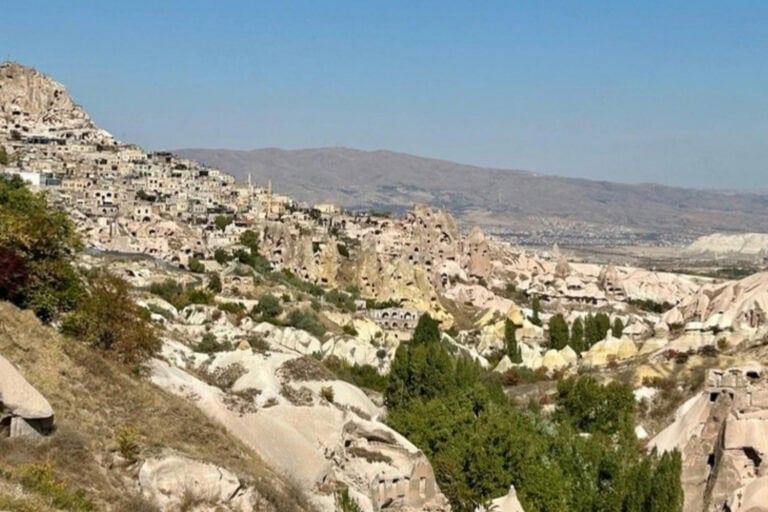
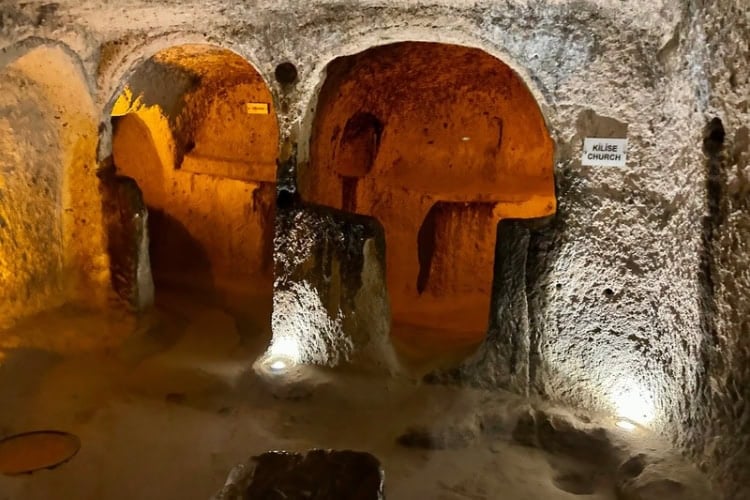
I find myself crouching as low as possible, yet keep banging my head, as I squeeze through a maze of tight tunnels of volcanic rock, some 3,000 years old. How short were those people, I wonder? Obviously, they weren’t claustrophobic.
I tread carefully through multiple levels with interconnected tunnels to living quarters, stables, wine cellars, storage rooms, communal kitchens and even a place of worship. It was designed to house a large population beneath the rocky landscape of Cappadocia for as long as possible.
The rooms, tunnels, and passages, descending some 65 feet and reaching up to eight floors, were carved into soft volcanic rock over a thousand years before Christ. The stone was easy to excavate but strong enough to create a large, enduring, and multi-level structure, demonstrating ingenuity.
The Kaymakli Underground City shows how its residents engineered a livable world deep below the surface. Wells were carved through the rock to ensure access to clean water.
A ventilation system connected the underground chambers to the open air. It brings in fresh oxygen and, in some places, limited natural light. These shafts could be sealed from within using large millstones, allowing the community to protect itself if threatened by invaders.
Once I stopped marveling at the underground architecture, I asked myself a fundamental question: Where the hell is the exit?
Stuck on the Hittites
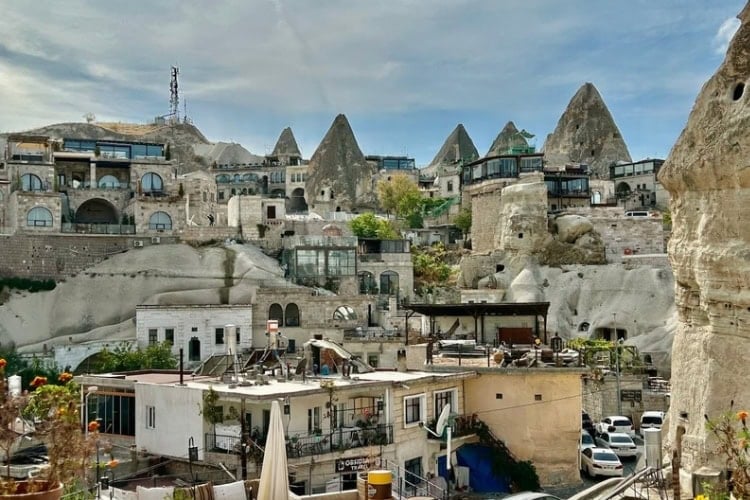
This ancient settlement, 180 miles from Ankara, is one of an estimated 200 ancient subterranean cities in the Cappadocia region.
“Later, when Christians came, it became an expanded place to hide from persecution and invaders,” says Öznur Doksöz, my guide throughout the trip.
I came to this historical region in central Anatolia, which makes up much of modern-day Türkiye. Here, ancient civilizations once came to conquer, thrive and eventually collapse into history. The Romans, Greeks, Phrygians, Lydians and Persians all left their mark.
But I am mostly hung up on the Hittites, a once-powerful kingdom that ruled over Central Anatolia from around 1650 to 1190 BC. Their kings were at times on a par with the mighty pharaohs of Egypt, their rivals.
They were the earliest known major inhabitants of the region, migrating into central Anatolia to establish their kingdom, with Hattusa as its capital.
Visiting some of their sites and artifacts, I wanted to discover what lessons this once-great kingdom could teach us and experience an authentic connection to our past.
“I think one of the primary things we can learn from the Hittites’ conception of their world and culture is related to their connection to nature and the environment,” explained an archaeologist on site.
“Water was a crucial resource to them because the economic basis of their society was agriculture and pastoralism.”
Easing into Anatolia via Istanbul
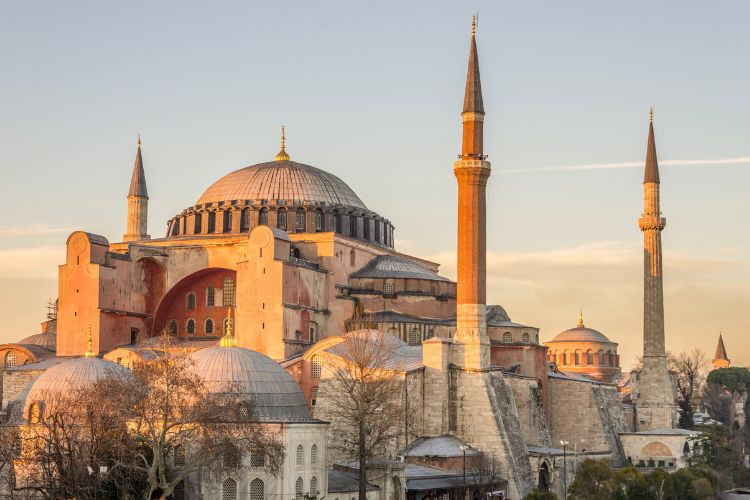
Arriving in Istanbul from New York, I meet Öznur. We spend a couple of days exploring the major sites of Hagia Sophia, the Blue Mosque, Topkapi Palace and the maze-like Grand Bazaar.
Fueled by a cup of strong Turkish coffee, great for jetlag, we take a one-hour morning flight to Ankara, Türkiye’s capital. It is here that I have my first contact with the riches of the Hittite Empire.
The Museum of Anatolian Civilizations is an essential stop. It showcases remarkable artifacts from the Phrygians, Urartians, Lydians, the Hellenistic world, and the Roman Empire. Pieces range from sculptures and ceramics to intricate jewelry.
However, its centerpiece is the Hittite collection: the brainchild of Mustafa Kemal Atatürk, Türkiye’s founder and first president.
The museum was founded in 1921 and later moved to its current home in a restored Ottoman caravanserai. It offers a vivid glimpse into the Hittites’ power, religion, and artistry.
Gateway to the Past
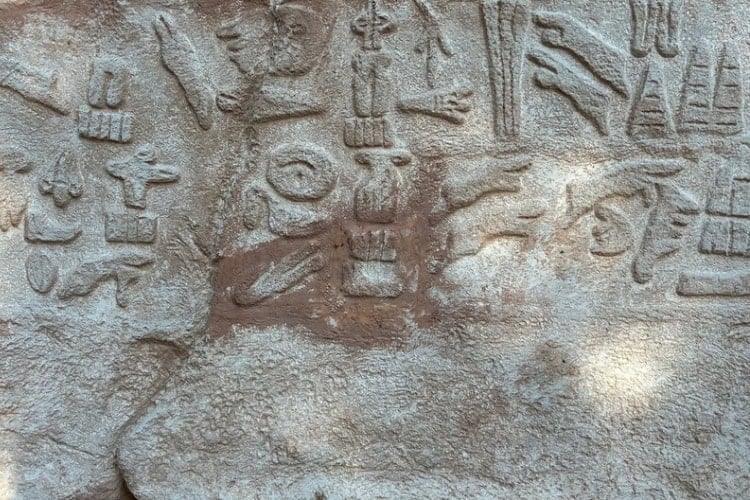
Like gateways to the past, I stand in touching distance of large stone blocks carved with scenes of kings, gods and rituals.
I marvel at a king’s dagger bearing the earliest known Indo-European inscription, affirming the power of the Hittite king Anitta and his authority over other cities. And I consider bronze and gold sun disks, symbolizing the sun, fertility and divine power, which were once placed on royal tombs.
But I linger longest at a Kadesh Peace Treaty Tablet. It’s a replica of the world’s oldest surviving written peace treaty, made between the Egyptians under Pharaoh Ramesses II and the Hittites under King Hattusili III.
I try to picture this being done circa 13th century B.C. The careful negotiation, the scribes bending over clay and papyrus and the moment two ancient empires agreed to bind their fates with ink and seals.
At Last, Yazilikaya, the Main Reason I Came to Türkiye
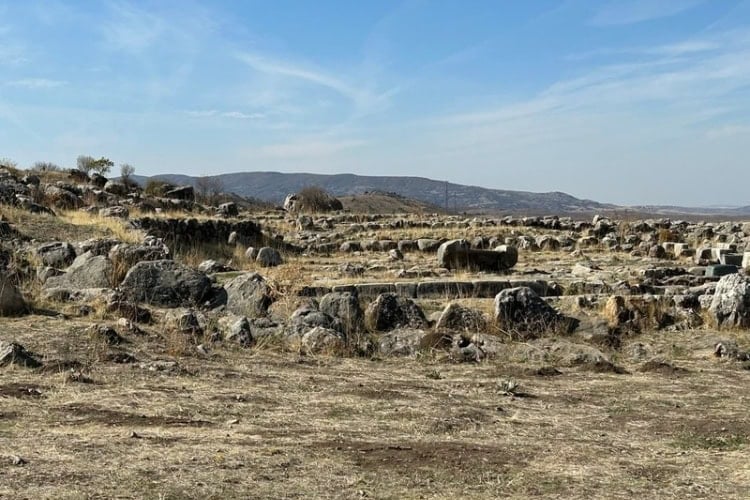
Photo by Paul Ehrlich
Early next morning, we drive to Çorum—direct flights don’t reach this part of Anatolia. It’s mostly a flat highway with occasional winding roads past mountains, brush-covered hills, and valleys of wheat fields.
It’s a quiet, unassuming journey, but I’m psyched about what waits at our destination over the next couple of days. The city is best known for Yazilikaya, the sacred site connected to the Hittite capital. It’s a place that has captured my imagination for years.
Dozens of ruins are scattered across the surrounding landscape. However, Öznur arranges a visit to Bogazköy for the most compelling site of them all: Hattusa, the ancient capital itself.
We start at Yazılıkaya, Turkish for “inscribed rock,” the largest known Hittite open-air religious site. “It has the best inscriptions of reliefs that tell us about many of the gods the Hittites worshipped,” says Öznur.
Recent Findings
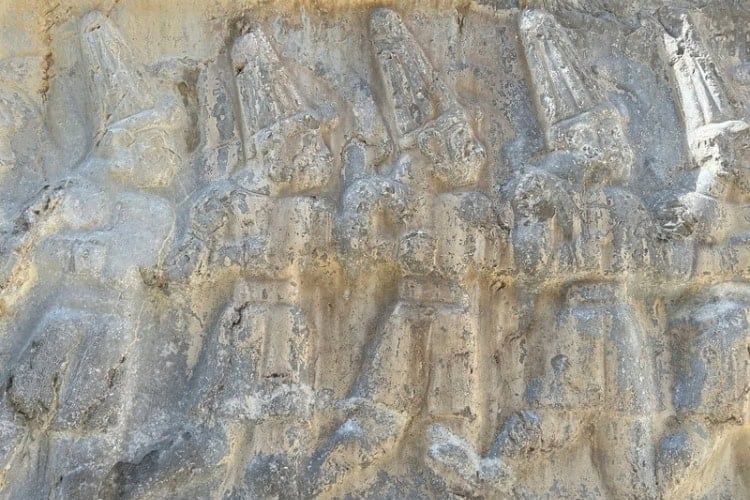
I walk slowly through the two rocky chambers, stopping to marvel at the numerous elaborate reliefs carved into the stone. These include Hittite gods, goddesses and Tudhaliya IV, one of the Hittites’ most powerful kings, who reigned from around 1245 to 1215 B.C.
Öznur tells me he completed this sacred site, won a major military battle against Assyria, built dams during a severe drought and undertook religious reforms. This was all during a period of increasing instability for the Hittite Empire.
“This sanctuary is believed to be where the Hittites held festivals and royal ceremonies,” explains Öznur.
In 2021, an international team of researchers suggested that the 90-plus carved reliefs represent the cosmos as the Hittites imagined it: earth, sky and underworld, each teeming with deities.
The Hittites symbolically tracked cycles of renewal, sunrise, lunar phases, and seasonal changes so precisely that it could function as a reliable calendar.
Hattusa: Walking the Capital
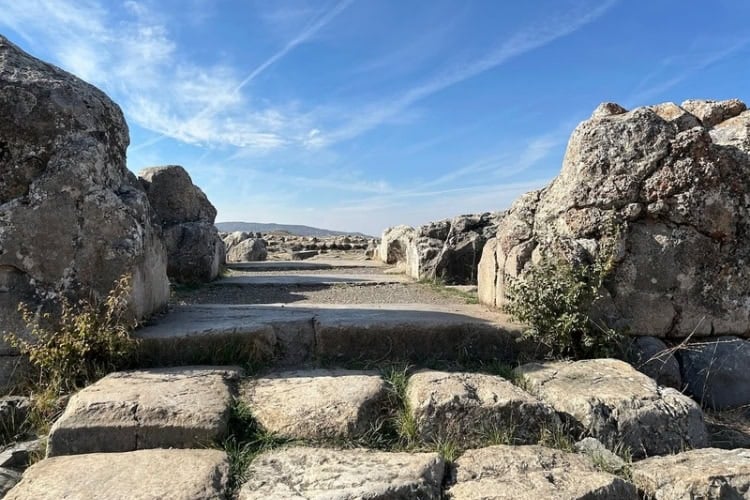
Later in the day, we drive about 165 miles to Göreme. Over the next couple of days, Öznur and I explored the sprawling capital Hattusa, a UNESCO World Heritage Site.
The capital is divided into two main sections. We begin in the Lower City, once an area of dense residential districts, granaries, administrative buildings, colonnaded halls, and an imposing system of fortified walls spanning 3.7 miles.
The site also includes the massive Great Temple, the largest structure of Hattusa. Dedicated to the storm god Teshub and the sun goddess Arinna, all that is left is a huge carved stone.
I pass my hand over the 1,600-year-old limestone block, smoothed and polished by time. The entire city has been reduced to an extensive archaeological site. Here, stone foundations and the ruins of massive city walls and gates outline a once thriving commercial and religious area.
Yet as I wander among age-old stones scattered in the hard brown earth, it is hard not to imagine this place once bustling with daily life.
The Decline of the Hittites
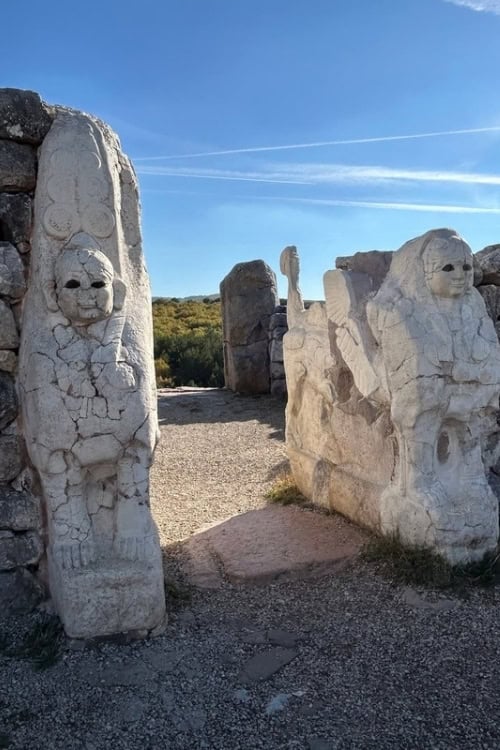
Indeed, walking through the ruins of Hattusa, I am struck by the awe and power of this warrior society. At its peak, it covered approximately 0.7 square miles. There were distinct inner and outer cities, protected by a massive stone fortification with large gates.
This was a capital built for defense. In their heyday, the Hittites faced intense regional upheaval from Egypt, Babylon and Assyria in a relentless struggle for control over the Near East.
Today, it’s late morning, and I’m exploring the Upper City, a fortified area of royal buildings. I first pass through the impressive Lion’s Gate, flanked by a pair of fierce-looking lions carved from huge stone blocks. This leads to a steep stone staircase to the ceremonial entrance, guarded silently by imposing sphinxes.
Here is the summit of Yerkapı, a 250-foot-long, 263-foot-wide, 50-foot-high man-made embankment that crowns the Hittite capital. As impressive as it is, below is a 233-foot long-vaulted tunnel carved through the massive fortification. A masterpiece of Bronze Age engineering.
It was not until 2022 that researchers discovered painted hieroglyphs in the Yerkapı tunnel, suggesting its purpose was not just for soldiers, but a symbolic passageway for religious rituals.
The Hittite Empire began to fragment and ultimately collapsed around 1200 B.C. This was driven by prolonged droughts, internal strife, disease and invasions by the nomadic Sea Peoples and the Kaska tribe. The Anatolian Bronze Age came to a close.
Modern Connections to Ancient Histories
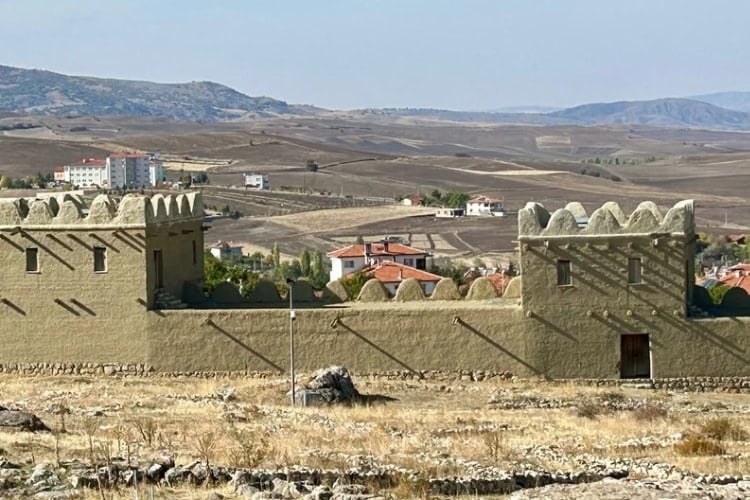
Photo by Paul Ehrlich
New settlements followed. Yet Bogazköy, the site of Hattusa, remains as a modern Turkish town, Boğazkale. Are the ancient voices ever heard in the wind?
The valley and hills stretch below me, weathered and scattered with the remnants of Hattusa’s past. Time feels slow, the weight of history feels real, a past that settles like a quiet presence.
Reflecting on my experiences, I find that the most important lesson the Hittites offer is our debt to history. Even without shared beliefs or customs, our understanding of the world is built upon centuries of accumulated history, faith and tradition.
If You Go
Guide: To arrange a similar trip starting in Istanbul, I highly recommend my extremely knowledgeable guide, Öznur Doksöz. Reach him via email: doksoz68@gmail.com
Getting to Cappadocia/Göreme: Fly into Istanbul, then connect to Nevşehir Airport (about 90 minutes). Arrange a hotel transfer on arrival or take a taxi into Göreme, roughly 30 minutes away. Kayseri Airport is another option and worth checking for competitive fares. Search flights on CheapOair — it searches hundreds of airlines at once, which is handy when routing through Istanbul, where timing and layover options vary.
Where to Stay: Staying in a cave hotel is genuinely one of the best parts of Cappadocia. The volcanic rock keeps rooms naturally cool in summer and warm in winter, and rooftop terraces are perfectly positioned for watching hot air balloons drift over the fairy chimneys at sunrise. Book ahead in spring and autumn.
Luxury (Üçhisar):
- Museum Hotel — Cappadocia’s only Relais & Chateaux property, set into the cliffs with sweeping valley views and rooms filled with Anatolian antiques.
- Argos in Cappadocia — Built into a restored monastery complex with underground tunnels, a wine cellar, and a spa. One of the most immersive stays in the region.
Mid-Range (Göreme):
- Kelebek Special Cave Hotel — A longtime Göreme favorite with a pool, Turkish bath, and rooftop balloon views.
- Sultan Cave Suites — Perched above the village, with individually decorated rooms and one of the best terraces in town.
- Cappadocia Cave Suites — Built into actual fairy chimneys, a highly unique stay.
Getting to Hattusa and Yazılıkaya: The sites are near Boğazkale in Çorum Province, about three hours from Cappadocia. No direct flights serve the area, so a rental car is the most practical option and lets you explore at your own pace. Book via Discover Cars for competitive rates across local and international agencies. Some Göreme tour operators offer guided day trips with transportation if you’d prefer not to drive. Plan for at least two days.
Top Sights
Istanbul: The city makes an excellent gateway. Key stops include Hagia Sophia, the Blue Mosque, Topkapi Palace and the Grand Bazaar.
Ankara: The Museum of Anatolian Civilizations is an essential stop for anyone interested in Hittite history. Allow at least two to three hours. Ankara is approximately one hour by air from Istanbul or a three- to four-hour drive.
Kaymakli Underground City: Open year-round. Located about 30 minutes from Göreme, easily combined with Göreme’s other attractions. Only four of the eight floors are currently accessible to visitors. Wear comfortable shoes and be aware that the tunnels are low and narrow. Viator offers many highly-rated, reputable tours. View options here.
Hot Air Balloon Ride: Pre-dawn balloon flights over Cappadocia’s volcanic landscape are a Göreme highlight. Best season: April to November. Browse options on Viator. Operators and conditions vary, so it’s worth having travel insurance in place before you go in case your tour gets canceled. Read our article, Best Travel Insurance for International Travelers: What to Know Before You Go, to learn more about your options.
Need a hand planning your trip? Here are the sites and services we rely on most, from booking tools to travel products we love.
Inspire your next adventure with our articles below:
- Three Hidden Gems in Turkey Every Traveler Must Discover
- Ephesus, Turkey: Marble Streets, the Celsus Library and a Legendary Cat
Author Bio: Before returning to New York, Paul Ehrlich spent almost 30 years primarily as a travel writer in Hong Kong and Southeast Asia, including the launch editor and editor-at-large for Travel + Leisure’s Asia edition. His work, taking him from Bhutan to Brazil, South Korea to South Africa, has appeared in Prestige Hong Kong, DestinAsian, Hospitality and Design, Premier Traveler, The Global Post, Robb Report, Tatler, Wall Street Journal, Politico, Matador, and other publications.
Want to discover more hidden gems and helpful travel tips? Join our free newsletter for the latest travel secrets and travel articles.
We are reader-supported and may earn a commission on purchases made through links in this article.

- Bonaire, Savored Slow: Cactus Liqueur, Caviar, Donkeys and Shore Diving - October 23, 2026
- Two Colorado Hot Springs Worth the Drive from Denver - October 23, 2026
- Is 55 Too Young for a River Cruise in Europe? - October 23, 2026
Planning another trip soon? ✈️
Add GoWorldTravel.com as a preferred source on Google. Click the button below so our local guides, packing hacks, and hidden-gem itineraries always show up first when you search!
Add to Preferred Sources