
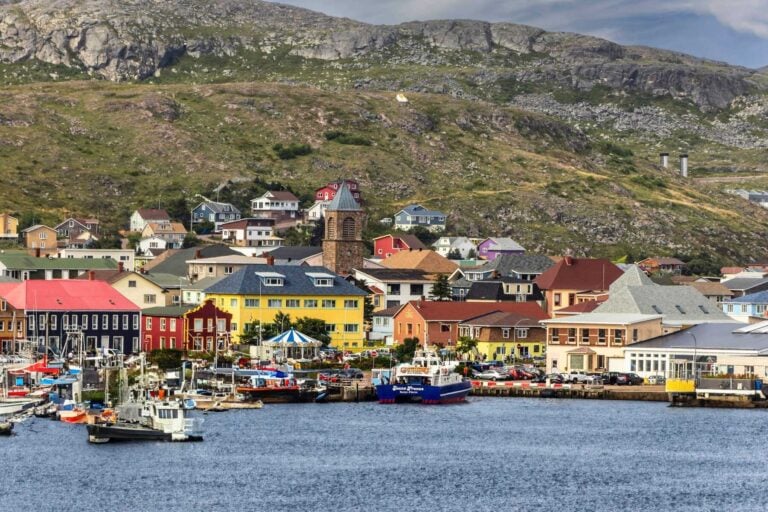

St. Pierre and Miquelon is an archipelago in the North Atlantic Ocean and the last remaining vestige of France in North America. France once held extensive territory in North America, including New France, which consisted of Quebec, Acadia, and Louisiana.
Great Britain and Spain assumed control of New France in the 18th century, but St. Pierre and Miquelon remained French.
There are eight islands, and St. Pierre and Miquelon-Langlade are the two largest. There are approximately 5,800 inhabitants, with 90% residing in St. Pierre, the capital.
Mais Oui! You’re Definitely in France

We visited St. Pierre and Miquelon while on a cruise and felt like we were in France the minute we disembarked. Residents serenaded us with La Marseillaise, the French National Anthem, and handed out miniature French flags.
French is the official language, and the official currency is the Euro, although some merchants accept Canadian and U.S. dollars. Residents are French citizens, observe French holidays, customs, and traditions, and vote in French elections. The President of France is the head of state.
We felt the laid-back French culture while walking around St. Pierre. There’s no home mail delivery, but residents don’t care. It gives them an excuse to come into town each morning and chat with friends while enjoying coffee with a pastry or waffle at one of the local cafés.
They relax in General de Gaulle Park in the town square and then stop at the bakery to buy freshly baked bread and croissants. If it’s Saturday morning, they stop at the Marché Forain, a farmers’ market along the seawall, to shop and socialize.
History of St. Pierre and Miquelon

France initially claimed St. Pierre and Miquelon in the 16th century, but it changed hands several times due to wars, treaties, and diplomatic agreements.
The French originally settled St. Pierre and Miquelon to use as a base of operations for cod fishing. The British attacked French colonial settlements on the islands several times in the late 1600s and early 1700s, and the inhabitants left.
In 1713, France transferred possession of St. Pierre and Miquelon to Great Britain along with Newfoundland.
Ownership reverted to France when the Treaty of Paris was signed at the end of the Seven Years’ War (the French and Indian War in the U.S.). France regained fishing rights in the waters around St. Pierre and Miquelon, as well as the right to come ashore in Newfoundland to dry their catch.
When France joined with the colonists during the American Revolutionary War, Great Britain retaliated by deporting French settlers.

During the next 30 to 40 years, possession of St. Pierre and Miquelon passed back and forth due to invasions by both Great Britain and France and turmoil associated with the French Revolution.
France reclaimed St. Pierre and Miquelon after Napoleon’s second abdication in 1815, and it became French for good in 1816.
Around the City of St. Pierre

The best way to see St. Pierre is to sign up for a guided tour at the Visitor Information Center. During our city tour, we learned that St. Pierre and Miquelon became a major hub for smuggling liquor into North America during Prohibition.
From January 1920 to December 1933, local warehouses stored over four million liters of whiskey and hundreds of thousands of cases of wine, brandy, rum, and Champagne. All were loaded onto smugglers’ ships bound for American and Canadian ports.
From the main town square, it’s an easy walk to the Pointe aux Canons Battery and Lighthouse. The battery was once a fort used to defend the islands from British attacks. The fort is long gone, but four cannons remain.
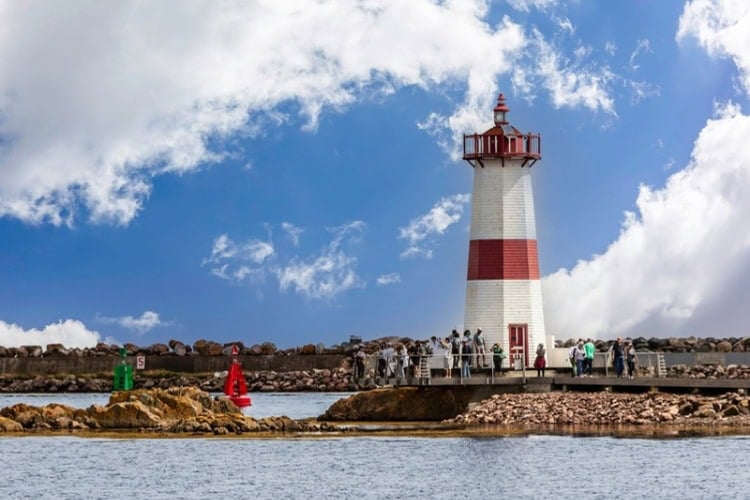
The red and white Pointe aux Canons Lighthouse is a short walk down the coast at the end of a stone pier. The tower is closed and the light is removed because it was no longer needed after the outer breakwaters were constructed.

Further along the coast are some colorful sheds with boats in front of them. They’re owned by Les Zigotos, a local fishermen’s group that’s dedicated to the preservation of St. Pierre and Miquelon’s wooden boat heritage.
There’s a small museum in one of the sheds where you can see equipment they use and read stories about distances some of the boats have traveled. Les Zigotos sometimes offer boat trips around the harbor or out to some of the islands.
Spend some time walking around St. Pierre and talk to the locals in stores and cafés. If you want to practice your French, don’t be shy. Everyone’s very friendly and accommodating. If you never studied French, no problem; most people speak English.
Hiking, Biking and Birds

The best way to see St. Pierre and Miquelon is on a bicycle or by taking a hike. Many locals recommend the Diamond Trail. It’s an easy, 2.2-mile trail (much of it on boardwalk) on Île aux Marins (Sailors Island) that features sweeping views of the rugged coastline, a former school, church, and cemetery.
If you’re lucky, you might meet some friendly horses grazing along the trail. Stop by the Visitor Information Center to get a map with descriptions and locations of all the available hiking trails.

If you prefer to bike around the islands, here are two places that rent bikes and electric bikes for around €10-15 per day.
X Sports SPM1 Rue des Francais Libres
BP 4412 St. Pierre
Phone: +508 41 33 00 Chez Adrian
11 Rue Victor Briand
Miquelon
Phone: +508 55 67 65
St. Pierre and Miquelon is a mecca for birdwatchers because of the abundance of seabird colonies. Cape Miquelon is the perfect place to see nesting gulls and birds of prey, including Hawks, Bald Eagles, and Merlins, a small species of falcon.
Grand Colombier Island hosts the only nesting site for Atlantic Puffins. You’ll also see Razorbills, Hawks, Kittiwakes, Great Cormorants, and Leach’s Storm-Petrels, a small seabird that nests here in large numbers.
Take an occasional break from the birds and look out to sea. You may see humpback and finback whales, dolphins, and seals. Les Zigotos and several tour operators offer boat tours to Grand Colombier Island. Check with the tourism office for schedules.

Escapade Insulaire offers guided hikes and bird/wildlife watching tours led by Gilles Gloaguen, a state-certified hiking guide. He grew up on St. Pierre and Miquelon and is trained as a scientist and naturalist.
Tell him what you want to see, and he’ll design a hike customized for your interests. He also offers tours of Miquelon.
If You Go

Getting There
- By cruise: This is the easiest way to visit. Holland America, Norwegian, Oceania and Seabourn stop here on several itineraries.
- By air: Air Saint-Pierre flies year-round from St. John’s, Montreal and Halifax to St. Pierre Pointe-Blanche Airport. It also runs summer flights from the Magdalen Islands and connects Miquelon with St. Pierre.
- By ferry: SPM Ferries sails from Fortune, Newfoundland, in about an hour to 90 minutes. Most visitors go as walk-on passengers because vehicle crossings are limited and come with extra requirements. Fortune has no airport, so fly into St. John’s and drive about 225 miles to the terminal.
Getting Around
St. Pierre is small, and you can walk from one end to the other in about 20 minutes. A few rental cars are available, but parking is limited and you’ll still reach many attractions on foot. If you plan to drive, check that your auto policy covers you in the EU. Visitors from outside the EU usually need to buy insurance, and it can be very expensive.
Where to Stay
Most hotels and inns are in town, within walking distance of restaurants and attractions.
- Les Terrasses du Port is a four-star hotel in the center of town. It has a gourmet restaurant, a spa and a fitness center with a counter-current pool, jacuzzi, sauna, steam bath, sensory shower and yoga.
- Hôtel Robert was built on the waterfront during Prohibition and once hosted Al Capone. It’s three minutes from the ferry terminal and five from the city center. Rooms have mini fridges and free Wi-Fi, and you can rent a car here with a seven-day minimum.
- Auberge St. Pierre is a three-star inn 10 minutes from the city center. Rooms have mini fridges, flat-screen TVs and free Wi-Fi, and breakfast is included. It offers free airport transfers and, when available, minivan island tours with a local driver and guide.
- Several companies also offer vacation rentals across the islands.
Travel Insurance
Fog and North Atlantic weather can delay ferries and flights, so it’s worth checking travel insurance plans on Squaremouth before you go.
Good to Know
- St. Pierre and Miquelon is 30 minutes ahead of Newfoundland and two hours ahead of Eastern Time.
- Many businesses close between noon and 2 p.m., on Saturday afternoons and all day Sunday, so plan ahead.
- Electricity is 220 volts with European plugs, so bring an adapter for your devices.
- The ferry crossing can be rough, so pack Dramamine if you get seasick.
- You can book ferry tickets online with a credit card, but the snack bar on board only takes euros.
- Dust off your French dictionary, pack a windbreaker and walking shoes and get ready to immerse yourself in French culture. Bon voyage!
Helpful Links
- Tourism St. Pierre and Miquelon
- Air Saint-Pierre
- SPM Ferries
- 5 Really Cool Things About St. Pierre and Miquelon
- St. Pierre and Miquelon Profile
Need a hand planning your trip? Here are the sites and services we rely on most, from booking tools to travel products we love.
Inspire your next adventure with our articles below:
Author Bio: Marni is a freelance journalist who writes about destination travel, local customs and cultures, and history. She lived all over the U.S., and caught the travel bug when she spent a year in Belgium as an exchange student. She’s a member of the International Food, Wine & Travel Writers Association (IFWTWA) and the Society of American Travel Writers (SATW).
Want to discover more hidden gems and helpful travel tips? Join our free newsletter for the latest travel secrets and travel articles.
We are reader-supported and may earn a commission on purchases made through links in this article.

Planning another trip soon? ✈️
Add GoWorldTravel.com as a preferred source on Google. Click the button below so our local guides, packing hacks, and hidden-gem itineraries always show up first when you search!
Add to Preferred Sources