
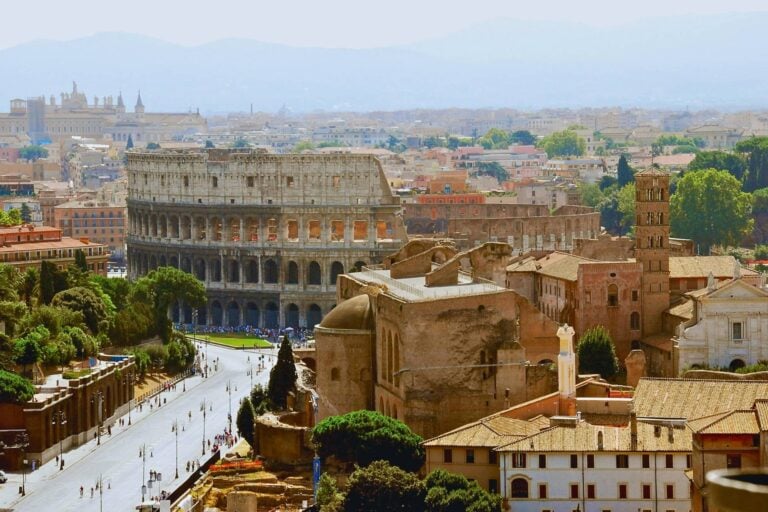
Greek temples, Roman arenas, buried towns, baths, forums, cave churches, and sacred roads sit within reach of trains, metros, local rail, shuttles, or buses. The trip can move from imperial Rome to volcanic Campania, Greek Paestum, cave-carved Matera, and Sicily’s Valley of the Temples without a car.
One itinerary can start with the Colosseum and Roman Forum, continue through Pompeii and Herculaneum, climb toward Vesuvius, pause among Greek temples at Paestum, and end on a Sicilian ridge lined with ancient sanctuaries. Few European routes offer that much visible history in such a practical sequence. The better approach is slow. The sites need time to register as places.
The Colosseum, Roman Forum and Palatine Hill: Start With Rome’s Political Theater
The Colosseum gets the photo; the Forum gets the city. Rome‘s amphitheater has become one of the most visited ancient monuments of all time, but the better visit comes with the addition of the Roman Forum and Palatine Hill. It is power, temples, courts, houses, processions, collapse, and reuse.
Book ahead. The 24-hour ticket includes the Colosseum, Roman Forum and Palatine, and a timed visit to the Colosseum. Metro B line Colosseo. If walking over from Piazza Venezia, Circus Maximus provides scale. The Baths of Caracalla deliver arches, space and fewer crowds.
Naples as the Rail Gateway to Southern Archaeology
On this itinerary, Rome and Naples make the cleanest couple. Between them, high-speed trains are provided by Italo, offering travelers a way out of Imperial Rome into the southern archaeological band.
Naples beats doing Campania as a long day trip from Rome – head to Napoli Centrale for national rail services, with Porta Nolana and Garibaldi stations connecting with the Circumvesuviana service for Pompeii and Herculaneum. Ancient Pæstum and Vesuvius itself are also easily accessible.
Pompeii and Herculaneum: Two Versions of the Same Disaster
Pompeii has the scale: streets, houses, shops, baths, brothels, mosaics, a forum, an amphitheater and long-distance city views. Give it a whole day, if you can. It’s a big site and it’s fully exposed. Visitor numbers are now capped at 20,000 a day, and entry is by a timed-slot ticket, so you’re best off booking ahead in summer.
Herculaneum is smaller and more intense, with more vivid domestic details, wider street views and some two-story buildings with upper datable. A half-day is plenty. Catch the Circumvesuviana Naples-Sorrento train and get off at Pompei Scavi-Villa dei Misteri (for Pompeii) or Ercolano Scavi (for Herculaneum).
Mount Vesuvius: The Original Landscape for the Ruins
You’ll get a proper sense of the size of Pompeii and Herculaneum when you see both the crater and the bay. Visit the mountain after the first buried city and you’ll get the wider picture.
Get to Ercolano Scavi on the Circumvesuviana, then continue by bus or a shuttle. Reserve your timed slot for a crater visit separately during peak times. Wear proper footwear, take water and sunglasses, and expect a dry and dusty path.
Paestum: The Greek Temples Many Travelers Should Stop Skipping
Paestum is where Greek Italy crosses from language to reality. Temples to Hera, Neptune (or Poseidon), and Athena are some of the best preserved Greek temples in Italy, set on enough open land to understand their size.
There are regional trains to Paestum, and the park is a walk from the station. Give it at least a half day from Salerno, a long day from Naples, and include the museum. Stopping long enough to snap a photo at Paestum isn’t a good use of transport time.
Rock Churches, Caves and a City Cut Into Stone
Matera changes the conversation. When you come from arenas and temples and buried towns, the Sassi are immediate living history: dwellings, rock churches, cisterns, alleys, stairs, and canyon-making survival architecture.
Bari is the common gateway to Matera by regional train or bus. Stay overnight if possible. The Sassi lose force on a rushed day trip, and the terrain asks for good shoes: stone steps, uneven lanes, climbs, and descents.
The Valley of the Temples: Sicily’s Open-Air Argument for Going Farther South
Agrigento’s Valley of the Temples gives the circuit its climax. The Temple of Concordia, Temple of Juno, Temple of Heracles, and the archaeological museum justify a proper half-day.
Reach Agrigento by train or bus from Palermo or Catania. From the town or the simply-named station area, local buses for the park leave both the town and the station. Go early or late for heat and light. The site is vast and open. Take water, a hat, and sunscreen.
Planned Without a Car, What Is the Route?
Rome. Colosseum, Forum, Palatine, Circus Maximus, Caracalla. Fast train to Naples. Naples. Pompeii, Herculaneum, Vesuvius. Regional train at least partway towards Paestum, then hop the train over to Bari and Matera, taking in Sicily and Agrigento at the end.
It would be a pity to squeeze Pompeii, Herculaneum and Vesuvius into a day, but if you must, book in advance. Run the local transit schedule the night before. Weekend or public holiday? Double-check everything. Shade and water should be planned into late spring, summer, or early autumn days. Sequence your movement in such a way that each site becomes its own place.
Want to discover more hidden gems and helpful travel tips? Join our free newsletter for the latest travel secrets and travel articles.
We are reader-supported and may earn a commission on purchases made through links in this article.

- Darwin, Australia’s Northernmost Capital, Combines Vibrant Markets, Waterfront Life and Access to Kakadu and Litchfield - October 11, 2026
- The Ghostly Side of Edinburgh: Haunted Castles, Underground Vaults and Murder Sites - October 11, 2026
- A Quest for the Best Frango Assado in Portugal’s Algarve - October 10, 2026
Planning another trip soon? ✈️
Add GoWorldTravel.com as a preferred source on Google. Click the button below so our local guides, packing hacks, and hidden-gem itineraries always show up first when you search!
Add to Preferred Sources