

Poland’s villages offer a relaxing alternative to sightseeing tours in the major cities. The Słowiński National Park on the north coast of Poland contains many traditional villages, offering plenty of opportunities to relax among beautiful surroundings.
A Special National Park
Our car struggled down the narrow, unpaved track leading to the house among the fields. No sooner had we parked than we were greeted by a local resident, a small orange cat that meowed in welcome. Evidently, this friendly creature was used to meeting happy, relaxed travelers.
The tiny house, which we had rented for a week, lay inside the tiny village of Izbica, close to the northern coastal cities of Gdynia and Gdansk. But my girlfriend and I weren’t planning on getting too close to the metropolis; we were here for a taste of rural life.
This area is part of the Słowiński National Park, a nature reserve known for its sand dunes and huge saltwater Łebsko Lake.
This National Park, one of 23 in Poland, was established in the 1960s in order to protect its unique landscapes and wildlife. Today, it’s popular with tourists from other parts of Poland, as well as those coming across the border from Germany and Czechia.
A Real Polish Village

After we had unpacked and settled in, it was time to explore Izbica. Walking around the quiet streets of the village in the dusky summer evening, it was clear to see that although this place might be a pleasant place for visitors, it was not made for tourists. A tractor was working in a field, while locals were bringing goats into an overgrown field.
The streets were lined with old cottages and houses, many showcasing finely detailed windows and balconies.
A few locals were seen tending their gardens or picking up essentials at the local store. As darkness fell and wood smoke drifted through the air, we stood and admired the modernist red-brick church, which has stood on the outskirts of the village since 1930.
Although it was peak tourist season, the village had a peaceful atmosphere. No loud parties or boisterous tour groups here.
There are many places to stay throughout the National Park and tourists are spread evenly between towns and villages.
Beach Life

The next day, it was time to experience a little Polish beach life. We drove a little way north to the town of Łeba. The port town only has a modest population, but it was buzzing when we arrived, swamped by visitors staying in the nearby villages and cities.
Łeba is one of the most popular beach towns in the area, located where the River Łeba meets the Baltic Sea.
We strolled down Nadmorska, a street lined with restaurants, bars, and small shops. Music blared from speakers and children screamed as they played with their new toys; a stark contrast from the peace of Izbica.
From the main street, we ventured down a woody trail towards the beach and its distinctive white sand dunes. Families were building sandcastles, sunbathing, or playing soccer next to the water.
Despite the warm summer weather, the Baltic Sea was cold, but we pushed our way into the water and enjoyed a bracing swim among gentle waves.
Getting Out On the Lake

Photo by Jan Meyer
After our day in Łeba, we decided to spend more time in the stillness of the village and its surroundings.
Just north of Izbica, the salty Łebsko Lake lies glittering like a forgotten gem. Because of its brackish water and important role in the natural ecosystem, it’s not common to swim there, but it has its own attractions.
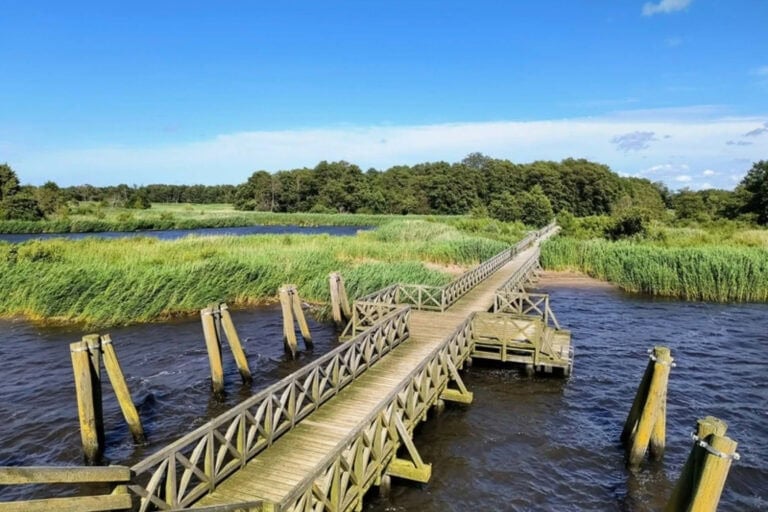
One of the most popular sites on the Łebsko Lake is the wooden pier on its south bank. From Izbica, it’s around an hour’s walk along the River Łeba. We strolled along the riverside path, stopping to dodge a tractor, before reaching our destination.
The pier itself extends out onto the salty surface of the lake. Standing out on the water, you can get a fine view across the shining lake, bordered by verdant green reed beds, with the calls of waterfowl echoing out across the water.
Pristine Nature

There are almost 100 miles of tourist walking trails throughout the National Park and we spent much of our vacation putting them to good use.
Hiking from village to village, it was easy to let our worries melt away, breathing in the clean air and admiring the dense woodland and meadows full of wildflowers.
The forests were teeming with insects. My girlfriend was too squeamish to stop and watch the bugs, but I found it fascinating to observe the varied ant species building huge mounds among the trees.
Caterpillars could be seen digging holes on the sandy paths, while bees drifted dreamily along the streams.
Wildlife Abounds

As one might expect, the wildlife in Polish villages is something special. The blend of wetlands, forests, and meadows provides habitats for a wide variety of species. Hardly an hour went by without some beautiful creature bounding by.
Even the local infrastructure is geared towards wildlife, with electricity poles and chimneys adorned with special platforms for storks to build their nests.
During the colder months, the storks migrate to warmer climes, traveling to Africa via the Middle East. Each year, they return to the same nests, becoming a fixture of local communities.
Driving around, we often encountered wildlife on the road. Once, a crane emerged in the road and began foraging for food, seemingly unconcerned at the line of traffic growing behind it. Locals waited patiently while the huge bird spread its wings in a “you shall not pass” gesture.
Maritime History

This stretch of coastline once served a vital purpose for trade and travel. It was frequented by heavy maritime traffic and elements of the infrastructure survive around the region.
In Łeba, you can see an active port with many boats used for pleasure, fishing, and other industries.
We visited Latarnia Morska Stilo, a huge lighthouse built in the 1900s. It’s located deep in the forest, around a 20-minute hike from the nearest hiking spot.
Its location, far from the coastline, may seem illogical, but it’s so tall that its light could be seen from the ocean.
Visitors can climb to the top of the lighthouse, which offers an amazing view out over the forest. Inside, you can learn about the workers’ lives or buy a few souvenirs to take home, such as books or local art.
Coastal Culinary Delights
As may be expected, the culinary traditions in the area focus on seafood. A food truck parked close to our house sold huge plates of herring and turbot. These fish are caught and prepared locally, so they are extra fresh.
Sweet cheese pancakes were also a popular option at local village eateries. Made with soft white cheese and sweetened with strawberry sauce, they are an interesting option for dessert or even a luxurious late breakfast.
Goodbye to Słowiński

Our final night in Izbica was a Sunday. In the evening, we began craving some soft drinks and so I went out in search of an open shop. The village shop was closed, but the bar inside a local hotel was still open.
Inside, the bartender agreed to sell me some bottles of cola to take away. But the signal in such a rural location was weak and the card payment wouldn’t process. While we waited, we stood talking in Polish, the man explaining he had a house and farm nearby to supplement his income at the hotel.
The payment never did process and I had no cash to hand. The bartender cheerfully told me to take the drinks home and come back with money sometime later.
The atmosphere in these villages is peaceful and trusting, and I had evidently made a good impression with my limited command of Polish; even a simple “dzień dobry,” meaning “hello,” can boost your reputation with Polish villagers.
If You Go
The Słowiński National Park is located close to the cities of Gdańsk and Gdynia on Poland’s north coast. Intercity trains travel to Łeba from Warsaw once a day and occasional buses can bring you down into the more isolated parts of the park.
Low-cost accommodation is available in the village of Izbica at Rowerowa Przystań.
The Zamek Łeba Resort & Spa in Łeba offers a more luxurious residential experience for those looking to push the boat out.
Latarnia Morska Stilo is open throughout the warmer months. Tickets cost 8 złoty, or around a couple of dollars.
Locals in Polish villages often do not speak English. They are friendly and will do their best to communicate with the aid of technology or mime.
Inspire your next adventure with our articles below:
- Exploring Jewish Krakow: Tracing the Rich History and Culture of Poland’s Jewish Community
- Poland’s Wieliczka Salt Mine: A 700-Year-Old Wonder Near Krakow
Author Bio: Jan Meyer is a Warsaw-based writer specializing in travel, history, and culture.
Want to discover more hidden gems and helpful travel tips? Join our free newsletter for the latest travel secrets and travel articles.
We are reader-supported and may earn a commission on purchases made through links in this article.

Planning another trip soon? ✈️
Add GoWorldTravel.com as a preferred source on Google. Click the button below so our local guides, packing hacks, and hidden-gem itineraries always show up first when you search!
Add to Preferred Sources