
“Welcome to Roberto’s stress-free tour!” our colorfully dressed guide announces, rolling his syllables with a theatrical flourish that immediately lifts our mood. “I’m not like most Italians who are uptight and always in a hurry.”
Judging by the flair of our flamboyant leader, there’s no question he means it.
We’d already seen a different side of Italian energy earlier that morning at the cruise terminal in Naples, where we witnessed what looked like an operatic duel between our taxi driver, Mario, and another outspoken cabbie.
Arms flailed wildly, voices boomed, and their faces were so animated that I thought they might actually come to blows.
Only later did we learn they were old friends—inseparable for twenty years and likely for twenty more.
In Italy, tempers flare easily, then fade just as fast.
As Roberto would later say, “In Italy, we erupt like a volcano, then we cool down again.”
Which, of course, leads us to the entire purpose of our day: Pompeii, the city frozen in time by the most infamous eruption in history.
A Giant at Rest
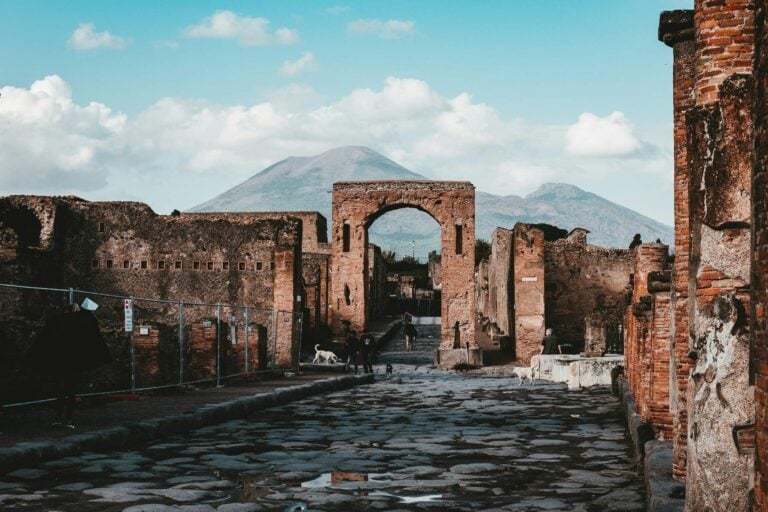
Although disguised today by a halo of clouds, Mount Vesuvius looms above Naples like a quiet but watchful sentinel.
Napoli—vibrant, chaotic, heart-stirring—is one of the oldest cities in the world, dating back to 8 BC.
It’s hard to imagine this bustling coastline being the setting for one of the greatest natural catastrophes in antiquity.
For eight centuries, Vesuvius slumbered silently. Then, in 79 AD, it famously blew its top twice over several days.
Roberto tells the story with the enthusiasm of someone recounting a favorite family legend.
“Twenty thousand people escaped,” he says, widening his eyes for effect.
“But two thousand servants returned to save their belongings. They did not survive. The lava was ten meters deep—almost four hundred degrees!”
His expressive hands move as if sculpting the air itself, matching each dramatic detail.
It’s clear that sharing this history is a point of pride for him—and for many Neapolitans, Pompeii is not simply a tourist attraction but a connection to the past that shaped their present.
Walking Into the Past

Our first stop is the amphitheater, an impressive open oval with stone risers radiating outward like ancient ribs.
Although one of two theaters that once animated the city—the smaller being for poetry and classical performances—this one still reverberates with sound.
While we pause for photos, one of the local guides spontaneously bursts into an operatic aria.
The acoustics are flawless.
For a moment it’s easy to imagine 20,000 spectators gathered here, captivated by music, drama, or—in 1971—Pink Floyd, who performed an iconic concert within these very walls.
By the time Pompeii was rediscovered in 1749, its roofs had collapsed and disintegrated beneath centuries of ash, yet the stone walls remained largely intact.
Today the city stretches across 170 acres, a testament to Roman engineering and the heartbreaking permanence of disaster.
Roberto, easily identified by his bright red umbrella bobbing above the crowd, leads us down rugged stone streets once lined with homes and shops belonging to the city’s more affluent citizens.

Every few meters, we come upon large, raised stones interrupting the roadbed.
“No sewers back then,” Roberto explains.
“These streets were also toilets. The big stones? They are bridges, so you don’t step in the mess!”
Despite the subject matter, we find ourselves laughing.
As primitive as the system was, the sloped lanes ensured that everything flowed downhill—an early, if inelegant, version of civic planning.
Life Inside the Villas

We step into one of Pompeii’s more opulent villas, its roof long gone but its layout beautifully preserved.
Roofless rooms frame a central atrium, where rainwater once poured into a marble basin before draining into an underground cistern.
The dining room—lavishly painted in deep reds and ochres—features stunning frescoes.
One depicts Hercules lounging with a goblet of wine, while another features Poseidon, the god of the sea, presiding over an oceanic scene.
Just beyond, three glass-encased plaster forms lie frozen in eternal repose—victims preserved in their final moments.
Their existence is thanks to Giuseppe Fiorelli, the 19th-century archaeologist who pioneered the technique of filling hollow ash pockets with liquid plaster to recreate the shapes of lost bodies.
“He was a genius!” Roberto says proudly, gesturing toward the ghostly figures.
And he’s right—the process was ingenious, respectful, and revolutionary for its time.
Shops, Wine, and Roman Life

The city feels remarkably familiar in its layout: bakeries, wine shops, millstones, laundries, and market stalls.
At one bakery, the massive brick oven still stands ready for bread or—pizza.
Another shop displays a large stone mill used for grinding grain.
And at the wine store, Roberto shares a particularly memorable detail.
“The wine was strong,” he warns.
“Forty-three percent alcohol! One sip—happy. One glass—dead.”
Perhaps not literally, but it certainly made for a short but spirited life.
Between the potent wine, lead pipes that delivered potable (and poisonous) water, and minimal prenatal care, the average Roman lifespan was startlingly brief—forty-five for men and only twenty-nine for women.
The Heart of the City

Our final stop is the forum, Pompeii’s central square.
Surrounded by government offices, the courthouse, bustling meat and fish markets, and the towering Temple of Jupiter, it once served as the thriving heart of civic life.
Even without roofs or intact facades, the space radiates significantly.
You can almost hear merchants bartering, citizens debating politics, priests blessing offerings, and children racing through colonnaded corridors.
Roberto ends his tour here—still cheerful, still relaxed, still living up to his “stress-free” promise.
The Fastest Ride in Naples
Mario, our morning taxi driver, is waiting exactly where we left him.
The moment we buckle in, we are launched into what feels like a personal audition for the Grand Prix.
The trip back to Naples should take twenty-five minutes. Mario does it in twelve.
He weaves, accelerates, swerves, and overtakes everything in sight—buses, scooters, bikes, pedestrians.
From my middle seat, whenever my fingers aren’t covering my eyes, I watch the speedometer climb past 160 km/hr.
I’m pretty sure this is the fastest my heart has ever beaten.
“I’ve been driving taxi twenty-five years,” he says calmly, flashing us a peace sign as he screeches to a stop.
“No worries. This is normal.”
Normal? Perhaps in Naples.
Stress-free? Not so much.
But as we stroll toward the nearby shops, castle, and pizzerias—and eventually back to our floating home, Holland America’s Koningsdam—the pulse slows, the laughter returns, and the day’s unforgettable blend of history, humor, chaos, and charm settles into memory.
Just another perfect day in Italy.
History Synopsis
Pompeii began as an early Italic settlement and later flourished under Roman rule, becoming a lively port city of markets, baths, and grand villas.
Though damaged by an earthquake in 62 CE, it remained vibrant and was steadily rebuilding.
In 79 CE, Mount Vesuvius erupted and buried the city in ash, preserving it in remarkable detail. Rediscovered in the 1700s, Pompeii now offers visitors an unparalleled glimpse into everyday Roman life, frozen in time.
Quick Tips for Visitors
1. Book a Guided Tour Early
Crowds peak mid-morning. Early arrival or a pre-booked tour helps you avoid long entry lines and ensures you hear the stories behind the stones. See how to get away from the crowds.
2. Wear Supportive Footwear
Ancient Roman streets are uneven, rocky, and sometimes slippery. Comfortable shoes make a huge difference.
3. Bring Water and Sun Protection
Pompeii offers limited shade, especially in summer. A hat, sunscreen, and water bottle are essential.
4. Give Yourself Time
Pompeii is massive—170 acres! Plan at least 2–3 hours, more if you’re a history fan.
5. For travelers who want a deeper understanding of Pompeii’s history, a Pompeii & Mount Vesuvius Full-Day Guided Combo Tour offers a chance to explore the ruins and then visit the volcano that shaped the city’s fate.
Need a hand planning your trip? Here are the sites and services we rely on most, from booking tools to travel products we love.
Inspire your next adventure with our articles below:
- Sweet Things: The Story of Italian Chocolate Candy
- A First-Timer’s 72 Hours in Rome: Rainlit Walks, the Sistine Chapel and Colosseum Awe
Author Bio: Since 1996, while freelancing, Jane Cassie has had thousands of articles published. Her stories have appeared CNN Magazine, Northwest Travel, New York Daily News, Chicken Soup For The Soul, Dreamscapes, Air Canada In-flight, Cottage Life, Epicure and Travel, just to name a few. She has been a regular contributor to Spa Life, INNspire, North American Inns Magazine, Cottage, and is a regular contributor to Inspire Magazines.
Want to discover more hidden gems and helpful travel tips? Join our free newsletter for the latest travel secrets and travel articles.
We are reader-supported and may earn a commission on purchases made through links in this article.

- Bukhara, Uzbekistan: The Silk Road City Where History and Art Thrive - October 20, 2026
- Hoi An, Vietnam: A Local’s Guide to the Ancient Town, An Bang Beach and Must-Try Dishes - October 20, 2026
- Why Cape Town’s Kloof Street Was Ranked the Coolest Street in Africa - October 20, 2026
Planning another trip soon? ✈️
Add GoWorldTravel.com as a preferred source on Google. Click the button below so our local guides, packing hacks, and hidden-gem itineraries always show up first when you search!
Add to Preferred Sources