
When I was seven, a harmless garter snake slithered across my path—and I bolted like I’d seen a ghost.
Decades later, even the thought of anything eel- or snake-like still gives me the heebie-jeebies.
So you can imagine my reaction when our Palauan guide casually mentions that a one-eyed eel might be lurking in the river near our hiking trail.
Wild, Wonderful Palau
My husband and I had come to Palau, a remote archipelago of more than 500 emerald islands scattered across the North Pacific, primarily for its underwater wonders.
Renowned among divers for sites like the Blue Corner, Jellyfish Lake, and German Channel, Palau also boasts unspoiled rainforests, hidden caves, ancient stone relics, and waterfalls that rival tropical dreams.
While most visitors come for the reefs, we wanted to discover Palau’s jungle secrets.
That’s how we ended up heading for Ngardmau Waterfall on the island of Babeldaob—the largest in the archipelago and still largely wild, with roads that twist through sleepy villages, coconut groves, and dense forest.
Read More: Langkawi: Where Ancient Rainforests Meet the Andaman Sea
Myth, Magic, And Mosquitoes
According to local legend, the thunderous 30-meter (100-foot) cascade at Ngardmau wasn’t formed by erosion, but by the body of a giant eel that fell into an eternal slumber.
His body became the winding river; his head, the waterfall. Whether true or not, it’s a vivid tale—and one that gave me shivers.
“Fear not,” our guide Jayvan grinned. “The only slithery thing you’ll cross today is the path.”
We’d been instructed to bring bug spray, swimsuits, sturdy shoes, and water. No problem. But the walking sticks Jayvan handed out at the trailhead should’ve clued us in that this wasn’t your average rainforest stroll.
Into The Jungle

The trail began with a descent of 375 mossy stairs carved into a steep jungle slope.
Gripping my walking stick like a lifeline, I navigated muddy switchbacks, rocky ledges, and thick jungle vines.

Every few steps, I’d stop—not just to catch my breath, but to admire the beauty.
Palau’s jungle is truly an Eden. Towering mahoganies stretch skyward, their roots clinging like octopus arms to the hillside.
Feather-leafed palms, banana trees, and flowering ginger line the path. More than 1,200 plant species, many endemic, flourish here. It’s humid, vibrant, and bursting with life.
But Palau’s rainforest doesn’t stop at flora. It’s alive in every sense of the word.
Wildlife Encounters, Big and Small

Just the day before, we took a Jungle River Boat Cruise.
While waiting to board, a fruit bat glided in and perched on my husband’s shoulder like an old friend.
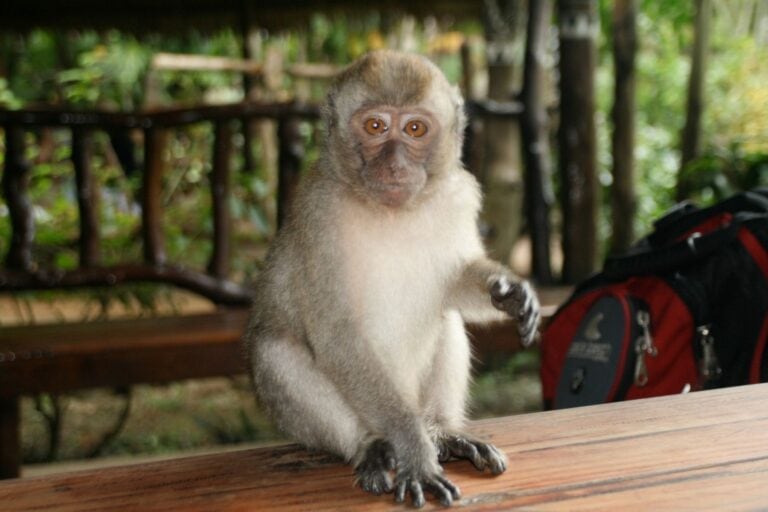
During lunch, a wide-eyed monkey peeked from the trees, and later, as we glided past mangrove-lined channels, a crocodile popped up to eye our boat.
It was thrilling—and a little unnerving. So when Jayvan reminded us that Palau’s wildlife “mostly keeps to itself,” I gave him a smile that probably looked more like a grimace and stayed close behind.
Along the trail, a cacophony of birdsong accompanied us. We spotted lizards, butterflies, and tiny frogs.
We passed fresh wild boar tracks and heard the distant call of a Palauan fruit dove, the country’s national bird. It was a symphony of sound, color, and motion—a sensory overload in the best way.

Echoes of the Past
As we descended deeper into the thickets, we crossed over rusty old railway ties, now overgrown by creeping vines. These relics were remnants of WWII, when Japanese forces built a track to haul bauxite from the mountains for aluminum production.
Running parallel to these relics is a new monorail, soon to be operational, meant to shuttle visitors up to the falls without the hike. (Good news for those who prefer jungle views without jungle sweat.)
We also learned that a zipline was planned—one that would have adventure seekers soaring from canopy to canyon.
“Jane of the Jungle,” I imagined, swinging above the trees.
But for now, there were no shortcuts. Just us, our walking sticks, and a prayer that our legs would hold out.
The River Challenge

After about 45 minutes, the trail ended at a wide, rocky riverbed.
There was no bridge. Just a thigh-deep crossing and a flimsy guide wire strung from tree to tree.
“It’s a snap,” Jayvan shrugged. “Just hold on and go hand over hand.”
The roar of the waterfall nearby swallowed his words.
With no other option, we stepped in, braced against the current, and made our way across like jungle warriors. The water was cool, the footing slippery, and my nerves humming—but we made it.
Under the Falls

And then, we saw it.
Bursting through a narrow gorge, the Ngardmau Waterfall thundered into a whitewater pool below. The air vibrated with mist and roar.
The cascade’s power was humbling, yet its setting—framed by moss-covered boulders and tropical greenery—was serene.
We stood in awe, letting the spray soak our clothes, our skin, and our spirits. There were no crowds. No vendors. Just raw nature, and us—tiny specks in its grandeur.
I forgot the fear. Forgot the eels. Forgot my aching legs. I was fully present, immersed in a jungle moment I’d never forget.
After the Trek
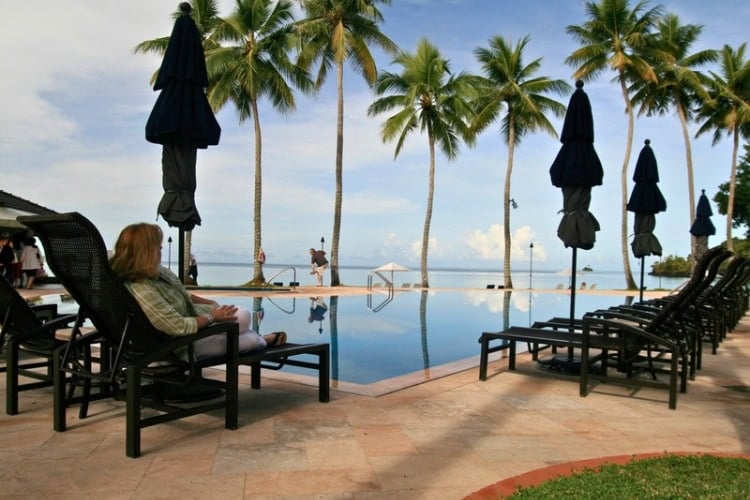
Later, back at our resort—the Palau Pacific Resort, a five-star oasis tucked into a quiet beachfront cove—I reflected on the journey.
It had been challenging, yes. But also deeply rewarding.
There’s something about sweating through the forest, slipping through rivers, and facing silly fears that makes the reward even sweeter.
Practical Tips for Visiting Ngardmau Waterfall
Getting There: Located on Babeldaob Island, accessible by car or tour from Koror (approx. 45–60 minutes).
Trail Length: Approx. 1 mile (1.6 km) each way
Difficulty: Moderate – includes stairs, river crossing, and uneven terrain
What to Bring: Walking shoes, swimsuit, towel, bug spray, waterproof bag, and water
Best Time to Go: Dry season (November to April) offers easier trail conditions
Tour Guides: Highly recommended for safety, history, and local context.
Need a hand planning your trip? Here are the sites and services we rely on most, from booking tools to travel products we love.
Inspire your next adventure with our articles below:
Author Bio: Since 1996, while freelancing, Jane Cassie has had thousands of articles published. Her stories have appeared CNN Magazine, Northwest Travel, New York Daily News, Chicken Soup For The Soul, Dreamscapes, Air Canada In-flight, Cottage Life, Epicure and Travel, just to name a few. She has been a regular contributor to Spa Life, INNspire, North American Inns Magazine, Cottage, and is a regular contributor to Inspire Magazines.
Want to discover more hidden gems and helpful travel tips? Join our free newsletter for the latest travel secrets and travel articles.
We are reader-supported and may earn a commission on purchases made through links in this article.

- Bukhara, Uzbekistan: The Silk Road City Where History and Art Thrive - October 20, 2026
- Hoi An, Vietnam: A Local’s Guide to the Ancient Town, An Bang Beach and Must-Try Dishes - October 20, 2026
- Why Cape Town’s Kloof Street Was Ranked the Coolest Street in Africa - October 20, 2026
Planning another trip soon? ✈️
Add GoWorldTravel.com as a preferred source on Google. Click the button below so our local guides, packing hacks, and hidden-gem itineraries always show up first when you search!
Add to Preferred Sources