
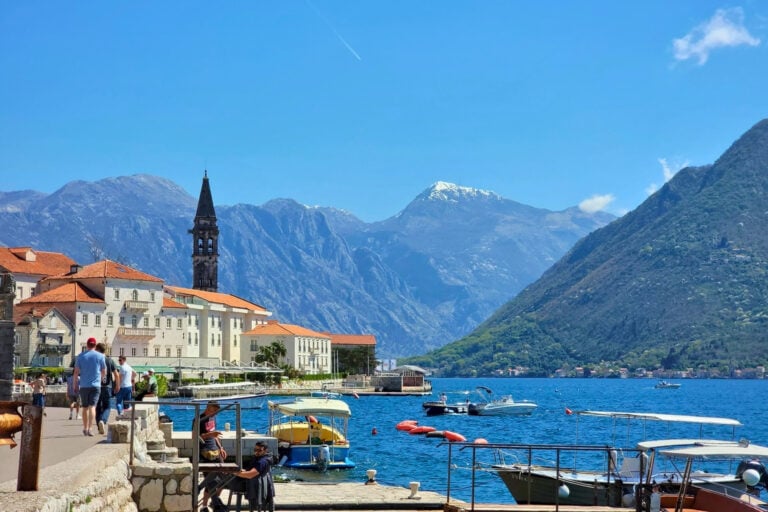
Driving through the countryside—from Croatia to Bosnia to Montenegro—it’s hard to reconcile this landscape with the Balkan region’s long reputation for hardened borders and fractured alliances. As Nataliya and I rode along with our guide, Nadia, the hillsides and mountains and still waters felt improbably serene, each element folding into the next with a quiet cohesion.
We crossed into Montenegro from Bosnia and Herzegovina after leaving Mostar and Kravice. The waters of the Adriatic began to reassert themselves in fragments—brief flashes between ridgelines—before narrowing and settling into the bay as a constant, steady presence.
Mountains rose sharply on either side of the road, as if the land had been thrust upward and never quite persuaded to settle back down.
Along the coast, the air softened, and the water opened into a wide, enclosed bay. “This is not the sea anymore,” Nadia said, smiling as we arrived. “This is a lake pretending to be the sea.”
She was referring to the Bay of Kotor, surrounded by the mountains of Montenegro—a contained world of green, gray, and shadow, where land and water seem to negotiate their boundaries in real time.
A Bay That Withholds Its Identity
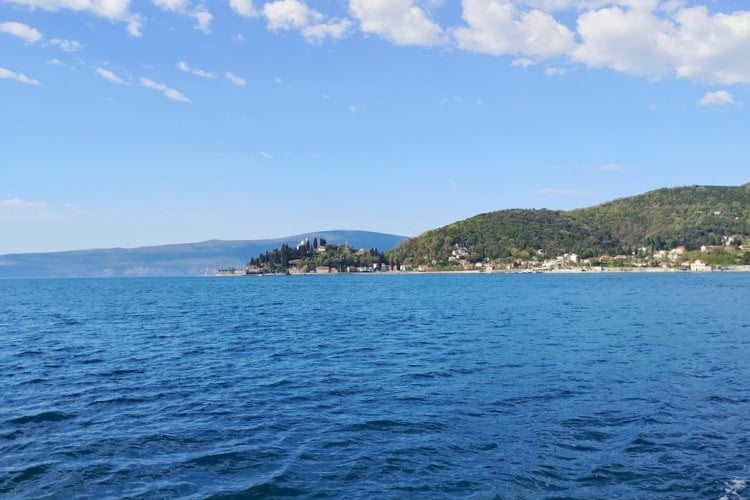
The Bay of Kotor is often described as a fjord, though geologically it is not. It behaves like one, however: long, narrow and deeply folded into the surrounding mountains.
The shoreline is a study in contrast. Stone villages cling to the base of cliffs. Churches rise above rooftops that seem less constructed than accumulated and bell towers punctuate the skyline as if each century insisted on leaving its own signature. Behind them, the mountains press forward, forming a backdrop that feels alive and engaged.
Montenegro itself is small in size but dense in experience. Its history unfolds as a succession of influences: Roman, Byzantine, medieval Slavic states, Venetian along the coast, Ottoman inland, Austro-Hungarian in later years. Each left its imprint without fully erasing what came before.
In the 20th century, Montenegro became part of the Kingdom of Serbs, Croats, and Slovenes (later Yugoslavia) following a familiar regional arc: monarchy, socialist federation under Tito, and eventual fragmentation in the early 1990s.
Unlike Bosnia, Montenegro did not become a primary battleground during the Yugoslav Wars, though it was not entirely untouched, absorbing both economic strain and the tensions of a region in transition. Independence came peacefully in 2006, making Montenegro one of Europe’s youngest nations. And yet nothing about this landscape feels newly formed.
Kotor: Where Stone Gathers and Holds
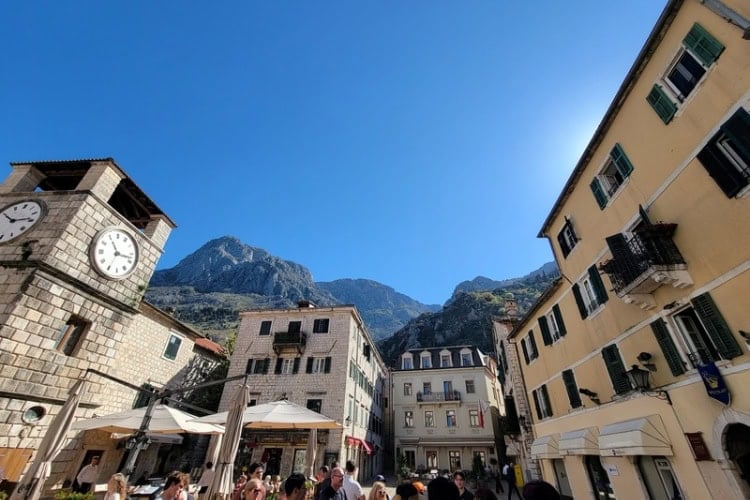
Old Town Kotor, a UNESCO World Heritage site, is encircled by massive walls first constructed in earlier periods and expanded and reinforced during centuries of Venetian rule, climbing the mountainside in a long, improbable ascent. From a distance, they appear less like fortifications than a continuation of the mountain itself, as though the mountain chose, at some point, to defend the people in the city below.
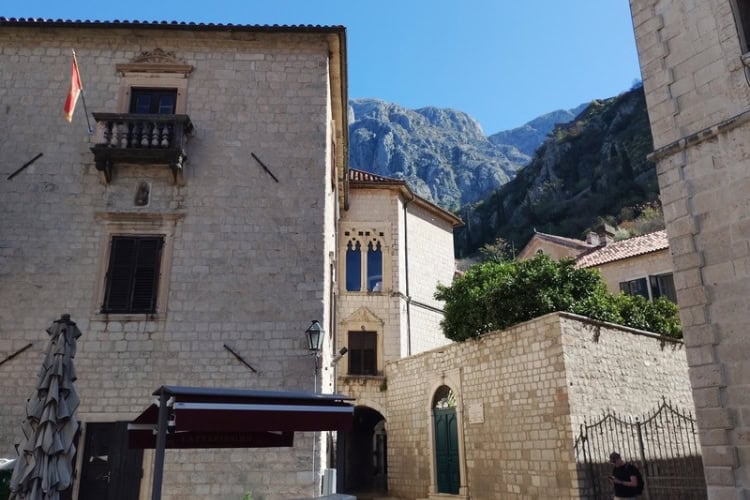
Inside the city walls, the streets narrow almost immediately. Stone passages open into small squares, then contract again into corridors where laundry stretches overhead between buildings that lean subtly toward one another, as though engaged in quiet conversation.
The Clock Tower and Arms Square
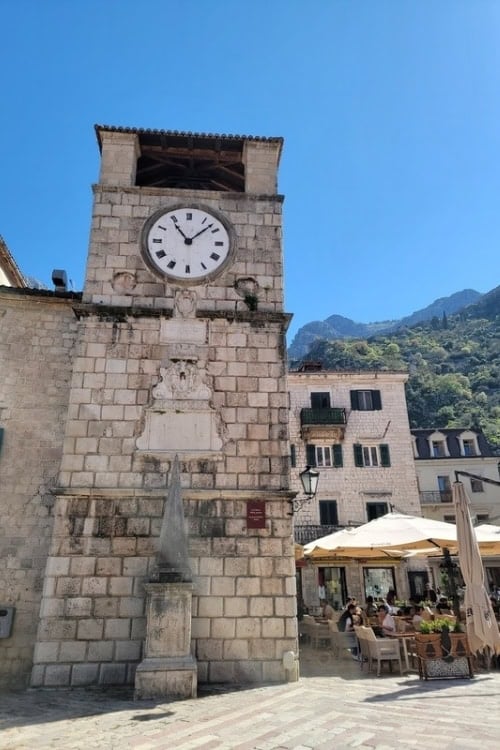
Nadia moved through the labyrinth with familiarity. She stopped in the main square beneath the Clock Tower, which anchors the Arms Square—a space that has served as marketplace, gathering point, and civic stage across centuries.
“Pisa has a larger tower and a greater lean,” she said. “But we love our leaning tower of Kotor.”
She gestured toward a narrow stone pillar nearby. “This is the pillar of shame,” she said with a smirk. “People were once chained here for public judgment.” She paused, and her smirk stretched on one side. “Now we have social media for that.”
Cathedral of Saint Tryphon
From the clock tower and pillar of shame, we stepped into the Cathedral of Saint Tryphon, whose Romanesque façade and twin towers date to the 12th century and carry the weight of centuries. Several earthquakes over the years, most notably the devastating 1979 quake, forced reconstruction, but everything was done with period materials and in the original style.
Inside, dim light settled over worn stone and fragmentary frescoes while relics and maritime artifacts hinted at Kotor’s long-standing ties to seafaring trade and the wider Mediterranean world.
Churches of Old Town Kotor
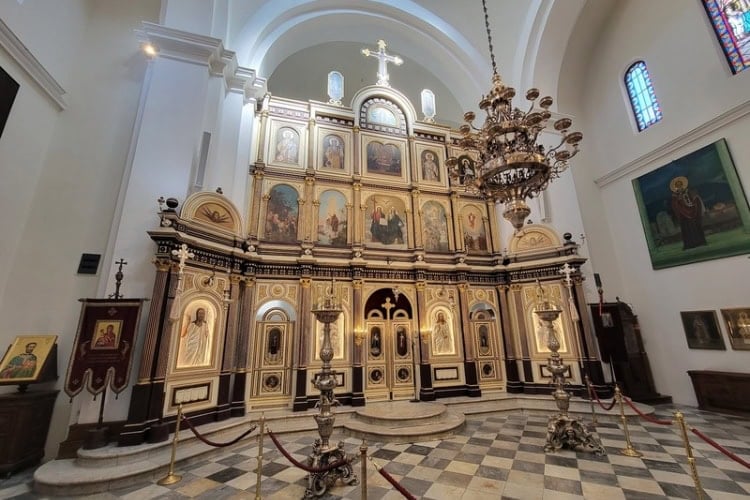
A short walk away stood the Church of Saint Luke, modest in scale but quietly profound. For generations, Catholic and Orthodox altars shared this space—an architectural compromise that speaks more eloquently than any historical summary about coexistence in the region.
Nearby, the Church of Saint Nicholas introduced a different visual language with darker stone, twin domes, and a distinctly Orthodox presence that broadened the town’s spiritual footprint.
Lunch in the Old Town
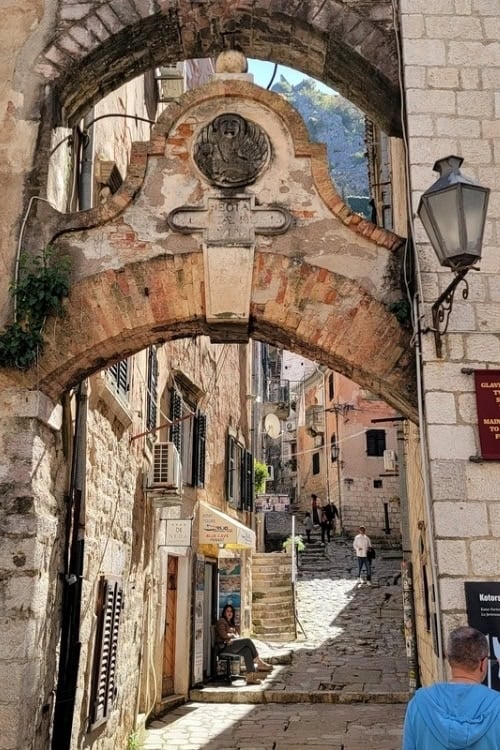
Cafés lined the edges of the surrounding squares. Locals passed through with purpose. Tour groups gathered briefly, then dispersed again into the narrow, winding streets.
We had lunch in one of those squares under a yellow umbrella, looking out at the people passing by and the surrounding buildings that looked like they came from another era. We washed down beef, potatoes and salad with local wine.
“It feels almost like the city is leaning inward,” Nataliya said.
She was right. The streets, the buildings, the walls, even the mountains themselves seemed to incline toward the center, as if drawn by something unspoken.
The Ascent: Following the Wall Into the Sky
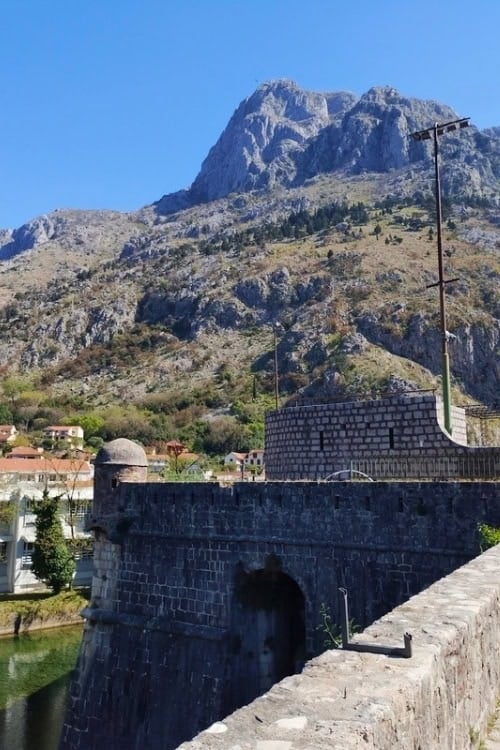
Above the city, the walls rise into the mountains in a long, deliberate line. Expanded and reinforced by the Republic of Venice over centuries, they trace not just a defensive perimeter but a relationship between city and terrain.
The climb begins near the Sea Gate, where the density of the Old Town gives way to open stone and sky. Not far along the path sits the Church of Our Lady of Remedy, a small, weathered chapel whose modest scale feels almost defiant against the vastness around it.
The ascent is steep and unrelenting. At intervals, the view opens: red-tiled rooftops below, church domes punctuating the skyline, the bay extending outward in narrowing bands of blue and gray.
At one pause, I stopped to catch my breath. “Worth it?” I asked.
“I think so,” Nataliya said, looking out over the water. “Ask me at the top.”
At the summit, near the remains of the San Giovanni Fortress, the geography of the bay revealed itself in full: layered mountains, branching inlets, and the Old Town reduced to a compact geometry of stone.
We both agreed: it was worth it.
Cream Cake in the Old Town
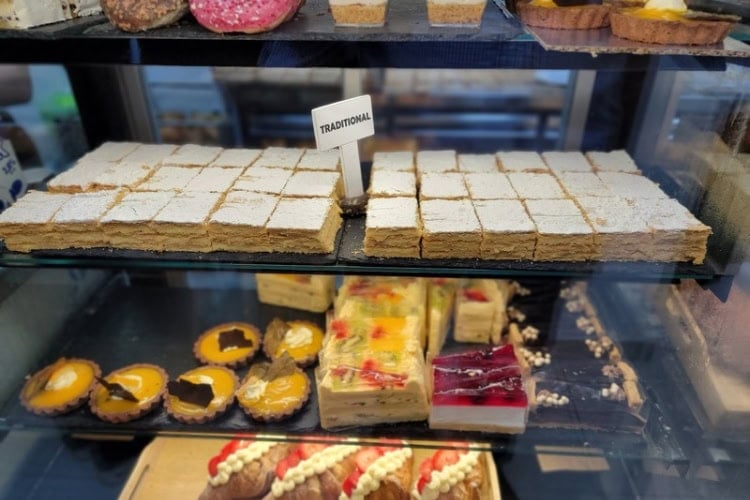
Descending felt easier, though no less deliberate, and we rewarded ourselves back in the Old Town with a cream cake—rich, filling, and familiar enough to remind us of a similar dessert we had tasted in Ljubljana, Slovenia.
Perast: A Town Facing Its Own Reflection
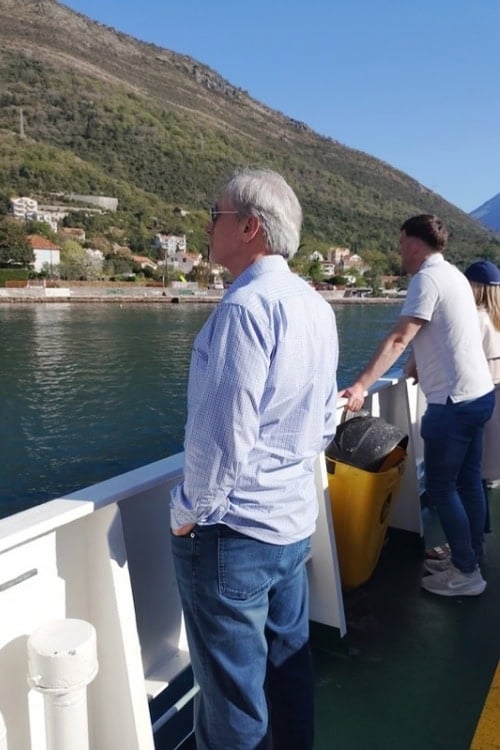
A short drive along the bay brings you to Perast, a small coastal town. Perast is built almost entirely along a single waterfront line, facing the water rather than turning inward. Across from Perast sit two small islands, one of them artificial.
Local legend says that sailors found an icon to Mary in the reef and were determined to one day build a church here. Sailors began throwing stones, debris, even old ships into the reef until, over the period of two hundred years, they had formed a manmade island.
That island is home to the Our Lady of the Rocks, a small church built on accumulated effort—layer upon layer of stone, devotion and maritime tradition. We took a boat across to get a closer look.
Inside Our Lady of the Rocks
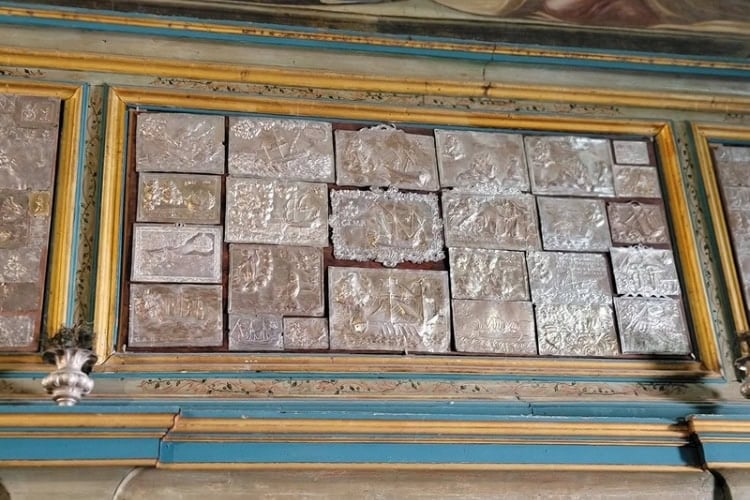
Inside the church, offerings from sailors lined the walls: paintings, pounded steel plates, artifacts, embroidered pieces, many of the pieces tokens of gratitude left by those who had returned safely from sea.
The Embroidery Stitched With Hair
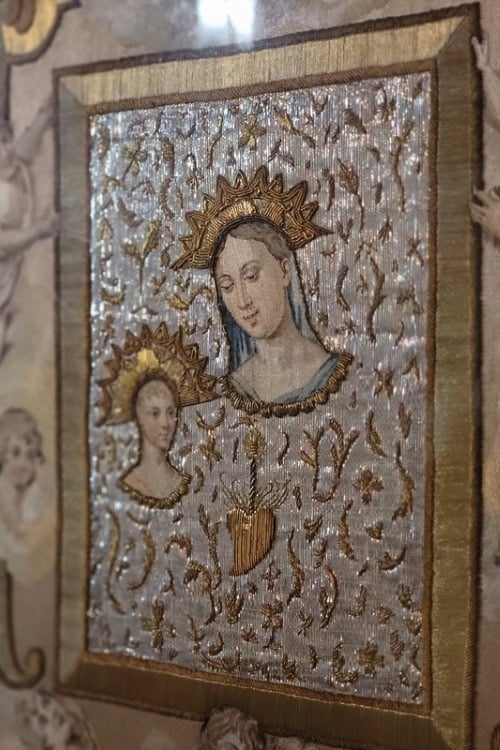
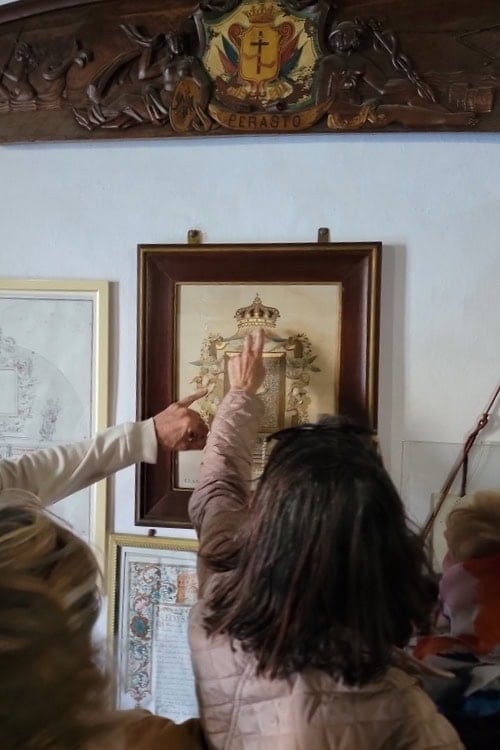
One framed piece stood out: a delicate embroidery of the Virgin Mary attributed to Jacinta Kunić-Mijović. While some accounts lean into the mystery of an anonymous artist, Jacinta’s twenty-five-year labor is at the heart of the island’s lore.
The artist is said to have begun her work in 1803 while waiting for her husband to return from sea, stitching her devotion into silk. When she eventually ran out of the gold and silver threads intended for the finer details, she turned to the only material she had left: her own hair. She used it to embroider the heads of the Virgin and the surrounding angels, creating a biological timeline of her wait.
As Nataliya and I leaned in, we could see the hair transition from a youthful, vibrant brown to a ghostly silver. Here was a quarter-century of longing rendered in a single, haunting frame.
Everyone here seemed to be impressed with the offerings from sailors thanking Mary for safe passage and successful voyages. Each time we passed by the embroidery, hoping for a dispersed crowd, another had formed. It was the most popular piece in Our Lady of the Rocks’ collection.
A Young Country With a Long Memory
Montenegro’s modern identity is often described in terms of size. It has a population of just over six hundred thousand—smaller than many cities. Small territory, small economy. But its historical density complicates that description.
For centuries, it existed at the edge of larger empires without being fully absorbed by them. Mountain geography played a role in that resistance, as did political structure and cultural persistence.
During the Yugoslav period, Montenegro was one of six republics within the federation under Tito’s leadership, part of a system that attempted to balance ethnic and national identities under a shared political framework.
When Yugoslavia dissolved in the 1990s, Montenegro remained in a political union with Serbia before separating peacefully in 2006 through a referendum.
Compared to Bosnia, the wars of the 1990s left fewer visible scars along Montenegro’s coast. But the proximity was close enough that no one here describes that era as distant.
At the Water’s Edge, the Mountains Rise
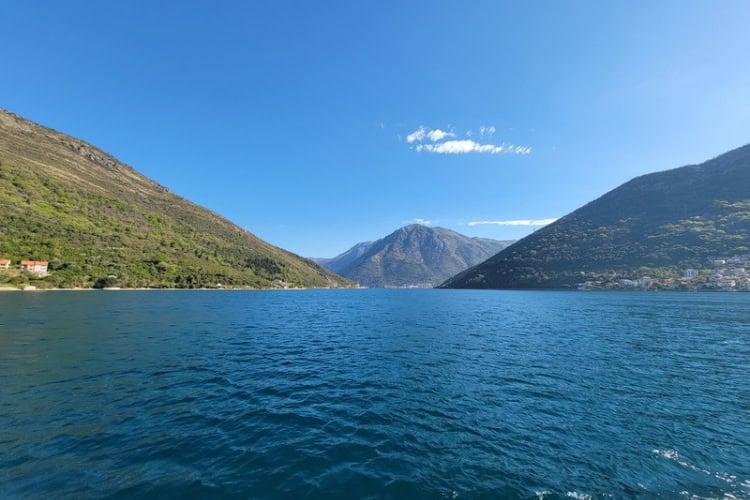
What stays with me most about Montenegro is not a single landmark—not even a single town—but the landscape. Mountains rise abruptly from the water. Roads wind in deliberate switchbacks. Towns grow upward rather than outward, negotiating space rather than claiming it.
By the time we left Kotor, the light had begun to soften, settling into that late-afternoon glow that lingers just before evening takes hold. Nadia guided the passenger van along the narrow road, tracing the edge of the bay, the water appearing and disappearing between stone buildings and stands of cypress.
At one bend, the view opened fully for a final time. The Bay of Kotor stretched out below us, impossibly framed by mountains that seemed to rise straight from the water’s surface. The Old Town was no longer distinct, just a cluster of pale stone gathered at the edge, dwarfed by everything around it.
“Last look,” Nadia said, glancing at us in the rearview mirror.
Nataliya turned in her seat, angling herself toward the window. I did the same. For a moment, neither of us spoke as we longed for the diminishing scenery to last.
Then the road curved again, and the bay slipped out of view—first partially, then completely—replaced by rock and hillside and the forward motion of the drive.
We were headed back to Dubrovnik, Croatia, where we would soon be greeted by another walled city, a larger city right on the Adriatic Sea. But as we drove through the countryside, our thoughts lingered on the Bay of Kotor.
Like that final view of the bay, Montenegro lingers in the memory not as a single image, but as something you find yourself looking back toward, long after the road has carried you on.
If You Go
Getting There
Most travelers experience Montenegro as a day trip from Dubrovnik. While it’s possible to rent a car, a guided tour offers both convenience and context, particularly given the region’s layered history. If you drive, confirm that your rental allows the border crossing into Montenegro before you pick up the keys. This day trip from Dubrovnik covers Perast and Kotor with an optional boat trip on the bay, while this private tour to Kotor and Perast pairs you with your own driver and guide so you can set the pace. Bring your passport either way, and in summer, an early start helps you beat the lines at the border.
Exploring Kotor
Once there, Kotor is best explored on foot, ideally early or late in the day when crowds thin and the light softens the stone. The Old Town is compact, but its richness lies in its details: churches tucked into corners, small squares that open unexpectedly and passageways that reward wandering.
The climb to the fortress walls is steep but rewarding, offering one of the most complete views of the Bay of Kotor. Pace matters more than speed. The upper stretch has little shade, so go early in warm months and carry water. Tickets are sold at the entrance inside the Old Town, or you can reserve your city walls ticket in advance.
Visiting Perast
Perast makes for an ideal half-day excursion, but it can be done in two or three hours if time is limited. Boats to Our Lady of the Rocks run frequently, and the short journey across the water is essential to understanding the bay’s maritime traditions.
Montenegro’s coastline pairs easily with travel through Croatia and Bosnia, but it rewards those who slow down long enough to take in the terrain itself. Here, the journey does not simply lead to the destination; the landscape becomes part of the journey itself.
Need a hand planning your trip? Here are the sites and services we rely on most, from booking tools to travel products we love.
Inspire your next adventure with our articles below:
- The Venetian Fortresses of Italy: Star-Shaped Cities, Hidden Tunnels and a Perfect Utopian Town
- How to Beat the Crowds When Traveling in Europe
Want to discover more hidden gems and helpful travel tips? Join our free newsletter for the latest travel secrets and travel articles.
We are reader-supported and may earn a commission on purchases made through links in this article.

- Montenegro’s Bay of Kotor: Stone Towns, Venetian Walls and Mirror-Calm Water - September 27, 2026
- Rila Monastery: A Day Trip Into Bulgaria’s Spiritual Heart - September 23, 2026
- Castles, Carriages, and Cellars: Following the Liechtenstein Trail Through Moravia - August 14, 2026
Planning another trip soon? ✈️
Add GoWorldTravel.com as a preferred source on Google. Click the button below so our local guides, packing hacks, and hidden-gem itineraries always show up first when you search!
Add to Preferred Sources