

My lower back flinched, anticipating the next craterous pothole along the dirt road leading to Jyrgalan.
The driver, perched on a comically large seat supported by an array of rusty springs, lurched up and down as his foot buried itself into the accelerator and the engine revved furiously in low gear across the mountain road.
The seat afforded the driver a certain level of comfort, meaning he showed little concern for the damage inflicted by the potholes on my back or on his van.
The journey to Jyrgalan had been on my mind since arriving in the Central Asian country of Kyrgyzstan. My curiosity only increased as I realized none of the travelers I’d met during my month in the country had ventured to Jyrgalan.
This only encouraged me to go out of my way in an attempt to find something hidden from the small but growing stream of hikers visiting the mountainous country squeezed between China, Kazakhstan, Tajikistan and Uzbekistan.
Welcome to Kyrgyzstan: The Land of Mountains, Horses and Yurts

Kyrgyzstan is one of the world’s most mountainous nations, with an estimated 90% of its landmass covered by towering peaks. This includes the formidable Jengish Chokusu, or Victory Peak, which stands at just over 7,400 meters along the Chinese border.
The dramatic ranges define the country’s rugged beauty, drawing adventurers from across the globe. Even the capital, Bishkek, finds itself nestled against a mountainous backdrop.
Very rarely are you far from a view of the mountains in a city characterized by its grey Soviet-era architecture, wide avenues, and markets with a history stretching back to the ancient Silk Roads that once crisscrossed the now somewhat forgotten country.
Since the fall of the Soviet Union, Kyrgyzstan’s economy has faced significant challenges. Unlike its resource-rich neighbors, Uzbekistan and Kazakhstan, which have greatly benefited from their extensive natural gas and oil reserves, Kyrgyzstan has struggled to establish a similar economic footing.
Slower growth and a different development path compared to other Central Asian states have, in some ways, left the traditional nomadic culture more untouched and prominent, especially away from the larger cities.
Best Kyrgyzstan Tours & Excursions
Life in Jyrgalan: A First-Hand Glimpse

I peered out of the cracked window of the minivan as it finally limped across the finish line into Jyrgalan with loud thuds, squeaking springs, and the ticking of the overheated engine.
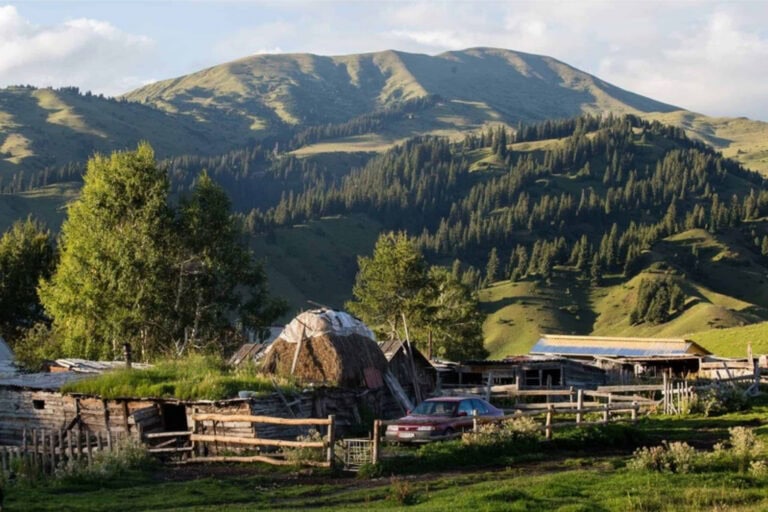
A few dozen single-floor concrete houses are nestled at the foot of several lush green hills that grow steadily into craggy mountain peaks. Just beyond the dirt roads, the outskirts of the village are littered with traditional yurts. Horses dot the lush green meadows, and groups of cows graze peacefully in the beaming sunlight.
In that moment, Jyrgalan was perfect. Hidden away from the world. Surrounded by mountains. Untouched. The sort of place that any hiker dreams of visiting. I shook the driver’s hand and thanked him for the smooth ride, suspecting the touch of sarcasm in my voice went over his head as he returned a smile and wished me good luck.
I left the bus stop and walked along the dirt road, meandering between the houses. Locals stared curiously at me while the children waved and giggled, practicing a handful of English phrases they’d learned at the local school.
The children followed me all the way to a small guesthouse at the edge of the village. I handed over a stack of som to the owner, dropped my bag, and over some local bread and jam, I began to plan my next few days of hiking.
Where To Stay In Jyrgalan
There are a handful of options when considering where to stay in Jyrgalan, with the most recommended options being members of the Jyrgalan Destination Management Organization (DMO).
The organization was established in 2017 to support the local community, enhance the visitor experience, and allocate a portion of the funds towards local development projects.
Since 2017, the organization has successfully directed funds to enhance the local community in Jyrgalan. This includes creating a new playground and football pitch, which now stand at the heart of the village.
Their work has been instrumental in transforming Jyrgalan into a trekking destination, generating significant income for local guides, guesthouse operators, and stores.
The half a dozen or so guesthouse options can be found on the DMO website. I stayed at the Alakol-Jyrgalan Guesthouse, where it’s also possible to buy a map of the local hiking routes and rent equipment such as tents, sleeping bags, and portable stoves.
Planning Your Hike In Jyrgalan

Jyrgalan offers a range of hikes. Some require multiple days in the wilderness with little to no human contact, while others can be completed in a single day.
The development fund is an attempt to improve the economic prospects of the locals who have suffered dearly since the fall of the Soviet Union, which saw the local mine close, leaving few opportunities for locals beyond herding.
A profound sense of isolation and distance from modernity hangs over the valley, which serves as a constant reminder that Jyrgalan’s beauty, while breathtaking, should not be taken for granted. Conditions can change quickly, turning treacherous (as I, unfortunately, discovered on one of my treks).
Most of the multi-day hikes will require you to pack a tent and food, even though nomads you meet along the way may invite you to spend the night in their yurts or join them for a meal.
I recommend renting equipment from Alakol-Jyrgalan Guesthouse, where you can also leave everything you don’t need for the hike, which should take some of the weight off your shoulders.
There are also occasional group hiking tours organized by Destination Jyrgalan, which you can book through their website. These organized tours generally involve a multi-day hike with a larger group of hikers, including food, accommodation, and often a local guide and pack horses to carry gear.
Three Days Surrounded by Mountain Passes, Craggy Peaks and Turbulent Weather
Boz-Uchuk lakes (3-4 Days/ 50km)

After a few hours of examining the map and possible routes, I decided to make my way to Boz-Uchuk Lake along a route that would take between 2-3 nights, depending on my pace.
Although the staff at Alakol-Jyrgalan were a little concerned about my plan to undertake the hike alone, the tension eased when I agreed to stay in contact via Telegram.
The plan was to cross a series of passes on my way to one of the Boz-Uchuk lakes, located around 3,500 meters above sea level along the Tian Shan mountain range.
The first day involved a steady climb out of Jyrgalan. About halfway, I was lucky enough to bump into three children who ushered me into their yurt and had me take a seat on the floor beside the small table.
The language barrier meant that our conversation was reduced to the few sentences I could muster up in Russian. Despite this, it was clear that I wouldn’t be leaving before eating and drinking tea.
The mother of the three siblings set the table and carefully handed me a piping hot bowl of Plov, a typical dish of rice, vegetables, and some form of meat (often horse), served with traditional Kyrgyz bread.
The Plov was followed by hot tea and then a dreaded cup of Kumis (fermented mare’s milk), which I had become an expert at drinking extremely quickly while entirely ignoring the acrid taste of lukewarm, semi-fermented horse’s milk.

Following the meal, I had almost no contact with anyone for the next three days, apart from a group of nomads who helped me cross the river at the foot of the Terim Tor Pass.
It’s worth being prepared for this river crossing; attempting it alone would be very risky, so it’s best to factor in time for walking along the river in search of someone with a horse.
I made it to the lakes on the third day. By this point, the weather had taken a turn for the worse. A snowstorm rolled in as I shivered in my tent beside the alpine lake, leaving me shivering until daybreak.
The snowstorm was a reminder of the danger that lurks behind the beauty of the Kyrgyz mountains. Anyone hiking in the region should be well prepared and experienced and consider hiring a local guide.

Alternative Routes From Jyrgalan
There are several other routes that are worth exploring if you have time and energy. Some can be completed in one day, meaning there’s no need to carry a tent, while others can take well over a week.
Turnaluu Kol Lake (1 Day/13Km)
One of the few hikes that doesn’t involve spending the night in a tent. The 13-kilometer loop begins on the outskirts of Jyrgalan and starts with a steady incline from around 2,200 meters to just under 2,800.
The highlight of the route is reaching Turnaluu Kol, which is tucked away in a dense alpine forest. The descent passes by a number of viewpoints that perfectly encapsulate the unique position of Jyrgalan, standing isolated and alone in the valley.
Robber’s Canyon (1 Day/19km)
The Robber’s Canyon trek is a challenging 19-kilometer circular route that allows hikers to experience a considerable amount of what Jyrgalan has to offer in a single day, with no need to carry much equipment.
The elevation gain along the route is just under 1,000 meters, and passes through several stunning valleys, including the demanding ascent through Uuru Tor (also known as Robber’s Canyon).

Keskenkiya Loop Trek (4 Days/50km)
A multi-day route that takes you into the wilderness surrounding Jyrgalan. This route gives you the opportunity to get a firsthand look at the traditional Kyrgyz lifestyle while taking in some of the most stunning scenery the region has to offer.
The hike takes you over the Jyrgalan Pass (Ak Kiya) at over 3,300 meters, culminating in a stunning view of the valley and a glimpse at some of the more rugged mountain peaks. The route involves a challenging river crossing that should only be attempted by experienced hikers with adequate equipment.
The Future of Jyrgalan and Kyrgyzstan

Globalization is a double-edged sword. The world has shrunk for many of us, but its once heavily guarded secrets, like Jyrgalan, are no longer so secret. The influx of hikers will bring much-needed economic opportunities for the people of Jyrgalan and the surrounding isolated communities, but its untouched beauty will be shaken.
Regardless of what the future has in store for Jyrgalan and Kyrgyzstan, more broadly in terms of tourism, for now, this small town tucked away under the shadow of the Tian Shan mountains is a destination not to be missed for anyone who enjoys feeling slightly out of their depth and far from home in the mountains.
Travel insurance is essential for any trip, offering peace of mind and protection. Explore options with SafetyWing or SquareMouth to find the coverage you need.
Useful Links
Trekking Routes: Jyrgalan Trekking Routes
Where To Stay: Jyrgalan Accommodations
Destination Jyrgalan Homepage: Destination Jyrgalan
Inspire your next adventure with our articles below:
Author Bio: Peter Zoltan Barker is a Hungarian-British freelance travel writer based in Barcelona. He has traveled to dozens of countries and especially enjoys writing about hiking and the personal stories of the people he has met along the way. His work has appeared in outlets including Newsweek, Yahoo, Travelmag, and The Daily Mirror.
Want to discover more hidden gems and helpful travel tips? Join our free newsletter for the latest travel secrets and travel articles.
We are reader-supported and may earn a commission on purchases made through links in this article.

Planning another trip soon? ✈️
Add GoWorldTravel.com as a preferred source on Google. Click the button below so our local guides, packing hacks, and hidden-gem itineraries always show up first when you search!
Add to Preferred Sources