


I’m originally from Portofino, a small Italian seaside town, though I’ve also lived near Venice, Milan, and Turin. My first real step outside Italy was as an exchange student in the Netherlands, an experience that opened the door to a long journey across Europe.
Since then, I’ve lived in Berlin, Paris, Madrid, and Barcelona, each place teaching me something different: Berlin’s creative chaos, Paris’s beauty, Spain’s food and energy. Eventually, I settled in Lisbon, drawn in by the slow living, the weather, and the easy access to nature.
Moving around so much taught me far more than how to pack a suitcase. I saw firsthand how different European countries handle visas, taxes, and remote work, and I learned what it actually takes to build a life here, not just as a traveler, but as someone trying to belong. If you’re thinking of making Europe your base as a digital nomad, here’s the guide I wish I’d had when I started.
Short Trips vs Long Stays

Europe offers options for both short-term travelers and long-term residents. If you want to test-drive Europe or hop between countries, the Schengen short-stay rule is your best friend. It allows you to stay in a country for up to 90 days every 6 months.
Many nomads rotate every three months between Schengen and non-Schengen countries like Albania, Montenegro, or the UK to stay longer in the region without overstaying. This is flexible and simple, but you cannot legally work or access healthcare under this arrangement.
For more stable arrangements, Digital Nomad Visas (DNVs) and residence permits are the way to go. These allow legal work, access to healthcare, and, in many countries, count toward permanent residency.
Understanding Long-Term Visa Options
There are two ways of staying long-term in Europe:
1. Digital Nomad Visas
- These allow you to live in a country if you work remotely for a foreign employer, or have clients outside the country you want to live in.
- Taxes are generally paid locally only if you stay long enough to become a tax resident.
2. Self-Employed / Freelancer Visas
- These are designed for freelancers with local clients or entrepreneurs with a business plan benefiting the local economy.
- These visas often have lower income requirements but require proof of income and either a letter of intent from local clients or a business plan.
Countries Offering Digital Nomad Visas in Europe

When I first looked at Europe’s digital nomad visas, I was overwhelmed by the different rules, income requirements, and family options. Here’s a breakdown to make it simple.
Income requirements listed are usually for a single applicant. Bringing a family typically increases the required amount by 30–50%, depending on the country. Note: The Czech Republic allows DNVs only for IT workers, and Latvia only for professionals employed by companies in OECD countries.
Countries Offering Self-Employed or Freelancer Visas
Countries that offer self-employed or freelancer residence permits include Portugal, Spain, Italy, Romania, Malta, Norway, Bulgaria, the Netherlands, Belgium, Poland, Germany, and France.
Requirements vary, but the typical pattern is:
- Lower income thresholds than DNVs (usually equal to the national average or minimum wage)
- A business plan or proof of local clients
- Registration of a local activity and tax obligations
Finding Remote Jobs or Freelance Clients
If you don’t already have a remote-friendly role, Europe has a strong ecosystem for finding work:
Remote job boards: EURemoteJobs, Remotive, Remote.io, We Work Remotely, SkipTheDrive, WellFound, FlexJobs
Freelance boards: Toptal, Braintrust, Fiverr, UpWork, Freelancer
Taxes: The Part Nobody Loves but Everyone Needs to Understand
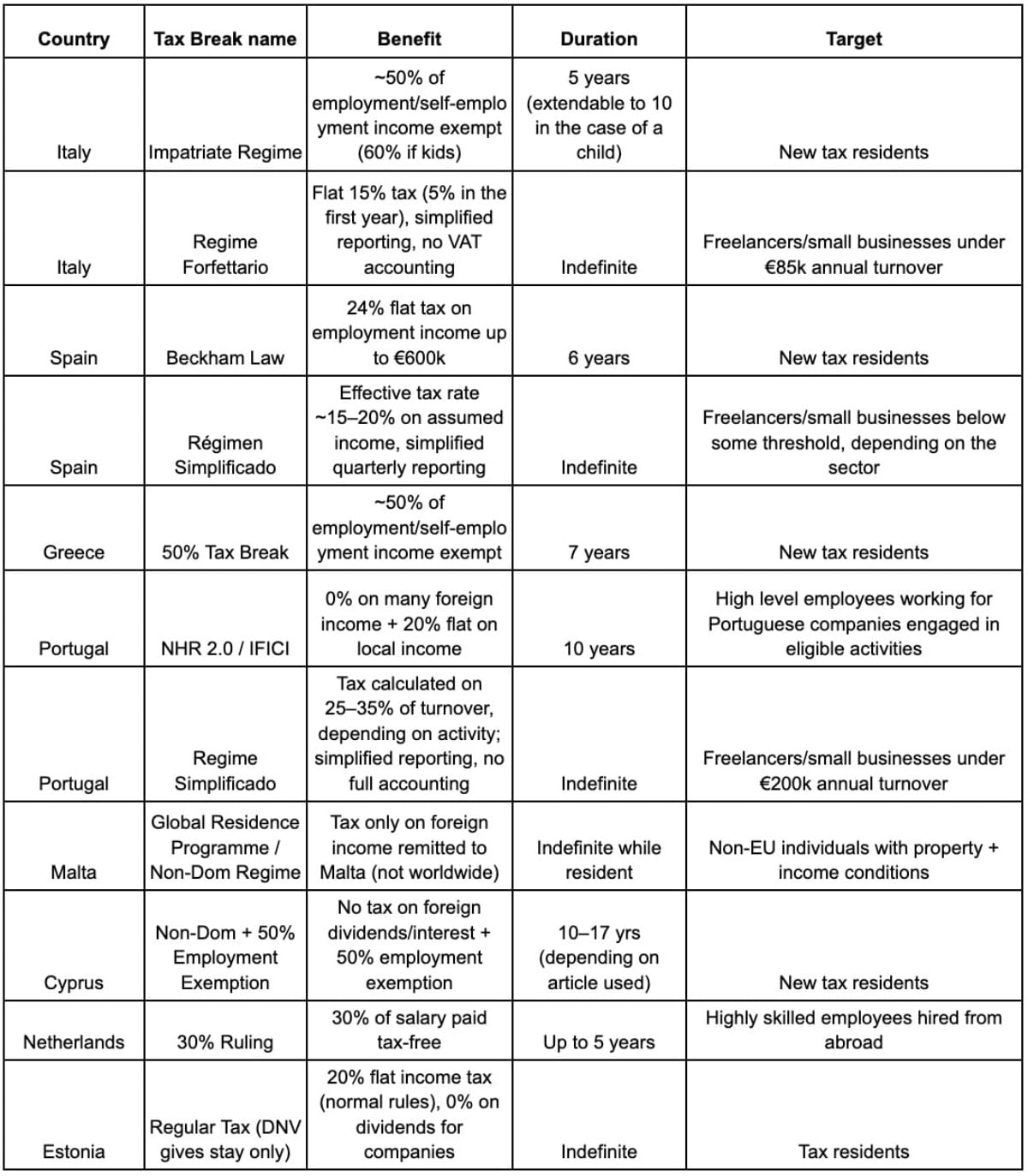
You generally become a tax resident in a country if you stay more than 183 days/year or if your center of life (family, work, home) is tied to that country. Tax residents are typically taxed on global income, though double tax treaties prevent double taxation. U.S. citizens can use FEIE to offset taxes. Popular Tax Incentives for New Residents
I have personally benefitted from the Beckham Law and the old NHR. These incentives can make a huge difference to your cost of living and long-term planning.
Picking Your Country
When choosing a base, I use this framework:
- Visa & Residency: Duration, renewability, family options.
- Taxes & Incentives: Special regimes, relocation grants, cost of living.
- Lifestyle & Climate: City vs. rural, beach vs. mountains, culture & outdoor activities.
- Infrastructure: Internet, coworking, healthcare, banking.
- Community: Existing nomad networks, co-living, local support.
- Long-Term Goals: Residency, citizenship, business, property, or family priorities.
To make the process easier, I built Movyzen’s Country Orientation Tool, an interactive map that compares 60,000+ data points across climate, economy, lifestyle, safety, internet, and more. It helps me, and others, evaluate countries based on personal priorities, from cost of living to long-term residency potential.
Where to Live: The Fun Part
Europe has a place for every vibe, but based on my experience, here are the places I’ve visited and loved the most:
First-Tier Cities (Large DN Communities, Great Infrastructure): Lisbon, Barcelona, Athens, Berlin, Amsterdam, Prague, Rome, Florence
Second-Tier Cities (Mid-Size, Lower Cost, DN-Friendly): Porto, Valencia, Malaga, Bologna, Palermo, Marseille, Lyon
Third-Tier / Emerging Cities: Syracuse, Trento, Bordeaux
Beach Towns: Ericeira, Biarritz, Split, Tenerife, Lagos, Aljezur, Sicilian Coast, Ligurian Riviera, Puglia Coast, Nice, Albanian Riviera, Istria
Mountain / Adventure Towns: Innsbruck, Andorra la Vella, Chamonix, Trentino/Dolomites
Rural / Countryside Towns: Tuscany, Umbria, Madeira, Calabria, Alentejo, Aragón & Galicia
These are the places I personally enjoyed the most. Visiting before committing is still important, but these locations are a good starting point for inspiration.
Read More: 6 Cheapest Places for Digital Nomads To Live and Work Overseas
Your Next Steps
- Clarify priorities: Lifestyle, visa ease, permanent residency, or financial incentives?
- Compare Destinations: Use your scorecard to see what aligns with your priorities.
- Pilot Visits: Short trips give first-hand experience.
- Join Communities: Expat groups, digital nomad forums, coworking meetups.
- Plan Strategically: Track visa windows, tax incentives, and organize documents.
Don’t wait for the “perfect” moment. Pick a destination, start planning, and take the first step. Your European adventure is about to begin.
Need a hand planning your trip? Here are the sites and services we rely on most, from booking tools to travel products we love.
Inspire your next adventure with our articles below:
- Best Capital Cities in Europe to Live While Working Abroad
- 4 Health and Safety Essentials Digital Nomads Must Prepare Before a Long Trip
Author Bio: Fabrizio is a global citizen and the Founder of Movyzen, a platform that helps people turn their dream of living in Europe into a tangible and actionable plan.
Having lived in nine countries, 6 of which in Europe, he’s learned how to build a meaningful life across borders and now shares that experience to guide others through visas, relocation, and lifestyle design.
Fabrizio’s mission is to help others find not just a new home, but a way of living that reflects their values, passions, and sense of purpose. From Portugal’s coastal gems to its rural villages, he continues to chase the beauty of a life well-lived.
Want to discover more hidden gems and helpful travel tips? Join our free newsletter for the latest travel secrets and travel articles.
We are reader-supported and may earn a commission on purchases made through links in this article.

- A Weekend in Cambará do Sul: Hiking Brazil’s Itaimbezinho and Fortaleza Canyons - October 26, 2026
- Uzbekistan’s Silk Road Cities: From Tashkent’s Markets to Samarkand’s Registan - October 26, 2026
- Lost in the Fjords: Finding Myself Through Her Eyes - October 26, 2026
Planning another trip soon? ✈️
Add GoWorldTravel.com as a preferred source on Google. Click the button below so our local guides, packing hacks, and hidden-gem itineraries always show up first when you search!
Add to Preferred Sources