
Nataliya and I left Dubrovnik early, heading inland toward Bosnia and Herzegovina. The sea faded behind us, its deep blues giving way to muted greens and grays, replaced by hills that rose in uneven folds.
Villages appeared without symmetry—clusters of red roofs and pale stone set against the landscape as if placed by instinct rather than design. The road curved and doubled back on itself, not so much guiding us forward as negotiating with the terrain, each turn revealing another slope, another valley, another quiet settlement tucked into the hills.
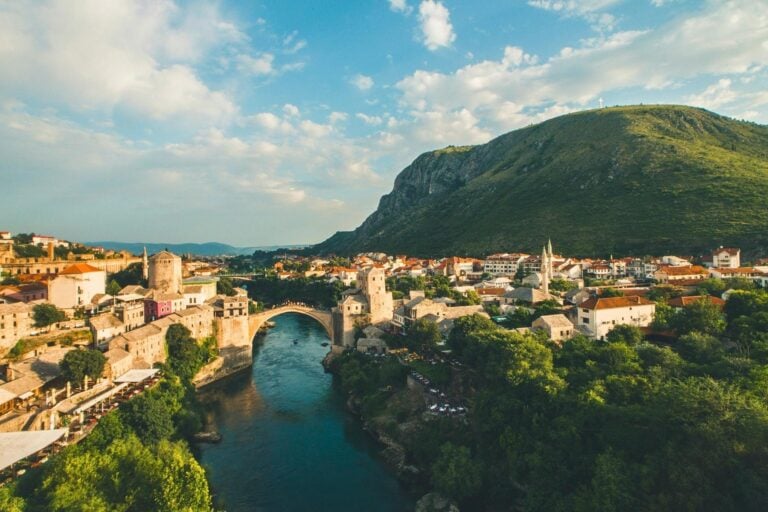
Our destination: the old town of Mostar.
Our guide for the day, Ivan, had the easy familiarity of someone who has spent his life moving between borders, or having borders move around him and the people who live there.
“My family used to live inside the Dubrovnik walls,” he said casually as we drove. “Right on top of where my kitchen used to be is a public restroom now.”
He smiled as he said it, but it seemed almost more a coping mechanism than true humor, as if geography had simply rearranged itself without consulting the residents.
Then, after a pause, he continued illustrating the region with family stories. “My grandmother was from Bosnia. My grandfather from Croatia. They used to argue about Tito all the time.”
In this part of the Balkans, history can be more than one thing at a time. Perspectives, even within the same city, differ significantly depending on who a local is, where a local is, and where a local’s family came from. You could say things in this part of the world are a bit … Balkanized.
A Region Shaped by Empires
To understand Mostar, it helps to understand what it has been.
For centuries, this region sat at the edge of empires—Roman, Byzantine, Ottoman, Austro-Hungarian—each allowing layers to remain behind rather than destroying and replacing what was there.
Religions followed the same pattern: Orthodox Christianity, Catholicism, and Islam existing not as abstractions, but as neighbors, sometimes in harmony, sometimes in tension, always in proximity.
By the 20th century, these individual identities were folded into something new: the Kingdom of Serbs, Croats, and Slovenes, later renamed Yugoslavia. It was a country built on the idea that differences could be unified into one cohesive nation.
After World War II, that idea transformed again under Josip Broz Tito. Yugoslavia became a socialist federation—communist in structure, but non-aligned in Cold War politics. For a time, Yugoslavia held strong. It held long enough for generations to grow up under the assumption that national identity (Serb, Croat, Slovene) could be contained within a larger political identity (Yugoslav).
But when Yugoslavia fractured in the early 1990s, that assumption collapsed with it, like so many buildings and bridges. What followed was not a single war, but a series of overlapping conflicts—ethnic, political, territorial—each redefining borders and relationships in real time.
In cities like Mostar, those fractures became visible in stone.
The Bridge That Was Built Twice
Mostar does not introduce itself gently. You arrive already aware of its center.
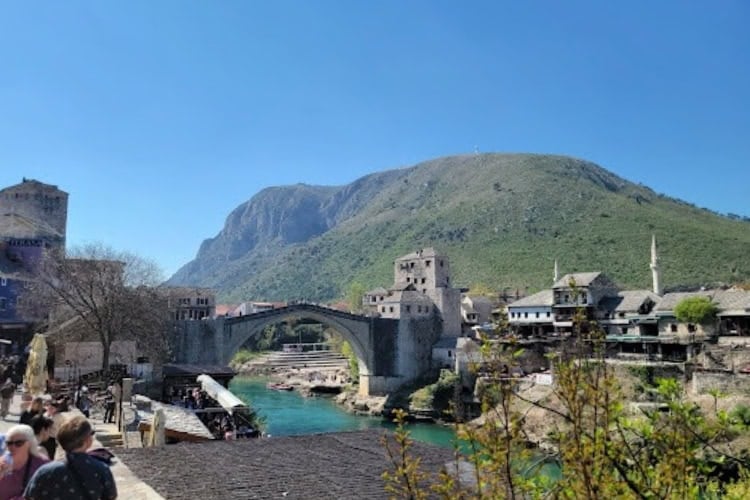
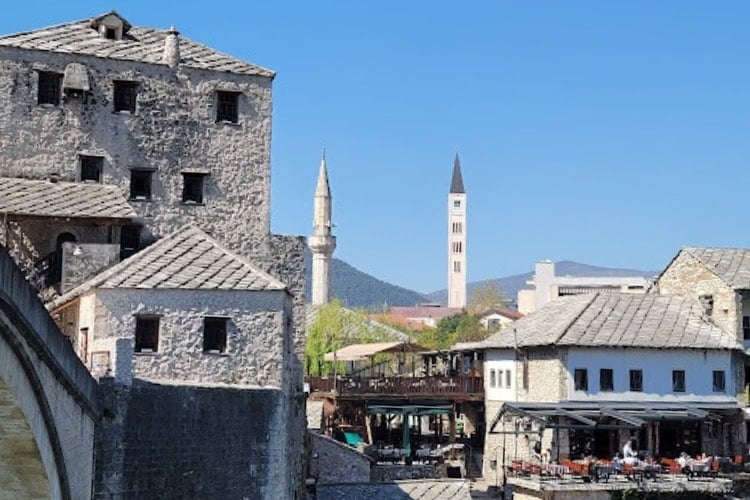
The Neretva River comes first, fast and cold, cutting through the city in a sharp line of turquoise and green. And then, rising above it, the reason many travelers come here: Stari Most, or the Old Bridge.
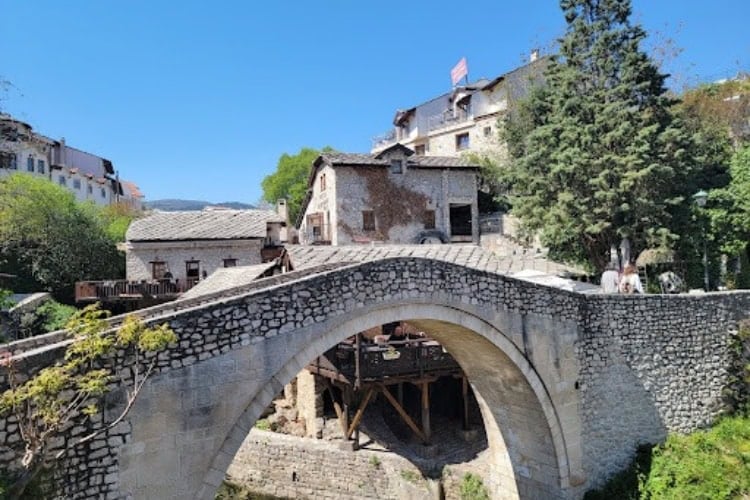
The Old Bridge is elegant in a way that feels almost improbable, a perfect stone arch suspended between two steep banks. But its beauty is inseparable from its history.
Built in the 16th century under Ottoman rule, it was commissioned to replace earlier wooden crossings that could not withstand the river’s force. According to locals, the architect (often identified as Mimar Hayruddin, a student of the great Mimar Sinan) undertook the project with considerable uncertainty, unsure whether such a wide stone span could hold. Legend suggests he feared the consequences if it failed. Some even say he fled the city after construction and before unveiling, afraid for his head should the heavy stone center plunk into the river.
It didn’t. The bridge stood—and remained—for more than 400 years.
It wasn’t until the early 1990s that the bridge really suffered. During the Bosnian War, Mostar became a focal point of conflict between Bosniak and Croat forces.
In 1993, the bridge was shelled and collapsed into the river below—an event captured on film and broadcast around the world, even as the international community struggled to respond in real time.
When our guide, Ivan, spoke about it, his tone did not change.
“It fell during the war,” he said simply. “Everyone saw it happen. But nobody knew what to do.”
The bridge that spans the river today is a reconstruction, completed in 2004 using traditional methods and original stone. The Old Bridge and surrounding Old Town are now recognized as a UNESCO World Heritage site.
“It is a symbol of the bridge between our people,” Ivan said. “We built it, we destroyed it, and we built it again. Last time it lasted over 400 years. For the new old bridge, we’re just over 30 years and counting.”
Crossing the Arch
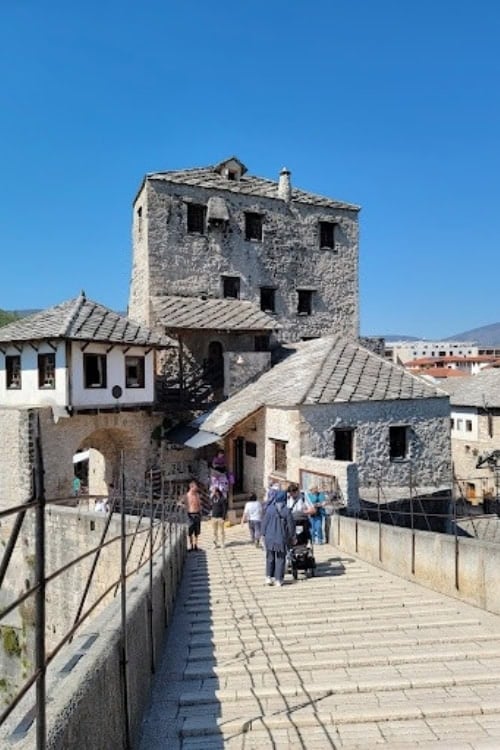
We walked slowly across the bridge. The stone beneath our feet was worn smooth, slightly slick in places, shaped by centuries of footsteps and weather. Below us, the river rushed past, its cold current visible even from above. Around us, visitors paused for photographs, standing at the center of the bridge and looking outward at minarets rising alongside church towers, at the layered stone of the old town.
On the far side of the bridge, the city shifted slightly. Not geographically, but emotionally. Cafés opened onto the river. Shops displayed copper work along narrow streets, especially along Kujundžiluk, the historic bazaar known for its coppersmiths. Artisans sat in front of their shops and stalls, hammering away at copper sheets and objects.
Here, tradition is still in practice: coppersmiths hammering decorative plates and goblets, the rhythmic clang of metal on metal echoing through the narrow street. It may have taken tourism to sustain these crafts economically, but there was a sense that preservation here runs deeper than profit.
National Nourishment
As we moved through the bazaar, the scent of grilled meat began to cut through the air—smoky, savory, unmistakable. We followed it into a small restaurant tucked along a cobblestone alley, where outdoor tables spilled into the walkway and the low murmur of conversation blended with traditional Bosnian music playing softly in the background.
Nataliya and I shared a large platter filled with a variety of foods: ćevapi sausages, their juices soaking into warm flatbread; pljeskavica patties, charred at the edges; creamy kajmak spread; dolma wrapped tightly in leaves; and ajvar, its smoky sweetness lingering with each bite.
The meal was hearty and unpretentious. We paired it with a local Mostar pilsner, cold and crisp against the richness of the food. A sketch of the Old Bridge was on the beer bottle’s label.
We finished with tufahija—poached apples filled with walnuts and topped with whipped cream—soft, sweet, and unexpectedly delicate after the heavier meal.
From our table, we watched the steady flow of life through the alley—locals greeting one another, visitors pausing to examine handcrafted goods, the quiet choreography of a place that continues, despite everything, to move forward.
The Cemetery That Stopped Time
If the bridge represents connection, the cemetery in Mostar represents interruption.
We reached it later that day, guided there quietly, without emphasis. At first, it looks like a park that has forgotten how to be one. Trees still stand. Paths still curve gently through it. Benches are scattered throughout. But it becomes clear almost instantly that this is no longer a park.
We scanned a long row of white tombstones. “All of them have the same end date,” Nataliya said. “1993.”
White tombstones fill what used to be a park, most bearing dates from the early 1990s, especially 1993. Row after row, the years repeat themselves with a quiet insistence. It is not just the number of graves that unsettles, but their proximity to one another, the way loss seems compressed into a single moment in time.
This was once a place where lovers met, where families gathered, where children played, where ordinary life unfolded in the open air. During the war, when movement across the city became dangerous, the main cemetery was inaccessible due to sniper fire. This park became the only available ground for burial.
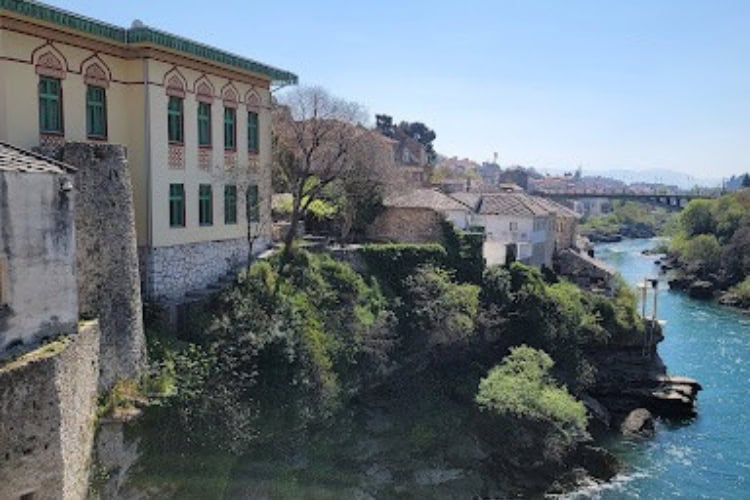
The stillness of the place carried a different kind of weight than the rest of the city. Even the air seemed quieter. Around the edges, buildings stood in varying states of repair—some restored, others still marked by impact, their scars left visible. Not neglected so much as preserved. Testament to terrible times.
In Mostar, repair and damage exist side by side without resolving into each other. The past is not hidden here. It remains, visible and present, woven into the everyday landscape.
Three Peoples, One City
One of the complexities Ivan explained as we drove away from Mostar was not about the past alone, but about the present structure of identity in Bosnia and Herzegovina.
“Bosniaks, Croats, Serbs,” he said, counting them lightly on his fingers. “Three peoples. Three systems. One country.”
The arrangement is political, shaped in part by the 1995 Dayton Agreement, but it is also lived. Schools, municipalities, even versions of history differ depending on where you stand.
Outside the city, we passed road signs in both Latin and Cyrillic scripts. In some places, one had been crossed out in spray paint by vandals on one side or the other.
“People think the war ended,” Ivan said, “but memories don’t die that quickly, and forgiveness doesn’t always come easy. The bombs and missiles and guns are gone. But that doesn’t mean the war is over for everyone.”
Some bridges require more time to mend.
Kravica: Washing It All Away
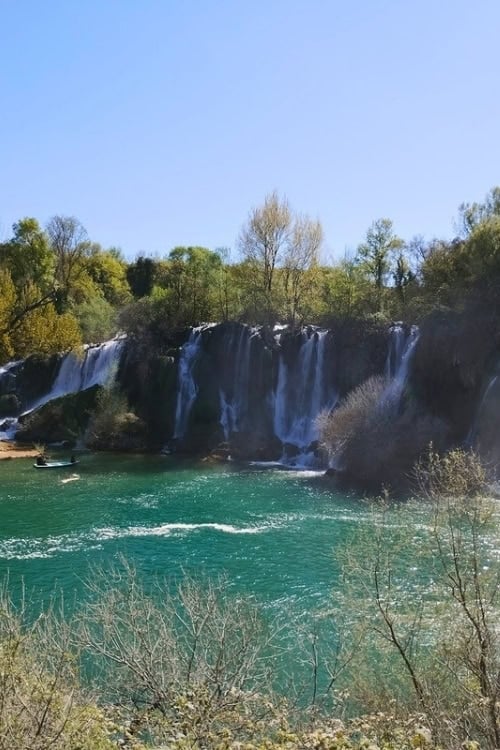
By the time we reached the Kravica Waterfalls, the landscape had shifted again. The falls descended in wide, layered curtains into a green basin, the sound of rushing water loud enough to erase conversation at the edge. Mist rose and settled unpredictably, catching the light in brief flashes.
People sat along the rocks, some leaning into the cool spray, others watching in silence. Still others waded into the water below the falls, their movements slow, almost tentative against the steady force of the current.
Nataliya stepped in, the water rising to her knees. She paused, letting the current move around her, then smiled. “This feels like a reset,” she said.
Standing there, it was easy to let the beauty of the waterfalls wash the troubles of the past and present away for one moment in time.
Fortified Bridges
The drive back toward the coast, out of Bosnia and back into Croatia, was relatively quiet. We enjoyed the beauty of the landscape—mountains, cliffs, scattered villages, and eventual glimpses of the Adriatic. The surrounding landscape provided its own narration.
Eventually Ivan spoke again. “My family was on both sides of everything. Croatian. Bosnian. Yugoslav. It depends which grandparent you ask. And sometimes, which year you ask.”
I nodded. “Even back home, families can be like that. Die-hard blue versus hard-core red arguing across a holiday dinner table.”
Nataliya added, “Only with words rather than weapons.”
I considered that. “Sometimes words can be the worst weapons.”
“Tell that to the residents of Mostar,” Ivan said with a bittersweet smile. “Or Dubrovnik.”
Before long, far below us, the stone city walls of Dubrovnik came back into view—red roofs pressed tightly together inside their stone perimeter.
“It’s beautiful, isn’t it?” Ivan said.
We nodded, watching in silence as the city grew closer.
“My grandmother was from Bosnia,” he added. “My grandfather from Dubrovnik. They loved each other. But they never agreed on Tito or Yugoslavia.”
In the Balkans, what seems like distant history is neither distant nor settled. It lives in cities, in families, in arguments and silences, in bridges rebuilt and in those still waiting.
If You Go
Most visitors to Mostar arrive from Dubrovnik, about a three-hour drive away. Private guides and organized tours are widely available and offer valuable context for the region’s layered history. There are several good private day trip options on Viator, most pairing Mostar with stops like Kravice Waterfalls or Počitelj.
Mostar is best understood slowly, with time for both the bridge and what surrounds it. The Old Town is compact, but its meaning emerges in the spaces between landmarks as much as in the landmarks themselves.
The reconstructed Stari Most is most powerful when experienced on foot. Local divers still leap from its height into the river below—a tradition that adds a living dimension to its long history.
The park-turned-cemetery is not formally presented as a tourist site, but it provides essential context for understanding the city’s recent past. Visitors should approach it quietly and respectfully.
Nearby Kravica Waterfalls are a common addition to most itineraries. It rewards those who linger, allowing the sound and movement of water to reset the pace of the day.
Need a hand planning your trip? Here are the sites and services we rely on most, from booking tools to travel products we love.
Inspire your next adventure with our articles below:
- Inside Kotor: Montenegro’s Walled Medieval City That Still Feels Like a Secret
- The Ultimate European Bucket List: 23 Life-Changing Experiences
Want to discover more hidden gems and helpful travel tips? Join our free newsletter for the latest travel secrets and travel articles.
We are reader-supported and may earn a commission on purchases made through links in this article.

Planning another trip soon? ✈️
Add GoWorldTravel.com as a preferred source on Google. Click the button below so our local guides, packing hacks, and hidden-gem itineraries always show up first when you search!
Add to Preferred Sources