

We were in Germany, and could not find a German restaurant. This was wrecking our plans entirely.
My wife and I were on a version of La Petite Boucle des Trois Pays, or the Little Loop of Three Countries.
The bike ride promises that you can saddle up and grab a gipfeli for breakfast in Switzerland, sit down for a lunch of schnitzel in Germany, and be in France in time for l’heure de l’apéro.
But here we were, wheeling uncertainly down Hauptstrasse in the direction of the Rhine, scanning for our Teutonic afternoon meal and coming up empty.
We saw several kabob houses, a burger place, and a couple of Asian restaurants.
Wait, over there…no, that’s Turkish. A Balkan bistro. Mediterranean. Thai. A hookah joint.
If you’re looking for evidence of Germany’s increasing cultural diversity and integration of immigrants from around the world, you’ll find plenty of it here.
But if you’re seeking sauerbraten, you stand a better chance in Milwaukee.
No matter. Our petite boucle might not have been textbook, but it was a delightful multinational, multicultural experience, delivering some cross-border insights, fresh air, and a bit of easy exercise.
Think of it as slow travel mixed, improbably, with an efficient use of time.
In any event it’s a great way to spend a day, or half a day, if you’re in the area of Basel, Switzerland.
Breakfast in Switzerland
Our adventure began with a proper Swiss breakfast at the distinguished Hotel Les Trois Rois, where we were staying.
Offerings were indulgent in the way travelers to Switzerland are familiar with: a bounty of fragrant cheeses, a lavish spread of artfully draped meats, and a bakeryful of aromatic breads and pastries.
The eggs are served soft, in the French style.
I used our coming ride as a shameless excuse to carbo-load, tucking into a second gipfeli, the crispier Swiss version of a French croissant.
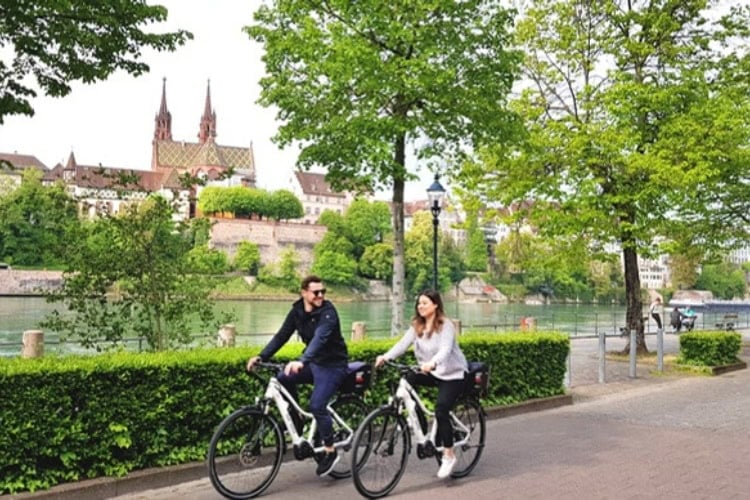
We rented bikes at Basel’s central train station, which is administered in that efficiently Swiss manner.
We maneuvered toward the Rhine by closely following the lead of the many saddled commuters and tourists who weave and cut amidst downtown Basel’s welter of trolleys, buses, and assertive pedestrians.
Following a Google map of a three-country route a friend had shared (several bike maps are available online), we soon found ourselves on a dedicated bike path along the river.
Our ride swept along a mostly flat Swiss route, past some commercial areas, including a campus of Novartis Pharmaceuticals.
We crossed the Rhine and into neighborhoods on the “other side” of the river.
The area had none of the features or facades a tourist will encounter in the tailored land of chocolate and raclette.
Narrow streets lined with small cars badly parked, block apartment buildings looming on either side, a tangle of bikes locked out front, residents toting plastic bags from the simple takeaways and groceries here and there.
I’m always reluctant to say I’ve discovered the “real” part of a place I visit, but I couldn’t help having that feeling there, on the other side of the Rhine.
Soon, the streets led to a paved path running along a stream through a forest, passing a small zoo; to our left, we could have hit Germany with a modest shot from a trebuchet.
The forest gave way to some small farms, a few cows lazing in a field.
Already, the city felt far behind.
About 45 minutes into our ride, we were barely breathing hard (to be fair, we’d rented e-bikes).
Now on a suburban road, we came to a border crossing into Germany.
While it had the booths, barriers, and gates you’d associate with document verification and booted guards carrying small firearms, nobody was home.
Switzerland and Germany are part of the Schengen area, which allows free passage among most European countries without passports.
We snapped a photo in front of the sign marking the German border and wheeled right through.
To dive deeper into the city, you can take a private walking tour with a local guide who shows you Basel beyond the usual sights.
Germany for Lunch

It’s always something of a disappointment when clichés turn out to be true.
And yet, as soon as we crossed into Germany, the neighborhood was suddenly formal, homogenous, and spotless.
If any place along our route felt like we’d moved from one country to the next when we crossed the line on a map, this was it.
But the route soon wound us toward Hauptstrasse, where the cliche collapsed as we failed to find authentic German food amidst the international offerings.
We finally settled on a food truck that offered currywurst.
It was a long pork sausage split and fried face-down on a grill, sliced into plump, meaty medallions, draped with a tomato curry sauce, a crunchy roll placed alongside.
This street food with Indian inflection turns out to have been created in Berlin.
It all provided a satisfying, if entirely unexpected, taste of Deutschland.

We ate our lunch at a picnic table with a tall, dark German beer, soaking in the neighborhood vibe.
It seemed to be a mix of young people, international families, and pensioners, all going about their business on a weekday afternoon.
Nearby, a crew was setting tables and stalls for an African music festival.
Wine Time in France

This left only République Française, about a 20-minute dawdle north.
A modest pedestrian bridge called Passerelle des Trois Pays connects the countries.
Next to the bridge on the German side is a park with mini-golf and an amusement center, while off to the left, there’s plenty of shopping, including the Swedish H&M.
Along the river stands a building housing an Asian restaurant.
If it or any other structure was part of a border security operation at some point, there’s no evidence of that today.
People just walk or bike across the bridge between Weil am Rhein, Germany, and Huningue, France, without comment, other than a selfie or two.
On the other side, this being France, the first thing you see is a wine bar.
We’d been biding our time, anticipating our French connection, but it was still only 15:25, too early to drink even by forgiving European standards.

Luckily, the people who run the wine bar, which opens at 16:00, were launching a wine store across the courtyard, and one of the staff there was happy to welcome us with a tasting.
And so Pierre — of course, his name was Pierre — poured us tastes of four wines as we sat in a comfortable leather couch, surrounded by hundreds of bottles of French wine rising up the walls of the shop.
He told us about each in his labored English, pointing to their regions in a book full of maps.
It was a lovely moment, and very French.
With the wine bar not yet open, there was no cheese on offer.
But our next stop, happily, was Switzerland, just 15 minutes up the path.
If You Go
Basel is a small, walkable, cosmopolitan city tucked along the northern border of Switzerland, located about an hour west of Zurich via the country’s shockingly efficient rail system.
Basel is known for its rich history and abundant art.
Its Kunstmuseum is said to be the oldest museum with a public art collection in the world.
It’s full of works by Western masters, including a collection of Picassos with a charming local back story.
Every June the Art Basel fair draws tens of thousands of fans and critics of contemporary art from around the world.
If it seems like there are museums everywhere, that’s not much of an exaggeration: Civic officials say there is one museum per square kilometer.
Restaurant offerings range from heavy traditional Swiss fare (Alpine raclette, cordon bleu) to eateries representing the many European and contemporary influences nearby.
Prices for food, like everything else in Switzerland, are high, between half again and twice as much as what you’ll pay in the U.S.
Currency is Swiss Francs only; Euros are not accepted.
Accommodations are expensive, too.
Still, we stayed at the splurge-worthy Hotel Les Trois Rois, a gorgeous, 300-year-old pile whose guests have included Napoleon Bonaparte and local boy Roger Federer.
It’s recently been renovated to add an extravagant avant-garde wing to complement its grand traditional quarters.
Our room had 15-foot ceilings and curtains instead of interior walls.
The hotel faces the Rhine and its restaurant has a lovely terrace overlooking the river.
One of its restaurants has three Michelin stars.
If you’d like to take in the three countries by bike, you’ll find information on short (less than three hours) and long (more than 13 hours) routes at the Trois Pays a Velo website.
To avoid the complications of renting a bike on the street (downloading apps and creating accounts in translation, and so forth), get your bike from Rent A Bike, located in the basement of the main train station, Bahnhof SBB.
If you have a Basel Card from your hotel, bring it; it’ll save you about half.
With the card, an e-bike for the day will cost you about $80.
An e-bike isn’t necessary; the route is mostly flat.
Related reading: An Adventure by Bicycle: The Closed Road in Denali National Park
Need a hand planning your trip? Here are the sites and services we rely on most, from booking tools to travel products we love.
Inspire your next adventure with our articles below:
- Skip the Crowds: 10 European Destinations That Are Actually Better in Fall
- How to Plan a Perfect Cross-Country Travel Adventure
Author Bio: Craig Stoltz is a freelance journalist writing about travel, food, and drink. His work has been published in Afar, Garden & Gun, Fodor’s, Frommer’s, Virginia Living, and many other publications. A former travel editor of the Washington Post, he lives in the Shenandoah Valley of Virginia.
Want to discover more hidden gems and helpful travel tips? Join our free newsletter for the latest travel secrets and travel articles.
We are reader-supported and may earn a commission on purchases made through links in this article.

- Winter in Michigan’s Keweenaw Peninsula: Sled Dogs, Saunas and Snowshoe Trails - October 27, 2026
- Love Across Borders: 8 Expert Tips for International Dating Success - October 27, 2026
- The Ecuador Amazon Lodge That Actually Lives Up to the Ecotourism Label - October 27, 2026
Planning another trip soon? ✈️
Add GoWorldTravel.com as a preferred source on Google. Click the button below so our local guides, packing hacks, and hidden-gem itineraries always show up first when you search!
Add to Preferred Sources