
A chance conversation with my car mechanic in north London, who was born on Faial, one of the nine islands of the Azores, one thousand miles off the coast of Portugal. He told me about his ancestors who had lived through a massive volcanic eruption in 1957, which had shrouded this tiny island in plumes of lava ash for months.
The incident counts as one of the biggest natural disasters in Portugal’s modern history. My interest was piqued.
A year later, I stood in the departure lounge of the airport in Ponta Delgada, the Azores’ capital, located on the biggest and busiest island, São Miguel. On a Friday afternoon, the tiny airport had the feeling of a bus station, with school kids, government officials and shoppers about to return home to the outlying islands of the archipelago.
My plan was to explore Pico, Faial and São Jorge, often referred to as the Azores Triangle because of their close proximity to one another.
First Light on Pico
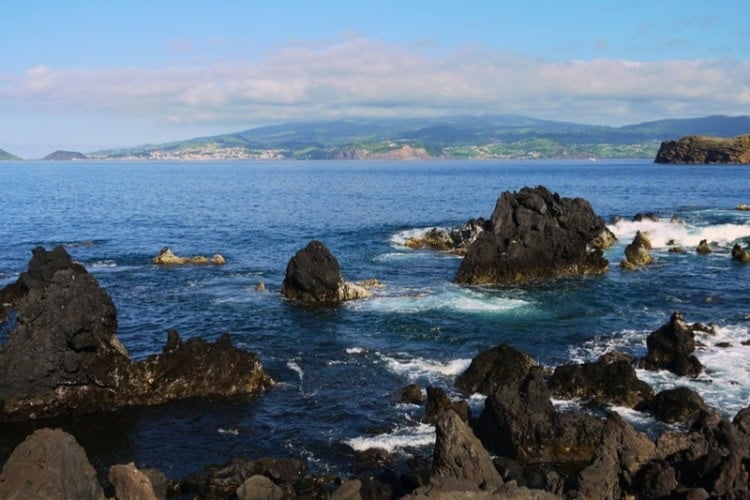
In preparation for the trip, I had booked accommodation on the western side of Pico in the sleepy seaside village of Madalena. I also reserved a small motorbike locally as my mode of transport. From the balcony of my rental apartment, an extraordinary landscape revealed itself.
Cabeço Gordo, at 1,043 meters (3,422 ft), the highest elevation on Faial, towers above the harbor town of Horta. Further to the north, I could just about see São Jorge and the distant lights of its main settlement, Velas. Ferries and fishing boats crisscrossed the channels between the islands, as if the Atlantic Ocean wasn’t a natural obstacle but a convenient maritime highway.
Madalena’s Wine Country
Madalena is a pleasant jumble of old houses, some of them made of lava stone, with a mid-sized harbor, some shops and restaurants, and plenty of holiday homes: no architectural gems but a wonderfully laid-back vibe. And it seems as if every resident takes immense pride in the local wine. I felt compelled to visit the Wine Museum on the outskirts of the village.
The well-curated complex was set up by the municipality in 1982 to illustrate a trade that has risen steadily in importance over the years. Wine had been cultivated on Pico since the 16th century, when landowning families on Faial were looking for ways to make this lava-stone backwater commercially viable.
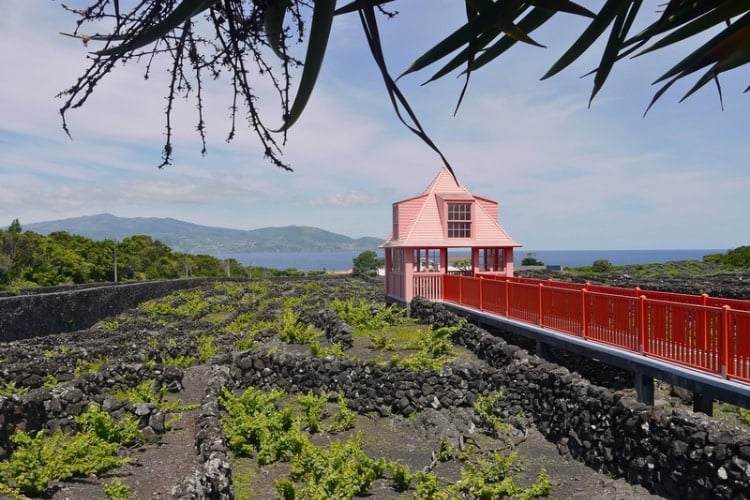
The land was cleared of rocks, which were stacked in neat walls along the perimeters of small fields. Fertile soil was then shipped over from Faial, and very soon the local nobility realized that they had hit the vinicultural jackpot.
The stone walls perfectly retained the sun’s warmth and acted as superb greenhouses, as long as you kept the vine rooted to the ground and did not cultivate it along hedgerows. Over time, the burgeoning trade attracted a professional class, which greatly boosted a local economy that had previously relied solely on fishing.
Read More: The Best Wine Regions in Europe for Your Next Tasting Adventure.
Whaling on Pico
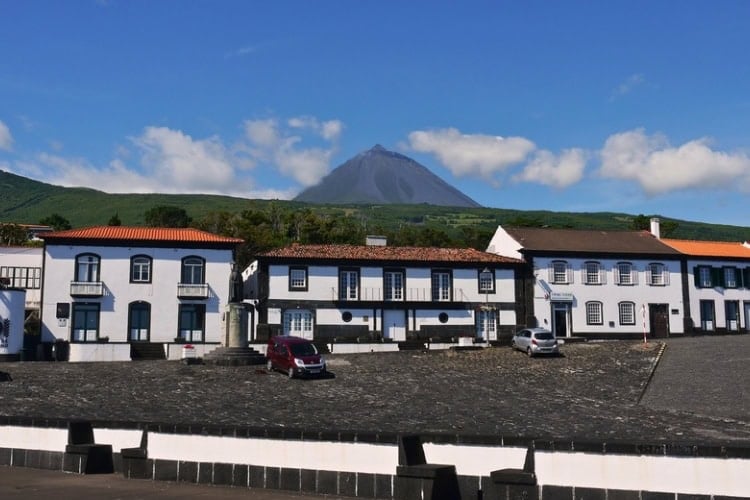
Pico had also become famous as one of Europe’s center for whaling, in particular around São Roque on the northern coast of the island. From as early as the 17th century, whalers from New Bedford and Nantucket often stopped along these shores to replenish supplies, but also to hire local fishermen to come along for the next hunt.
Having learned the trade from their fellow American mariners, the islanders put their new skills to profitable use. Pods of whales often rested in the calmer waters of the Azorean archipelago, and once a whale was spotted, the crew dropped whatever they were doing on land, ran to the harbor, jumped into their longboats and rowed feverishly to catch up with these giants.
One harpoon alone did not kill the beast, but eventually, with more toggle heads spiking its body, the animal came under such stress that its heart eventually gave in; a gruesome end. The crew then heaved the whale back to São Roque’s factory for the slaughter process to commence.
In preparation for the country’s membership of the European Union, the practice was banned by the Portuguese government in 1984. In return, the islanders were promised financial support, which unfortunately failed to materialize. This prompted three old-time mariners to stage a protest by hunting down one last whale. That was in 1987, when a 300-year-old tradition came to a timely end.
Climbing Mount Pico
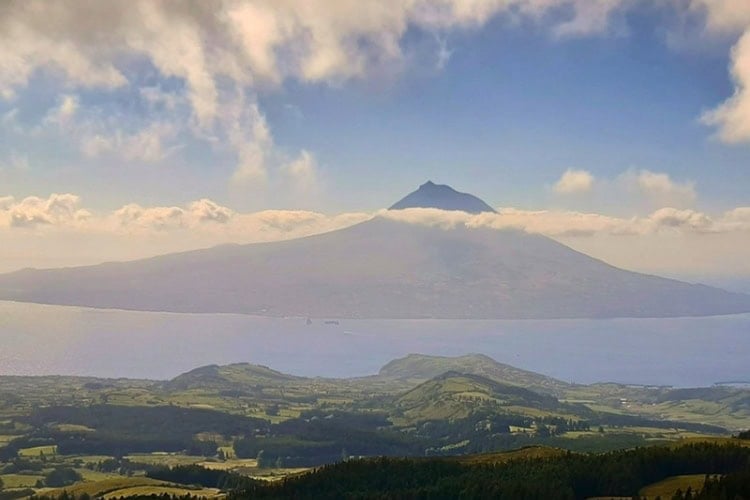
A visit to Pico Island would not be complete without hiking up the slopes of the unimaginatively named Mount Pico, at 2,351 meters, Portugal’s highest peak. It turned out to be an arduous climb: three hours up an extinct volcano, not always along a beaten path, but also across lava rocks, on occasion, scrambling on all fours.
For the first hour, I hiked through a thick bank of mist before eventually emerging to glorious sunshine with the surrounding islands partially covered by a blanket of clouds.
Back at the National Park entrance, a ranger told me about the oldest climber ever to scale Pico’s heights: a 92-year-old Japanese woman who had lived all her life on the slopes of Mount Fuji, which accounted for what must have been a horse-like lung capacity. Her exhausted daughter and granddaughter apparently trailed behind at some distance.
Volcanic Disasters on Faial
Early the next morning, I boarded a 30-minute commuter ferry and headed for Faial’s hinterlands, riding on narrow roads flanked by flowering agapanthus and hydrangeas through rolling green hills, pasturelands and forests with eucalyptus groves.
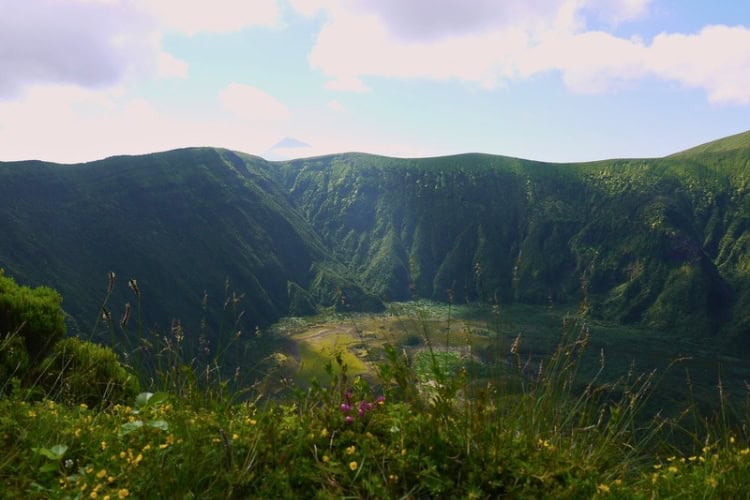
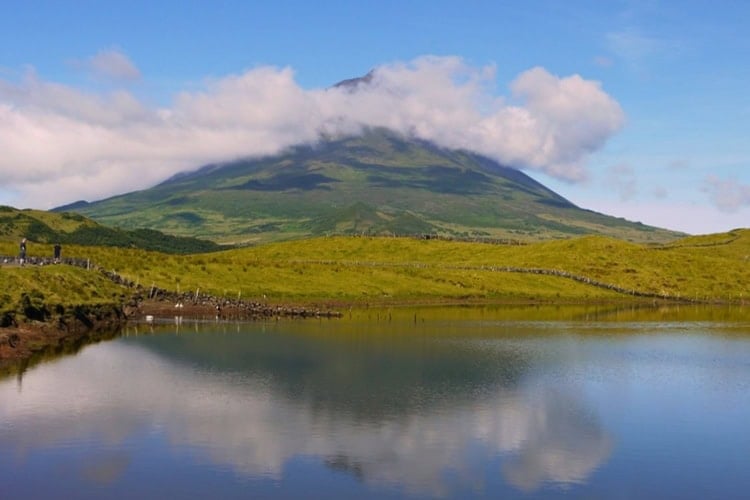
The motorbike just managed the steep climb up to 1,000 m to Caldeira, a cauldron of a volcano whose top had been blown off by an eruption about a thousand years ago. At this altitude, the views were stupendous; over to São Jorge, but also across the strait where Mount Pico rose majestically above a thin veil of clouds.
The cauldron was just as spectacular. Circumventing its rim on foot took about two hours, along a narrow path with vertical drops of 400 meters to the lush and verdant crater floor.
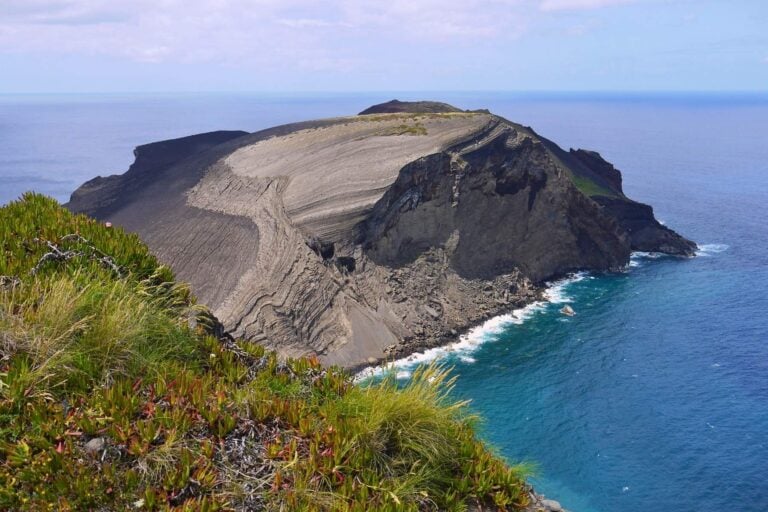
Another thirty minutes on the bike and I reached the westernmost point of the isle at the moonscape of the Capelinhos volcano, where that infamous eruption of 1957 had taken place. The blast had lasted for an incredible 13 months and obscured not just Faial, but also the other Triangle islands under a toxic cloud of ash and volcanic debris.
It made agricultural production impossible, with the local population facing the prospect of starvation. John F. Kennedy, back then the senator from Massachusetts, sponsored the so-called Azores Immigration Act, which allowed four thousand people to be rescued and brought to the United States.
Slowly, nature is reclaiming the territory, with weeds spreading their seeds across a landscape that was once choked by volcanic ash. The contrast to the green ambience of the cauldron could not have been starker: eerie, ghostly and sculptured, but also undeniably beautiful.
Horta, Faial’s Historic Heart

I made my way back along Faial’s south coast to its surprisingly buzzing capital, Horta. Together with Ponta Delgada, the town forms the administrative center of the Azores, with a court, numerous civic buildings, schools, a hospital and even a university outlet devoted to marine biology.
Plenty of jobs to keep a population of 15,000 settled on a year-round basis. The pleasant atmosphere is complemented by an intriguing history, since Horta was once of crucial strategic importance in connecting Portugal with her colonial possessions in Latin America and in Africa.
And Faial was also essential as a stopover for cross-Atlantic seaplanes (the first successful attempt was made in 1919), whilst also serving as a vital connection point for the global cable network.
Arriving in São Jorge
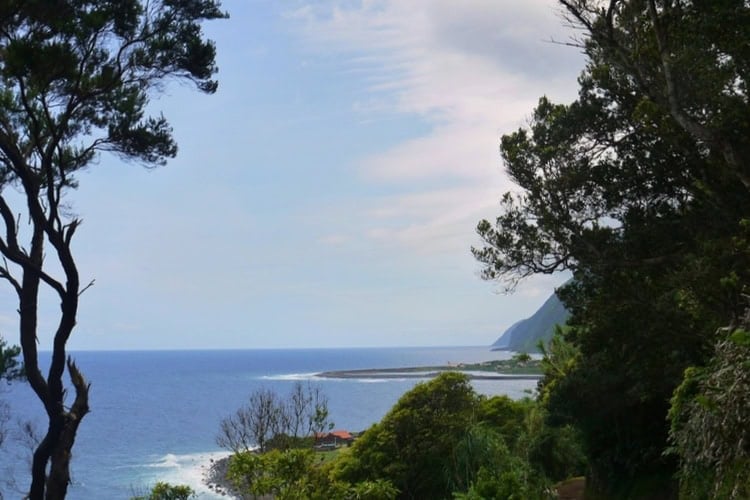
Over to São Jorge, the final stop of my itinerary. The one-hour ferry from Madalena docked at Velas, a quiet and pretty small town with cobblestone streets and cute houses grouped around a picturesque church square. Velas is dwarfed by the island’s incredibly steep topography: sheer vertical cliffs on all sides, dissected by precarious hairpin roads of often questionable quality leading on to a high-lying plateau.
São Jorge is also remarkable for the profusion of so-called Fajas, which roughly translates as belt or strip. Over millennia, the stormy waves of the Atlantic nibbled away at the island’s cliffs and, in the process, formed little fertile stretches of land just above sea level.
Just to the east of Velas, I visited one of Europe’s few coffee plantations at Faja dos Vimes. The landscape became even more dramatic on the north coast, where I swam in rock pools at Faja do Ouvidor.
Journey’s End on São Jorge
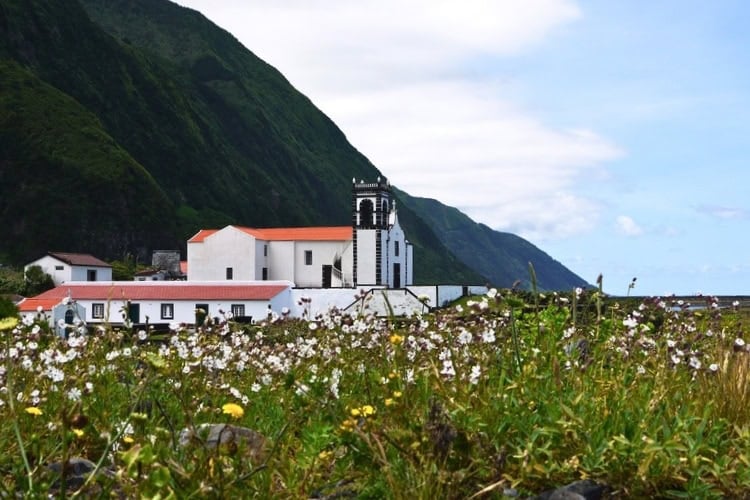
Also on the north coast, I was enchanted by Faja dos Cubres, accessible by an impressively steep though mercifully paved road leading down to the sea. From there, I hiked along a dirt track frequented by quad bikes to Faja do Caldeira Santo Cristo.
Local hotel entrepreneurs had chosen this hamlet as the idyllic setting for an island retreat that offers its guests the chance to get away from the trappings of civilization. I felt as if I had reached the precipice of Europe. This was travel off the beaten track, quite literally in this case.
On the way back to the ferry terminal, I ventured further upland past fields and livestock, bracing strong winds and drifting rain clouds towards the island’s highest peak, Pico da Esperança (1,050 meters). I wasn’t entirely sure whether I had made it to the top. The drifting fog was just too dense.
Back in London, I had to pay a visit to the same car mechanic who had sent me on my way. To my mind, the Azores Triangle is a fabulously rewarding destination for the independent traveler: the astonishing volcanic landscape, the intricate history, the unique geology, the chance to travel beyond the crowds, the absence of mass tourism, the friendly locals, the laid-back atmosphere, the sheer sense of natural beauty that counts among the best that Europe has to offer. I asked him: ‘What are you still doing here?’ ‘Good question, ’ was his reply.
If You Go
Ponta Delgada on the Azores’ biggest island, São Miguel, has direct flight links to many North American and European cities, including New York City, Boston, Chicago, Toronto, Lisbon, Porto, London, and Frankfurt. Flights to the outlying islands of the archipelago are provided by SATA Azores Airlines.
As for accommodations, the retreat on São Jorge, which was mentioned in the article, is the Kuanza Nature Experience. In Madalena on Pico, the Hotel Terramar has the best reviews. In Horta on Faial, you could try the Faial Garden Hotel.
For (motor) bike rentals, try NaturRent in the harbor of Madalena, which also provides excursions, for instance, to the top of Mount Pico. Should you prefer four wheels, the Azores’ biggest car rental agency is Ilha Verde, which has outlets at the airports on Pico and Faial.
Inter-island ferries are provided by Atlantico Line.
There are two outstanding museums, which illustrate the history of whaling on Pico Island. The Whaling Industry Museum is located in São Roque do Pico on the island’s north coast. On the south coast, check out the Whalers Museum in Lajes do Pico, which features a U.S.-made documentary from the 1950s.
The history of winemaking can be explored at the Wine Museum just outside of the west coast village of Madalena.
To find out more about volcanic eruptions, seaplanes, and cable networks, head for the Horta Museum on the island of Faial.
Need a hand planning your trip? Here are the sites and services we rely on most, from booking tools to travel products we love.
Inspire your next adventure with our articles below:
- A Taste of Things to Do in Porto, Portugal: Port Wine is Just the Beginning
- Day Trip from Lisbon: Cascais, the Mouth of Hell, and Europe’s Westernmost Point
Author Bio: Andy Staab is a London-based content developer (#andyshiddeneurope) and travel writer who has been exploring Europe for over four decades. He has a penchant for remote places, focusing on the Great Outdoors, history and political storytelling.
Want to discover more hidden gems and helpful travel tips? Join our free newsletter for the latest travel secrets and travel articles.
We are reader-supported and may earn a commission on purchases made through links in this article.

- Fall Day Trips from Vancouver: 7 Scenic Walks Worth the Drive - September 15, 2026
- Laos for Backpackers: Vientiane, Vang Vieng and Luang Prabang on a Slow-Travel Route - September 15, 2026
- Why “Just Immerse Yourself” Won’t Teach You Spanish, No Matter How Long You Stay - September 15, 2026
Planning another trip soon? ✈️
Add GoWorldTravel.com as a preferred source on Google. Click the button below so our local guides, packing hacks, and hidden-gem itineraries always show up first when you search!
Add to Preferred Sources