
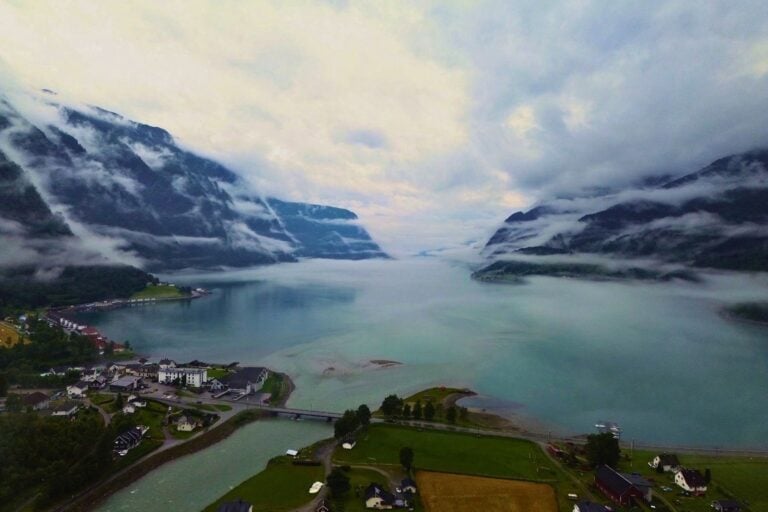
Most people meet the Sognefjord at Flåm, where the cruise ships dock and the souvenir shops hum. We met it at the other end entirely, in the Luster kommune, where the fjord narrows into the Lustrafjord and the mountains close in like a held breath.
There were seventeen of us, guides included. Among the group were wheelchair users, amputees, and several autistic members, some with Asperger’s. What we had in common was more useful than what we didn’t: nobody wanted an easy holiday.
The plan was simple enough to say out loud. Six days on the water in kayaks, canoes and pack rafts with a sprinkling of barbecues on beaches and side trips to a glacier and Norway’s oldest stave church.
Why Luster, Not Flåm
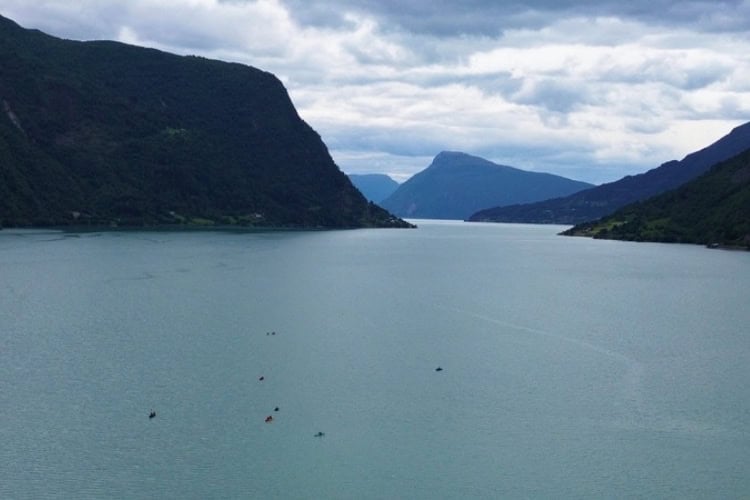
Luster sits at the innermost reach of the Sognefjord, Norway’s longest and deepest fjord. Its own arm, the Lustrafjord, runs a further 40 kilometres to the little village of Skjolden — about as far from the sea as a fjord can take you.
The water here is a milky glacial green, fed by meltwater from the Jostedalsbreen ice cap high above the villages of Solvorn, Ornes, Skjolden and of course Luster.
That quiet mattered to us more than most groups. For our autistic members, no crowds meant no sensory overload, no queues to negotiate and endless sights to gaze over. For our paddlers, it meant calm, sheltered water and empty beaches to land on.
For a similar calm, fjord-like paddle far to the south, see Montenegro’s Bay of Kotor: Stone Towns, Venetian Walls and Mirror-Calm Water.
Seventeen People, Three Kinds of Boats
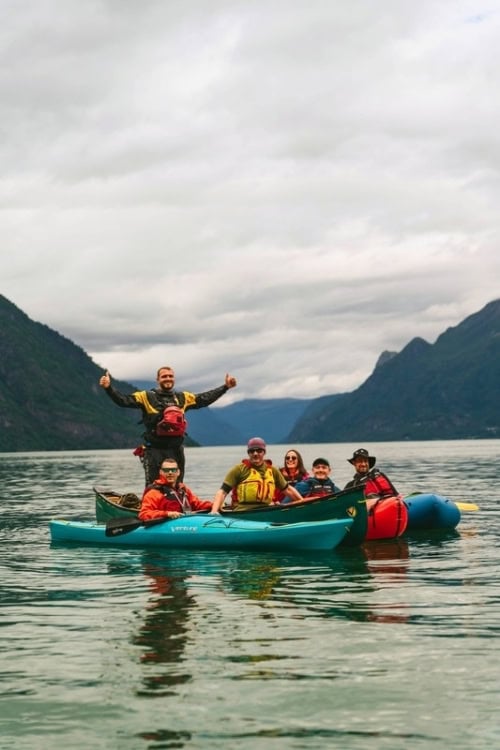
A mixed-ability group needs a mixed fleet, and ours looked like a small armada. Double sea kayaks took the paddlers who wanted speed and distance. Open canoes carried those who preferred stability, company and somewhere to put a flask.
The pack rafts were the revelation. Light, forgiving and easy to get in and out of, they turned out to be ideal for our members with more limited mobility — a wheelchair can be left on the shore and the water becomes a great leveller.
Five Days on the Water
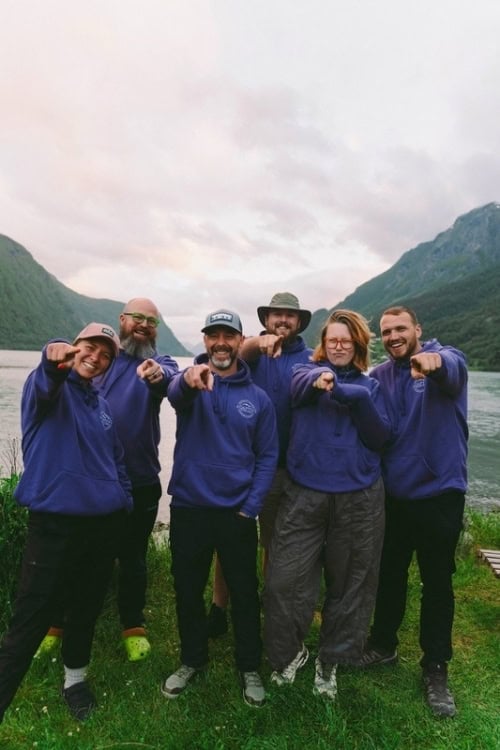
We fell into a rhythm quickly. Mornings began with the fjord like glass, the guides loading boats while the rest of us tattled gently about who was in which craft for that day.
Distances didn’t matter much. Some days we paddled a few hard kilometres along the shoreline beneath waterfalls; other days we simply crossed to a beach and stayed there.
The point was that everyone was on the water, every day, under their own steam.
It is a strange and wonderful thing to look down a raft of boats and see seventeen people — every body different, every boat different — all moving in the same direction. Nobody was a passenger.
Barbecues on the Beach and the Long Light
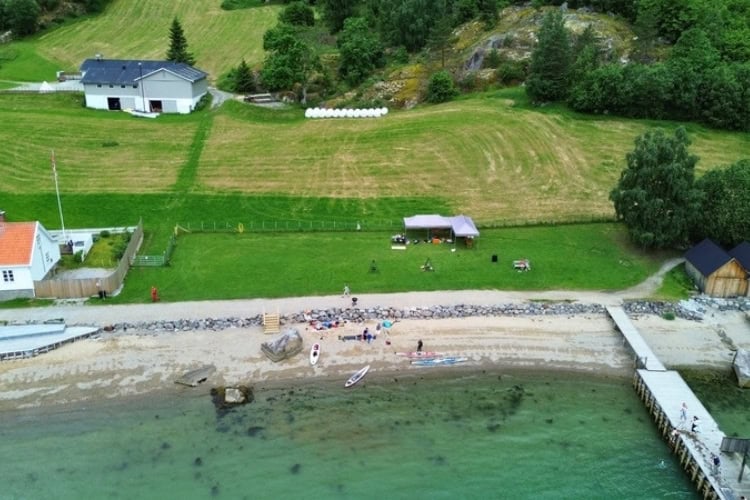
Summer this far north barely bothers with darkness, and we used every hour of it. Late afternoon barbecues, driftwood smoke drifting out over the fjord and the freshest food cooked ready to order.
There’s a particular kind of conversation that only happens around a fire when the day has been hard-won. Guides, paddlers, carers, PAs and parent titles — the labels dissolved somewhere between the sausages and the fifth round of coffee.
Standing Under the Ice at Nigardsbreen
You cannot come to Luster and ignore the ice that made it. We took a day away from the boats and drove up the Jostedalen valley to Nigardsbreen, a great blue tongue of the Jostedalsbreen glacier — mainland Europe’s largest ice cap.
A small boat crosses the glacial lake towards the ice, which spared our wheelchair users the roughest section of the approach. Up close, the glacier creaks and drips and glows an impossible blue, and the whole group went quiet in a way five days together hadn’t yet managed.
It’s also a sobering visit. The markers showing the glacier’s retreat over recent decades are a stark reminder that this landscape is changing fast — see it while it is still this mighty.
The Oldest Stave Church in Norway
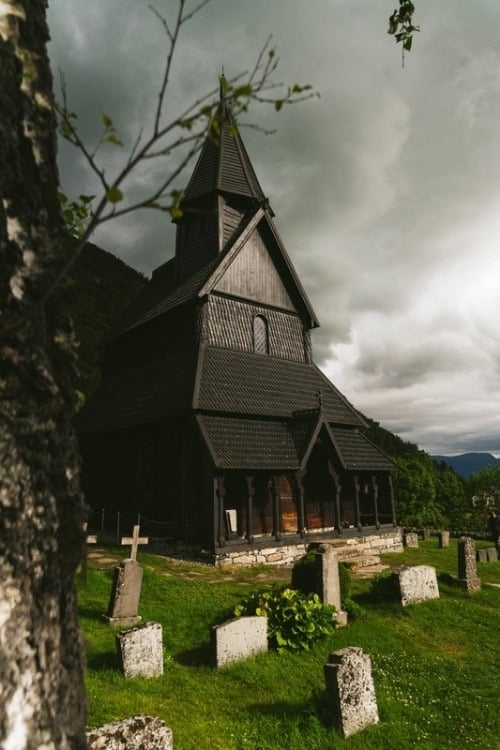
Our other shore day took us to Urnes Stave Church, perched above the fjord at Ornes and reached by the tiny ferry from Solvorn. Built around 1130, it is the oldest of Norway’s stave churches and a UNESCO World Heritage Site.
The carvings on its north portal — serpents and vines biting into one another — are older than the church itself, salvaged from an earlier building. Standing in that small dark wooden space, with 900 years above your head and the fjord glittering below, is worth the whole journey on its own.
Fair warning: the site is historic, the paths are steep and access is genuinely limited. We made it work with planning, patience and teamwork — which, by day four, this group had in ridiculous quantities.
What Accessible Adventure Actually Looks Like
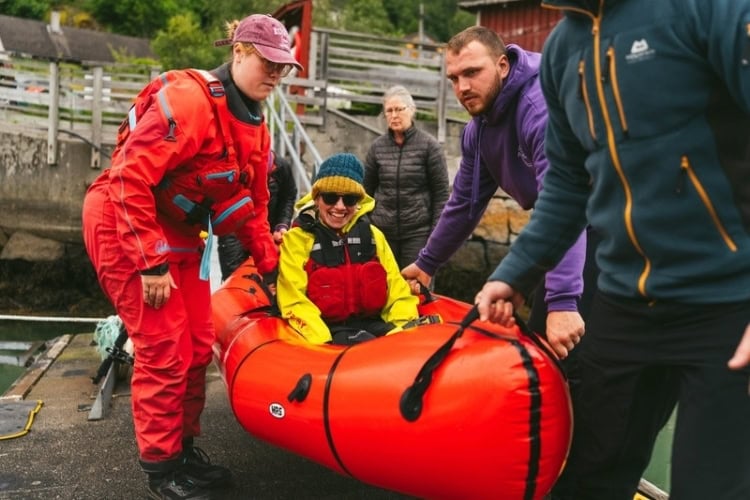
Here is what our five days in Luster taught me. Accessible adventure is not a watered-down version of the real thing; it’s the real thing, planned properly.
It looks like choosing pack rafts over rigid kayaks, beaches over jetties, and a quiet fjord arm over a famous one. It looks like building a day around what seventeen different people can do, rather than what one imagined average person can.
Norway made it easier than most places would. But the fjords don’t ask who you are when you’re on the water — and for five long, bright days, neither did we.
For another quiet-water Nordic journey, read Finding Stillness in Sweden’s East Coast Archipelago.
If You Go
Getting there: The nearest airport is Sogndal (via Oslo or Bergen); Luster is around 30–45 minutes by road. Skjolden, Solvorn and Gaupne make good bases. We chose to drive from Oslo; while the drive is 7 hours, every minute is worth it.
On the water: Calm, sheltered conditions on the Lustrafjord suit mixed-ability paddling from June to August.
Nigardsbreen: Reached via the Breheimsenteret visitor centre in Jostedalen (jostedal.com). The boat across the glacial lake shortens the approach; guided ice walks are for the sure-footed only.
Urnes Stave Church: Open summer months; the Solvorn–Ornes ferry carries vehicles and foot passengers (visitnorway.com). Access involves steep paths — contact the site ahead about mobility needs.
Accessibility: Norway is generally strong on access, but rural Luster is not step-free. Plan transfers and accommodation early, and talk to operators honestly about any needs — we found people bent over backwards to help.
Need a hand planning your trip? Here are the sites and services we rely on most, from booking tools to travel products we love.
Inspire your next adventure with our articles below:
- Slow and Steady Wins the Holiday: Why England’s Canal Boats Are the Ultimate Antidote to Modern Life
- Quietcations: 12 Places to Step Into Nature and Recharge
Author Bio: Nick Morrall is an expedition leader, outdoor practitioner and co-founder of Adaptive Expeditions, an organisation focused on making meaningful adventure accessible to people of all abilities. With a background spanning outdoor education, paddlesports and social care, Nick has spent many years using adventure as a way to build confidence, independence and connection. Through Adaptive Expeditions, he helps design and lead inclusive experiences across the UK and Europe, from multi-day paddling and cycling journeys to winter expeditions in Scandinavia. Nick is passionate about challenging perceptions of what people can achieve and believes that, with the right support, adventure should be open to everyone.
Want to discover more hidden gems and helpful travel tips? Join our free newsletter for the latest travel secrets and travel articles.
We are reader-supported and may earn a commission on purchases made through links in this article.

- New Brunswick’s Bay of Fundy: Trails, Waterfalls and Ocean-Floor Walks at Three Signature Parks - October 17, 2026
- Fjords, Freedom and Finding a Way: Accessible Adventure in Norway - October 17, 2026
- The Ultimate Gift for Travelers Who Don’t Want More Stuff: 10 Epic Experiences in the US - October 17, 2026
Planning another trip soon? ✈️
Add GoWorldTravel.com as a preferred source on Google. Click the button below so our local guides, packing hacks, and hidden-gem itineraries always show up first when you search!
Add to Preferred Sources