

8th continent? Yes, you read that correctly. The hottest news in geological circles lately is the potential of the planet’s newest, eighth continent: Zealandia.
It is a giant jigsaw piece of the Gondwanan supercontinent, hiding in plain sight east of Australia. Zealandia is named after its crown jewels — yes, you guessed it — New Zealand!
The catch? It is a mostly submerged mass of continental crust deep in the Pacific Ocean. Though still not official, Zealandia is already attracting names, including Tasmantis and the Māori name Te Riu-a-Māui, the land of the Polynesian god Māui.
What Makes A Continent?
Going back to first principles, what makes a continent? It’s not just about size.
A continent is usually a large landmass made of continental crust — thicker, less dense, and older than the surrounding oceanic crust. When continental and oceanic crust collide, the heavier oceanic crust sinks, leaving continents high and sometimes giving rise to mountains, earthquakes, and volcanoes.
But defining continents isn’t simple. Europe and Asia are connected on the same landmass but considered separate continents, while India and Arabia sit on their own crust yet are seen as part of Asia.
Partly that’s because their sizes don’t justify defining them as separate continents. Size, geology, and even culture all play a role, which is where exceptions are common and definitions get complicated.
Meet Hidden Zealandia
Enter Zealandia. Mostly underwater, this massive landmass is made of continental crust, thicker than oceanic crust but thinner than most continents.
Once part of the supercontinent Gondwana, Zealandia split off around 100 million years ago. Its crust stretched and sank over time, submerging more than 90% of the land beneath the Pacific.
Despite being underwater, Zealandia is huge — around 4.9 million square kilometres, about the size of India and over half of Australia.
That’s far bigger than typical microcontinents, such as Madagascar. So why was it overlooked? Traditional geology focused on land, leaving submerged continents hidden.
Modern marine mapping, seismic studies, and undersea sampling have revealed Zealandia’s true scale and structure, putting it on the map — and into current conversations about Earth’s continents.
Where Zealandia Emerges

Only a few pieces of Zealandia jut above water. Though a handful, they form a mesmerising set of mostly temperate islands. This includes:
- New Zealand, the largest portion above water
- New Caledonia, a stunning archipelago in the southwest Pacific, governed by France
- Lord Howe Island, a subtropical Australian island with the world’s southernmost reef
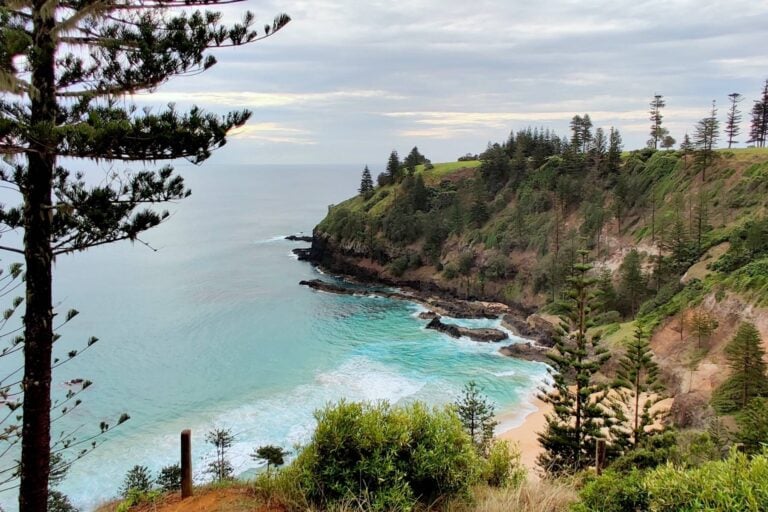
- Norfolk Island, another Australian territory with a dark penal history and island paradise today
New Zealand: The Crown Jewels of Zealandia

New Zealand is the largest portion of Zealandia above sea level — including the North Island, South Island, Stewart Island, and dozens of islets.
This visible landmass gives a tangible sense of Zealandia’s scale. Without it, the continent would remain a largely abstract undersea concept. (Not to be confused with Wellington’s wildlife ecosanctuary, also named Zealandia.)
New Zealand’s astonishing landscape diversity is shaped by the tectonic interactions between the Australian Plate and the Pacific Plate beneath Zealandia.
In the South Island, the oblique collision between the plates forces up the Southern Alps, creating dramatic scenery of peaks, valleys, and ancient glaciers. Franz Josef and Fox Glaciers carve through the mountains.
Fiordland’s Milford Sound and Doubtful Sound, with sheer cliffs and cascading waterfalls, rank among the world’s greatest natural wonders. Rudyard Kipling famously called Milford Sound the “eighth wonder of the world.”
For those wanting to maximize the experience, a small group tour from Queenstown combines the scenic drive along Milford Road with a boutique nature cruise, getting you closer to waterfalls and wildlife than larger vessels can manage.
Alternatively, adventurous travelers can opt for a coach and scenic flight combination that lets you drive through the remarkable landscapes and return by air over the Southern Alps.
More South Island Highlights

Beyond these landmarks, the South Island dazzles with Abel Tasman’s golden bays and turquoise water. Aoraki/Mount Cook National Park offers world-class stargazing in the Aoraki Mackenzie International Dark Sky Reserve.
Add the wine regions of Marlborough and Central Otago. The adventure capital of Queenstown. The ski slopes of the Remarkables. The wildlife of the Otago Peninsula and the spellbinding Hokitika Gorge.
There’s whale-watching in Kaikōura and the pristine tranquillity of Stewart Island’s Rakiura National Park. Each place showcases a different expression of Zealandia’s character.
North Island’s Volcanic Landscape

The North Island presents a different natural drama. Volcanic landscapes, geothermal fields, and lush rainforests arise from crustal stretching and thinning.
Rotorua is the geothermal heart of the country, with sulphurous lakes, bubbling mud pools, and erupting geysers. Nearby Lake Taupō sits atop one of the world’s most active supervolcanoes.
Tongariro National Park — with its volcanic peaks and the celebrated Tongariro Alpine Crossing — offers a landscape familiar to many as Mordor from The Lord of the Rings.
Other North Island gems include the glowworm-lit Waitomo Caves and the rugged cone of Mount Taranaki. The Coromandel Peninsula has golden beaches and native forest.
Explore Waipoua Forest with its ancient kauri giants, the historic beauty of the Bay of Islands, and the swirling confluence at Cape Reinga, the spiritual northern tip of the country.
Fans of Peter Jackson’s films will find a long list of shooting locations across both islands, starting with the famous Hobbiton set in Matamata, two hours south of Auckland.
Rotorua’s geothermal wonders reveal themselves best with local knowledge. Join an off-the-beaten-track geothermal tour that takes you beyond the main attractions to Rainbow Mountain’s colorful crater lake and Te Manaroa Spring, where boiling water surges from the depths, finishing with a soak in Waikite Valley’s natural thermal pools.
How to get there: There are direct flights from many parts of the world to Auckland, Wellington, and Christchurch. From Australia, flights are frequent and relatively short.
New Caledonia: Melanesia’s Window into Zealandia

New Caledonia is the second-largest landmass of Zealandia above sea level, after New Zealand. Culturally, it belongs to Melanesia.
The region includes the Indigenous Kanak peoples along with Melanesian populations in Fiji, Vanuatu, Papua New Guinea, and the Solomon Islands. New Zealand sits within Polynesia.
James Cook named it New Caledonia in 1774, thinking the rugged highlands of Grande Terre resembled Scotland. Today, the archipelago is an overseas territory of France, and residents hold French citizenship.
World-Class Marine Environments

New Caledonia is world-renowned for its extraordinary marine environment. Its vast turquoise lagoon is a UNESCO World Heritage Site enclosed by one of the largest barrier reef systems on Earth.
These protected waters offer exceptional snorkelling, diving, sailing, and encounters with turtles, rays, sharks, and vibrant coral ecosystems.
Grande Terre is long, mountainous, and ecologically exceptional. Its central range, the Chaîne Centrale, culminates at Mont Panié.
To the south, the Isle of Pines — often called the “Jewel of the Pacific” — is famed for crystal-clear lagoons, towering columnar pines, powdery white-sand beaches, and swimming grottoes like the Piscine Naturelle.
Nouméa adds a cosmopolitan layer with palm-lined bays, French cafés, museums, and a vibrant waterfront. The Jean-Marie Tjibaou Cultural Centre celebrates Kanak identity through art, design, and storytelling.
Together, New Caledonia’s geological heritage, cultural depth, and breathtaking landscapes make it a gateway to Zealandia’s ancient past and a vibrant part of modern Melanesia.
How to get there: Fly from nearby hubs, such as Australia or New Zealand, to Nouméa. A cruise from Sydney is another wonderful way to explore the islands.
Lord Howe Island: UNESCO Jewel

Lord Howe Island is a tiny paradise on the western edge of Zealandia. It belongs to New South Wales, Australia, and sits much closer to Australia than New Zealand.
It is just a two-hour flight from Sydney. If you have time in the city, explore Sydney’s best gardens before you fly.
Protected Paradise

Shaped like a slender crescent in the Tasman Sea, the island gained global attention when Lonely Planet named it a top destination in Best in Travel 2020.
Its charm is protected by a strict cap of only 400 visitors at any time, preserving a rare sense of seclusion. Volcanic ridges tower above a luminous lagoon with the world’s southernmost reefs.
Panoramic viewpoints such as Malabar Hill, Kim’s Lookout, and Transit Hill reveal sweeping vistas of reef-fringed shores and dramatic peaks.
One of the island’s greatest highlights is the legendary Mt Gower hike — a full-day, guided ascent into mist-soaked cloud forest and one of Australia’s most rewarding summit experiences.
Island Adventures

Beyond its mountains, Lord Howe offers slow-paced adventures that match its unhurried rhythm. Most visitors get around by bicycle on palm-lined roads.
Peaceful spots like Lagoon Beach are perfect for swimming and paddleboarding. Blinky Beach is renowned for sunrise views and surfing. Ned’s Beach is a favourite for snorkelling and gentle fish encounters.
Read More: Top 6 Routes for an Epic New Zealand Road Trip
Conservation Success Story

Conservation is at the heart of the island’s identity. Lord Howe is one of Australia’s great ecological success stories.
The Lord Howe Island Woodhen, once critically endangered, now thrives thanks to predator eradication programs. Offshore stands Ball’s Pyramid, the world’s tallest sea stack.
It shelters the Lord Howe Island Phasmid, a giant stick insect thought extinct until its rediscovery in 2001. Strict biosecurity, habitat restoration, and research protect these UNESCO-listed ecosystems.
Norfolk Island: Cultural Crossroads

Farther from Lord Howe, midway between Australia and New Zealand, lies Norfolk Island — an external territory of Australia with a dramatic Pacific history.
First settled by Polynesians and later claimed by the British in 1788, it soon became infamous as one of the harshest penal colonies in the British Empire.
Convicts called it “Hell in Paradise” for its brutal discipline amid startling natural beauty. After the penal era, a new chapter began in 1856 with the arrival of the Pitcairn Islanders.
They were descendants of the Mutiny on the Bounty crew and their Tahitian companions, resettled here when Pitcairn grew too small. Their surnames, dialect (Norf’k), and traditions still shape the island.
A Unique Island Culture
Norfolk’s culture is a blend of British, Polynesian, and Pitcairn heritage. The island’s spirit of independence shows in its festivals, language, and governance history.
Modern Norfolk is peaceful and slow-paced, with rolling green hills, dramatic sea cliffs, and a lifestyle built around markets, small farms, and proud preservation of heritage.
Visitors encounter a place where the past is present — in the food, the language, and the rhythm of daily life. The calm turquoise waters of Emily Bay are ideal for safe swimming and snorkelling.
Coral gardens shelter colourful fish, the second most southern reef after Lord Howe. The Kingston World Heritage Site, with restored penal buildings and four museums, vividly tells both convict and Pitcairn stories.
Around the island, dramatic viewpoints such as Mount Pitt and Anson Bay provide sweeping panoramas. Coastal trails lead to hidden coves and forested reserves filled with endemic birds.
Evenings bring wide skies glowing with spectacular sunsets over cliffs and pines, a quiet reminder of the island’s unique blend of beauty, history, and solitude.
Zealandia’s Bigger Picture

Zealandia challenges our land‑based notion of what a “continent” is. Continental crust doesn’t always equal visible land. While the concept has matured, we may still wait before it is formally included in the club of continents.
Continent or not, its islands are destinations of extraordinary character. In this far-flung corner of the Pacific, where Polynesia blends into Melanesia and meets Australia, lies a cluster unlike anywhere else.
Each place is shaped by spectacular geology, layered histories, and deep cultural roots. For travellers who love islands, mystery, and landscapes forged by fire, water, and time, Zealandia awaits.
Inspire your next adventure with our articles below:
- The Allure of Brisbane: A Guide to the City’s Top 10 Attractions
- Upolu, Samoa: A Hitchhiking Adventure Full of Heart
Author Bio: Ayan is a consultant by profession who loves traveling, and has been to nearly 30 countries. He likes writing about his travel experiences besides scribbling poetry, short stories and essays.
Want to discover more hidden gems and helpful travel tips? Join our free newsletter for the latest travel secrets and travel articles.
We are reader-supported and may earn a commission on purchases made through links in this article.

- What to Do in Bordeaux: A Wine Lovers’ Guide to One of the World’s Most Prestigious Wine Regions - October 1, 2026
- The Ultimate Gift for Travelers Who Don’t Want More Stuff: 10 Epic Experiences in the US - October 1, 2026
- Walking the Camino de Santiago de Compostela After 65: 10 Tips for Baby Boomers - October 1, 2026
Planning another trip soon? ✈️
Add GoWorldTravel.com as a preferred source on Google. Click the button below so our local guides, packing hacks, and hidden-gem itineraries always show up first when you search!
Add to Preferred Sources