
I hadn’t been to Greece in more than three decades. My previous visit had involved a cumbersome flight from the mainland and several frighteningly small planes between islands. This time, I was looking forward to a different introduction aboard a clipper ship recalling the golden age of sail.
After arriving in Athens, I checked into the historic Hotel Grande Bretagne, giving myself time to shake off jet lag before boarding the four-masted Star Clipper.
From my balcony overlooking Syntagma Square and the hotel’s rooftop lounge facing the Acropolis, I mapped out a few leisurely dinners and walks through the city’s ancient neighborhoods. Over plates of horiatiki and glasses of Agiorgitiko wine, I adjusted to Greek time.
The concierge arranged the 30-minute taxi ride that took me to Piraeus, Athens’s historic port. A veritable maritime crossroads, Piraeus is a blur of ferries shuttling between the mainland and the Greek islands, commercial ships arriving from around the world, and international cruise ships.
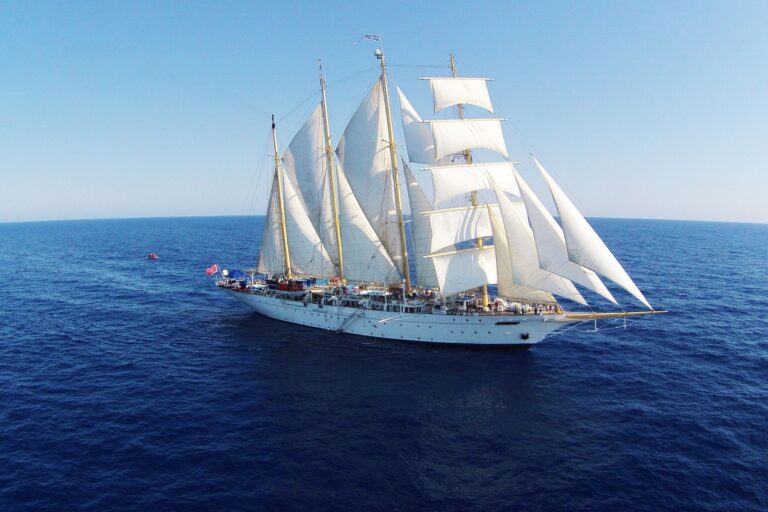
Against this backdrop, Star Clipper looked refined and graceful. Her four masts rose above polished teak decks and gleaming brass fittings, their web of rigging stretching skyward. I knew this wouldn’t be an ordinary cruise: the ship itself was as much a destination as the islands and ports I was about to visit.
A Nautical Beauty: Star Clipper
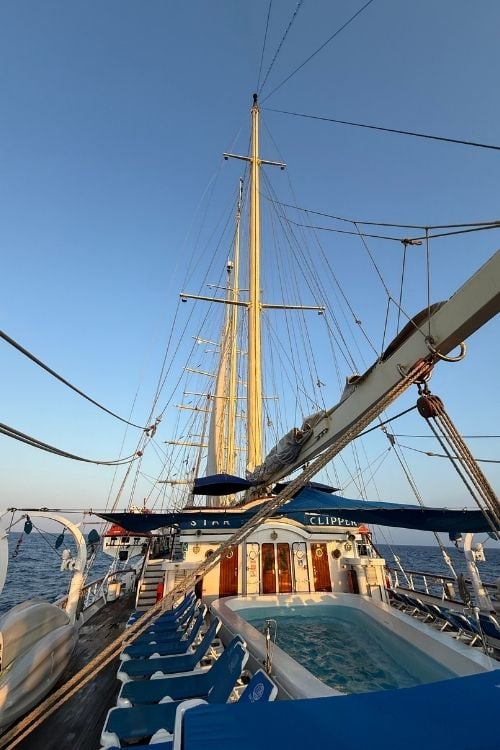
With a maximum of 166 passengers, the four-masted tall ship evokes the romance of great clipper ships while offering modern comforts.
There are no waterslides, Broadway extravaganzas or P.A. announcements directing you to the next activity. Instead, what you hear is wind filling the sails, halyards tapping the masts, and waves lapping against the hull.
Star Clipper’s square sails on the foremast and fore-and-aft sails on three other masts create an unmistakable silhouette at sea, recalling the tall ships I admired around Boston Harbor while growing up.
The journey began gently: late-afternoon boarding led to check-in and a relaxed dinner. Captain Yuriy Slastenin and cruise director Peter Kissner introduced themselves in three languages – English, French and German – reflecting the nationalities of the guests.
Peter’s opening talk was a precursor to his nightly updates and lectures, all of which kept us in tune with the ship’s itinerary. The biggest takeaway was that weather could easily change plans, and we should be as flexible as the ship itself.
Exploring and Making Friends
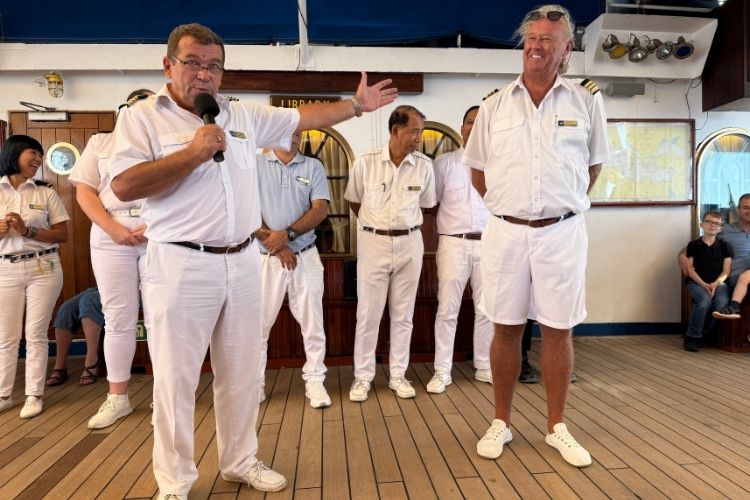
The next day was one of my favorites, a sea day. I welcomed the opportunity to explore the ship and meet the crew and fellow passengers.
Within a day, crew members greeted me by name. Restaurant servers remembered my favorite wine and how I took my morning coffee. My stateroom was refreshed seamlessly and frequently, another example of the attentive service onboard.
One of the pleasures of sailing aboard an international ship was getting to know travelers from around the world. Conversations flowed as easily as the sea breeze, whether over breakfast, during excursions, or with a pre-dinner cocktail at the Tropical Bar.
I helped raise the sails with new friends from Austria, compared tasting notes with the owner of a French vineyard, played backgammon with an English teenager who proved to be a formidable opponent, and met Italians who enthusiastically volunteered to help me plan my upcoming trip to Sicily and Sardinia.
Onboard Dining
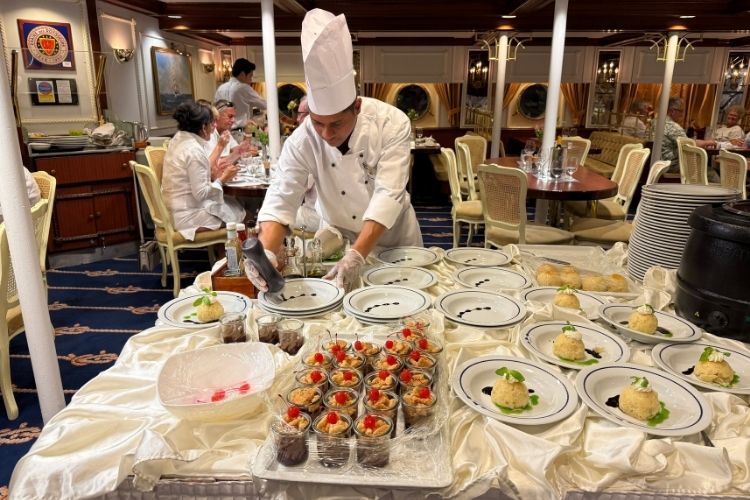
I started each day with sunrise yoga on the deck. A challenging balance practice due to the motion of the ship, the asanas left me invigorated and ready for breakfast.
Wady, our maître d’, was always ready with a smile and a latte. Eggs cooked to order, fresh fruit, pastries, and Greek yogurt were served in the handsome blue and gold Clipper dining room.
Themed lunch buffets ranged from Greek and Turkish fare to dishes from Asia and Italy.
Cocktail hour snacks were served in the Tropical Bar adjacent to the always-open coffee station. Sam, the music director, provided daily piano accompaniment there and later in the Piano Bar.
Dinner was a fine-dining occasion, elegant but not fancy, with international cuisine featured alongside Greek and Turkish specialties. Seafood, meat and vegetarian options changed each night, with a cheese course, salad and dessert to follow.
One night I feasted on tandoori chicken, the following on spiny lobster tail. A baked Alaska dessert or crème caramel was the perfect finale. The ship’s wine selection was impressive, with well-priced selections from around the globe.
Onboard Adventures
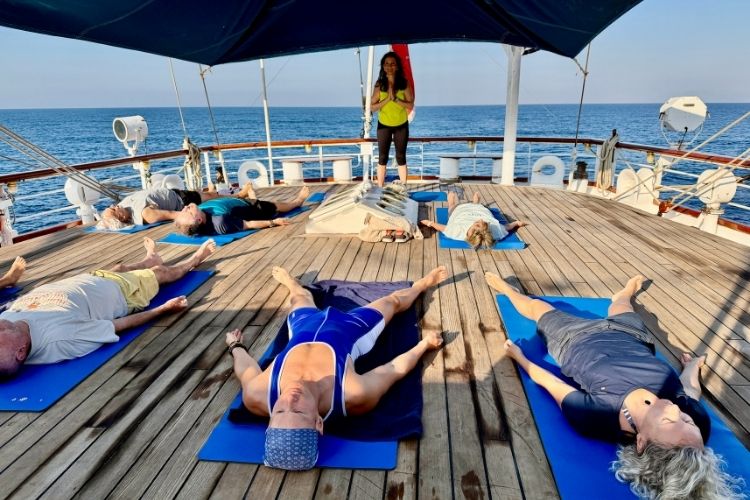
Beyond meal choices and yoga poses, Star Clipper also challenged me with adventurous experiences.
I had heard about climbing the ship’s mast. The idea reminded me of trapeze sessions I had done on other trips. But even after an Asian-inspired massage with Daisy to relax my muscles and nerves, I hesitated as I clipped into the safety harness and looked up the rope ladder.
The crew patiently guided each step. Slowly, rung by rung, I climbed to the platform near the top of the mast. My reward was an endless expanse of blue Aegean Sea stretching beyond the deck and rigging below.
Later I learned that the day’s increasing winds meant I had been the last climber before the activity was suspended.
Another “rush” entailed maneuvering into the bowsprit net with nothing but the sea beneath. This gave me a different perspective on the ship, especially with the sails billowing behind me.
Standing on deck at sunset with a glass of Champagne became another favorite ritual. Often timed with a sailaway to music by Vangelis, it was a perfect coda to each day, no matter how windy.
As darkness settled over the Aegean, the masts and rigging were illuminated in one of Star Clipper’s most cherished traditions.
First Stop: Santorini
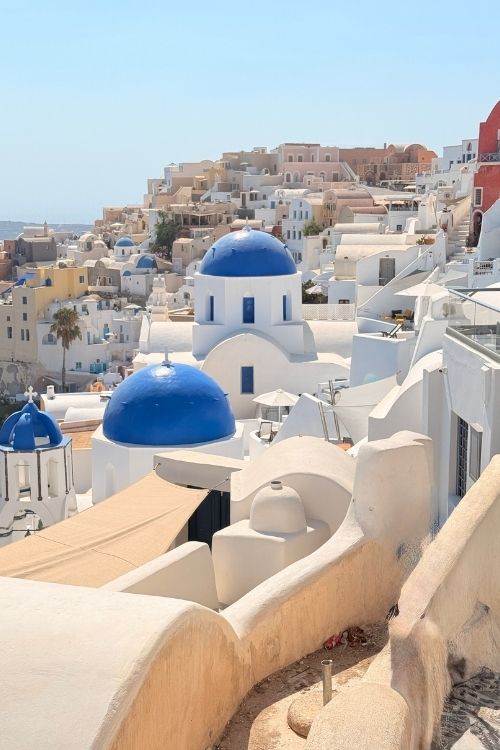
Image credit Meryl Pearlstein
Santorini sits in the southernmost portion of the Cyclades archipelago. Formed by an ancient volcanic eruption, the island is a spectacular crescent of rock encircling a water-filled caldera.
Sailing into this dramatic setting is a photographer’s dream, with white cubical buildings and blue-topped churches clinging to steep cliffs.
We began our visit to Santorini at the excavated archaeological site of Akrotiri. Often compared to Pompeii, this sophisticated Bronze Age settlement was buried beneath volcanic ash following an eruption around 1600 BC that altered Santorini’s landscape.
Preserved streets, multi-story buildings, storage jars and frescoes show a civilization that flourished more than 3,500 years ago. One curiosity begged further analysis: a “bathroom” contained side-by-side toilets. It did make you wonder.
The island’s volcanic past shapes its identity in another way as well, with its wines. I was already a fan of Santorini’s Assyrtiko, a crisp white wine that pairs well with seafood and vegetable dishes.
At a vineyard, I learned that Assyrtiko grapes thrive in the porous volcanic soil, made up of lava, pumice and ash. This soil retains moisture throughout the year and helps give the wine its distinctive saline finish.
Both Oia and Fira, the island’s two main towns, were jammed with tourists angling for the perfect photo or souvenir. After negotiating the crowds on pathways and staircases, it was a pleasure to duck into Hassapiko, also known as Marykay’s Bar, for yogurt with honey and a glass of wine before trekking to the cable car that descends to the harbor.
An Old Favorite: Rhodes
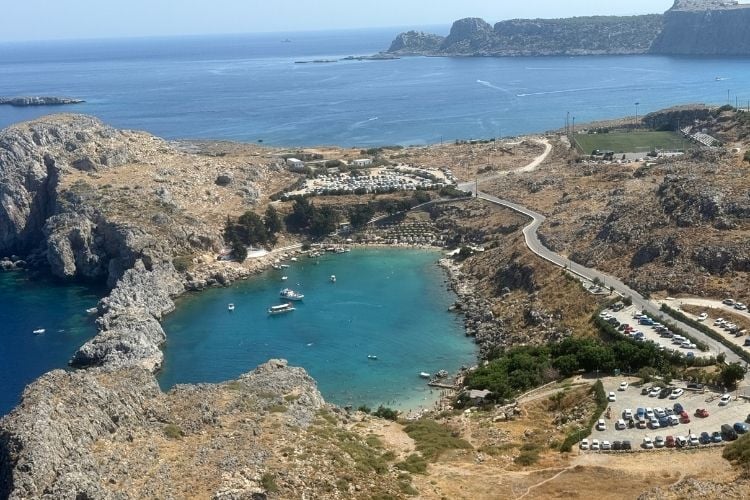
Our sailing route also brought us to the Dodecanese islands, to Rhodes, the island that had been my favorite from my earlier trip.
Lindos, a short drive from Rhodes Port, is the site of an imposing hilltop acropolis, with ruins dating from the 4th century BC. With some 350 uneven stone steps, this isn’t a climb for those with mobility concerns.
The twenty-minute hike begins through a covered market passage where residents sell lace and regional trinkets. Along the way, a relief of an ancient warship carved into rock appears beside the path, a reminder that sailors had followed these routes for more than 2,000 years.
Past this, a medieval castle and ruins of a Roman temple give a welcome break from the beating sun. At the summit, the remains of a Greek assembly hall, a stoa, define a grand portico once supported by 42 columns.
Panoramic views extend across the brilliant blue water of the bay below and the maze of streets spilling toward the sea.
Rhodes Old Town
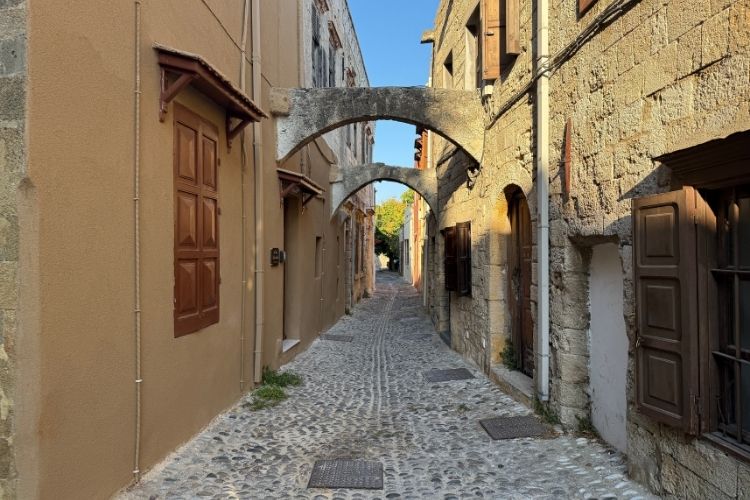
I cooled off with a glass of fresh pomegranate juice before heading to Rhodes’ UNESCO-listed Old Town. Surrounded by thick stone walls and a moat, with 11 massive gates, Rhodes’ medieval city was built over layers of Greek and Roman history and fortified against successive invaders.
Inside, narrow cobbled lanes twist into courtyards and lively squares that take on a souk-like feeling with restaurant and shop touts calling out enticing offers. Other areas, such as the Street of the Knights, are quiet and atmospheric, evoking images of crusaders who built their inns there.
Away from busy Hippocrates Square, near the ancient Jewish Quarter, I scored a coveted outdoor table at Hatzikelis Fish Taverna. Whole grilled fish, simply prepared and impeccably fresh, arrived alongside Greek potatoes, octopus and glasses of tsipouro, a traditional grape spirit with a kick reminiscent of Italian grappa. I sat among families and locals who quickly filled the remaining seats.
While Greek islands like Santorini and Rhodes bear the imprint of successive civilizations, Star Clipper’s Turkish port stops offered another perspective on the past.
Bodrum, Turkey
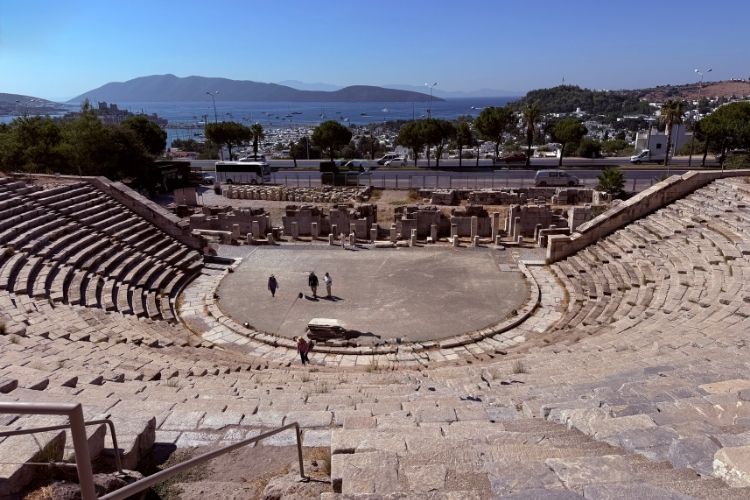
Bodrum, originally called Halicarnassus, has long been one of the eastern Mediterranean’s strategic crossroads. The imposing Castle of St. Peter, built by the Knights Hospitaller, stands guard over the harbor and is today home to the Bodrum Museum of Underwater Archaeology.
Nearby stood the Mausoleum at Halicarnassus, one of the Seven Wonders of the Ancient World, now reduced to scattered remains and rubble from a series of earthquakes.
Remarkably well-preserved, the Theatre of Halicarnassus began in the 4th century BC as a venue for Greek tragedies and comedies, later hosting Roman gladiator battles and animal fights. Looking across its rows to the marina dotted with luxury yachts, I could easily imagine why this site had been chosen.
Dalyan River
The second excursion took me to a less touristy side of Turkey.
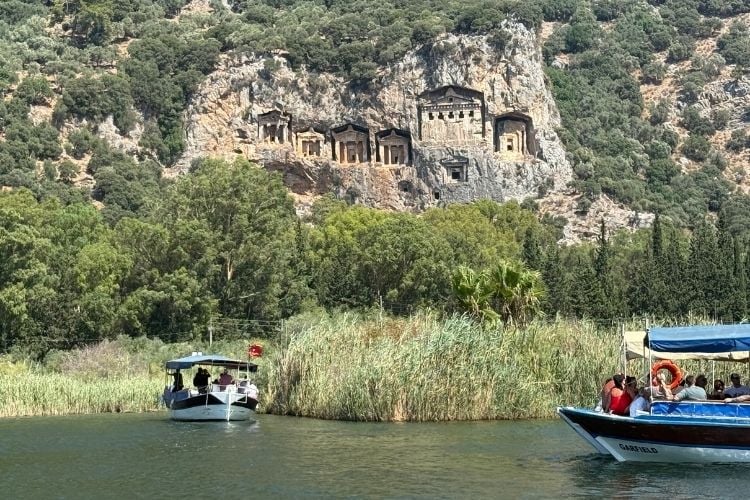
From aboard Star Clipper, I boarded a small riverboat to explore the tranquil Dalyan River, where Lycian rock tombs, carved into sheer cliffs more than 2,000 years ago, overlook the water.
The leisurely cruise wound through emerald reeds alive with birds before reaching the area’s therapeutic mud baths and sulfur-rich thermal pools. Happily slathered from head to toe in viscous gray mud, I looked like I had just emerged from Santorini’s volcanic eruption.
A few minutes later, after the mud had dried and begun to cake, I rinsed in warm mineral waters, hoping for the promised wellness benefit.
The excursion continued to Iztuzu (Turtle) Beach, a ribbon of golden sand separating the saltwater Mediterranean from the river delta. Popular among locals, the beach takes its name from the endangered loggerhead sea turtles that return each year to nest.
Changing winds delayed our return to the Star Clipper. Strong winds also made our scheduled call at Hydra impossible.
Charming Poros
Instead, Captain Yuriy set a new course for Poros. One of the Saronic Islands, Poros lies just southwest of Athens, separated from the Peloponnese by a narrow channel.
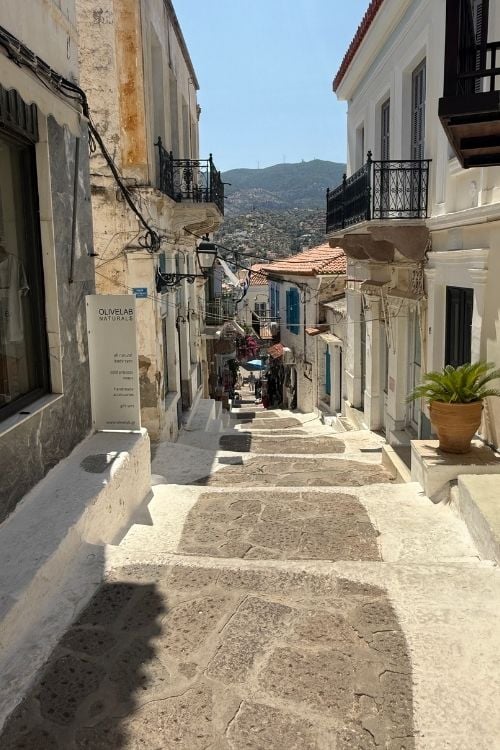
As Star Clipper entered Poros’s turquoise-blue harbor, whitewashed homes, red-tiled roofs and church domes climbed the hillside above the shoreline.
Poros Town’s lively promenade is lined with inviting shops and cafés. After browsing rows of breezy linen dresses and handmade leather sandals, I stopped for an invigorating Greek frappé, the country’s frothy iced coffee made with instant coffee, cold water and ice.
Away from the shore, I wandered into narrow streets that zigzagged upward through town, enjoying the morning’s relaxed tempo. Each turn revealed a local boutique, a flower-laden balcony or a view toward the harbor below.
The streets eventually led to the island’s most visible landmark, the Clock Tower, standing sentinel over the water.
The balance of the day was spent at Russian Bay Beach, a shady cove whose name recalls the Russian naval station established there during the 19th century. It was our only beach day in Greece, a relaxing afternoon spent among local families with water sports courtesy of Star Clipper.
The following morning brought one final gift.
Piraeus Sunrise
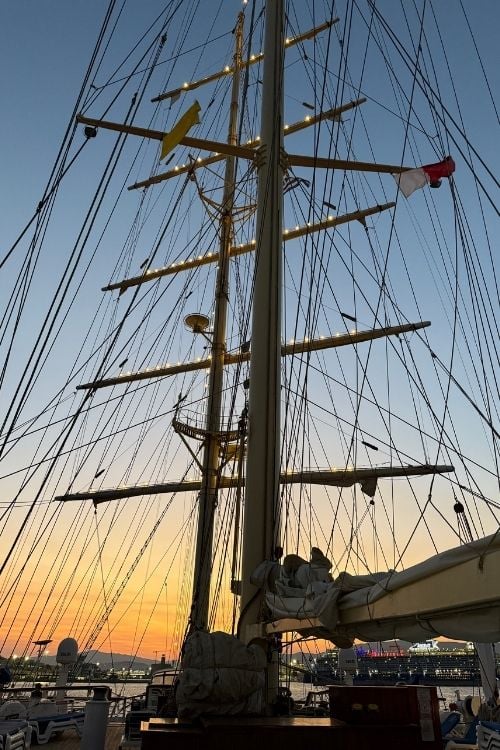
Before sunrise, I slipped quietly onto the deck as the ship approached Piraeus. I was alone except for the crew preparing for arrival at the harbor. The sea was calm, the air cool, and the first hints of daylight slowly illuminated the mountains surrounding Athens.
Beneath her four towering masts, Star Clipper glided smoothly into the harbor beside vessels many times her size. The city had barely awakened. In the silence of early morning, with only the sound of water against the hull and muffled instructions from the captain, it was easy to understand the enduring appeal of life under sail.
Need a hand planning your trip? Here are the sites and services we rely on most, from booking tools to travel products we love.
Inspire your next adventure with our articles below:
- 10 Best Places to Visit in Greece for an Unforgettable Trip
- Top 10 Things to Do in Rhodes, Greece: So Much More Than a Beautiful Beach Destination
Want to discover more hidden gems and helpful travel tips? Join our free newsletter for the latest travel secrets and travel articles.
We are reader-supported and may earn a commission on purchases made through links in this article.
- Sailing the Greek Islands: Rediscovering the Aegean Aboard Star Clipper - September 12, 2026
- Plitvice Lakes: Your Guide to Croatia’s Most Spectacular National Park - August 29, 2026
- Sailing the Amalfi Coast: Stunning Sights You’ll See With Star Clippers - October 9, 2025
Planning another trip soon? ✈️
Add GoWorldTravel.com as a preferred source on Google. Click the button below so our local guides, packing hacks, and hidden-gem itineraries always show up first when you search!
Add to Preferred Sources