

I boarded the puddle jumper plane for a 12-minute flight from St. Maarten to Saba; it was a race against time before sunset. The tiny commercial runway located on Saba’s jagged coast doesn’t have lights, making daylight landings mandatory.
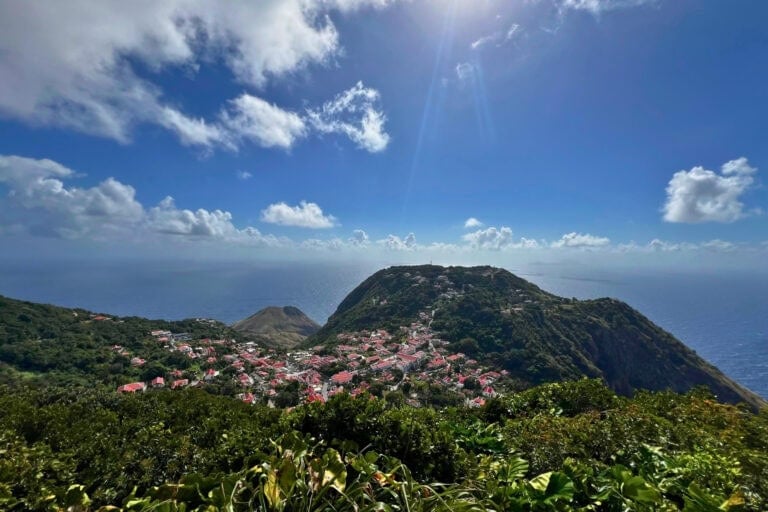
Sitting just behind the pilots, white-knuckled, crossing the Caribbean waters, we made our descent to the island of Saba with red roofs peppered along the island peaks.
It felt like less than a minute on the runway, and we disembarked with the sun setting just over the horizon, where I’d spend the next 6 weeks exploring this island with a population of around 2,000 people.
No Mass Tourism: Preserving Authentic Island Life
Unlike many Caribbean destinations, Saba has deliberately avoided mass tourism development, with no cruise ports that would bring overwhelming numbers of day-trippers and no large resorts that consume vast resources and alter the landscape.
Hence the name, “Unspoiled Queen of the Caribbean.” This approach allows for personalized experiences and significantly reduces environmental impact.
As climate change threatens Caribbean destinations, the tiny 5-square-mile Dutch island of Saba is pioneering innovative sustainability initiatives that could serve as a model for island communities worldwide.
This “Unspoiled Queen” of the Caribbean is working diligently to maintain its pristine environment while developing eco-conscious tourism approaches that preserve its natural beauty for generations to come.
Brief History of Saba

Saba’s rich history spans centuries of European colonization, cultural resilience, and adaptation to its unique geography. Here’s a timeline of key events:
Early History and European Contact
Saba was originally inhabited by Arawak and later Carib indigenous peoples. Christopher Columbus sighted the island in 1493, though he did not land there. The island’s name may derive from the Arawak word “Siba,” meaning rock.
The first European settlers were Englishmen who arrived in 1632, followed by Dutch colonists from the neighboring island of St. Eustatius around 1640. Despite the island’s seemingly inhospitable terrain with no natural harbors or flat land, these settlers established a permanent presence.
Colonial Period
Throughout the 17th and 18th centuries, Saba changed hands between the Dutch, English, French, and Spanish, with the Dutch ultimately maintaining control. Unlike other Caribbean islands, Saba never developed large-scale plantations due to its mountainous terrain.
The island became known for seafaring, with many Sabans becoming skilled sailors and captains. During the 18th and 19th centuries, Saba men frequently left the island to work on ships, while women developed the renowned “Saba lace” industry that brought income to the island.
Modern History

Saba remained part of the Netherlands Antilles until this entity was dissolved in 2010. On October 10, 2010, Saba became a special municipality of the Netherlands, maintaining direct ties with the Dutch government rather than gaining independence.
Today, Saba has evolved from its seafaring past to focus on sustainable tourism and education, with the establishment of Saba University School of Medicine bringing a new dimension to the island’s economy and culture.
Cultural Heritage
Saban culture represents a unique blend of Dutch, English, African, and Caribbean influences. The island’s isolation helped preserve distinct traditions, architecture, and even a unique dialect of English that contains elements of 17th-century British English.
Traditional Saban cottages with their red roofs and white walls remain an iconic symbol of the island’s architectural heritage. The community’s resilience in building a life on this challenging terrain has shaped a distinctive identity that continues to evolve while honoring its diverse roots.
Marine Conservation Success Story
Since establishing the Saba Marine Park in 1987, this small island has maintained one of the Caribbean’s healthiest reef systems.
Unlike many regional coral ecosystems struggling with bleaching and degradation, Saba’s marine environment thrives through strict protection measures, like no fishing in key zones to protect marine biodiversity and comprehensive coral reef conservation initiatives.
“The marine park’s success comes from community buy-in,” explains a representative from the Saba Conservation Foundation.
“Our no-fishing zones, mooring buoy systems, and dive site management have created a sustainable model where tourism and conservation coexist.” Youth education forms a cornerstone of Saba’s marine strategy.
Local students and interns from various universities in the Netherlands participate in regular educational programs that combine classroom learning with hands-on experiences.
These initiatives are creating a generation of conservation-minded citizens who understand the importance of protecting their island’s marine resources.
The dive industry, a critical economic pillar for Saba, has embraced sustainable practices. Operators like Sea Saba follow strict protocols that minimize impact while maximizing educational opportunities for visitors.
By limiting group sizes and emphasizing conservation during dive briefings, they’ve transformed underwater adventures into ambassadorship opportunities.
Terrestrial Conservation: Balancing Ecosystems and Heritage

On land, Saba faces unique conservation challenges. The island’s goat population presents a complex environmental dilemma that highlights the intersection of conservation necessity and cultural sensitivity.
While goats traditionally represent food security and cultural heritage for islanders, overpopulation has led to severe erosion, threatening both terrestrial ecosystems and downstream marine environments through sedimentation.
The government’s goat management program has sparked community conversations about finding a balance between environmental protection and cultural preservation.
Through education and stakeholder engagement, Saba is developing a nuanced approach that acknowledges both scientific imperatives and local values.

I often found myself living in a paradox. Having ‘bounty hunters,’ as I call them, came to the house I was staying at to ask if I had seen any goats.
This left me in a moral conundrum: do I snitch on the goats, which could lead to their removal for the sake of sustainability, or do I tell a half-truth that I hadn’t recently seen any goats to protect them?
“It’s not just about removing goats,” notes a local conservation officer. “It’s about helping the community understand how a managed approach benefits everyone, including protecting agricultural lands and preventing dangerous landslides that threaten homes and infrastructure.”
This transparent approach to addressing difficult conservation challenges demonstrates Saba’s commitment to finding sustainable solutions that respect both environmental science and community perspectives.
Trail System: Sustainable Tourism Infrastructure

Saba’s network of hiking trails represents another sustainability success story. The island’s 20+ trails provide low-impact ways for visitors to experience its spectacular landscapes while contributing to the local economy.
The Saba Conservation Foundation maintains these paths using methods that prevent erosion and protect native vegetation.
Volunteer trail maintenance programs engage both locals and visitors in conservation work to encourage regenerative tourism.
Every Thursday, I would join the team hitting the trails, learning about invasive species management, erosion control, and the importance of preserving Saba’s unique cloud forest ecosystem for locals and visitors alike.
The iconic Mount Scenery trail, which leads to the highest point in the Dutch Kingdom, exemplifies this balanced approach.
Carefully maintained steps and guidance on staying on designated paths help protect the sensitive cloud forest ecosystem while providing an unforgettable experience for hikers. You might also encounter a friendly local on the paths, who’s happy to chat your ear off and talk about the history of the island.
Renewable Energy Leadership

Perhaps Saba’s most ambitious sustainability initiative is its drive toward 100% renewable energy. The island’s 4MW Solar PV Park, combined with 14MWh Battery Energy Storage and 0.5MW Wind Energy project, represents a transformational approach to energy independence.
Key elements of Saba’s renewable energy transition include:
- Working toward becoming the first Caribbean island to achieve 100% renewable energy
- Solar panels that already supply a majority of the island’s power needs
- Dramatic reduction in reliance on imported fossil fuels
“This isn’t just about reducing carbon emissions,” explains a representative from the Saba Electric Company. “It’s about energy security, reduced costs for residents, and demonstrating that small islands can lead in climate solutions.”
The renewable energy project aims to generate enough power to supply the entire island for approximately 20 hours on most days, dramatically reducing dependence on imported diesel fuel.
This transition not only decreases Saba’s carbon footprint but also creates economic benefits by redirecting funds previously spent on fuel imports to local development initiatives.
Community-Led Sustainability: Art and Culture

Saba’s sustainability efforts extend beyond environmental conservation to embrace creative community development and cultural heritage preservation.
The innovative “Adopt-A-Box” project through the Sea and Learn Foundation transforms utilitarian electrical boxes into a walking art gallery that showcases the island’s history, culture, and natural environment.
Local artists have embraced sustainability in their creative practices as well. From jewelry crafted using natural materials and seeds from the island to clothing made from locally sourced fabrics, Saba’s creative community demonstrates how sustainability can be integrated into cultural expression.
The Sea and Learn Foundation exemplifies Saba’s holistic approach to environmental education.
They frequently host community events, beach cleanups, and educational opportunities that bring scientists, conservationists, and educators to the island to share knowledge with both residents and visitors.
Through workshops, field activities, and presentations, the program builds environmental awareness while creating meaningful connections between visitors and the local community.
Local, Low-Waste Living
Saba has implemented impressive sustainable living systems despite its small size. Experience farm-to-table agriculture, like the tucked-away Rendez-Vous at Ecolodge, with an on-island hydroponic farm that provides fresh produce.
There is strong support for local businesses and artists, with no large chains. Here you’ll be supporting local with unique gifts and experiences, including shops like Marie de Saba Jewelry and The Studio, offering hand-crafted and sustainably sourced materials from the island, like seeds and a variety of flora.
Waste Management Innovation
On an island where space is limited, waste management presents unique challenges.
Saba has implemented a comprehensive approach that emphasizes reduction, recycling, and responsible disposal. Educational programs in schools and community centers help residents understand proper waste sorting and reduction strategies.
The island’s commitment to sustainable waste management extends to visitors as well. Accommodations provide clear guidance on recycling practices, and tour operators enforce strict “pack it in, pack it out” policies for hikers and outdoor enthusiasts.
Water Is Precious
Saba’s entire water supply is dependent on rainfall: every house or business is outfitted with large containers (cisterns) that catch rainwater. When staying at a villa or cottage, keep water use to a minimum.
A Model for Island Sustainability

As Caribbean destinations face increasing environmental pressures from climate change and tourism development, Saba offers a compelling alternative model.
By prioritizing conservation, community involvement, and sustainable infrastructure, this tiny island demonstrates that economic development and environmental protection can be complementary rather than competitive goals.
For travelers seeking authentic experiences that support rather than exploit local environments, Saba provides a destination that aligns with the values of responsible tourism.
Each visitor dollar contributes to conservation initiatives, renewable energy projects, and community development efforts that preserve the island’s unique character.
Through its pioneering approach to sustainability, the “Unspoiled Queen” is proving that small islands can make a significant impact in addressing global environmental challenges.
As other destinations look for pathways toward more sustainable tourism models, Saba’s integrated approach offers valuable lessons in balancing economic needs, community values, and environmental imperatives.
In a region where tourism often comes at an environmental cost, Saba stands as a beacon of possibility—a demonstration that with vision, community engagement, and determined implementation, even the smallest places can lead the way toward a more sustainable future.
Getting There
Flights from Canada and the USA fly into Sint Maarten (SXM), or you can take a 90-minute ferry; however, it is only available on limited days and is subject to short-notice cancellations. The other option is a puddle jumper flight with 15 seats on WinAir.
It’s a ride of a lifetime, so make sure you sit in the front right of the plane, practically in the cockpit with the pilots. Since Saba has the smallest commercial runway, landing the plane is quick and may give you whiplash.
Secondly, flights are only available during daylight hours, so if you’re on the last flight of the day, hope you don’t have a delay or otherwise, you may need to spend the night in Sint Maarten.
Know Before You Go
Given the small island, a majority of food is imported from Miami, with shipments on Wednesdays when grocery stores will be stocking their shelves.
With that being said, products are taxed twice as they stop on the island of Sint Maarten, so be aware that some items carry a higher price. I paid $8 for a bag of rice and $12 for a jar of peanut butter (March 2025)
- English is the main language and Dutch and Spanish are widely spoken.
- USD is the main currency.
- Best time to visit: December to April.
- Getting around: there are a couple of taxi services and very limited rental cars; however, Juliana’s Hotel does offer a shuttle.
- Be sure to get travel insurance
- If you need help planning your trip, you can reach out to me
Where to Drink & Dine
- Brigadoons – great dinner spot with friendly and hospitable staff
- Colibiri – hosts evening events under a canopy of trees, and is great for grabbing a beverage
- Saba Snack (2 locations)
- Busy Bee Bakery – perfect for morning coffee and treats
Where to Stay
- Juliana’s Hotel & Tropics (has a film showing on Wednesdays on the history of the island)
- Novel Cottage
- El Momo Cottages
Need a hand planning your trip? Here are the sites and services we rely on most, from booking tools to travel products we love.
Inspire your next adventure with our articles below:
Author Bio: Erica Hanger is a travel writer, content marketer, and responsible travel advisor with a passion for sustainable travel and cultural preservation. With years of experience exploring off-the-beaten-path destinations, she specializes in crafting authentic travel experiences that benefit local communities while minimizing environmental impact.
Her work focuses on promoting responsible tourism practices, highlighting lesser-known destinations, and creating meaningful connections between travelers and local cultures. Through her writing and consulting services, she helps travelers plan immersive journeys that go beyond traditional tourist routes.
Want to discover more hidden gems and helpful travel tips? Join our free newsletter for the latest travel secrets and travel articles.
We are reader-supported and may earn a commission on purchases made through links in this article.

- Language Learning Travel Guide - September 12, 2026
- Safari Travel Guide - September 12, 2026
- Luxembourg City in 24 Hours: Essential Sights, Views and Cafés - September 12, 2026
Planning another trip soon? ✈️
Add GoWorldTravel.com as a preferred source on Google. Click the button below so our local guides, packing hacks, and hidden-gem itineraries always show up first when you search!
Add to Preferred Sources