
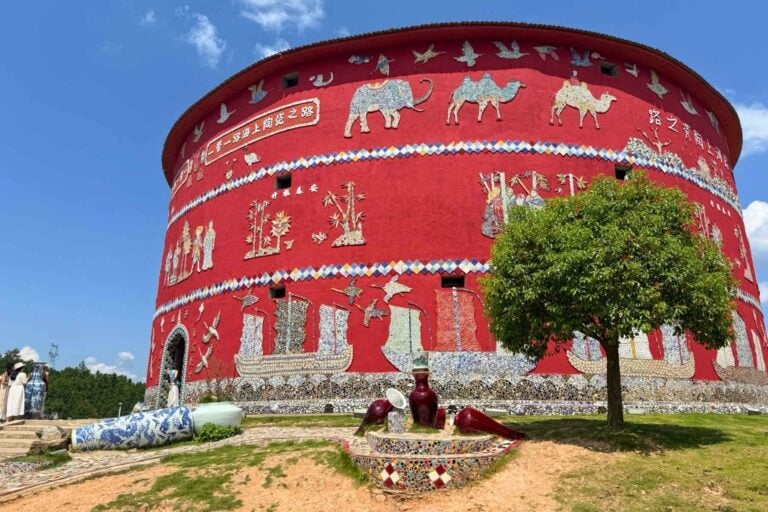
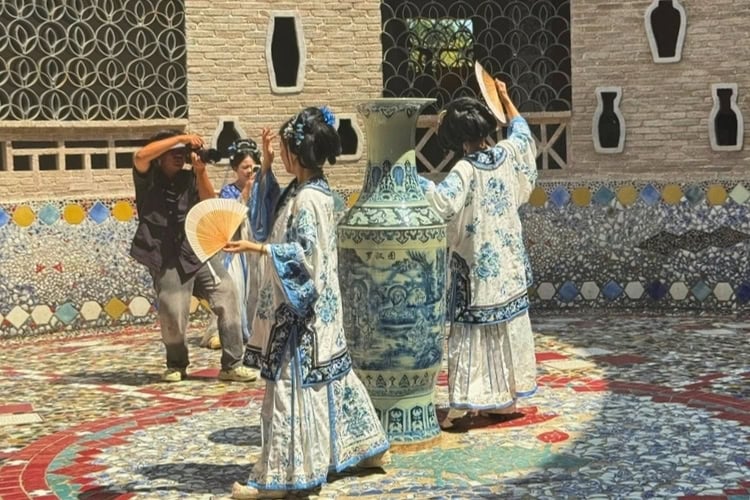
I’m standing in the open courtyard of a round building, gazing up at three stories of surfaces covered with mosaic—walls, pillars, doorways. In the center, young women in Ming Dynasty-influenced blue and white dresses and elaborate braided updos pose for photos beside a blue and white urn taller than they are.
It’s taken me three planes to get to Jingdezhen. But the Porcelain Palace is enough to take my mind off jet lag, lack of sleep and lost luggage.
Yu Ermei worked in the porcelain industry for 70 years. She started building this complex of elaborately mosaicked buildings in 2011 when she was 80. It took about six years and her life savings to complete, plus overcoming friction from family members who would have preferred the money be spent elsewhere.
“I drew all the porcelains inside this building,” the late artist said in a video shot in 2021, when she was 91. “The designs, all the things were done by me. There are 72 genres in the porcelain industry and I know all of them.”
Not only did I love the beauty of a building made with 60,000 pieces of ceramics and 80 tons of porcelain shards, I immediately developed a mad fangirl crush on this illiterate octogenarian who built a palace.
And that was just my introduction to Jingdezhen. I spent four days in the porcelain capital of the world, learning about this ancient art and finding out why Jingdezhen Handicraft Porcelain Industry Sites was inscribed on the UNESCO World Heritage list in 2026.
A Short Intro to Porcelain History at the China Ceramics Museum
From a porcelain perspective, Jingdezhen has it all: raw materials, kilns, master craftsmen and merchant associations. From the 10th to 19th centuries, Jingdezhen had profound influence on industry, art and trade in China and beyond. Its blue and white porcelain became a symbol of Chinese culture.
I visited the Jingdezhen China Ceramics Museum on my first full day in the city. The museum puts the thousand-plus-year history into chronological sequence.
My small group of Americans and one Canadian relied on Peter Zhu, the single English-speaking guide out of 100 guides at the museum. While porcelain aficionados come to Jingdezhen from around the world, the tourism is overwhelmingly domestic. The museum is packed on a Sunday morning with Chinese people of all ages raptly admiring and photographing historic porcelain pieces.
Peter explained the differences between porcelain and pottery, notably that kaolin is the special type of clay used to produce porcelain, which is then fired at a high temperature. We saw tall Yuan Dynasty vases depicting Mongolian and Islamic designs, made for export to Iran. Peter showed us a huge water jar decorated with dragons, “an old-school fire extinguisher,” and oil bowls designed to hold eternal flames at tombs.
Some of the porcelain had been pieced back together because emperors destroyed almost everything for being subpar. Emperors chose ten pieces they liked and had the rest smashed, Peter said.
We learned that porcelain isn’t just decorative, but carries a symbolic language. Fish symbolize wealth while deer mean harmony, longevity and high official rank. “These meanings embody the extensive and profound culture of China,” Peter told us.
When I saw a Tang Dynasty camel, a sense of recognition stopped me in my tracks. We have a very similar one in my town at the Portland Art Museum. Seeing this familiar object on its home turf gave me a new sense of connection.
Folk Vs. Royal Kilns
The emperor and his entourage got their fine porcelain from royal kilns. But commoners made do with dishes from folk kilns.
Folk Kilns at Raonan and Jingdezhen
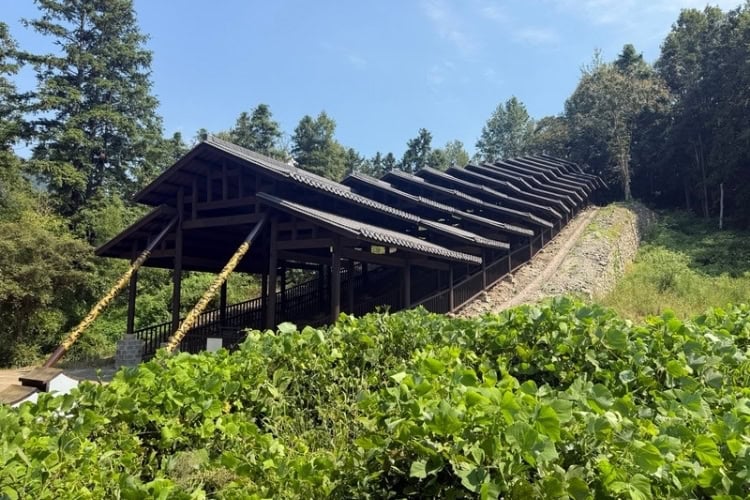
Our group visited a couple of folk kilns. At Raonan Outdoor Ceramics Museum about an hour northeast of Jingdezhen, we saw how early porcelain was produced with huge water-powered trip hammers rhythmically pounding porcelain stone into clay. There was a multi-chambered, thousand-year-old kiln—the style is called a dragon kiln—built up a hillside that could fire a massive amount of pottery in one go.
The Ancient Kiln Folk Customs Museum within Jingdezhen City is the best place to see artisans making porcelain using traditional methods. You can wander the tranquil paths, listening to soothing Chinese music piped in from hidden speakers and see porcelain pieces in all stages of production. Pots and bowls are drying everywhere in the sun.
For a small fee, I tried my hand at making a pot on a wheel—with a lot of help from the artisan. It was very wet and slimy, not easy to apply the right pressure, especially since he was ordering me in Chinese which had to be translated. Chinese tourists laughed and cheered me on as I destroyed my first attempt, started over, and eventually produced a simple bowl.
The Imperial Kiln at Taoyangli
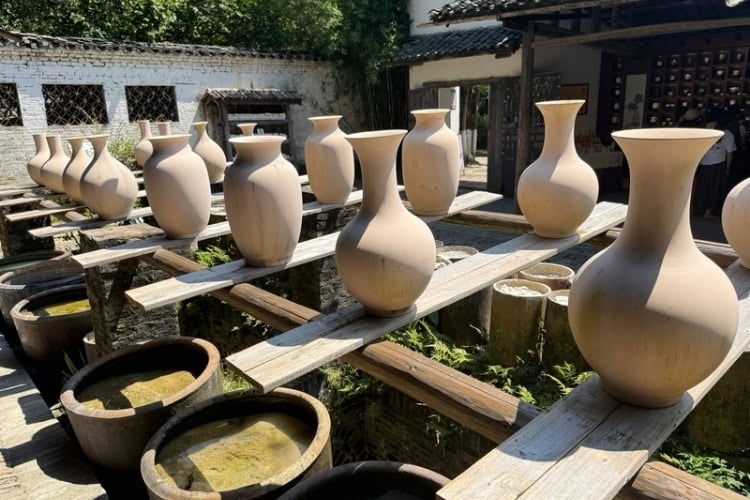
It’s a different story at the royal kiln. Guide Liu Yue—English name Yvonne—steered us through the old paths of the Taoyangli Historical and Cultural Tourism Area, where a royal kiln operated from 1369–1911. It was rainy and slick, so we tried not to slip on the kiln tears—bricks that overheated in the kiln, then liquefied and became glossy—mixed in with the rougher stones.
The royals were much fussier about their porcelain. There were certain patterns and symbols only royals could use, such as dragons. They owned yellow.
The grounds included a pagoda, archaeological dig, temple and the Jingdezhen Imperial Kiln Museum. Inside the temple, Yvonne showed us a statue of Tong, a real man in the Ming Dynasty who sacrificed himself by climbing inside a kiln so that the emperor wouldn’t punish his coworkers for subpar work. His bones made a perfect porcelain jar and now he is honored by Jingdezhen porcelain workers who know him as the Kiln God or the Immortal Master of Wind and Fire.
Outside the temple we contemplate June Mountain, a grassy hill with a pagoda on top. The “mountain” is built on discarded pieces of broken pottery rejected by the royals. Contemplating the historical differences between the haves and have nots helped me better understand the appeal of communism.
Porcelain Is Everywhere
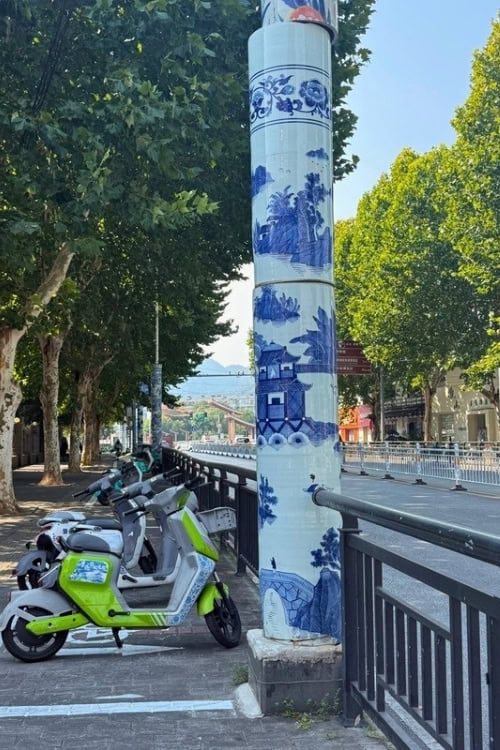
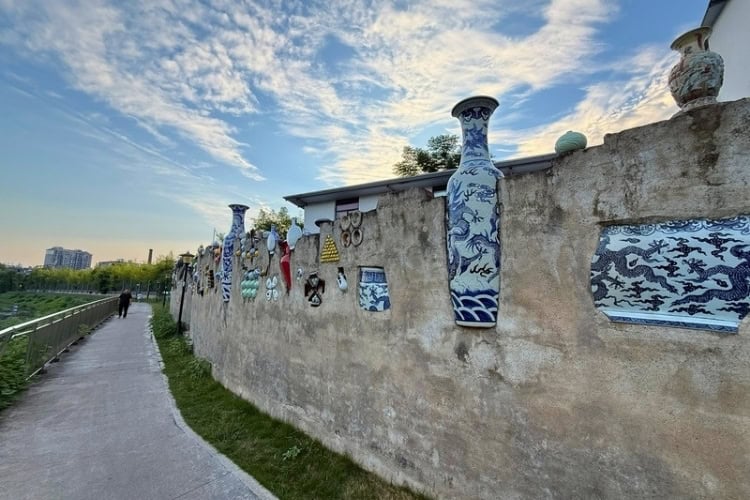
On my early morning walks in Jingdezhen, I found porcelain in unexpected places. As I walked amongst weeping willows along the Chang River just after sunrise, I came across a long section of wall embedded with porcelain urns, plates and shards. Another day, I noticed all the streetlights on a busy street were encased with round cylinders of blue and white porcelain.
A Living Craft at Taoxichuan
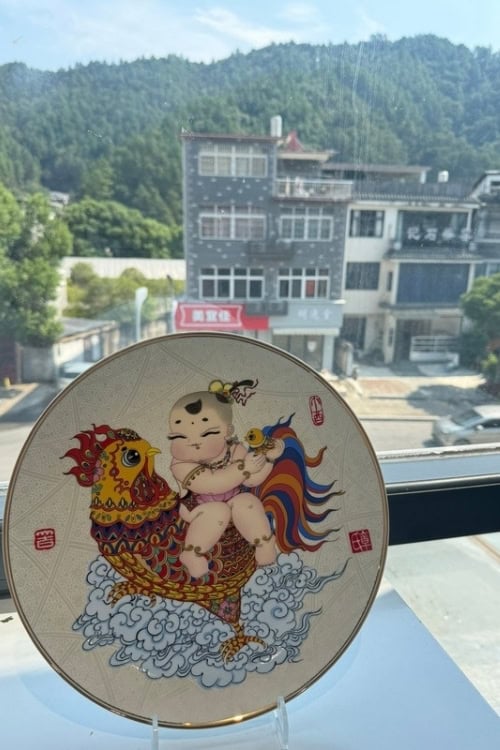
While many people visit Jingdezhen for its history, the porcelain craft is very much alive. One night we stroll the crowded Taoxichuan Ceramic Art Avenue, where young craftspeople make porcelain depicting cats, baked goods and cartoon characters, as well as more traditional motifs. Walking through downtown Jingdezhen, the night market and shops are full of work ranging from cheap and factory made to exquisite and expensive.
Zhang Chen, originally from Shangrao City, has lived in Jingdezhen for 22 years and attended Jingdezhen Ceramic University. He’s a leading artist, curator and teacher who works with artists who come to Jingdezhen from all over the world. “I love this city because our career focuses on ceramics,” he said. “That’s my whole life, being a ceramic artist and designer.”
Porcelain is the life of the city. And now that it has a new UNESCO status, the world will be hearing more about it.
For more, read Uzbekistan’s Silk Road Cities: From Tashkent’s Markets to Samarkand’s Registan.
If You Go
There aren’t international flights to Jingdezhen, so if you’re visiting from outside of China, you’ll need to connect through a domestic hub like Beijing, Shanghai or Guangzhou. Avoid checking luggage, especially if you have a tight connection. Unlike many US carriers, Chinese carriers won’t deliver your lost luggage to your hotel, adding extra layers of inconvenience and complexity to reclaim your stuff.
I stayed at the Taoyi Wangnan Hotel, which was very convenient for shopping and walking by the river. The room was spacious and I especially liked my window seat overlooking the street below.
Tea lovers should take a side trip 30 kilometers southeast of Jingdezhen to Hanxi Village. You can try teas at a tea shop and walk through the terraced tea plantation. It’s beautiful and green and you’ll feel far from any city.
March through June are typically the rainiest months, while May through September are the hottest. It was pretty hot and sweaty during my September trip.
An English-speaking guide is extremely helpful if you don’t speak Chinese. Translation apps on smartphones also help.
Need a hand planning your trip? Here are the sites and services we rely on most, from booking tools to travel products we love.
Inspire your next adventure with our articles below:
- Exploring Nanjing, China: 48-Hour Trip That Changed My Perspective
- 14 Must-Know Tips for Easier, Stress-Free International Travel
Author Bio: Teresa Bergen is a Portland, Oregon, USA-based writer specializing in outdoors, eco, vegan and sober travel. She also enjoys branching into culture and history, such as checking out the Jingdezhen porcelain scene.
Want to discover more hidden gems and helpful travel tips? Join our free newsletter for the latest travel secrets and travel articles.
We are reader-supported and may earn a commission on purchases made through links in this article.

- Jingdezhen, China’s Porcelain Capital: Kilns, Museums and the Porcelain Palace - November 5, 2026
- Skyros: The Authentic Greek Island You’ve Never Heard Of - November 5, 2026
- Fort Lauderdale’s New Era: The Best Places to Stay, Eat, and Explore Around Pier Sixty-Six - November 4, 2026
Planning another trip soon? ✈️
Add GoWorldTravel.com as a preferred source on Google. Click the button below so our local guides, packing hacks, and hidden-gem itineraries always show up first when you search!
Add to Preferred Sources