
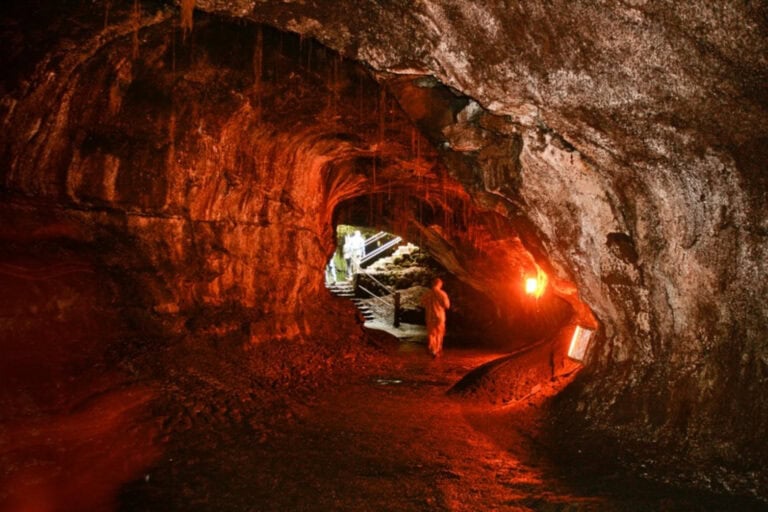
As a child, I was afraid of the dark. Confined spaces didn’t thrill me either. Decades later, as I peer into the black mouth of a cave on Hawaii Island, I discover that some fears have remarkably long memories.
“Don’t worry,” my husband, Brent, says reassuringly. “I’ve heard the only things living in these caves are tiny crickets.” I inch closer to his heels. “And they’re eaten by blind spiders,” he responds. I inch even a little closer.
Officially known as the Island of Hawaiʻi, Hawaii Island is the largest and youngest of the main Hawaiian Islands, a place where active volcanoes, black-lava landscapes, rainforests and beaches reveal an extraordinary story of creation.
Hawaii is usually experienced in brilliant sunshine, on palm-fringed beaches, along rainforest trails and from volcanic overlooks. But some of Hawaii Island’s most fascinating landscapes are hidden beneath our feet.
How Lava Tubes Form
The island is riddled with lava tubes, underground passageways created during volcanic eruptions. As rivers of molten lava flow, their exposed surfaces cool and harden while liquid lava continues traveling beneath the crust. When the eruption ends, or the lava is diverted elsewhere, it can leave behind an empty subterranean corridor.
Over the course of our visit, we’re exploring three very different examples, beginning with an easy introduction and gradually venturing into darker, rougher and decidedly more adventurous territory.
For someone with a fear of darkness, enclosed spaces and spiders, it’s an interesting travel plan.
An Introduction to Hawaii’s Underground World
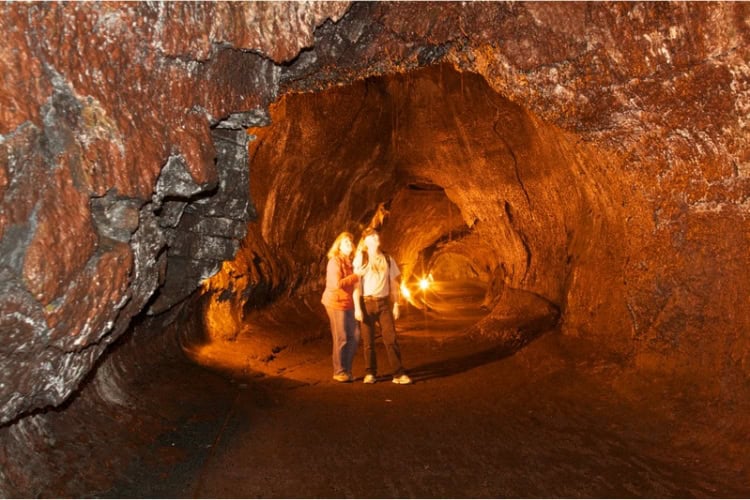
Our initiation takes place at Nāhuku, the lava tube long known as Thurston Lava Tube, in Hawaiʻi Volcanoes National Park.
The transition couldn’t be more dramatic. One minute we’re surrounded by a lush Hawaiian rainforest, with enormous tree ferns arching over the trail. The next, we’re descending into a tunnel created by one of the most powerful forces on Earth.
Nāhuku was formed roughly 500 years ago during an eruption of Kīlauea. Molten lava once surged through this passageway at temperatures of around 2,000 degrees Fahrenheit. Today, it’s considerably more welcoming.
During regular daytime hours, lights illuminate much of the cavern, revealing the smooth and sculpted surfaces left behind by the lava. The established trail also makes this a relatively gentle introduction to Hawaii’s subterranean world.
Safety in Numbers
We’re certainly not alone. Nāhuku is one of Hawaiʻi Volcanoes National Park’s popular attractions, and other visitors make their way through the tunnel with us.
I don’t mind. There’s safety in numbers.
The experience also provides a fascinating lesson in the forces that created these islands. Lava tubes function almost like arteries, carrying molten rock away from an eruption beneath an insulating hardened crust. When the supply eventually stops and the remaining lava drains away, the hollow tube remains.
Standing inside one, it’s difficult to comprehend that the quiet passageway surrounding us once carried a river hot enough to melt almost anything in its path. At the end of the illuminated section, Brent looks toward the darkness.
“How about we keep going?”
A few adventurous souls are heading farther into the shadows. I look at them. I look at Brent. Then, without answering, I head toward the stairs and the welcoming Hawaiian sunshine.
Apparently, my transformation into a fearless spelunker will take a little longer.
Deeper Into the Darkness
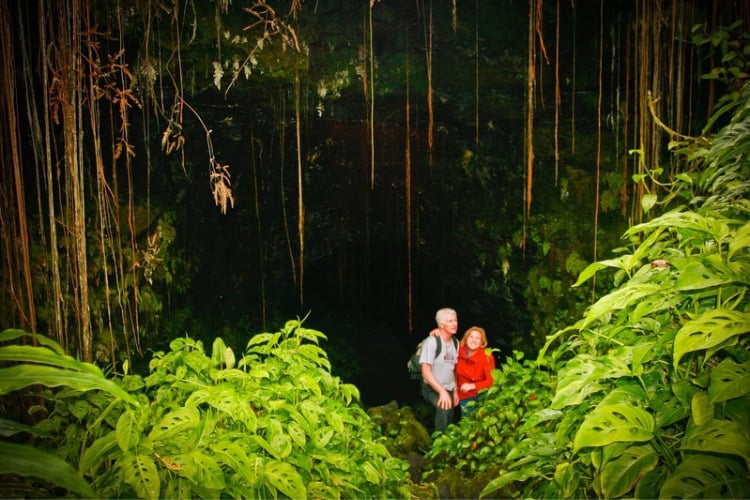
Our next underground encounter is Kaumana Cave, near Hilo. This one immediately feels different. There are no illuminated pathways waiting below. Instead, a stairway descends through dense vegetation toward dark openings created when part of the lava tube’s ceiling collapsed.
Kaumana is associated with the enormous 1880–81 Mauna Loa eruption, when lava travelled toward Hilo for months before the flow finally stopped short of the town. Hawaiian history and culture are intertwined with the story.
Princess Ruth Keʻelikōlani famously travelled toward the advancing lava flow and appealed to Pele, the Hawaiian volcano deity, as Hilo faced the threat of destruction.
Standing above the cave entrance, though, I’m concentrating less on history and more on the two black openings below. To me, they resemble a pair of enormous eyes staring back from the earth, their edges fringed with dangling vines.
“That’s just a welcoming wink,” Brent says.
Easy for him to say. This time, however, I’m prepared. The flimsy sandals are gone, replaced by sturdy shoes, and I have a flashlight firmly in hand.
We Descend
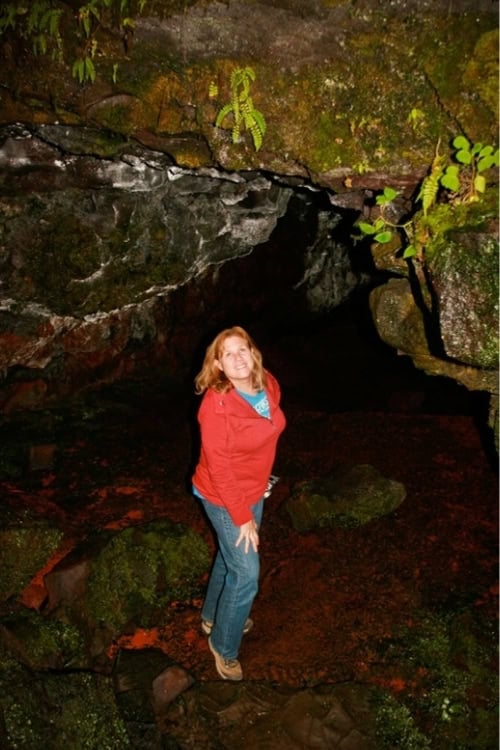
Almost immediately, the easy stroll of Nāhuku is replaced by something far more adventurous. The terrain is uneven and the darkness much more complete. We scramble over hardened lava, duck beneath low ceilings and squeeze through narrow passages. Our flashlight beams skim across walls shaped by flowing magma, revealing textures and formations invisible from the surface.
The farther we travel, the more my apprehension gives way to fascination. This isn’t simply a cave. It’s a frozen river of lava. Every ripple and curve provides evidence of movement. Some surfaces are smooth and flowing; others are rough and jagged. We’re walking through the aftermath of an eruption that helped shape the island itself.
And somewhere along the way, I stop thinking about spiders. Almost.
Pele’s Underground Palace
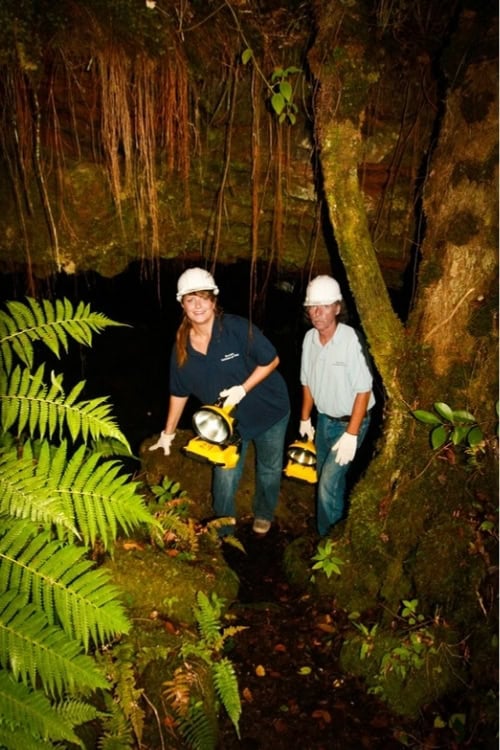
By our third cave experience, I’m feeling considerably more confident.
Which, as it turns out, is useful.
Our final underground adventure takes us into a privately operated lava-tube system near Kurtistown, south of Hilo. At the time of our visit, it was known as Kīlauea Caverns of Fire and offered guided tours into a sprawling subterranean landscape.
There were several levels of adventure. The most ambitious involved hours underground, protective gear, ladders, scrambling over rubble and squeezing through openings that looked barely wide enough for a human body.
“Are you game?” Brent asks.
Absolutely.
For the shorter tour.
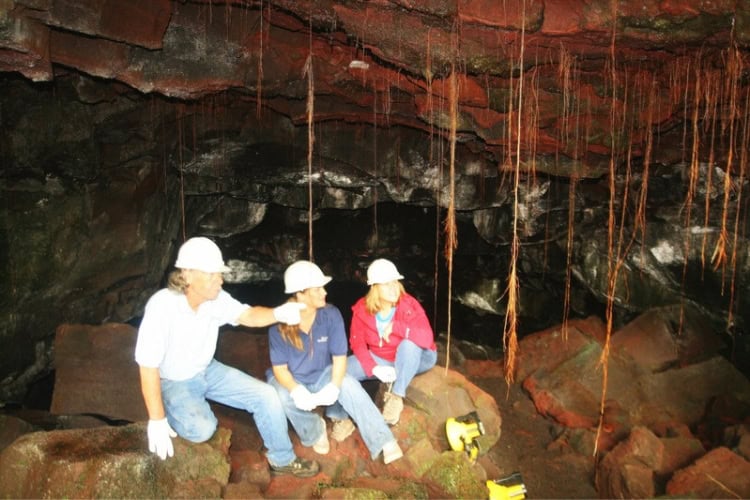
Hard hats secured and lights switched on, we descend once again from tropical greenery into darkness. This time, though, I don’t hesitate. The beam from our lights reveals an underground gallery created entirely by volcanic forces.
Some formations hang overhead. Others rise from the floor or appear to have been frozen in mid-flow. Reds, burnt ochres, copper tones, blues and silvery shades mingle across the rock like an underground palette.
The lava itself takes on dramatically different personalities. There’s rough, razor-edged ʻaʻā and smoother pāhoehoe, its surface appearing folded and swirled as though the molten rock had been suddenly turned to stone.
Nature has sculpted familiar-looking forms as well. One smooth slab reminds us of an enormous tongue. Jagged projections resemble a bed of nails. Cracks and ripples create patterns that look almost too deliberate to have been made without human hands.
The Line We Didn’t Cross
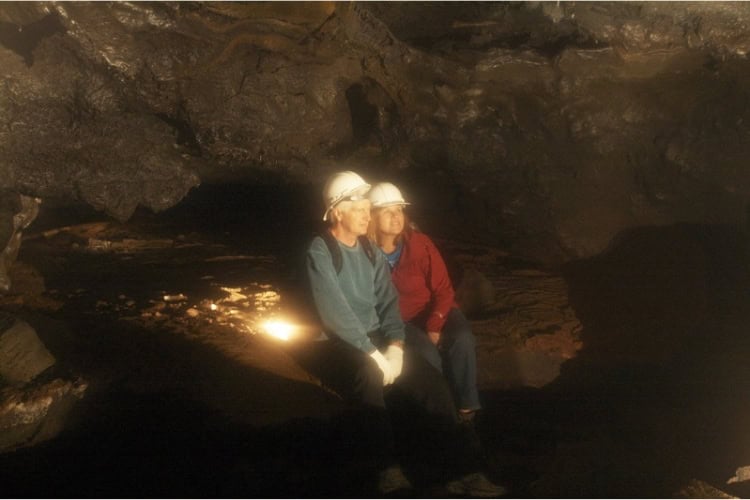
Yet everything around us was created by heat, pressure, movement and time.
Eventually, a narrow channel leads toward another chamber. To continue, we’d have to crouch low and maneuver beneath wicked-looking projections hanging from the ceiling.
Brent looks at me. I look at the opening. I’ve conquered the darkness, scrambled over lava and squeezed through narrow passages. There’s no need to get carried away. We stay where we are. From our rocky perch, I switch off my light for just a moment.
Darkness envelops us. There are no palm trees down here. No turquoise waves, tropical cocktails or golden beaches. Instead, we’re surrounded by the very substance that built Hawaii Island, lava that once travelled beneath the earth as a glowing river before cooling into the silent passageways we’re exploring today. It’s a side of Hawaii that most visitors never see. And perhaps that’s what makes it so extraordinary.
When we finally emerge into daylight, the familiar tropical world seems almost startlingly bright. I take one last look toward the darkness behind us.
Three caves later, I’m still not ready to call myself a spelunker. But I’ve discovered that sometimes the most memorable way to experience an island isn’t to look toward the horizon.
It’s to look beneath your feet. And, happily, I haven’t seen a single spider.
Top Picks
Nāhuku (Thurston Lava Tube): Located within Hawaiʻi Volcanoes National Park, about 30 miles southwest of Hilo. The lava tube is open 24 hours and is normally illuminated from 8 a.m. to 8 p.m. Parking is extremely limited, so early morning or late afternoon visits are recommended. Park admission applies, but no separate reservation is required for Nāhuku. Check current park conditions before visiting, as volcanic activity, construction and other conditions can affect access.
Kaumana Cave: Located just outside Hilo, Kaumana offers a much less developed lava-tube experience. Bring a reliable flashlight or headlamp and wear sturdy footwear. The cave floor can be wet, slippery and uneven. Visitors should explore only as far as their abilities and conditions safely allow.
Guided lava-tube tours: Private guided cave experiences and availability can change, so travelers interested in a more adventurous underground excursion should check current Hawaii Island tour offerings before their trip. Guided tours can be a good choice for visitors who want to explore beyond easily accessible public lava tubes. Some highly rated guided options:
- This Hawaii Volcanoes National Park and Hilo day tour walks you through Nāhuku alongside the park’s other highlights, with round-trip transport included.
- This Big Island in a Day tour pairs a stop at the Thurston Lava Tube with waterfalls and historic Hilo sightseeing.
If You Go
Getting there: The Island of Hawaiʻi is served by two main airports: Hilo International Airport (ITO) on the east side and Ellison Onizuka Kona International Airport at Keāhole (KOA) on the west. Because of the island’s size and the distances between attractions, renting a car is the most convenient option for independent travelers.
More information: Visit the official GoHawaii tourism website for Hawaii Island travel planning and the National Park Service website for current Hawaiʻi Volcanoes National Park conditions, closures, fees and visitor information.
Need a hand planning your trip? Here are the sites and services we rely on most, from booking tools to travel products we love.
Inspire your next adventure with our articles below:
- When to Visit Hawaii: Complete Guide to Seasons, Weather and Crowds
- Which Hawaiian Island is Best to Visit? A Guide to Hawaii
Author Bio: Since 1996, while freelancing, Jane Cassie has had thousands of articles published. Her stories have appeared CNN Magazine, Northwest Travel, New York Daily News, Chicken Soup For The Soul, Dreamscapes, Air Canada In-flight, Cottage Life, Epicure and Travel, just to name a few. She has been a regular contributor to Spa Life, INNspire, North American Inns Magazine, Cottage, and Inspire Magazines.
Want to discover more hidden gems and helpful travel tips? Join our free newsletter for the latest travel secrets and travel articles.
We are reader-supported and may earn a commission on purchases made through links in this article.

- Inside Hawaii Island’s Lava Tubes: Nāhuku, Kaumana and a Guided Cavern Near Hilo - September 13, 2026
- 18-Day Colombia Road Trip Itinerary by Bus or Car - September 13, 2026
- Language Learning Travel Guide - September 12, 2026
Planning another trip soon? ✈️
Add GoWorldTravel.com as a preferred source on Google. Click the button below so our local guides, packing hacks, and hidden-gem itineraries always show up first when you search!
Add to Preferred Sources