


Standing on Edinburgh’s Royal Mile, in the heart of Old Town, I felt as if I had wandered into a place I had long known.
I took a moment to absorb the surroundings. The cobbled streets lined with worn stone buildings, hidden closes, and shopfronts that seemed untouched by time all stirred a strange sense of recognition.
And that’s when it struck me.
Long before I booked a flight to Scotland, I had already wandered through versions of Edinburgh through the pages of books I had loved for years.
Standing there, I knew this wasn’t going to be a trip spent following landmarks. I wanted to experience the city that had inspired generations of writers and readers like me.
A City Built Like a Novel
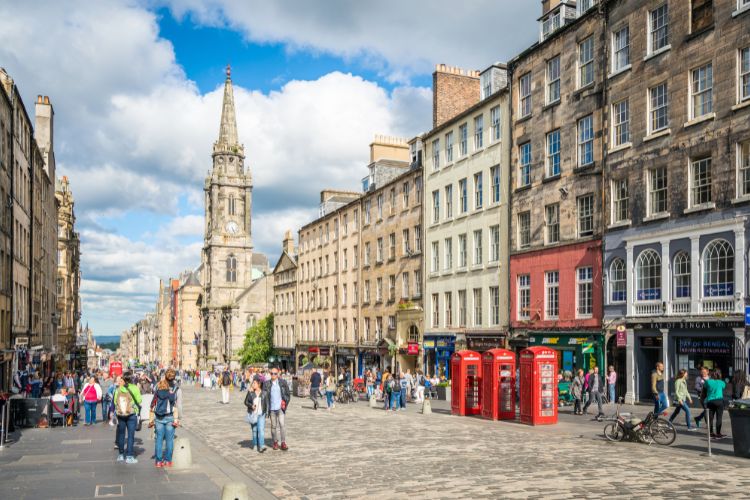
The Royal Mile feels like the opening chapter of Edinburgh. It’s where many first-time visitors begin, but it only hints at what lies beyond the busy thoroughfare.
Before long, I found myself leaving the crowds behind and slipping into the narrow closes that branch off the main street. I never knew what waited at the end of each one.
Some opened into quiet courtyards hidden between centuries-old buildings. Others led down steep stone staircases or into narrow lanes where the sounds of the Royal Mile seemed to disappear altogether.
I kept following them, curious to see where each one would take me.
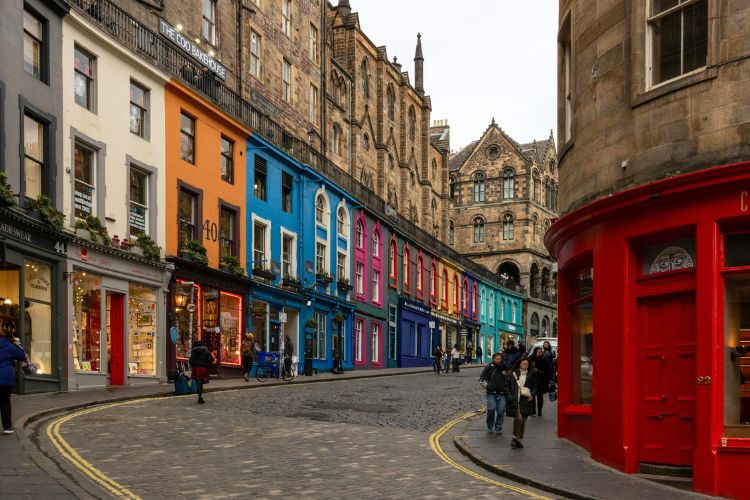
Eventually, my wandering brought me to Victoria Street, where the muted greys of Edinburgh’s Old Town suddenly gave way to one of the city’s most vibrant streets.
The narrow cobbled street curved downhill between tall stone buildings, while an upper terrace overlooked cafés and independent shops tucked around every corner.
With the street disappearing around the bend ahead of me, it wasn’t difficult to understand why visitors compared it to Diagon Alley from the Harry Potter series.
Cafes and Gravestones
I slipped into a quiet café, pulled out my notebook, and tried to capture some of that magic on paper. Somewhere between writing, watching people pass outside and another cup of coffee, I lost a few hours of my afternoon.
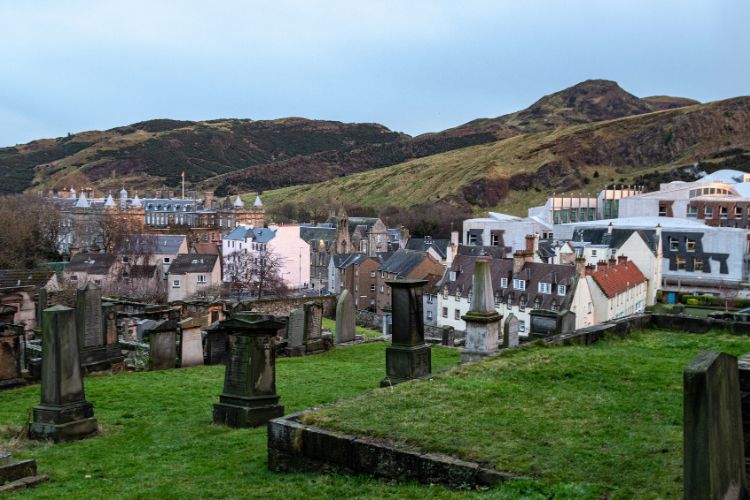
I then continued towards a more planned detour into Greyfriars Kirkyard. Within minutes, the bright shopfronts and busy cafés had given way to weathered gravestones, dark stone walls and paths winding beneath old trees.
Gravestones leaned at odd angles, many of their inscriptions worn almost smooth by time. Around the edges of the cemetery, elaborate tombs stood behind iron gates. I wandered slowly between them, reading names and wondering about the lives that had ended here.
Standing among the weathered gravestones, it felt like the kind of place where stories naturally take root.
Finding Peace in Dean Village
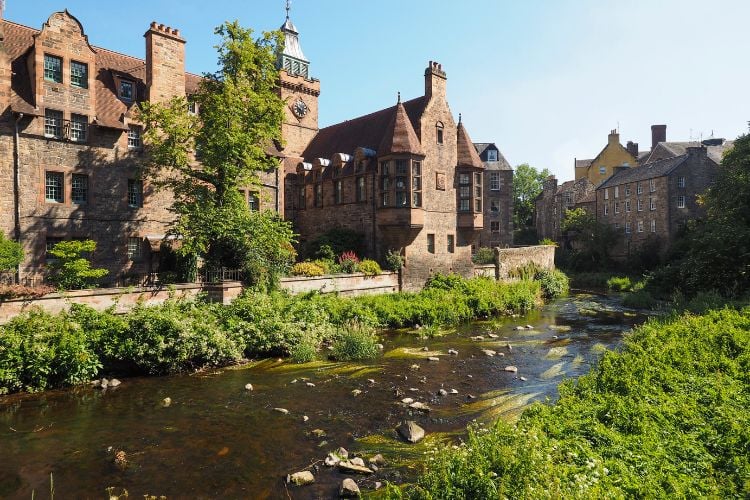
After hours of wandering Edinburgh’s busy streets, I was ready for a quieter side of the city. Dean Village offered exactly that.
Once a bustling milling community, it now feels wonderfully removed from the rest of the capital. The Water of Leith flowed quietly past old stone cottages, and for a few peaceful minutes, it felt as though the rest of Edinburgh had simply disappeared.
I finished the day on Calton Hill as the evening light settled across the rooftops, church spires, and castle. Around me, people had gathered quietly to watch the sun sink behind the skyline, conversations fading as the city was bathed in soft golden light.
Before I’d visited a single literary landmark, the city itself had already captured my imagination.
Tracing Edinburgh’s Literary Trail
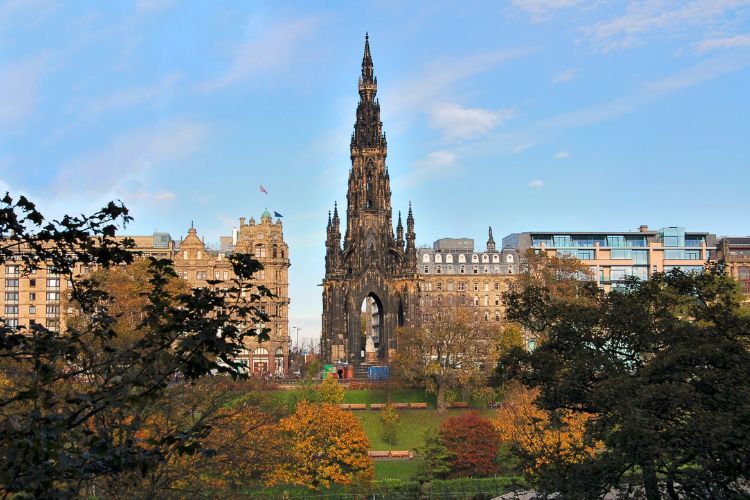
Edinburgh’s literary identity extends beyond a single writer or era. However, few figures stand out as much as Sir Walter Scott.
Rising above Princes Street Gardens, the Scott Monument is one of the largest monuments in the world dedicated to a writer, making it a natural starting point for anyone following Edinburgh’s literary trail. Climbing its narrow spiral staircase offers one of the city’s best views.
Not far from the monument, the Writers’ Museum brings together the stories of Scott, Robert Burns, and Robert Louis Stevenson. Inside, I found myself lingering over handwritten manuscripts, portraits, and well-worn personal belongings that bring Scotland‘s literary giants surprisingly close.
Just outside, Makars’ Court can be easy to overlook at first. Then I looked down and noticed the paving stones beneath my feet were filled with quotations from Scotland’s poets and playwrights.
As I wandered through the courtyard, one in particular made me smile: Robert Louis Stevenson’s words, “There are no stars so lovely as Edinburgh street lamps.“
The night before, I had admired the city’s softly glowing street lamps. It seemed Stevenson had simply found the perfect words for a feeling I’d only just begun to understand.
Back on the streets, the literary trail continued effortlessly. Sherlock Holmes stood near Arthur Conan Doyle’s birthplace, while across the city, characters from Kidnapped seemed to have wandered off Robert Louis Stevenson’s pages and onto the pavement.
Edinburgh doesn’t hide its literary history behind museum doors. Its writers rise above the skyline, their words appear beneath your feet, and their characters turn up on street corners. Soon, simply walking through the city becomes part of the literary trail itself.
Where Edinburgh’s Literary Story Continues – The Contemporary Scene
Today, Edinburgh’s literary legacy lives on in the libraries, independent bookshops, and well-worn pubs where readers discover new voices and writers continue to gather.
Libraries: Where the City Still Comes to Read
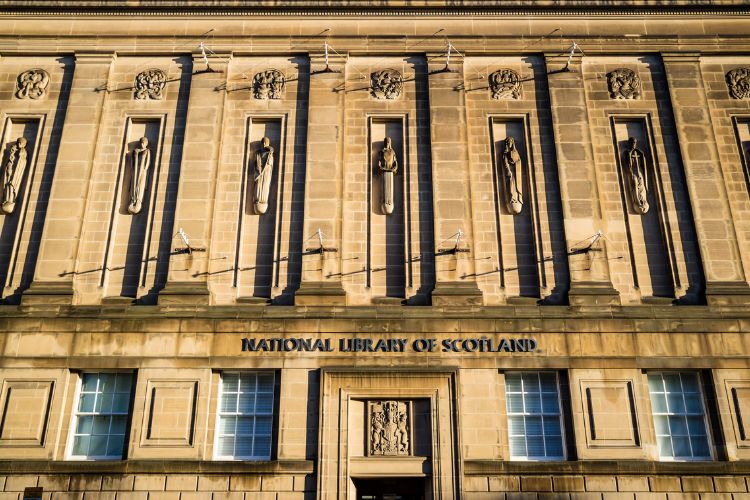
Edinburgh’s literary heritage isn’t confined to its monuments. At the National Library of Scotland, centuries of literary history sit side by side, from Shakespeare’s First Folio and a Gutenberg Bible to the papers of modern Scottish writers. Nearby, the Scottish Poetry Library celebrates the country’s lasting poetic tradition, inviting readers to discover both classic and contemporary voices.
Yet not every Scottish story began on the page.
For centuries, tales were passed from one generation to the next through spoken word, long before they were written down. The Scottish Storytelling Centre keeps that tradition alive today.
Listening to a personal essay there gave me goosebumps. The pauses, laughter, and emotion in the storyteller’s voice brought the story to life in a way the printed page never could.
Bookshops: Getting Lost Among Edinburgh’s Shelves

Image by Anne-Cécile Robert from Pexels via Canva
Nestled in quiet streets and historic buildings, Edinburgh’s independent bookshops invite readers to spend an afternoon browsing, not knowing what they’ll find.
I certainly didn’t expect to spend an entire day moving between them, but somewhere between one bookshop and the next, the hours quietly slipped away.
My own wanderings began at Armchair Books, where towering shelves, narrow aisles, and the unmistakable scent of old books made every corner feel like a discovery.
Just a short walk away, McNaughtan’s Bookshop, Scotland’s oldest second-hand bookshop, specializes in rare and antiquarian books. Beautifully bound editions and old maps of Edinburgh lined the shelves. Through an adjoining gallery, I found Typewronger Books, which shifted focus from rare editions to LGBTQ+ literature, writing on sex and sexuality and works by marginalized authors.
The afternoon continued at Rare Birds Book Shop, Scotland’s only bookshop devoted entirely to women’s writing. Every shelf celebrated female voices, and I found it impossible to leave empty-handed, picking up two books to take home.
A little further on, Lighthouse Bookshop offered another perspective, with socially conscious and politically engaged books that challenge ideas and spark conversations.
By the end of the day, it was clear to me that Edinburgh’s literary soul isn’t built around one genre, one writer, or even one way of reading. Whether you’re looking for a rare first edition, queer fiction, women’s voices, or just a quiet corner to browse, Edinburgh has a shelf waiting for you.
Literary Pubs: Where Stories Spill Beyond the Page
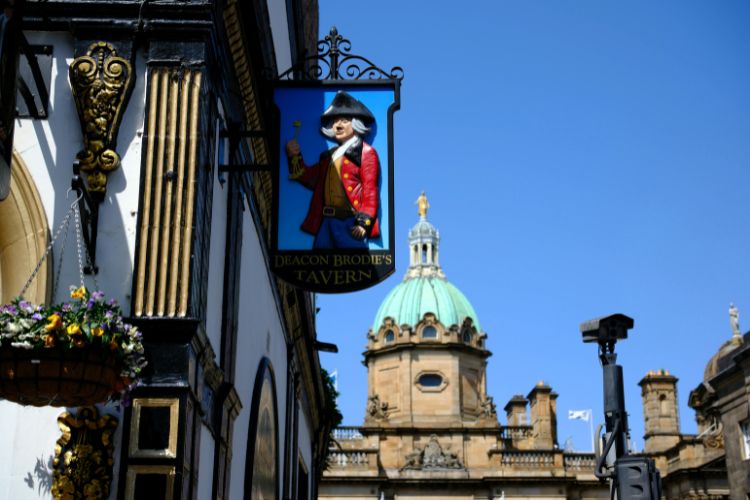
After a day spent wandering bookshops, I headed to The Oxford Bar to meet a friend who studies in Edinburgh.
What started as a conversation between us soon grew to include the people sitting nearby. Before long, we were swapping book recommendations, favorite Scottish authors, and stories of the places we’d discovered around the city.
The Conan Doyle Tavern pays tribute to the Edinburgh-born creator of Sherlock Holmes. Meanwhile, Deacon Brodie’s Tavern recalls the remarkable double life of William Brodie, whose story inspired Robert Louis Stevenson’s The Strange Case of Dr Jekyll and Mr Hyde.
By the end of the evening, it felt impossible to separate Edinburgh’s literary history from its everyday life.
Here, stories aren’t confined to bookshops or libraries. They continue over coffee, at pub tables, and in conversations with complete strangers. Edinburgh doesn’t just celebrate famous books. It makes you want to keep reading.
The City That Celebrates Reading
Every August, Edinburgh shows that its greatest chapter is still being written.
During the Edinburgh International Book Festival, readers, writers, and book lovers gather for talks, debates, and book signings, while emerging voices share the stage with some of the world’s most celebrated authors.
This year’s theme, Changing Your Mind, feels particularly fitting in a city where ideas have always mattered as much as stories.
For a book lover, there may be no better time to visit. Between events, you might browse the festival bookshop with a freshly signed copy tucked under your arm, settle into a nearby café to start reading it, or spend far longer than planned discussing an idea you’ve just heard.
Throughout the festival, it feels as though the whole city is reading alongside you.
Reflections
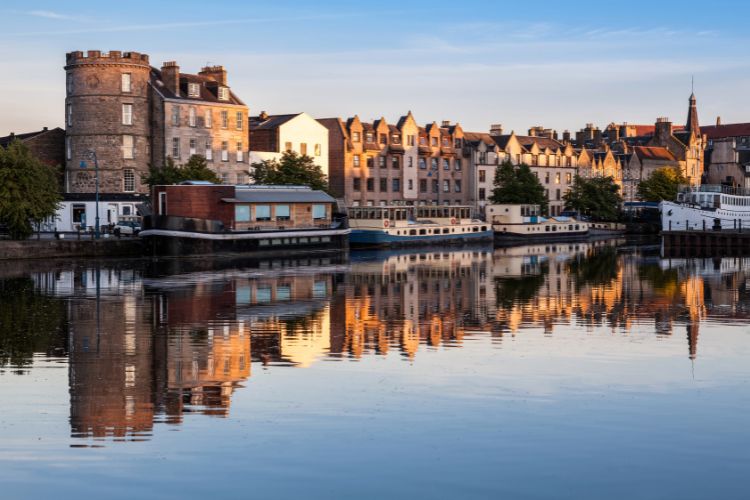
By the time I left Edinburgh, the city no longer felt like a place I knew only through the pages of books. I had wandered the streets that sparked my imagination, followed the traces of writers who left their mark here, and seen how deeply books remain part of everyday life.
I hadn’t arrived in Edinburgh looking for its literary soul. The city led me to it, one street, story, and unexpected literary monument at a time.
Perhaps that’s what makes Edinburgh so special for book lovers: its literary soul isn’t found in any one writer, landmark, or book, but in the way the city quietly turns every walk into another story worth taking home.
If You Go
Follow the literary trail:
The Edinburgh Literary Pub Tour sends two actors leading small groups through the wynds and pubs of the Old and New Towns, bringing Scott, Stevenson and Edinburgh’s other literary figures to life along the way.
Where to stay:
- The Radisson Collection Hotel, Royal Mile Edinburgh sits within walking distance of the Royal Mile, Grassmarket and Victoria Street, putting most of this route right outside the door.
- The Witchery by the Castle occupies a 16th-century building on Castlehill, just steps from the castle esplanade, with gothic suites that lean into the same sense of history running through Edinburgh’s streets.
What to read first:
- For readers who want the history behind the wandering, Edinburgh: Literary Lives & Landscapes traces the city’s literary connections from Stevenson and Scott through Muriel Spark and Irvine Welsh.
- Robert Louis Stevenson’s Kidnapped sends young David Balfour through the same closes and wynds explored here, written by the man whose words are underfoot in Makars’ Court.
- Ian Rankin’s Knots and Crosses introduces Inspector Rebus, the fictional regular whose favorite watering hole is the very real Oxford Bar.
Need a hand planning your trip? Here are the sites and services we rely on most, from booking tools to travel products we love.
Inspire your next adventure with our articles below:
- Scotland’s 5 Most Epic Destinations: From Monster Hunting to Fairy Tales
- Experience the Magic of Scotland’s Isle of Skye
Author Bio: Shivika is a UK-based writer and Editor-in-Chief of the student-led publication Empoword Journalism. Currently travelling across Asia and Europe on a gap year, she is particularly interested in stories that explore the intersection of travel, culture and literature.
Want to discover more hidden gems and helpful travel tips? Join our free newsletter for the latest travel secrets and travel articles.
We are reader-supported and may earn a commission on purchases made through links in this article.

- El Nido, Philippines: The Islands I Came For, the People Who Made Me Stay - September 30, 2026
- A Guide to Noodles in Vietnam: How to Slurp Like a Local - September 30, 2026
- Travel Guide to Japan - September 29, 2026
Planning another trip soon? ✈️
Add GoWorldTravel.com as a preferred source on Google. Click the button below so our local guides, packing hacks, and hidden-gem itineraries always show up first when you search!
Add to Preferred Sources