

Prague and Budapest are not overrated. That is part of the problem.
They are beautiful, storied and entirely worth seeing, which is exactly why so many travelers have tried to see them at once. In the busiest corners, wonder can start to feel pre-written. The bridge, the castle, the ruin bar, the river view. Beautiful, yes. But also photographed so often that the experience can begin to feel like standing in line for someone else’s memory.
That does not mean travelers should avoid Prague or Budapest. It means the region deserves a wider lens.
Why Look Beyond Capitals
Eastern and Central Europe are full of cities where history is not less present, only less packaged. Places where old stone still belongs to daily life, where coffee is not only a lifestyle prop, where empires left marks without turning the whole city into a theme park. These are cities with layered architecture, complicated histories, strong food traditions and enough beauty to justify a trip, but not so much international attention that they have been flattened into a single postcard.
They are not “undiscovered.” People live there. People love them. People have been building, grieving, rebuilding, arguing, praying, eating, and making art in them for centuries. The better way to think of them is this: they still have room to breathe.
For travelers who want the history and atmosphere of Europe without the crowd crush, Sarajevo, Plovdiv, Brașov, and Košice make a compelling case for looking beyond the usual circuit.
1. Sarajevo, Bosnia and Herzegovina
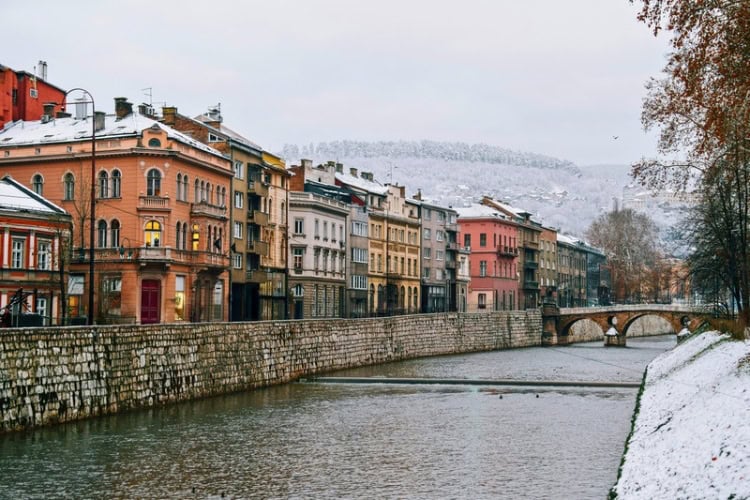
What makes it distinctly itself: Sarajevo is where Ottoman lanes, Austro-Hungarian facades, and 20th-century rupture meet in a city that refuses to become simple.
How to get there: Fly into Sarajevo International Airport, which sits just outside the city. Travelers already moving through the Balkans can also reach Sarajevo by bus from cities such as Mostar, Dubrovnik, Split, or Belgrade, though overland travel in the region often takes longer than the distance on a map suggests.
Sarajevo is not a city to rush through for pretty views, though it has plenty of them. It is a city that asks for attention. Walk its center and the architecture seems to change mid-stride: Ottoman bazaar streets, Austro-Hungarian buildings, minarets, church towers, synagogues, scars from the siege, and the ordinary rituals of modern life all folded into the same valley.
That density is what makes Sarajevo so powerful. It is one of Europe’s most layered cities, but it does not present its history as a clean sequence of eras. Instead, everything feels close together: faith and empire, assassination and war, resilience and coffee, grief and hospitality.
The place to begin is Baščaršija, Sarajevo’s old bazaar and historic heart. In Kazandžiluk, the old coppersmith street, the city becomes wonderfully tactile: copper coffee sets hanging in shopfronts, hammered trays catching the light, the ritual of Bosnian coffee feeling less like a café trend than a civic inheritance. It is a small detail, but it helps explain the city. Sarajevo’s past is not only something you read on a plaque. It is worked by hand, poured into cups, and carried into the present.
Travelers should resist the urge to treat Sarajevo only as a tragedy site. Yes, the city carries immense historical weight. But Baščaršija reminds visitors that Sarajevo is not only a place where history happened. It is a place where life continues with warmth, stubbornness, and style.
One thing that justifies the trip: Walk from Baščaršija to the Latin Bridge, then continue along the Miljacka River. It is a short walk physically, but historically enormous. Few European strolls compress so much: Ottoman Sarajevo, Habsburg Sarajevo, the place tied to the assassination of Archduke Franz Ferdinand and the beginning of World War I, and the modern city moving around it all.
2. Plovdiv, Bulgaria
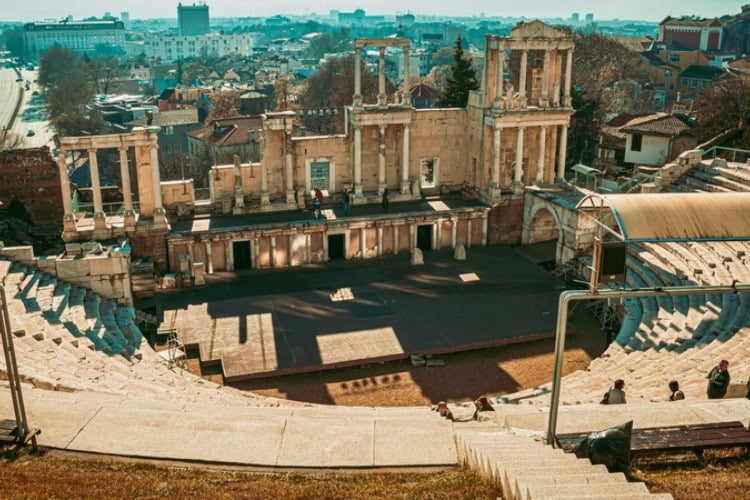
What makes it distinctly itself: Plovdiv feels like an ancient city that never stopped being lived in.
How to get there: The easiest route is through Sofia, Bulgaria’s capital. From Sofia, buses to Plovdiv are frequent and usually take about two hours, while trains are also available and can be a slower but scenic option.
Plovdiv is the kind of city that makes the word “underrated” feel lazy. It is not lacking in beauty, history or cultural confidence. It is lacking only the level of international shorthand that makes a city instantly recognizable to travelers who have never been there.
That may not last. Plovdiv has been gaining attention, and for good reason. It has Roman ruins in the middle of town, a colorful old quarter, a lively arts district, and the kind of layered urban texture that makes wandering feel productive. Unlike some ancient cities where the past sits behind glass, Plovdiv lets antiquity interrupt the everyday. Roman stones are not distant. They are part of the route to dinner.
The Ancient Theatre of Philippopolis is the obvious star and sometimes obvious things are obvious because they are worth it. Built into the hillside, the theater still feels alive rather than fossilized, especially when used for concerts and performances. From the seats, the city opens below and the Rhodope Mountains hover in the distance. It is hard not to feel that Plovdiv understands something many more famous cities forget: old places do not have to choose between preservation and pulse.
Beyond the theater, leave time for Kapana, the city’s creative district. Its name means “the trap,” which feels appropriate in the best way. This is the kind of neighborhood where a traveler can turn a corner and feel the city loosen its collar: murals, small galleries, design shops, tables spilling into narrow streets, and the easy hum of people who seem to be using the district rather than simply posing inside it.
One thing that justifies the trip: See a performance at the Ancient Theatre if the schedule allows. Visiting ruins in daylight is worthwhile, but sitting in an ancient theater while it is being used for art again changes the experience. It stops being only a monument and becomes a living room for the city.
3. Brașov, Romania
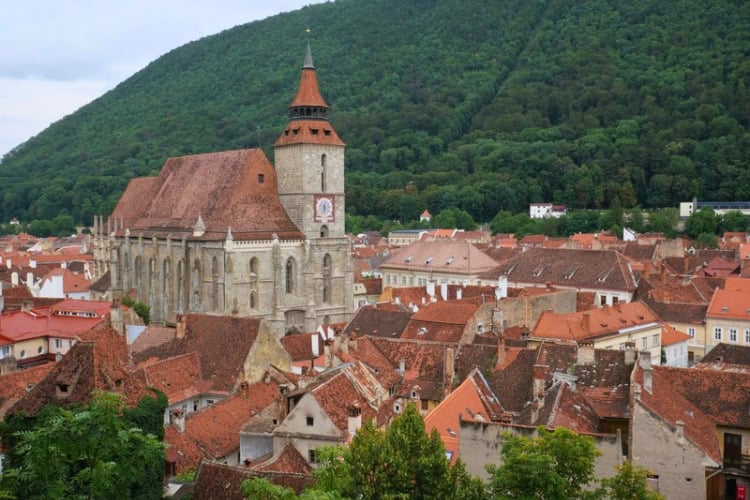
What makes it distinctly itself: Brașov is the Transylvanian city that gives you Gothic stone, Saxon streets, and a green mountain wall in the same glance.
How to get there: Most travelers arrive through Bucharest, then continue by train to Brașov. The rail journey is generally around 2.5 to 3 hours, depending on the train. Brașov also works well as part of a longer Transylvania itinerary with stops such as Sinaia, Sighișoara, or Sibiu.
Brașov has the kind of beauty that sounds almost too neat on paper: medieval square, Gothic church, mountain backdrop, cobbled lanes, pastel facades. In a less interesting city, that combination could tip into storybook excess. But Brașov has enough texture to keep it grounded.
This was a Saxon city, a fortified trading center and a crossroads in Transylvania, and that history still shapes the old town. Council Square gives travelers the postcard version first: tidy, colorful, and framed by the Black Church and surrounding hills. But the better experience comes from drifting into the side streets, where the city feels less polished and more lived in.
The Black Church is Brașov’s anchor. Its scale changes the mood of the old town, pulling the eye away from the cafés and souvenir shops toward something older and heavier. Stand in Council Square long enough and the city’s prettiness starts to rearrange itself. The pastel buildings are charming, yes, but the dark church and the forested slope of Mount Tâmpa keep the scene from becoming too sweet. Brașov is beautiful, but it is not delicate.
Brașov is also a useful corrective to the lazier version of Transylvania travel. Yes, Bran Castle is nearby, and yes, many visitors come looking for Dracula. But Brașov deserves better than being treated as a staging ground for vampire kitsch. Its real appeal is not horror. It is atmosphere: mountain air, medieval geometry, and the sense that the Carpathians are not scenery but part of the city’s personality.
One thing that justifies the trip: Take the cable car or hike up Mount Tâmpa for the view over Brașov’s old town. From above, the city’s shape makes sense: red roofs, church towers, defensive walls, and the forest pressing close on every side. It is the kind of view that explains why people keep romanticizing Transylvania, even when the real place is more interesting than the myth.
4. Košice, Slovakia
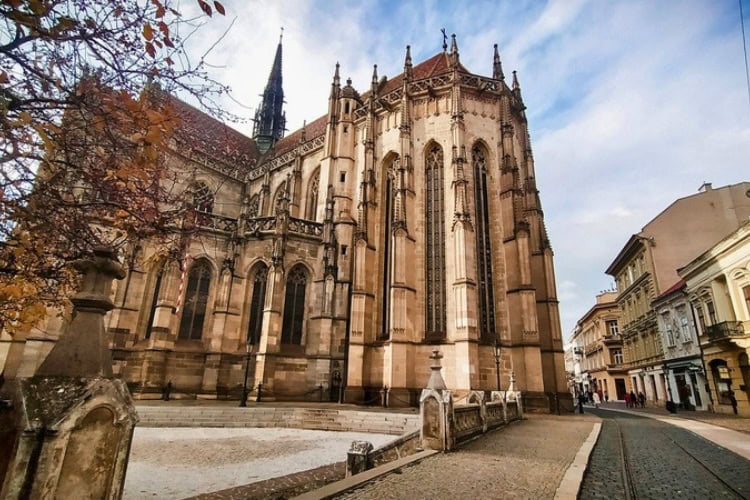
What makes it distinctly itself: Košice has the bones of a grand Central European city, but the rhythm of a place still mostly living for itself.
How to get there: Košice has its own airport, though many travelers will arrive by train or bus as part of a regional trip. It is especially practical from Budapest, Bratislava, or Kraków, making it a smart stop for travelers who want to move beyond the most obvious Central European route.
Košice is the quiet argument for slowing down. It does not have Prague’s global fame or Budapest’s river drama, but it has something many crowded cities struggle to protect: a center that still feels civic rather than performative.
The old town stretches around Hlavná Street, a long pedestrian spine lined with cafés, fountains, historic buildings, and the city’s great Gothic showpiece, St. Elisabeth Cathedral. This is not a city where visitors need to race through a dozen required stops. The pleasure is in the scale. You can sit, walk, look up, get coffee, wander into a courtyard, and still feel like you are participating in the city rather than consuming it.
St. Elisabeth Cathedral gives Košice its vertical drama. It is the largest cathedral in Slovakia and dominates the center without overwhelming it. Around it, the city unfolds with a confidence that is easy to underestimate: elegant but not precious, historic but not frozen, lively without shouting for attention.
That balance is clearest around the Singing Fountain near the State Theater. On paper, a musical fountain sounds like the sort of thing that could turn kitschy fast. In Košice, it works because the scale is right. The water, bells, theater facade, and pedestrians on Hlavná Street all belong to the same civic room, giving the center a slightly old-fashioned charm without making it feel staged.
Košice also works because it complicates the mental map of Europe. Travelers often imagine the region as a chain of greatest hits: Prague, Vienna, Budapest, Kraków. Košice sits outside that reflex. It reminds visitors that Central Europe is not only capitals and bucket-list icons. Sometimes the most satisfying stop is the one that lets you arrive without a script.
One thing that justifies the trip: Climb the north tower of St. Elisabeth Cathedral. The reward is not only the view, but the reorientation. From above, Košice reveals itself as a city of rooftops, spires, courtyards, and café-lined streets: compact enough to understand, layered enough to keep exploring.
Need a hand planning your trip? Here are the sites and services we rely on most, from booking tools to travel products we love.
Inspire your next adventure with our articles below:
- 10 Affordable Countries in Europe Worth Adding to Your List
- Puddle Jumping Through Prague: What to Do When It Rains
Want to discover more hidden gems and helpful travel tips? Join our free newsletter for the latest travel secrets and travel articles.
We are reader-supported and may earn a commission on purchases made through links in this article.

- El Nido, Philippines: The Islands I Came For, the People Who Made Me Stay - September 30, 2026
- A Guide to Noodles in Vietnam: How to Slurp Like a Local - September 30, 2026
- Travel Guide to Japan - September 29, 2026
Planning another trip soon? ✈️
Add GoWorldTravel.com as a preferred source on Google. Click the button below so our local guides, packing hacks, and hidden-gem itineraries always show up first when you search!
Add to Preferred Sources