


Europe has proved incredibly popular with travelers in recent years, and several cities are feeling the strain of mass tourism, including Amsterdam.
The city has taken steps to rein in overtourism by striving to cap the number of overnight stays.
But I haven’t written off the Netherlands. During four trips in the past three years, I’ve discovered these Dutch cities make an appealing alternative to their crowded capital.
Say Cheese in Gouda
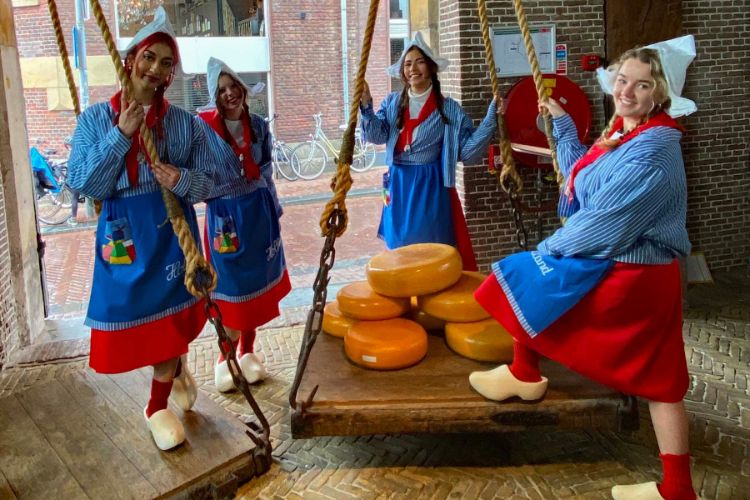
The city’s namesake cheese accounts for more than half the cheese production in the Netherlands. Visit from April through August when the Cheese Market takes over Markt Square every Thursday morning (except Ascension Day).
I watched men and women in folk costumes place golden rounds of cheese on the cobblestones. This practice began in 1395 when farmers brought their wares to town to haggle with traders. Today, the bargaining, marked by the clapping of hands, is just for show.
At De Goudse Waag, the 17th-century weighing station on the square, boys clambered on horse-drawn wagons to unload great wheels of cheese onto the original scales. The building now houses the city’s tourist office.
Nibble a Stroopwafel
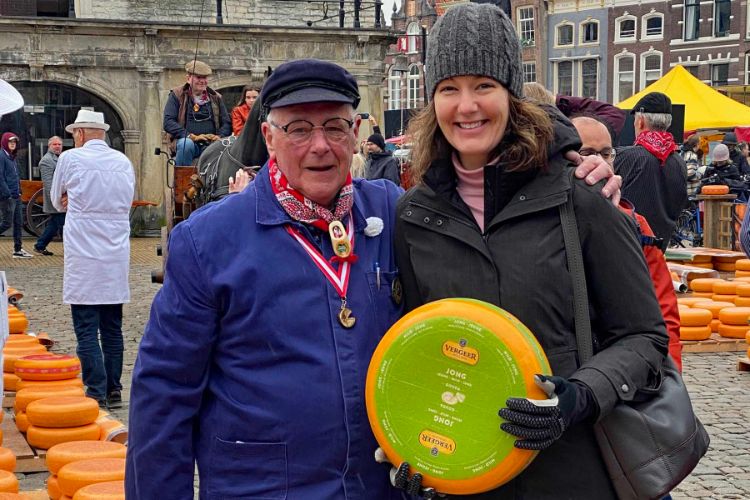
As brass bands played on the square, I browsed stalls of regional crafts, cheese and Gouda’s other signature food, the syrup waffle or stroopwafel.
The traditional version of this treat—the recipe is secret—consists of a waffle sliced in half with sweet caramel syrup slathered between the two pieces. On Cheese Market days, you can make your own during a workshop at Berg’s Bakery.
Nearby Kamphuisen syrup waffle factory offers one-hour tours of its version of the stroopwafel, two thin, round cookies held together by a gooey caramel filling.
Gouda’s Town Hall, rebuilt in 1450 after a fire destroyed the original, anchors Markt Square. It is currently closed for renovations, but you can admire its Gothic architecture accented by red and white shutters from the square.
Look up at its balcony, where criminals were executed on a scaffold. The last hanging took place in 1860. In modern times, the balcony has been used for more pleasant purposes, such as the arrival of St. Nicholas, Santa Claus.
Down the street, I peeked inside Sint-Janskerk, the longest church in the Netherlands. Named for John the Baptist, Gouda’s patron saint, it’s known for its 72 16th-century stained glass windows depicting scenes from the Bible and Dutch history.
If you’d rather explore the Stadhuis and Sint-Janskerk’s stained glass windows with a local guide, this walking tour through Gouda’s historic center wraps up with a proper cheese tasting.
The Hague
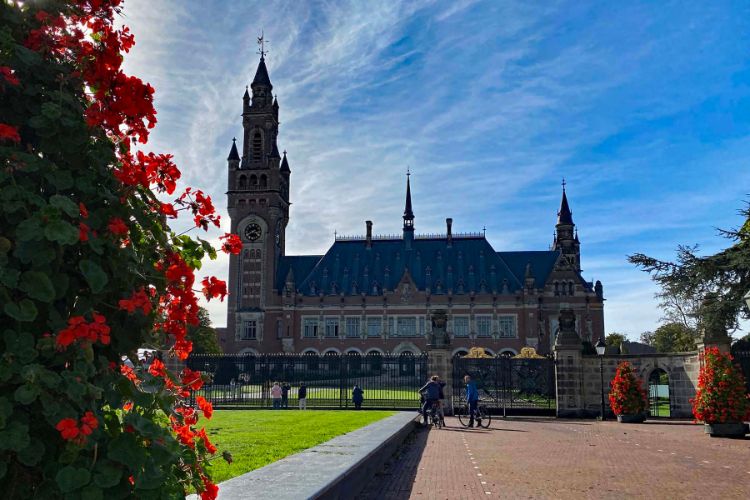
Photo by Katherine Rodeghier
Amsterdam is the capital of the Netherlands, but The Hague, or Den Haag, is the seat of government with the Parliament, a royal palace and foreign embassies.
It’s best known as the location of the International Criminal Court as well as the United Nations International Court of Justice in the much-photographed Peace Palace.
Tours are generally unavailable when the court is in session, which was the case when I visited. However, the museum-like visitor center had an impressive array of exhibits well worth my time.
Art Museums
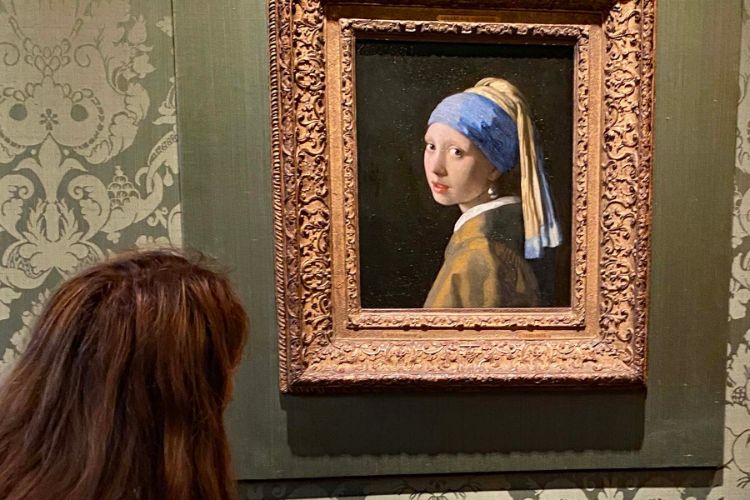
Photo by Katherine Rodeghier
I spent days exploring The Hague’s many museums. In the Mauritshuis, I gazed upon Rembrandt’s “The Anatomy Lesson of Dr. Nicolaes Tulp” and Johannes Vermeer’s “Girl with a Pearl Earring,” nicknamed the “Mona Lisa of the North.”
The museum was built in the 17th century as the residence of the nephew of William of Orange.
The Kunstmuseum Den Haag was also worth a look. It has fine and applied art, including works by Picasso, Monet, Kandinsky and the world’s largest Mondrian collection.
The Escher Museum showcased the work of the graphic artist and optical illusionist M.C. Escher. It’s housed in a former royal palace.
Crazy About Cars
If you love automobiles, allow plenty of time to browse the more than 275 in the Louwman Museum, the world’s oldest private collection of motor cars.
A standout for me was the Swan Car with a body in the shape of a swan and glow-in-the-dark eyes. Its former owner, an eccentric Scotsman living in Calcutta when it was the capital of British India, sat in the rear and used a ship’s makeshift telegraph to issue commands to the driver.
Love the beach? The Hague is one of the few Dutch cities that has one. Scheveningen on the North Sea is a Dutch twist on Coney Island and Santa Monica with bars, restaurants, a casino, a surf shop, a Ferris wheel and a bungee-jumping tower.
Maastricht
On the map of the Netherlands, Maastricht hangs like an appendage from the southern border, squeezed between Belgium and Germany.
It dates from Roman times, was ruled by Spain, and was conquered by the French Sun King Louis XIV in a siege that cost the life of D’Artagnan, captain of the musketeers from the Alexandre Dumas novel. I found a bronze statue standing on the spot of his demise near the Tongeren Gate.
Today, the city is best known as the birthplace of the European Union. Twelve countries signed the Treaty of Maastricht in 1992, paving the way for the introduction of the euro.
Kin of Christ
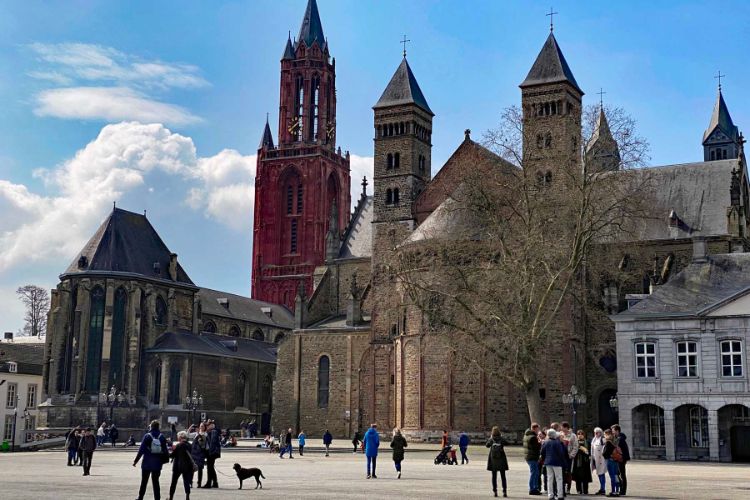
Photo by Katherine Rodeghier
Maastricht has 1,677 national heritage buildings, second only to Amsterdam. I walked through the cobblestoned old town to one of them, the Basilica of St. Servatius, the largest Romanesque church in the Netherlands.
Legend has it that Servatius is a distant cousin of John the Baptist, making him a descendant of Jesus Christ. The basilica was built over the site of Servatius’ burial in A.D. 384.
In the basilica’s Treasury, part of the saint’s skull is encased in a richly decorated golden bust. More relics of saints are contained in the 12th-century Shrine of St. Servatius, a gilded chest decorated with enamel and semi-precious stones, arguably the most important medieval object in the Netherlands.
The faithful carried these religious treasures on processions through the city, a practice that continues every seven years.
Next to the basilica stands the Gothic St. Janskerk, a Catholic church that became Protestant in 1632. I climbed its 263-foot tower for a panoramic view of Maastricht and Vrijthof Square just below.
The town’s main square is surrounded by heritage buildings, hotels, bars, and restaurants and is the site for outdoor concerts, polo matches, street carnivals, and the annual Christmas market.
World War II Cemetery

Maastricht was the first Dutch city to be liberated during World War II. Maps of Allied military operations appear on the wall of the Netherlands American Cemetery and Memorial near Margraten, a worthwhile 15-minute detour from Maastricht.
The memorial’s Court of Honor has a 101-foot tower standing over a reflecting pool and a statue titled “Mourning Woman.” Behind it, the graves of 8,301 members of the U.S. military are set in neat rows, including 40 sets of brothers and six Medal of Honor recipients.
As I walked past the headstones, I saw several decorated with tulips and other flowers placed by Dutch citizens who’ve adopted graves to honor their liberators.
Delft
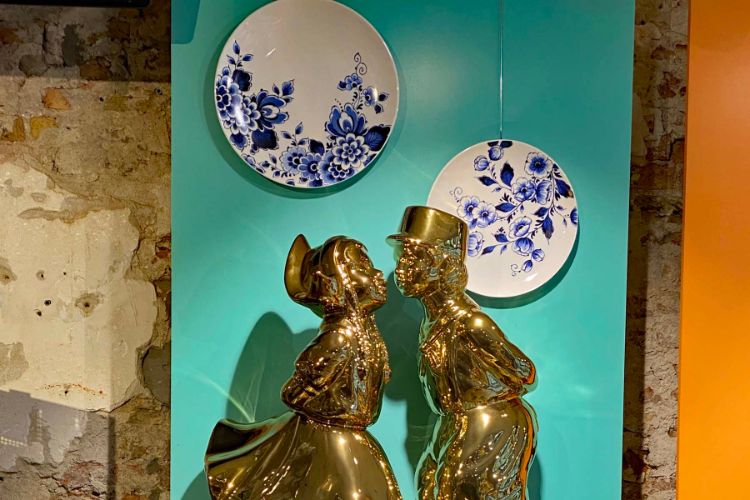
This city might be called a mini-Amsterdam for the canals that entwine it. Its name comes from the Dutch verb delven, to dig, as in the excavation of a delf, a manmade waterway.
But it’s best known for its hand-painted blue-and-white earthenware. Delftware, or Delft Blue, originated as a 17th-century knockoff of expensive Chinese porcelain imported by the Dutch East India Co.
At its peak, Delft had more than 30 porcelain factories. The oldest, Royal Delft, has been in business since 1653, and a self guided ticket to its museum and factory includes an audio tour and lets you skip the line, or you can book a hands on workshop if you’re feeling creative.
I saw visitors painting tiles at the Heinen Delft Blue Concept Store downtown while I browsed among its displays of traditional and contemporary pottery.
Since I was in the neighborhood, I strolled around Market Square fronted by City Hall and made note of modern interpretations of Delftware design, from public art to street signs.
Vermeer’s Hometown
Delft was often portrayed in the background of paintings by its most famous resident, Johannes Vermeer, born here in 1632.
The Dutch Master and other artists of the Delft School are known for their scenes of domestic life, churches, streets, and public squares, but Vermeer stands out for his ability to render light on his subjects. Have a look at reproductions of his work at Vermeer Centrum Delft, a museum devoted to his life.
Vermeer’s talent was not recognized during his lifetime. He died a pauper, leaving a wife and 11 children, and was buried in Delft’s Old Church. Constructed from 1246 to 1350, the church takes its nickname, “Crooked John,” from its leaning tower built atop a filled-in moat.
The 246-foot tower began to sink during construction, but bricklayers continued anyway, creating a kink. Standing a distance away, I could see the tower, now stabilized, tilt about six feet out of plumb.
Visitors with sturdier legs than mine climb 367 steps inside the tower of the New Church, completed in 1496, for a view of Delft. The church houses the tombs of the Dutch royal family.
Since its founder, William I of Orange-Nassau, was assassinated in 1584, almost all members of the family have been buried near him in the royal crypt.
Need a hand planning your trip? Here are the sites and services we rely on most, from booking tools to travel products we love.
Inspire your next adventure with our articles below:
- A Dutchman’s Guide to the Netherlands: Local Wisdom from a Nile Encounter
- Must-see Places to Enjoy on a Family Trip to Amsterdam
Author Bio: Katherine Rodeghier has researched destinations in nearly 100 countries and taken cruises across the globe. Her travel experiences span all seven continents, including close encounters with penguins in Antarctica, lions in Tanzania and tortoises in the Galapagos Islands. Her journalism career began in suburban Chicago writing and editing an award-winning travel section for the Daily Herald. She has won numerous awards for writing and photography from the Society of American Travel Writers and the Midwest Travel Journalists Association.
Want to discover more hidden gems and helpful travel tips? Join our free newsletter for the latest travel secrets and travel articles.
We are reader-supported and may earn a commission on purchases made through links in this article.

Planning another trip soon? ✈️
Add GoWorldTravel.com as a preferred source on Google. Click the button below so our local guides, packing hacks, and hidden-gem itineraries always show up first when you search!
Add to Preferred Sources