

History can be strange. The telling of history can be even stranger, as I discovered on a warm afternoon in San Antonio, Texas.
A British rock star, enamored by a TV show about a Tennessee frontiersman produced by the father of Mickey Mouse, enlightened me about the Alamo. The famed Spanish mission turned fortress that has stood as an icon of Texas Independence.
Before Texas became the 28th state of the United States, it was a country unto itself, the Republic of Texas. And, before being its own republic, it was formally a part of Mexico.
Texas’ long and very colorful journey to statehood begins and ends for many Americans and all Texans with The Alamo.
However, what we think we know, or at least what I thought I knew, about the iconic clash in the heart of what is now San Antonio has become blurred by out-sized legends, fanciful myths and the not-too-subtle spectacle of Hollywood.
Walt Disney, John Wayne and Becoming a Fan

Paint-by-numbers was a popular form of artistry for kids like me in the 1960s. A line illustration with numbers coordinating to paint colors allowed unskilled Picassos to create a fairly acceptable painting.
My first one, a birthday gift, was of the final assault of the Alamo by Mexican soldiers upon the walls defended by the Texans and Davy Crockett. Even with numbers to follow and the simple ability to stay within the lines, my artwork was not frameable.
However, the subject intrigued me to no end. I found myself enamored with Davy Crockett, Jim Bowie and the fight for Texas independence.
It’s a heroic tale; a small band of Texas patriots, less than 200, defending the aging fort against an army of thousands before succumbing to the overwhelming numbers.
With the rallying cry of “Remember the Alamo,” a Texan army eventually won its independence from Mexico.
Add in reruns of Walt Disney’s Davy Crockett and an epic John Wayne movie, and I was hooked.
It wasn’t until much later in life that I undertook a pilgrimage to the site that had so fired a youthful imagination.
Much to my surprise, I learned what little I actually knew about the famed battle, its famous participants and how the former Genesis drummer and lead vocalist helped to set me straight.
Read More: Celebrating on San Antonio’s River Walk: Food, History, and Pure Fiesta
A Small Monument Casts a Towering Shadow

During an inaugural trip to San Antonio, we walked into Alamo Plaza, past the Alamo Cenotaph. The 60-foot-tall memorial to the defenders who lost their lives during the 1836 battle was encased by scaffolding, undergoing restoration.
We came upon what we recognized as The Alamo. The first thing I was struck by was, well, how small it appeared.
This out-sized pantheon to Texas liberty has cast a towering shadow across the history of the Lone Star State for centuries. But, yet, before me, the familiar limestone bell-shaped façade was dwarfed by the sky-scraping skyline of the city of San Antonio that had grown up around it.
Modern skyscrapers dwarfed the famed portico. Where once stood the north wall of the 3-acre fortress, now stood the massive granite-clad Garcia Federal Building and the lofty gothic-style Emily Morgan hotel, which rose 13 stories above our heads.
The second thing that we noticed was the tremendous amount of construction going on across from the Alamo.
Near where the west wall once stood, the multi-story skeletal remains of the Crockett building, once home to the visitor center, were swarmed by a bevy of workers in the mid-afternoon sun.
Because of this, we were directed to a temporary 2×4 and plywood-built shed located on the plaza, where we purchased our tickets for the audio tour of the grounds.
The Iconic Alamo Church

To reach the inner grounds, we entered directly into the Church, that building we know as The Alamo.
The gently curved “bell-like hump” atop the Sanctuary is the signature look of the façade. That hump may be the most iconic image in Texas history.
It’s even on the flag of the city of San Antonio. But it wasn’t there during the Battle of the Alamo. Thus began our education.
The distinct scalloped roofline that is visible today was added by the U.S. Army much later, long after Texan independence was achieved.
We joined several other visitors and would-be historians with phone-sized audio players firmly pressed to our ears. All of us stared upwards at the immaculately whitewashed ceiling.
My next lesson learned was that the ceiling wasn’t there during the battle either. Again, added by the army. I was beginning to question all that I knew of the Alamo.
The Artistry of the Sacristy

As we followed the prompts of the audio guide, we entered the sacristy. During the final battle, most of the defenders’ families, the women and children, had gathered in the sacristy of the church.
They were inside the sacristy because it was one of the only areas inside the Alamo church that had a roof.
Here we learned that after the final shots had been fired and all of the defenders had fallen, Santa Anna released the surviving families in order that they could spread the word of the consequences for those who defied him.
Within the confines, we were also presented with the beauty of the original frescoed walls from the time of its being a mission.
In 2000, conservators worked to remove nine layers of US Army whitewash to discover the previously unknown patterns. The Alamo continues to surprise.
An Ancient History

Photo by Frank Hosek
The history of the Alamo isn’t just about the 13-day 1836 siege and final battle. It wasn’t even built as a fort.
The Mission San Antonio de Valero was founded by Catholic missionaries in 1718 in what was then New Spain.
It was the first of five missions built in the area meant to convert local Indigenous people. They lived, farmed, and worshipped within the protective stone walls of the mission.
In the 1800s, as Mexico sought independence from Spain, the mission was reinvented as a pseudo fortress, first for Spanish forces, then for Mexicans. Then, finally, the Texans led by Bowie, Crockett and Travis.
Even the U.S. Army occupied the site for 3 decades, utilizing it as a quartermaster’s depot.
By the turn of the twentieth century, the Alamo had long been abandoned, with much of its original structure succumbing to time and neglect. Its legacy was also beginning to fade from history.
After years of physical abandonment and near engulfment by inner-city development, what was left of the Alamo was saved by the Daughters of the Republic of Texas to become the revered institution it is today and includes a museum filled with artifacts.
Ralston Family Collections Center

Located behind the historic Alamo church on the far side of the Pecan tree-shaded gardens, there stands the new 24,000-square-foot, $15 million Alamo Collections Center. The stone and wood-trimmed building blends in well to its surroundings.
The Ralston Family Collections Center displays over 500 artifacts, a fraction of the total collection available, related to the battle and its participants.
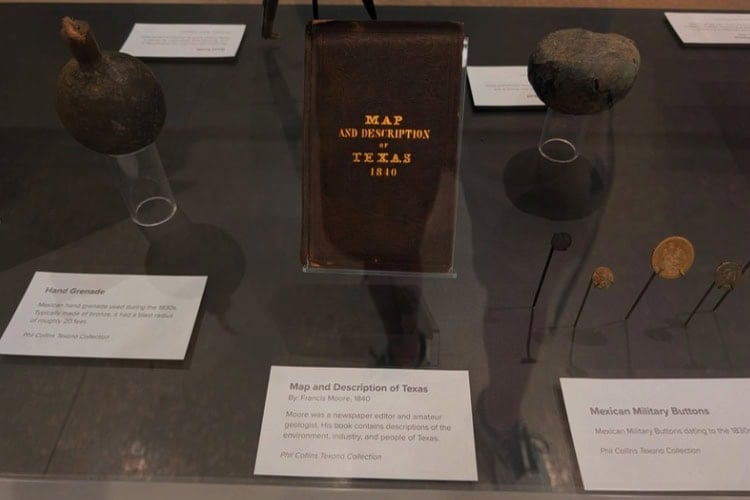
As my wife wandered off, I stood before glass cases full of the instruments of 19th-century war. Some pieces gleamed of polished steel; others displayed the pitted and rusty results of being buried beneath the battlefield for over a century before being unearthed.
The forbidding black barrels of cannons actually used at the clash stared back at me with their gaping maws.

The dazzling, Napoleonic-style uniform of General Antonio Lopez de Santa Anna is in stark contrast to the homespun and buckskin worn by the defenders.
While I bent over one case to better view some Mexican military buttons, I read the little white card identifying the objects and noticed that they were from the Phil Collins Collection.
I began to realize that several more items had the same notation. Although there are many items from other collectors, the name Phil Collins intrigued me.
Curious, I asked a nearby docent if that was the famous Phil Collins of rock fame. Indeed, it turns out, it is the former drummer and frontman for Genesis and a successful solo singer.
In 2014, the British rocker donated more than 400 items from Texas’s revolutionary period to the state.
Phil Collins, the Rock Star

Photo by Frank Hosek
How did a rock star from Middlesex, England, become a collector of memorabilia related to the Texan fight for independence?
Just like millions of coonskin cap-wearing youths of America, as a five-year-old, he was enamored with the Walt Disney version of the fall of the Alamo and the tale of America’s King of the Wild Frontier and his noble end. That fascination never left him.
As his success provided the means, it became his passion to collect artifacts and documents until his collection rivaled Texas itself.
Beyond his extensive collection, Mr. Collins has also lent his famed voice. “The Alamo Under Siege” is a room-sized diorama of the Alamo fortress as it appeared in 1836.
Under dim lights, Collins’s soft, British accent drifts down from hidden speakers, narrating the events of the final battle.
As several of us stood around the large display, we followed the action as he described it, illuminating each area of the fort discussed.
Afterwards, we strolled the aisles of the gift shop, where shelves were filled with Alamo jams and butters, and souvenir plates and mugs stood near cookbooks and collector pins. Of course, the ubiquitous coon skin caps received a lot of attention.
I purchased two volumes on the history and impact of the Battle of the Alamo. I felt the need to be better informed beyond the John Wayne version.
Our final stop, the Long Barrack, is the oldest building on the Alamo site. We learned that the limestone Long Barrack housed Spanish missionaries almost 300 years ago and saw some of the fiercest fighting as a last stand for the Alamo defenders.
Not Without Controversy
The story of The Alamo isn’t without controversy. Recent books and articles by academics question how the story is told. Many don’t even realize that, at the time, Texas was a Mexican state.
The seeds of revolution are many and varied. The story of the Tejanos (Mexican Americans) who fought and died alongside the Texans is just now becoming more widely known.
As we exited the church, passing a bronze statue of Mr. Crockett, we were once again hit with the staccato beat of pneumatic hammers and power drills. The work continued on the Crockett building, which is being reconfigured into the new 4-story Alamo Visitor Center and Museum, capable of displaying the entire collection of memorabilia.
It will serve to expand on the Alamo legend while also telling the full 300-year history of the site and its people.
The Legends

I walked away with a newfound appreciation for the Alamo Story and the legends of my youth.
On the second floor of the Alamo Exhibit in the new Ralston Family Collections Center, there is an outsized painting of the final onslaught of the Mexican Army upon the Alamo.
In the center of the painting are Jim Bowie, Davy Crockett and William Travis. They look remarkably like the Hollywood actors Richard Widmark, John Wayne, and Lawrence Harvey.
Appropriately so, I suppose, as it was commissioned by Wayne for his epic movie version of “The Alamo.”
Although dramatic, the painting plays fast and loose with the facts. The three were not even together in the end. Bowie died fighting from his sickbed in the south barracks, and Travis was one of the first to die at the west wall.
Crockett’s legacy is clouded, as is much of the final minutes of the battle. Some say he surrendered and was executed, others that he went down fighting at the palisade, swarmed by many Mexicans.
Legends don’t give up easily, and so it goes at times with The Alamo. I was reminded of a quote from another John Wayne movie, “When the legend becomes fact, print the legend.”

If You Go:
The Alamo is located in downtown San Antonio, Texas.
- The Alamo
- Open Daily: 9 a.m. – 5:30 p.m.
- Entry into the Alamo Church is free
- Audio Tours – $20.00 per person
- Guided Tour – $48.00 for Adults
For an in-depth experience, book the San Antonio Premium City Tour, which includes the Alamo and a River Walk cruise.
Need a hand planning your trip? Here are the sites and services we rely on most, from booking tools to travel products we love.
Inspire your next adventure with our articles below:
Author Bio: Frank Hosek relishes traveling with his wife, Kathy. He enjoys discovering new experiences, meeting the people that make those experiences memorable, and sharing their adventures with others. He has written for Go World Travel Magazine, The Daily Journal, News Gazette and Lifestyles magazine. Frank has won awards from IWPA and NFPW for his travel writing. He looks toward the horizon for the next adventure.
Want to discover more hidden gems and helpful travel tips? Join our free newsletter for the latest travel secrets and travel articles.
We are reader-supported and may earn a commission on purchases made through links in this article.

- The Great Lakes Shipwreck Museum: Honoring the Legend of the Edmund Fitzgerald - September 11, 2026
- Driving I-90 Across South Dakota: Badlands, Wall Drug and Roadside Icons - September 2, 2026
- Gettysburg National Military Park: A Visit to Hallowed Ground - August 31, 2026
Planning another trip soon? ✈️
Add GoWorldTravel.com as a preferred source on Google. Click the button below so our local guides, packing hacks, and hidden-gem itineraries always show up first when you search!
Add to Preferred Sources