
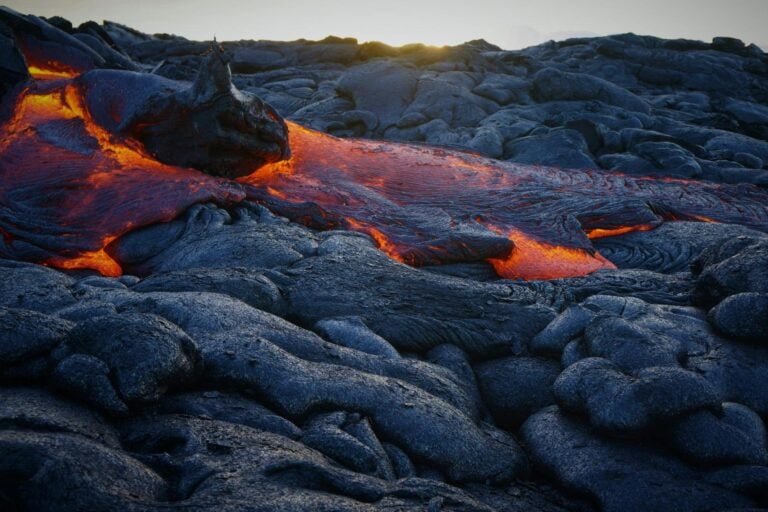

At Hawai’i Volcano National Park on Hawai’i Island, you can sleep at the rim of one of the most active volcanoes. The park is vast, at 354,561 acres.
It is a diverse ecological place with rainforests, extinct craters, cooled and dry lava fields, petroglyphs, and plenty of forest regrowth to view. Much of the park can be viewed from the roadside pull-offs if you are there for just a day.
Why Staying Overnight at Hawai‘i Volcanoes National Park Is Worth It

To better understand the park, we spent a day and a half there, squeezed between two nights. This allowed for three easy and one moderate hike in the park’s different ecological zones.
Spending two nights allowed us to get to the popular trailheads or parking areas around 9 AM, getting ahead of the day trippers. We also liked the park after 4 PM, when most visitors drive back to the Kona coast, 2 hours north.
Spending a night at Hawai’i Volcano National Park also has its advantages. With the rim of Kilauea at 4091 feet and the region dark, guests can view countless stars when the sky is clear.
Another nighttime bonus during our stay was viewing the magma bubbling up from the crater’s opposite side. From a distance, it appeared to be a bright orange geyser. Keep in mind that visiting the crater and seeing lava involves good luck and timing.
The Visitor Center

Any visit to the park should start at the Kilauea Visitor Center. Here, friendly rangers and volunteers will provide you with a map, current conditions, and recommended hikes based on your interests and abilities.
Inside the visitor center are geological and nature exhibits about the area. There is also a store where you can find a wide range of volcano-related items for both adults and children. Proceeds from the sales benefit the park.
Read More: How to Visit Hawaii Responsibly: 10 Low-Impact Travel Tips
Driving Through the Park

Volcano National Park is easily accessible via two roads. The Chain of Craters Road heads south for 18.8 miles until it reaches the coast. The Crater Rim Drive is 11 miles long, with much of it located on the crater rim.
Each road has well-marked pull-offs or parking lots. These can lead to views of small craters, the start of a hike, or a view of vast lava fields that have hardened in recent decades. Most stops have interpretive signs. Day trippers should allow three hours per road, including time for one hike off each road.
Most of the roads are well-maintained, with a speed limit of 30 mph. Pay attention when driving, as the surface is prone to change due to the area’s active volcanic nature. Heed any “Earth Cracks” sign and slow down. It is not unusual to find a small split in the road.
Puʻuloa Petroglyphs

Start your day early and drive straight to the Puʻuloa Petroglyphs. For many, this is the best time to do the 1.5-mile round-trip hike before the sun gets too high and hot.
The walk is mostly flat on a dark, dried lava flow until it reaches a boardwalk at the end. Due to the uneven terrain, sneakers or hiking shoes are recommended.
Puʻuloa is a sacred site for Hawaiians and has been ritually used for over 500 years. It is the most extensive petroglyph field in the state, with over 23,000 images. Scraped into the lava, you will see animals, people, canoe sails, geometric shapes, and thousands of circular depressions representing children.
Your Guide to Travel to Hawaii
Hōlei Sea Arch
If you like unusual geological formations, continue to the end of the road to view the Hōlei Sea Arch. From the parking lot, walk 1000 feet on the paved road until you see an outcrop with signs on the right. This is the viewing point for the 90-foot-high sea arch connected to the cliff, said to have formed 550 years ago.
Thurston Lava Tube

One of the most popular short walks in the park is to the Thurston Lava Tube. Reaching the tube is a short walk through the lush rainforest. Listen to the sounds of tropical birds calling each other. The tube entrance is a big hole in the cliff surrounded by vegetation.
It is estimated that this 600-foot lava tube was formed between 350 and 500 years ago. It was created when a river of magma heated to 2000 degrees Fahrenheit and flowed underground via pressure and gravity.
After the flow left, a perfect tunnel cooled to form a unique ecosystem of plants and creatures. The tube is open 24 hours, but is lighted only during the day. The parking lot fills up faster than others because of the tube’s popularity and the adjoining crater hike.
Hawaii Volcanoes National Park Tours and Tickets
Kilauea Iki Overlook and Hike
Sharing the same parking lot as the Thurston Lava Tube is the start of the Kilauea Iki Hike. This is said to be one of the park’s best hikes. Hikers should be in good physical condition to walk a four-mile loop down to its 400-foot crater.
I recommend taking the hike clockwise. Doing this has you exiting the crater via stairs with the last three-quarters of a mile flat and easy.
The hike starts downhill on a switchback path through the forest, where plant life covers every inch of space. Eventually, you will reach the 3000-foot-long crater. The bottom here has a black, hot, hardened lava floor.
In 1959, this crater was a deep lake of boiling magma with molten rock shooting up 1900 feet. Stop at the crater’s center to listen to the birds in the trees along the cliffs. Also, notice the “mess” of uneven and rolled lava that dried at the end.
Continue up through the steps. Allow two to three hours here. If you miss the hike, drive to the overlook and peer down at its impressive crater.
Devastation Trail

The Devastation Trail is a flat, leisurely one-mile stroll that shows how the landscape has evolved since the 1959 eruption. Growth takes a while to embed itself in the hardened lava. The dominant species are the Ohi’a tree and some colorful flat shrubbery.
Steam Vents

Along Crater Rim Drive is the Steam Vents parking lot. Claimed to be the “breath of the volcano,” steam is created when rain seeps deep into the ground until it reaches heated rocks. The hot rocks instantly turn the water to steam, which rises to the surface.
The vents are fenced off to protect you from falling in, yet close enough to feel the heat on your face. For the best photos, go in the morning when the air is cool and the steam is thick. From the steam vents, walk to Kilauea’s crater edge for an up-close view.
Here, you will see several steam vents inside the wide crater. If you are lucky, there may be magma boiling up.
If You Go
Lodging
The Volcano House Hotel was established in 1846. The present version has 33 guest rooms, 10 cabins, and 16 campsites. Guests are greeted at check-in with mimosas and chocolate chip cookies by the friendly staff.
About half the rooms have crater views. Guests with a parking lot view can still enjoy the crater from the large sitting room, complete with rocking chairs and picture windows. The hotel features two restaurants (reservations are required) and two shops.
Food
Volcano Village, located a few miles away, offers several dining options. We recommend the Ohelo Café for its wood-fired ribs and pizza. The Tuk-Tuk Thai Truck for lunch was tasty and reasonably priced.
The Volcano House’s Kilauea Lodge Restaurant is an upscale establishment, offering good service and food. Their buffet breakfast, which included an egg station, was convenient and offered a discount to hotel guests.
Park Entrance
Hawai’i Volcano National Park charges $30 per vehicle per day. The annual America the Beautiful Park pass also gets you in.
You can purchase this bargain-priced card at the gate for $80, which is good at all national parks (seniors are $20). Download the park app for the latest information here.
Insiders Tip
Bring a warm jacket for the evenings or budget for a sweatshirt at the gift shop. We also recommend packing an umbrella, hiking shoes, or grippy sneakers, and a reusable water bottle.
When driving back to Kona, detour to Papakōlea Green Sand Beach to see one of only four green-hued beaches worldwide. Just down the dirt road from it is the southernmost point of the United States.
Need a hand planning your trip? Here are the sites and services we rely on most, from booking tools to travel products we love.
Inspire your next adventure with our articles below:
Author Bio: After 30 years, Tab Hauser left the business world and reinvented himself as a journalist and professional photographer. His travels have taken him to seven continents and 100 countries or unique locations. He is an Explorers Club Friend, a member of the New York Press Association, a diver, and a U.S. Coast Guard Licensed Captain. This native New Yorker now calls Colorado home. Follow on Facebook at https://www.facebook.com/tab.hauser/ and Instagram at https://www.instagram.com/tabhauser/
Want to discover more hidden gems and helpful travel tips? Join our free newsletter for the latest travel secrets and travel articles.
We are reader-supported and may earn a commission on purchases made through links in this article.

- Two Weeks in Central Newfoundland: Sharks, Small-Town Culture and Come From Away in Gander - September 11, 2026
- Slow Down on Prince Edward Island: A Relaxed Four-Day Itinerary of Dunes, Seafood and Seaside Inns - September 11, 2026
- Cape Town’s Unique Experiences for the Curious Traveller - September 11, 2026
Planning another trip soon? ✈️
Add GoWorldTravel.com as a preferred source on Google. Click the button below so our local guides, packing hacks, and hidden-gem itineraries always show up first when you search!
Add to Preferred Sources
Every year I fly from Melbourne to Florida with a stop in Hawaii and these sound like great suggestions when I’m next on the Big Island. Thanks so much Tab!
tab’s reviews are great. a sophisticated and indepth analysis of sights and things to do that you won’t see elsewhere. so many topics to choose from. much better insights then i have found in the many tour books. and no books to carry. i recommend to everyone no matter what place you plan to explore.
Great story, now I want to go there! Good to see you being published again, I really enjoy your travel stories.
Most Hawaii travel tips are based around the beaches, so this was a delightful change of scenery and full of exciting photos and descriptions of the amazing volanic park and hikes. The insider tips into when to see specific areas etc are a real bonus!
Great summary of key highlights to see, and appreciate the recommendation to stay at the park itself to beat the day trippers. Lots of great & useful info here for a first time or repeat visitor. It has been many years since we’ve been there, and I do remember feeling way too rushed to get back to our cruise ship. Time to return , using Tab’s recommendations! I will also suggest that a high level familiarity with volcanology will greatly enhance your experience there. You will see the volcano alive right there, and will understand the geological processes at work right under your feet! Go enjoy and send us pictures! Best, GL
A very descriptive and informative article on Hawaii’s National Volcanoes Park. Our family is planning a trip to Hawaii in early 2026. This adventure is something that we will now add to our daily itinerary. With 2 young kids this will be not only enjoyable but also educational.
Great story, will really help us out next time there
Looks like an amazing adventure. The photos look other worldly. Would love to see it for myself!