
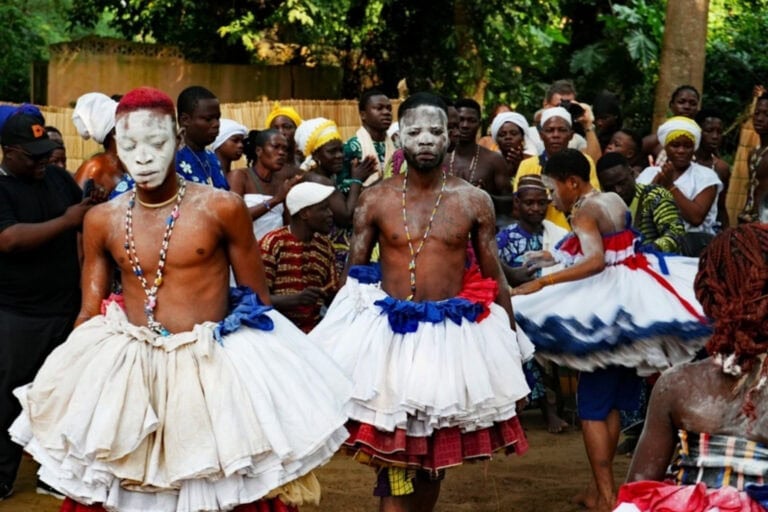
On the eve of Vodun Days, Benin’s annual Voodoo Festival, the building excitement was palpable on the streets of Porto-Novo, the capital. The spirits were becoming restless, agitated, and ready for action.
The Egungun and Zangbeto would appear suddenly, often with an entourage of followers in tow. They swept in and upon people with the force of their righteousness, bellowing incantations, invoking spirits of ancestors, and then demanding monetary offerings.
Enveloped head-to-toe in colorful beaded gowns, their faces hidden, the Egungun are sacred Voodoo ancestral figures. It is believed they have taken human form to impart knowledge and justice, connecting the living world with the divine.
The Zangbeto are the traditional Voodoo police force; dressed in a head-to-ground, haystack-like straw costume believed to house spirits. Faces also covered, they once patrolled the streets at night to ferret out criminals and witches.
People are enthralled and at times intimidated by these Voodoo figures, and during Vodun Days, they come out in force across the country.
The Roots and Beliefs of Vodun
Little-known, peaceful, and very friendly Benin, a sliver of a country in West Africa, is the homeland of one of the great animist religions of the continent, with some 50 million followers in West Africa.
Vodun, or Voodoo, is not the revengeful practice of sticking pins in dolls representing your enemy as portrayed in film. Adherents believe there are numerous deities and countless spirits, from the spirits of ancestors to spirits within every part of nature, all around us at all times.
Addressing, respecting, revering and pandering to them is an absolute necessity to ward off afflictions and bad luck while increasing one’s chances of achieving goals and desires.
Benin is the only country in the world where Voodoo is the national religion. And while it’s on heightened display during the festival, it is alive, practiced, and prominently on exhibition everywhere you go in the country all year round, making the nation a fascinating place to visit.
Festival Day in Ouidah
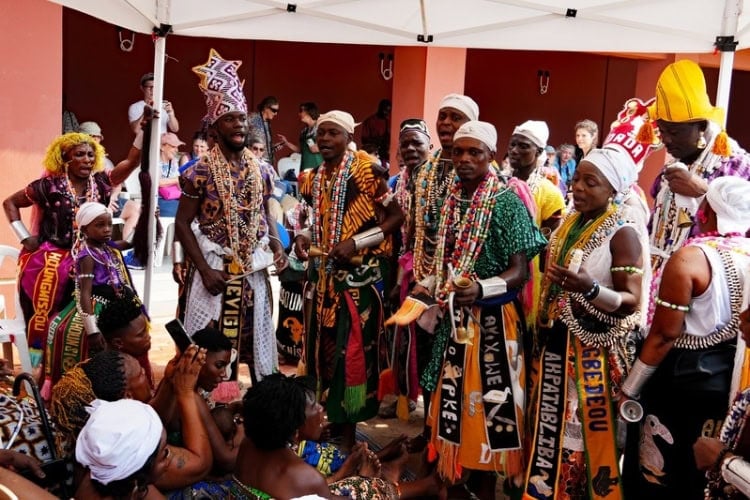
Festival day in Ouidah, Benin’s Voodoo capital, exploded with fever-pitch passion and pageantry, verve and eye-rolling trances.
In the Sacred Forest, a lush garden believed to be overloaded with gods and spirits, the King of the Festival arrived with a large entourage dressed mainly in blue and white, signaling the start of the festivities.
Drummers dressed in brilliantly colored masquerade pounded out a piercing, building beat until the dancers, in grass skirts and white-painted bodies, leapt into action, spinning, gyrating, drifting into a trance. The frenetic rite rolled on for hours.
Walking down an Ouidah street, we happened upon a shrine where a Voodoo priest beckoned to us to approach. I was instructed to bow before him as he offered his blessings, sealed with a donation.
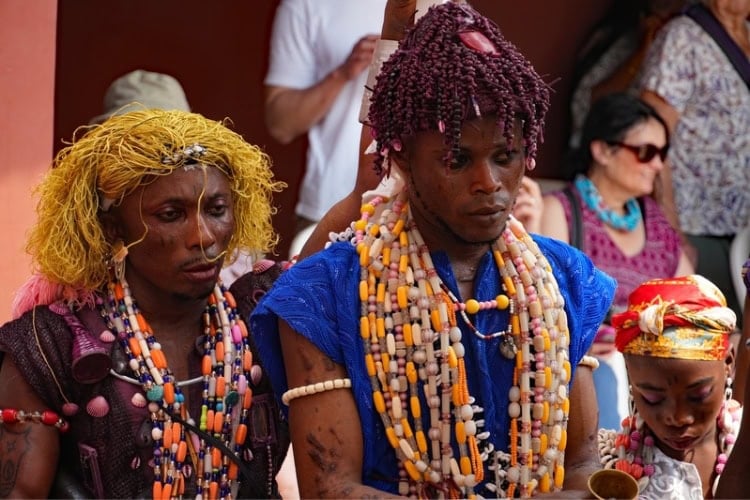
At another juncture, we encountered a group of Voodoo priests and followers, in bejeweled and beaded outfits in a kaleidoscope of colors and patterns, with hair of many hues. It was a continuous procession that stopped to bellow invocations, say prayers, and accept offerings.

Motorbike Taxi to the Beach
At one point, hearing something was happening at the beach, we hopped on a motorbike taxi, three of us onboard.
But the number of people and vehicles was overwhelming. They were squeezed like sardines in the narrow, closed lane for motorbikes only, the driver struggling to navigate the frantic traffic; my feet and knees were shaved many times.
Once there, we stumbled into a gargantuan beach party. Thousands were drinking, dancing and waiting in expectation for something to happen (but never did) while a local rapper shrieked his content over a powerful PA system.
It was not what I expected, nor the locals, who told me the festival has changed completely. A relatively small religious celebration has grown into an international event. Now, many thousands are coming from across West Africa and around the world. It will never be the same.
Exploring the Cultural Sites of Benin
Benin, however, is much more than only Voodoo enchantment and mystique. Porto-Novo’s center, with its palaces and temples, is a tableau of Benin history and culture.
The Central Mosque is a checkerboard of architectural elements and faded pastel colors. It was originally a church built in the Afro-Brazilian style, brought to Benin by emancipated slaves returning from Brazil. It became a mosque in 1911.
The bizarre design of the Temple of the Queen Mother mimics a termite hill. Legend says she gave birth to nine children, all of whom became Voodoo gods, hiding behind a termite nest.
A sprawling, poorly maintained compound of mud buildings, in the orangey-brown color of the earth here, the Royal Palace is a maze of royal chambers and meeting rooms. It was once the seat of the powerful Hogbonu Kingdom.
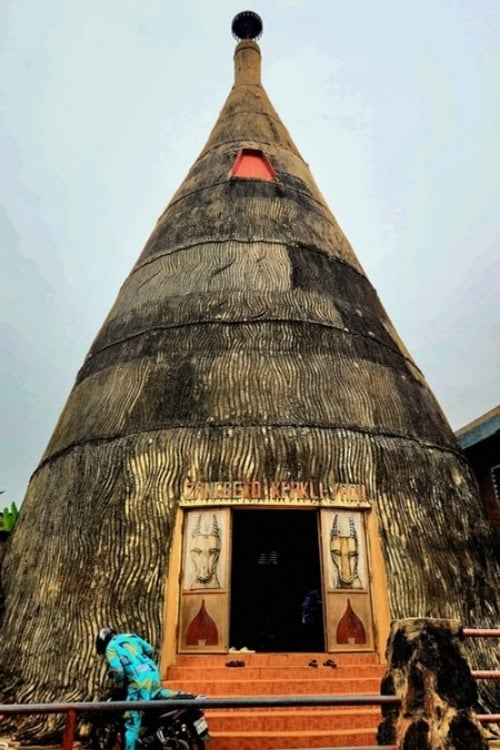
The eccentric, conical Kpakli Yaou Temple is dedicated to the Zangbeto, Voodoo’s guardians of the nighttime peace.
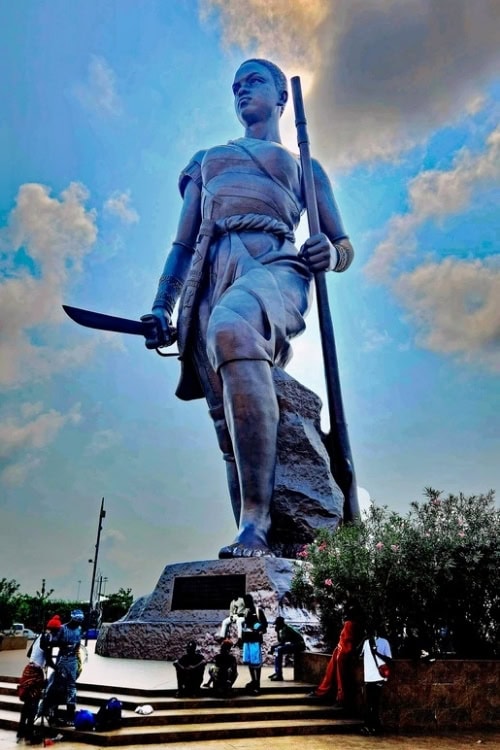
Cotonou, the largest city, also boasts the country’s largest sights. The 100-foot-high statue of the Agojie is an iconic image, often portrayed as a signature photo of Benin.
The Agojie were legendary Amazon warriors, a fearsome, all-female military regiment in the powerful 17th-19th century Kingdom of Dahomey (modern-day Benin). The towering figure, 150 tons in battleship gray, is armed with a sword and a long-barreled rifle.
The Great Art Wall is a massive mural, 12-feet-high and more than 3,000 feet long ‒ and growing because it’s still being added to ‒ that depicts Benin’s history. The longest mural in Africa and among the world’s most extensive, it was created by more than 40 domestic and international artists as an open-air museum.
The Mystique of Ouidah

Ouidah itself is arguably Benin’s most mysterious and atmospheric destination, with its sandy streets of rubbly mud houses, crumbling Afro-Brazilian mansions and marshy inlets where salt is produced. In addition, there is an array of Voodoo shrines, temples, and gods (which are usually physically represented simply by a mound of earth wrapped in material with eyes and a mouth, streaked and stained by candle wax and palm oil).
The 300-year-old, renovated Portuguese Fort administered what was once one of Africa’s largest slave trading operations. The long walk from Ouidah’s slave market to the ships is today memorialized by the ‘Door of No Return’ monument.
A Visit to Ganvie
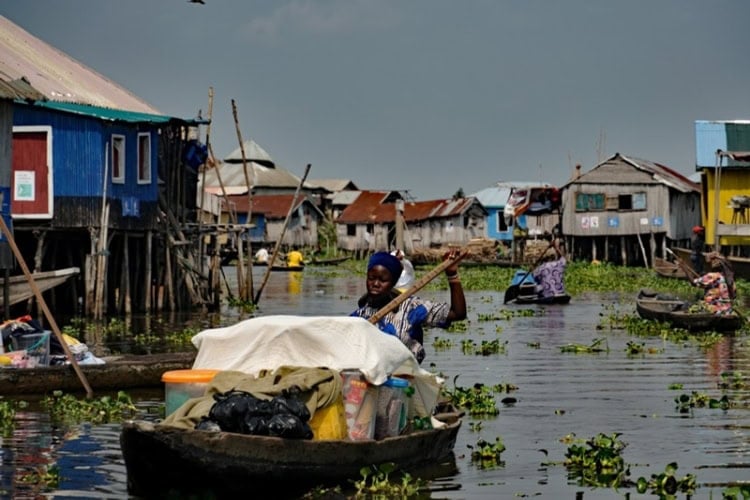
Africa’s largest floating village, the dynamic Ganvie, stands out among the world’s stilt settlements for its size and vibrant commercial activity.
Founded in 1717 as a sanctuary for runaway slaves, today it is a thriving waterborne community on Benin’s largest body of water, Lake Nakoue.
The heart of the village is afflicted by today’s typical urban problem ‒ a traffic jam. But this is boats, coming and going, transporting people, goods, and fish, either paddled, punted or motor-powered. Some even have makeshift sails made from various scrounged, repurposed materials such as a sheet or plastic tarp.
Ganvie survives on fishing, fish farming and tourism. Boatmen ferry visitors to artisan studios, souvenir shops, small eateries and to see the ingenious fish trap system: numerous palm fronds embedded in the shallow lake create rows of tight fencing that trap passing fish. Ganvie is a “tentative” candidate to be named a UNESCO World Heritage Site.
A Royal Audience in Dassa
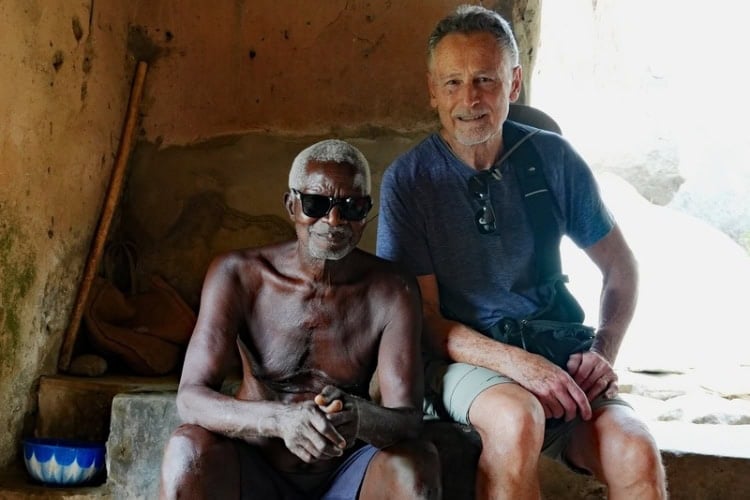
In Dassa, I was fortunate to experience an audience with a king. Though he looked decidedly unroyal, his bearing was regal and poised. Dressed in nothing more than blue shorts, wearing dark glasses, looking extraordinarily wrinkle-free for a 93-year-old, he answered questions deftly in French and insisted I sit next to him for a photo.
His ancestor, a Nigerian prince, migrated here some 150 years ago. The prince founded a once-powerful kingdom atop a boulder-strewn mountain hanging over the town of Dassa in central Benin.
Occupying old mud buildings on the summit, protected by a room of Voodoo gods, the King of Dassa enjoys deference and respect and presides over occasional rituals. But like the fate and state of many former rulers in Africa, the kingdom has ebbed away.
Possotome and the Sacred Forest
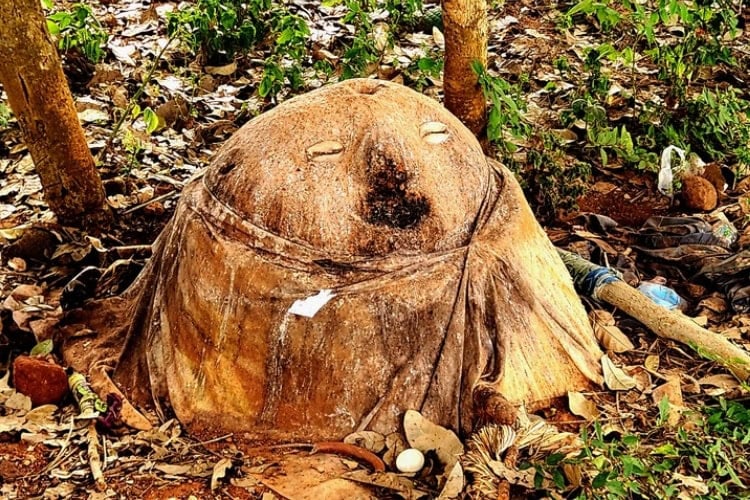
Possotome is renowned for the spring that gushes forth here. Its bottled water is sold nationally, yet a visit is actually a deep immersion in Voodoo.
The village is ringed by a Sacred Forest, filled with shrines dedicated to deities where rituals are performed regularly.
The main village god (as usual, a mound of earth with eyes and a mouth) is revered for its powers, particularly to boost men’s sexual prowess and help women get pregnant. Walking the dirt lanes uncovers many other gods.
Possotome doesn’t have or need a police station because a very large Voodoo shrine purportedly keeps the peace.
The Dankoli Shrine Experience

The famous Dankoli Shrine, or maybe infamous, is like nowhere else in Benin. People come here specifically to thank the gods with animal sacrifices.
The shrine is a lurid, fetid mound, anchored with poles and white flags, soiled continuously with palm oil, candle wax, local alcohols, sugar water and animal blood.
Supplicants follow a prescribed ritual. They drive a wooden stake into the shrine that represents their wish, splash the shrine with liquids that may include palm oil, sugar water, and alcohol, and pray to the gods. If their wish comes true, then they must return to pay the gods with an animal sacrifice.
While I was there, I watched a man kill a goat and carry the bleeding animal dripping blood around the shrine.
Rather than macabre or demonic, “The sacrifices are designed to get the attention of the gods with an offering of something valuable,” explained Confidence, my guide in Benin.
For a poor Beninese, a sacrificial chicken and especially a goat is a significant investment.
Exploring Other Cultural Attractions

A peaceful boat trip up the Black River through lush forest brought us to small villages where artisans demonstrated their skills and wares. Grand Popo is endless beaches of fine sand and boat trips through lagoons straddling the Atlantic Ocean.
Abomey, another former seat of a powerful kingdom, boasts royal palaces. However, the highlight here is the wacky Chameleon Temple, mimicking the reptile’s shape.
Due to its color-changing ability, the chameleon has a special place in the Voodoo pantheon. It is believed to be a gateway between the physical and spiritual worlds.
The adjacent pictograph-covered house of the temple’s priest is even more of a hoot. The entrance is via a giant, open mouth of a panther (the Voodoo symbol for Benin) with huge fangs.
Spiritual Life in Benin

“Voodoo is everywhere… it is everything,” said Confidence. “Adherents believe their life’s path will be determined by how faithfully they follow Voodoo tenets, practices, and rituals. That it is the only way to ensure happiness, health, prosperity, a good marriage and whatever one’s hoping and wishing for.”
Voodoo is also regularly combined with other religions to benefit from all the spirits and gods. Christian saints, for example, may be incorporated as additional spirits.
“Africans are very spiritual people who may live Vodun daily but on Friday go to the mosque or on Sunday to mass,” explained Confidence.
The Evolving Festival
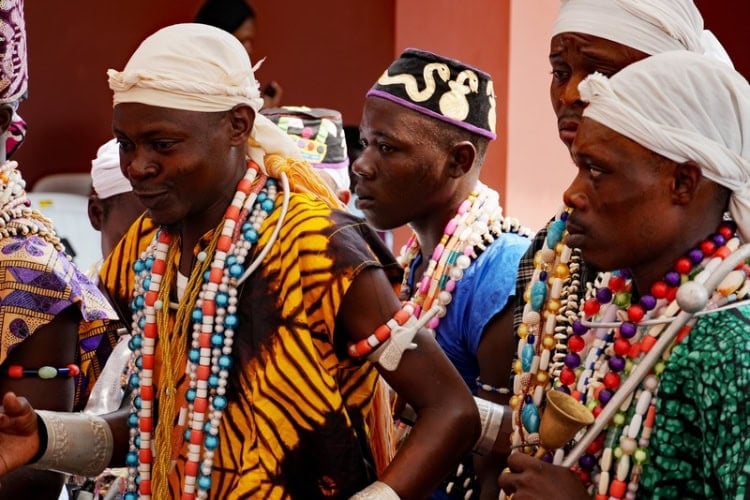
The Vodun Days were bursting at the seams, with crowds not seen in the past. Mystical rituals and bloody animal sacrifices, I was told, were common at the public festival years ago.
Today, the festival celebrates Voodoo with dance, music, masquerade and incantations. While the festival has changed, it remains an exciting and exhilarating event.
Timing a visit to Benin to coincide with Vodun Days, every January 10, promises seeing the Voodoo capital of the world at its spiritual peak.
Need a hand planning your trip? Here are the sites and services we rely on most, from booking tools to travel products we love.
Inspire your next adventure with our articles below:
- A Rare Journey Into Mali: West Africa’s Time-Forgotten Kingdom
- Discover Tunisia: 10 Incredible Things to See and Do in the Heart of North Africa
Author Bio: Freelance travel/food writer and photographer Edward Placidi discovered his passion for exploring the world ‒ and sampling its foods ‒ as a teenager and has rambled to the far corners of the planet, leaving behind footprints in 136 countries (so far). He has contributed articles and photographs to scores of newspapers, magazines and websites. When not traveling, he is whipping up delicious dishes inspired by his Tuscan grandmother who taught him to cook, with as many ingredients as possible coming from his vegetable and herb garden.
Want to discover more hidden gems and helpful travel tips? Join our free newsletter for the latest travel secrets and travel articles.
We are reader-supported and may earn a commission on purchases made through links in this article.

- What to Do in Bordeaux: A Wine Lovers’ Guide to One of the World’s Most Prestigious Wine Regions - October 1, 2026
- The Ultimate Gift for Travelers Who Don’t Want More Stuff: 10 Epic Experiences in the US - October 1, 2026
- Walking the Camino de Santiago de Compostela After 65: 10 Tips for Baby Boomers - October 1, 2026
Planning another trip soon? ✈️
Add GoWorldTravel.com as a preferred source on Google. Click the button below so our local guides, packing hacks, and hidden-gem itineraries always show up first when you search!
Add to Preferred Sources