
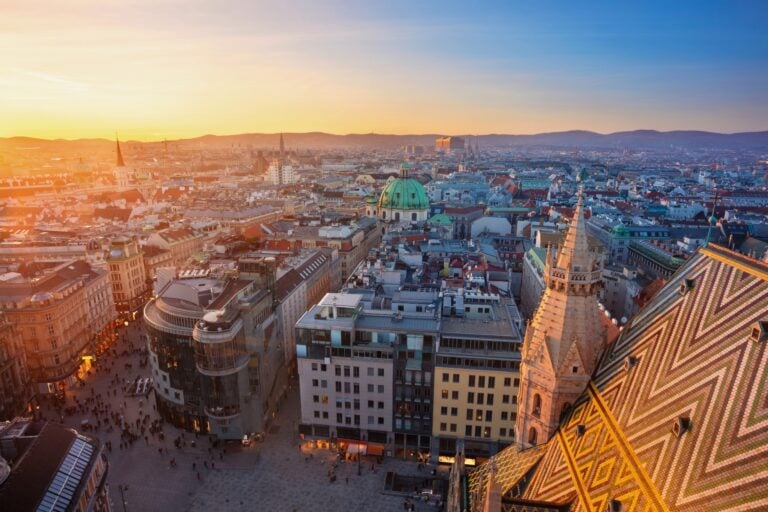

Vienna did not overwhelm me. It corrected me.
I arrived with the quiet arrogance of someone who thinks he understands European cities — the rhythm, the cafés, the architecture.
I thought I knew how to observe beauty. I thought I knew how to travel slowly.
Vienna exposed the difference between moving slowly and being still.
The Lesson In Stillness

The lesson began in a café near Herrengasse. Marble columns rose like silent witnesses, chandeliers cast a subdued glow over polished wood, and newspapers hung neatly on wooden rods.
I ordered a Melange and, almost automatically, began checking my phone. The waiter noticed.
He didn’t scold me. He didn’t comment. He simply placed the porcelain cup before me with deliberate grace, set down a small glass of water beside it, and said: “You have time.”
It wasn’t a suggestion. It was a statement.
In that room, time did not pass — it expanded.
Around me, elderly men read newspapers with monastic concentration. A woman in a wool coat stirred her coffee without speaking, as if in conversation with her own thoughts.
No one seemed concerned with productivity. No one was consuming the moment. They were inhabiting it.
I had come from Naples, a city of heat and velocity. Vienna felt composed, almost disciplined. But not cold — never cold. Its warmth is subtle, controlled.
Read More: What Makes Vienna’s Coffeehouses Unlike Anywhere Else
Architecture Of Composure

Walking later along the Ringstrasse, I understood that this composure is architectural.
The boulevard is not simply beautiful; it is orchestrated. Built after Emperor Franz Joseph ordered the demolition of the medieval city walls, it was designed to demonstrate imperial stability.
The Vienna State Opera stands in dignified Neo-Renaissance symmetry. The Parliament building borrows from ancient Greece. The Rathaus stretches upward in Gothic Revival confidence.
Every façade seems measured. Nothing spills beyond its proportion. Even grandeur here respects balance.
Schönbrunn’s Subtle Restraint

At Schönbrunn Palace, once the summer residence of the Habsburg dynasty, I felt the weight of continuity.
Maria Theresa governed an empire from these rooms. A young Mozart once performed before royalty. The gardens unfold with mathematical precision, fountains aligned along invisible axes.
And yet, standing there, what moved me was not power but restraint.
Vienna never performs its history loudly. It assumes you will notice.
Lessons On A Tram
My most human moment came not in a palace but on a tram.
I boarded confidently, convinced I was heading toward the vineyards of Grinzing. Ten minutes later, the cityscape told a different story. I was lost — quietly, politely lost.
An elderly man beside me noticed my confusion. His name was Karl, a retired history teacher.
In fluent English, he began explaining the district we were passing through — how Beethoven once lived nearby, how Freud had walked those streets, and how certain buildings still carried scars from the Second World War.
“Vienna remembers,” he said. “But it does not dramatize.”
He guided me to the correct stop, but more importantly, he reframed the city for me. Vienna is not frozen in nostalgia; it is layered. It builds around its past rather than replacing it.
That sentence lingered longer than any monument.
Breakfast As Philosophy
And then there was breakfast.
In Vienna, breakfast is not functional — it is philosophical.
A Semmel roll with butter and apricot jam. A soft-boiled egg tapped open with quiet precision. A Melange served in porcelain. No paper cups. No takeaway culture. Coffee is not portable because contemplation is not portable.
And the cakes.
Sachertorte is not indulgence; it is institution. Created in 1832 for Prince Metternich, its dense chocolate layers conceal apricot jam beneath a dark glaze polished like lacquer.
Served with unsweetened whipped cream, it resists excess. It demands balance.
Apfelstrudel, by contrast, is gentler — thin pastry enveloping apples and cinnamon, often dusted lightly with powdered sugar. It carries warmth without weight.
Even dessert here reflects discipline.
Music Without Spectacle

Music, too, feels different in Vienna.
I attended a small chamber performance near the Hofburg Palace. No spectacle. No theatrics. Just strings filling a modest hall with measured intensity.
Mozart and Beethoven are not decorative references here; they are structural foundations.
The audience listened with stillness bordering on reverence.
In Vienna, culture is not consumed. It is upheld.
Grace As Discipline
On my final morning, I returned to the same café.
I did not check my phone. I did not rush.
I watched steam rise from my coffee and noticed how sunlight filtered through tall windows, touching marble surfaces with understated warmth.
Outside, trams moved with quiet precision. The city felt steady — never frantic, never chaotic.
I realized something subtle but profound: Vienna practices grace as discipline.
Elegance here is not flamboyant. It is intentional. It is built into architecture, into food, into music, into the simple act of sitting at a table without urgency.
Some cities leave you energized. Others leave you restless.
Vienna left me recalibrated.
It reminded me that refinement is not about luxury. It is about proportion. About knowing your cultural weight and carrying it lightly.
And somewhere between a mistaken tram ride and a waiter’s patient gaze, I understood that travel is not always about discovery.
Sometimes, it is about correction.
Vienna corrected my pace.
And in doing so, it changed the way I inhabit time.
Need a hand planning your trip? Here are the sites and services we rely on most, from booking tools to travel products we love.
Inspire your next adventure with our articles below:
- 10 Reasons to Love Vienna: Why This City Stole My Heart
- How to Spend 3 Days in Vienna Like a Local: Complete Weekend Guide
Author Bio: Domenico is a travel writer based in Naples, Italy, with a focus on cultural immersion, European history, and food-driven storytelling. His work explores how architecture, local traditions, and everyday rituals shape the identity of a place.
Want to discover more hidden gems and helpful travel tips? Join our free newsletter for the latest travel secrets and travel articles.
We are reader-supported and may earn a commission on purchases made through links in this article.

- Bonaire, Savored Slow: Cactus Liqueur, Caviar, Donkeys and Shore Diving - October 23, 2026
- Two Colorado Hot Springs Worth the Drive from Denver - October 23, 2026
- Is 55 Too Young for a River Cruise in Europe? - October 23, 2026
Planning another trip soon? ✈️
Add GoWorldTravel.com as a preferred source on Google. Click the button below so our local guides, packing hacks, and hidden-gem itineraries always show up first when you search!
Add to Preferred Sources