


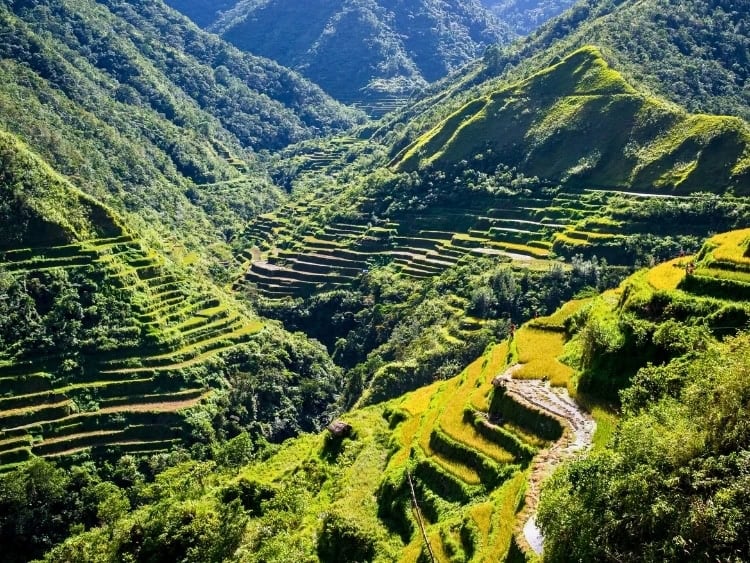
I gaze into the lush green valley, where terraces ripple in seemingly endless rows, their fractal-like patterns catching the last light of the fading sun.
A profound stillness hangs in the air, broken only by the low grunts of farmers working knee-deep in mud, as they carefully plant individual stalks one by one, just as their ancestors have done for thousands of years.
The Ifugao Valley is a place of contrast. The stunning beauty of the rice terraces, small creeks, and picturesque villages often distracts from the reality of the lives of the people who call it home.
Hard Work Amid Beauty

The people of the Ifugao Valley are brutally hard-working. To this day, there is very little industry in the region. Cultivating rice remains the primary source of income and sustenance.
However, as is often the case in an increasingly globalized world, the younger generation’s interest in such work is diminishing as they begin to seek opportunities in the big cities, most often in the megacity of Manila.
Our tour guide, Miller, explains that he himself had spent several years in Manila working. But during the COVID-19 pandemic, he made his way back to his ancestral home.
He points out that life in Manila was tough. Maybe not as tough as planting rice, he says with an honest grin as the sun sinks behind the still paddies.
Miller goes on to explain that since returning to Ifugao, he has found that the growing stream of tourists seeking a more authentic experience, far from the world-famous beaches in the south of the country, has become an increasingly valuable source of income.
A Multi-Day Trek Across Ifugao’s Ancient Terraces

The two-day hike through the rice terraces began early in the morning. We set off from the Banaue Pink Eco Hostel, where our host had put us in contact with Miller.
My girlfriend and I were squeezed into a makeshift sidecar attached to an old Honda Dream, its panels roughly cut and manually beaten from corrugated iron.
The old Japanese bike chugged along as we slowly climbed the hill leading out of Banaue, following the only stretch of tarmac toward the most accessible village along the increasingly popular hiking trail.
As the scorching sun rose higher, the paved road abruptly gave way to stone steps. I clumsily pulled myself out of the sidecar, and we began our descent to the first village.
The path was marked by a long series of unevenly spaced steps, where we occasionally paused to take in the views or let locals carrying enormous loads pass us on their way in and out of the village.
Teenage girls and older women moved comfortably up and down the steps, balancing bags of concrete mix and enormous baskets of food and supplies, while we struggled in the humidity beneath the relentless heat.
The sight of such heavyweights pressing down on their slim necks was a stark reminder of how tough life is for many in the region. It provided a glimpse into the reality behind the exodus of young people that Miller had described earlier.
An Evening in Cambulo
We continued down the steps and eventually reached the bottom of the valley, where we followed the ridges along the rice terraces to the village of Cambulo.
The village is made up mostly of simple single-floor buildings with corrugated iron roofs. Chickens, dogs, and the occasional cat wander freely between the narrow alleys separating the houses.
Our accommodation, arranged as part of the tour, was situated at the bottom of the village, backing onto the river that runs through the region, supplying the terraces with ample water through a complex and ancient distribution system.
We dropped our bags in one of several rooms on the top floor of the guesthouse and set out for an evening walk.
A steep trail of concrete steps led out of the village and high into the terraces that surrounded Cambulo.
The silence of the evening was interrupted by the occasional sound of farmers’ bare feet sloshing through the deep mud as they planted rice.
In many ways, it is as the sun nears the horizon that the true beauty of the valley is revealed. The fading light glimmers on the water, catching the green shoots that blanket the endless terraces stacked high into the hills as far as the eye can see.
The walk back was slightly less tranquil as Miller was keen to show off his favorite playlist.
The majority of the songs were reggae with a Filipino twist, along with a series of AI-generated hits.
Fortunately, after a little negotiation, he agreed that it might be best to enjoy the sounds of nature instead.
An Early Start in Cambulo

The alarm sounded at 8:00, but the relentless humidity had woken me hours before. We began our hike after a quick breakfast at the homestay.
The hike started with a walk through the village, where dozens of children were playing while their parents left to tend to their fields.
A narrow metal bridge at the back of the village led us to the first concrete staircase climbing out of the valley.
The humidity thickened as the steps wound deeper into a forest of palm trees and dense green shrubs.
Sweat trickled down my back as I tried my best to keep pace with Miller, while women carrying heavy loads followed steadily behind us.
Eventually, the staircase came to an end, and we began to follow a maze of rice fields, tracing the edges of the terraces along the same footpaths the farmers of the village walk every day.
The next few hours took us deep into the hypnotic expanse of rice terraces. The entirety of the valley is marked by banks of rice that have stood for thousands of years.
We passed farmers planting rice and tiny hamlets where children waved before returning to the tasks their parents had assigned them that morning.
Ending the Day at Tappiya Waterfall in Batad
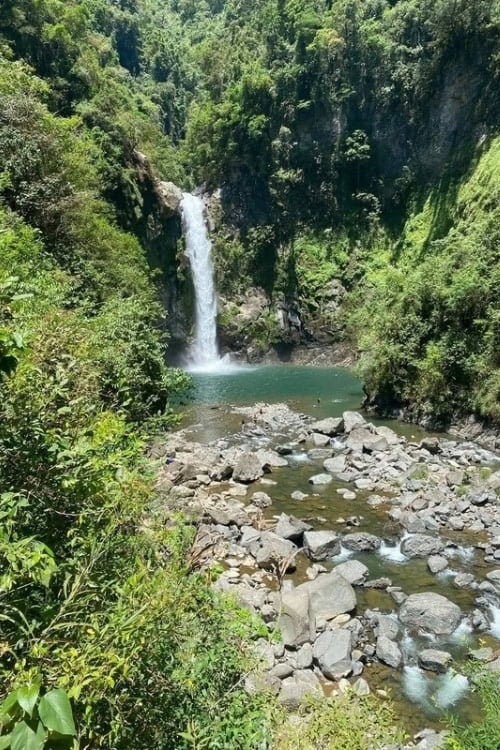
Just as the heat of the day was reaching its peak, we arrived at the viewpoint before the Tappiya Waterfall.
We stopped at one of the only guesthouses in the area for water before trekking down a familiar set of concrete steps toward the falls.
The waterfall lies hidden behind the village at the bottom of the valley.
Its crashing waters have carved out a considerable pool that resembles a lake rather than the usual small basins found at the base of jungle cascades.
It is a stunning location, isolated from the outside world by thousands of acres of rice terraces, and the perfect place to end a journey through the Ifugao Rice Terraces.
The History of the Ifugao Terraces and Its People
Over 1,500 years before the Spanish explorer Ruy López de Villalobos named the archipelago Las Islas Filipinas in 1543—after Prince Philip of Spain, later King Philip II—the Indigenous communities of Ifugao had already transformed the rugged highlands of northern Luzon.
With hand tools and communal labor, they carved an intricate system of terraces into the mountainsides, turning the Cordillera into a living canvas of rice fields.
Rice itself was not native to these mountains; it arrived through ancient Chinese trade routes, yet the Ifugao made it their own.
Cultivation centered on the sacred Tinawon variety, planted only once a year, accompanied by rituals and ancestral traditions.
Unlike the lowlands, where foreign influence often reshaped ways of life, the Ifugao preserved their distinct relationship with the land, passing their methods down almost unchanged through countless generations.
Beyond these mountains, however, the wider archipelago was swept up by the tides of history: Spanish colonization, brief British occupation, Japanese invasion, and decades of American rule.
The Philippines would not emerge as an independent nation until 1946.
Yet high in the Cordillera, some 350 kilometers north of Manila, the rice terraces endured as a constant symbol of resilience and continuity in a country shaped by upheaval.
Today, the Ifugao terraces are recognized as a UNESCO World Heritage Site, but they are more than relics of the past. They are a living landscape, sustained by the same patient labor that created them.
While the majority of travelers are drawn to the pristine beaches further south, to truly gain insight into the history and people of the Philippines, one must venture deep into Luzon and wander through the villages that dot the largest continuous expanse of rice terraces on the planet.
The Future of the Ifugao Terraces and Its People
Like much of the rural world, the future of this region is uncertain.
For thousands of years, locals have cultivated rice using traditional methods, and the modern world has, for the most part, remained at a distance.
The valley’s isolation has turned it into a living time capsule, preserving a way of life that once defined much of Southeast Asia.
But the tide is shifting. Many young people are leaving in search of opportunities elsewhere, while technology and social media bring outside influences ever closer.
The same platforms that draw visitors to the terraces also encourage the younger generation to dream of lives in faraway cities and countries.
Still, it is not all doom and gloom. Tourism, if guided in the right direction, offers a chance for balance.
With thoughtful travelers seeking more than beaches and luxury resorts, Ifugao’s culture and economy can grow in a way that benefits both locals and visitors.
In this way, the terraces may continue to endure, not only as a breathtaking landscape but as a living heritage carried forward by the people who sustain them.
Multi-Day Hikes: 2 Nights, 3 Days
For anyone with more time, it is possible to extend the route to two nights and three days.
On the second day, you will visit another village further off the beaten path before heading back to Banaue.
The process for arranging this tour is exactly the same as the one-night option and can be organized through most hostels and guesthouses in Banaue.
I didn’t have time for this, but everyone I met who did said it was well worth the extra money and effort.
Where to Stay in Banaue
There’s a growing number of hostels and private accommodations in Banaue, although most of them remain fairly basic, so don’t expect to be staying in luxury hotels or fancy apartments.
The Banaue Pink Eco Hostel is an extremely popular budget option, as is the Cool Breeze Lodge and Café. Other options can be found on Booking.com and Hostelworld.
Related Reading: Burials in the Sky: On the Trail of the Hanging Coffins of Sagada, Philippines
Best Time to Visit Banaue and Surrounding Villages
The ideal time to visit Banaue is from April to May, when farmers are planting the rice, or in October, just before the harvest, when the terraces are at their most vibrant.
How to Get to Banaue From Manila and Back
The most popular way to reach Banaue from Manila is by bus, a journey of about 9 to 10 hours that costs roughly 1000 PHP ($17 USD).
Services usually depart from the Ohayami Trans terminal in Manila and arrive directly at the Banaue bus station.
Another option is to hire a private car. While this is more expensive for solo travelers or couples, it can become cost-effective when shared among a larger group.
A private hire also allows more flexibility with stops along the way, making the long trip more comfortable.
The return trip to Manila can be made with the same methods of transport.
The bus leaves once per day from the Banaue station. For the most up-to-date departure times, inquire at your accommodation.
How to Find a Guide in Banaue
The majority of accommodations in Banaue can help you find a guide. It may be worth contacting the owners prior to arrival to make sure they can assist.
If not, the Banaue Pink Eco Hostel will gladly help, as will several others, including the popular Cool Breeze Lodge and Cafe.
Need a hand planning your trip? Here are the sites and services we rely on most, from booking tools to travel products we love.
Inspire your next adventure with our articles below:
- Guimaras Island, Philippines: A Local’s Guide to Mangoes, Monasteries, and Quiet Beaches
- The Ultimate Guide to a Bali Backpacking Trip
Author Bio: Peter Zoltan Barker is a Hungarian-British freelance travel writer based in Barcelona. He has traveled to dozens of countries and especially enjoys writing about hiking and the personal stories of the people he has met along the way. His work has appeared in outlets including Newsweek, Yahoo, Travelmag, and The Daily Mirror.
Want to discover more hidden gems and helpful travel tips? Join our free newsletter for the latest travel secrets and travel articles.
We are reader-supported and may earn a commission on purchases made through links in this article.

Planning another trip soon? ✈️
Add GoWorldTravel.com as a preferred source on Google. Click the button below so our local guides, packing hacks, and hidden-gem itineraries always show up first when you search!
Add to Preferred Sources