
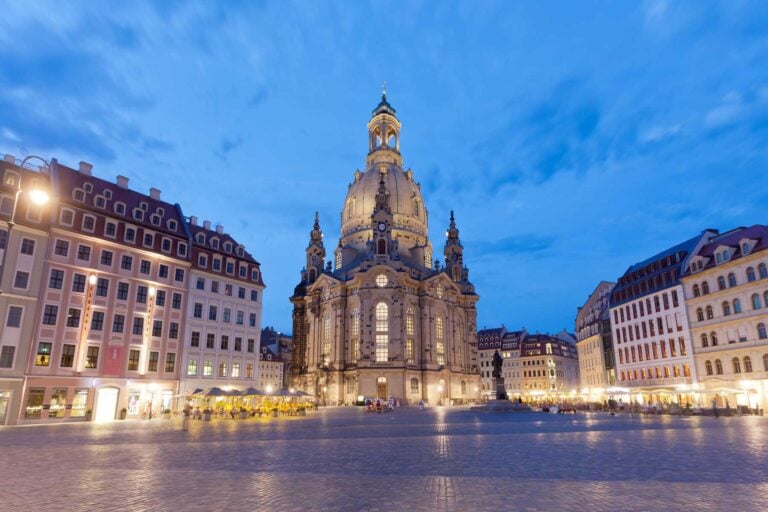
I am standing in Neumarkt Square in Dresden when the feeling hits me. It is a brilliant spring evening. Café tables fill the cobblestones. People laugh. A street musician plays somewhere nearby.
And there, rising above it all, is the Frauenkirche — Dresden’s Church of Our Lady — pale and gold and magnificent, its great dome in soft light.
I have stood in this square before.
It was 1987. I was 19 years old, an American exchange student studying in Vienna who had gotten the rare opportunity to spend a month in what was then East Germany — the German Democratic Republic, a Soviet satellite state in the grip of the Cold War. I had taken a day trip to Dresden.
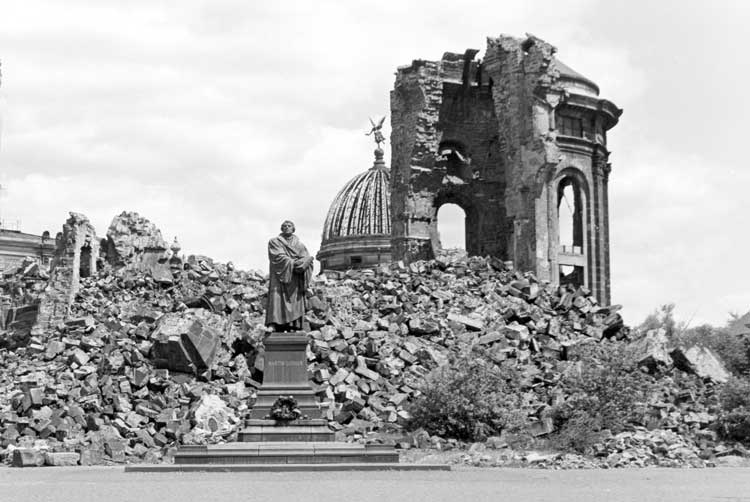
What I remembered from that visit was gray. Everything was gray. The buildings were dark with decades of pollution, unrepaired, uncared for. And in the center of the square, where the Frauenkirche now stands in its full Baroque glory, there were ruins. Just piles of ruins, covered in snow.
The church had been firebombed in February 1945, and for more than 40 years, East Germany had left it exactly as it fell, a monument to destruction, or perhaps simply a problem too enormous to solve.
I am standing here now, in front of a towering, beautiful Frauenkirche, and it’s hard to put the two images together.
How Dresden Rose from the Ruins
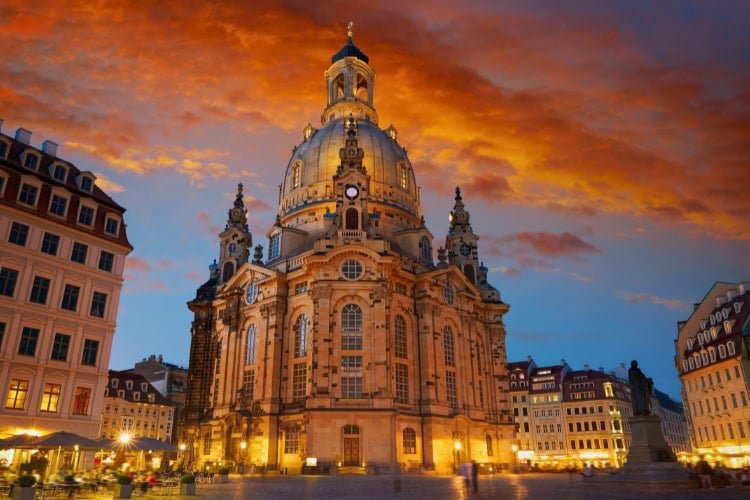
The Frauenkirche was rebuilt stone by stone starting in the 1990s, completed in 2005, funded largely by international donations, including major contributions from Americans, and driven above all by the insistence of Dresden’s own citizens.
One detail about the church really moves me: the golden cross crowning the dome was crafted by a British goldsmith, the son of an RAF airman who had helped bomb the church that fateful day in 1945. It was placed there as an act of reconciliation.
“The beauty of Dresden was regained only by the pressure and dedication of the local population,” Christoph Münch, director of Dresden Tourism, tells us over lunch. “Dresden citizens didn’t give up. They put so much pressure that in the end, we got our historic center back.”
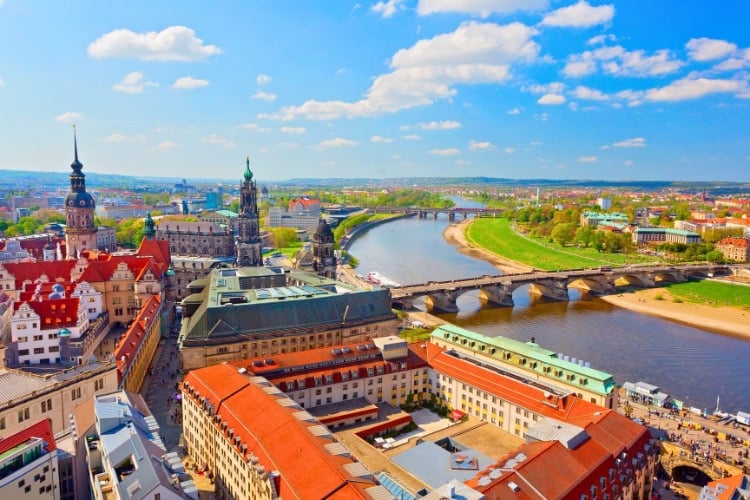
That sentence is the key to understanding Saxony, a German state in eastern Germany bordering Poland and the Czech Republic. It’s about two hours south of Berlin by train.
Many visitors to Germany overlook this region in favor of Berlin or Bavaria. I think that’s a mistake.
Saxony is one of Europe’s great surprises, offering extraordinary mid-size cities humming with culture and reinvention alongside tiny towns of almost improbable beauty and historical depth. Getting off the beaten path here doesn’t feel like a compromise. It feels like a discovery.
Leipzig: Bach, Porsche, and a Rainforest in the City
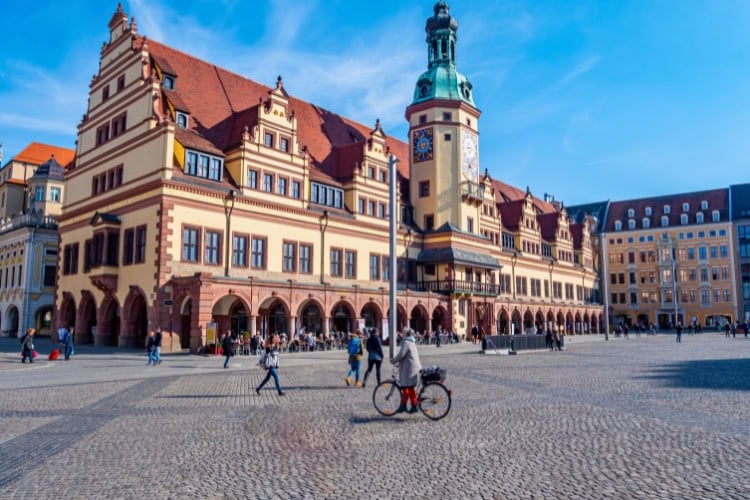
Traveling with friends, we began our trip several days earlier in Leipzig, Saxony’s largest city, with a population of around 634,000. One of the oldest trade fair cities in the world, Leipzig is also a powerhouse of music and culture whose heritage rivals Vienna’s.
It’s a place I visited briefly in 1987, and like Dresden, it has transformed beyond recognition. What I remember from that time is a drab, closed-off city, but today, I find a confident, vibrant place that wears its history lightly and its ambitions openly.
A Stay at the Steigenberger Grandhotel Handelshof
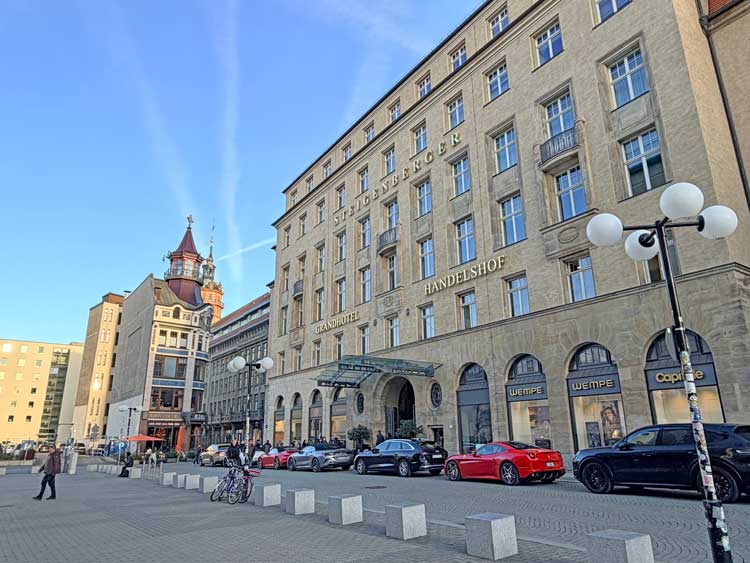
My home base for two nights is the Steigenberger Grandhotel Handelshof, housed in a magnificent 1909 trade fair palace right on the market square. Modern luxury has been folded seamlessly into the historic shell, with contemporary glass and furnishings set against a foundation of century-old stone.
The staff is warm, genuinely fun, and unflappably professional. One travel writer has compared them to the hotel staff in Wes Anderson’s fictional film, The Grand Budapest Hotel, an apt comparison, even if that film was actually shot in Görlitz, our next destination.
Niemeyer Sphere
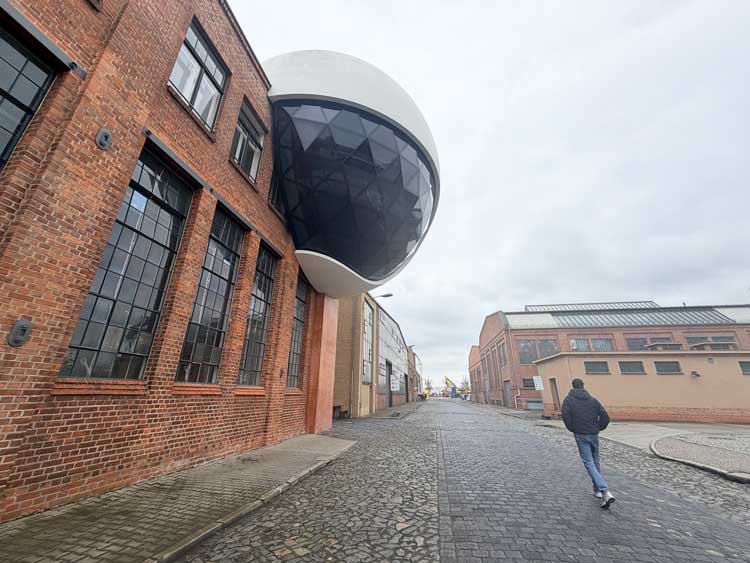
Our first afternoon in Leipzig takes us to the Niemeyer Sphere, a striking, futuristic structure completed in 2020 on the campus of Kirow, the world market leader in railway crane manufacturing, where the company still builds cranes on-site today.
Based on one of the final designs by Brazilian architect Oscar Niemeyer before his death, the grand sphere is the only Niemeyer design realized in Germany in decades.
A Visit to the Porsche Leipzig Factory
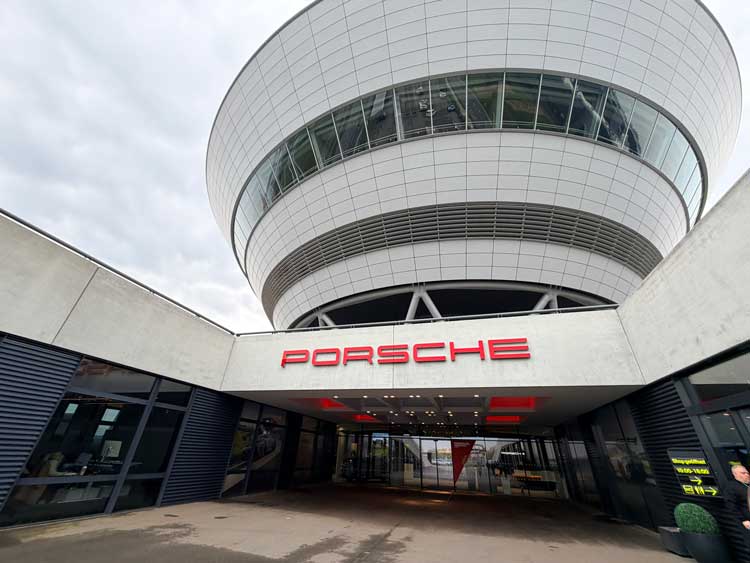
Next, we tour the Porsche Leipzig plant, the company’s second production site in Germany after its home base in Zuffenhausen, where about 550 Macans and Panameras are built largely by hand every single day. Each one is built to the buyer’s exact specification.
No photos or videos are allowed inside, which only adds to the sense of witnessing something rare. Afterward, I get to test drive a Cayenne on the facility’s off-road course: hills, uneven terrain, mud. A thoroughly unexpected way to spend a morning in Germany.
Leipzig’s Bach Museum, Coffe Baum, and the Church That Changed History
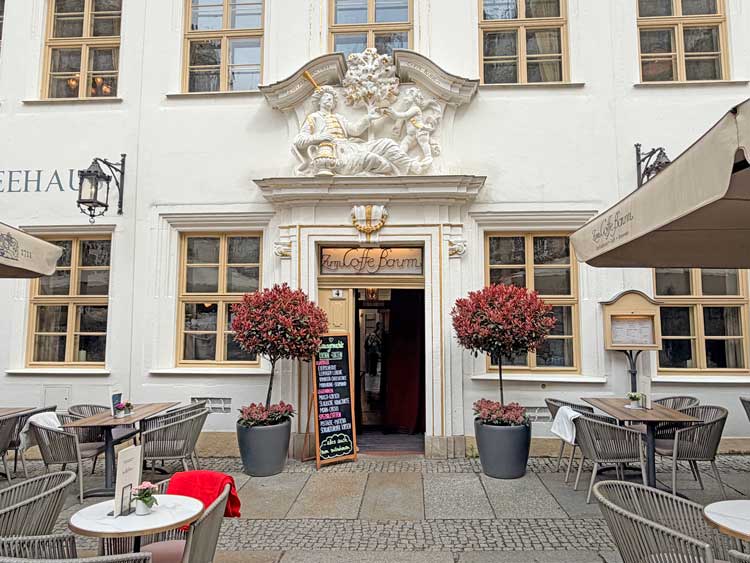
Back in the city center, we have lunch at Zum Arabischen Coffe Baum — the Arabian Coffee Tree — one of the oldest coffeehouses in Europe, serving Saxon coffee culture since 1711. Bach drank here. So did Napoleon and Schumann.
The Leipzig Bach Museum offers a virtual encounter with the composer himself. In the historic summer hall of the Bose House, where Bach once played music privately with the family, the master appears on screen and sits down at the harpsichord.
It is unexpectedly moving to view this simulation of the master himself. Bach spent the last 27 years of his life in Leipzig. St. Thomas Church is where he is buried.
St. Nicholas Church, just steps away, is where the Peaceful Revolution of 1989 began, with candlelit protests that helped bring down the Berlin Wall. Leipzig holds its history close.
Leipzig Zoo and An Indoor Rainforest
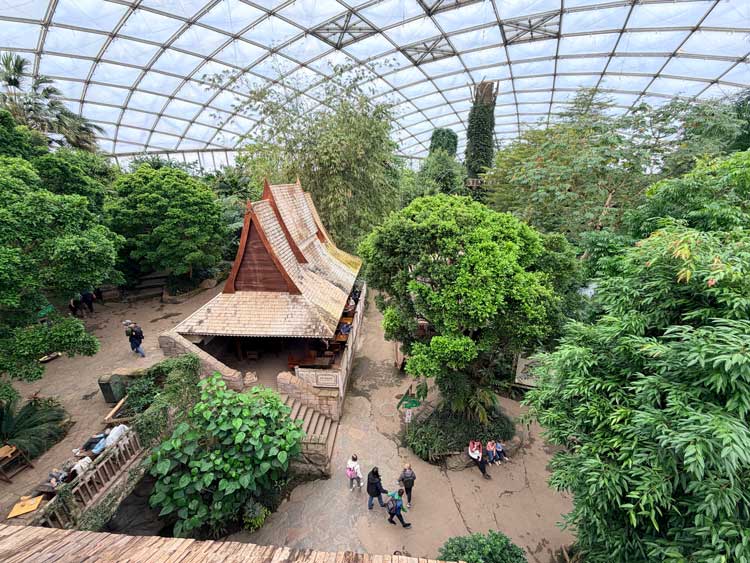
Our next stop takes a lighter note. The Leipzig Zoo is a favorite with locals and visitors. Founded in 1878, Leipzig Zoo has spent two decades reinventing itself, and Gondwanaland is the result: an indoor tropical rainforest the size of two football fields, with nearly 170 animal species and 500 plant varieties across three continents.
The roof soars 34 meters, with real planting — more than 24,000 plants — and full UV light pouring through. Walking through it feels less like visiting a zoo and more like stepping into another continent.
The 500-Year-Old Auerbachs Keller
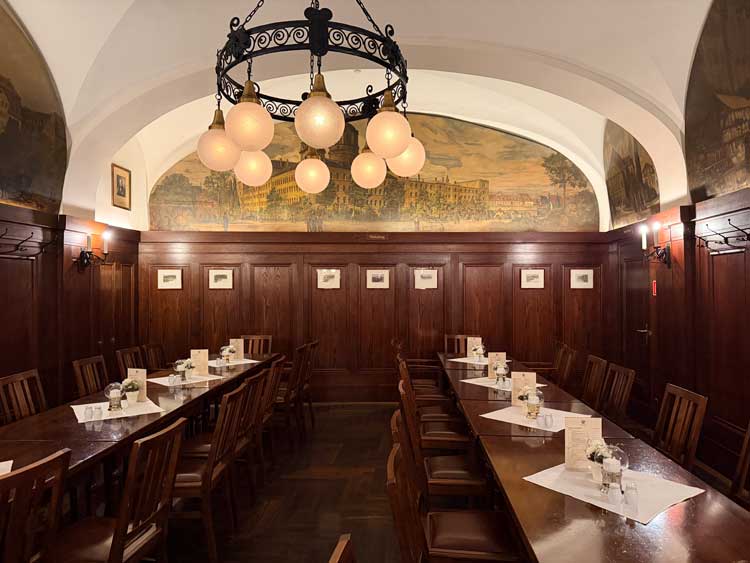
That evening, dinner is at Auerbachs Keller, one of the world’s most famous restaurants, which recently celebrated its 500th anniversary and is immortalized in Goethe’s Faust. We eat well. It feels like exactly the right way to end a day in Leipzig.
Colditz Castle: The WWII Prison No One Could Escape
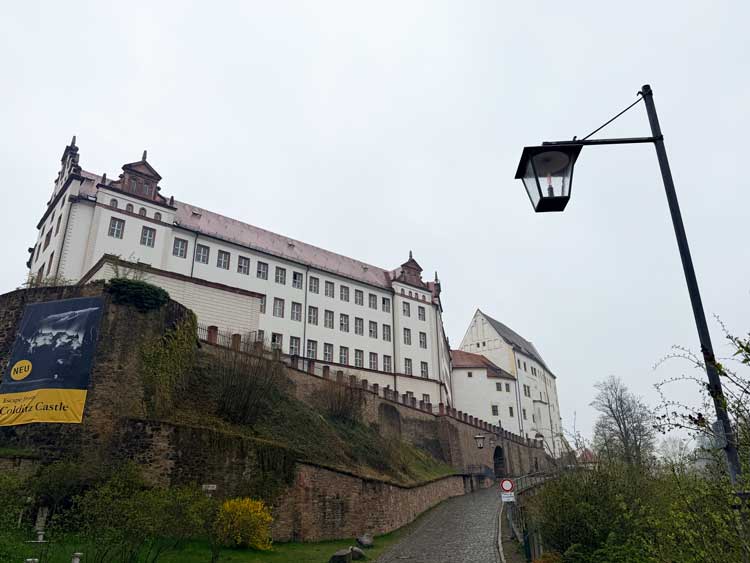
From Leipzig, we drive east to Colditz, where the famous WWII castle perches above the town like something out of a dark fairy tale.
The Nazis used this medieval fortress as a maximum-security prisoner of war camp for Allied officers who had already escaped from other camps — the escape-prone, the troublemakers, the incorrigible. The Germans considered it escape-proof. The prisoners considered that a challenge.
What followed was one of the most extraordinary contests of the entire war. The French dug a tunnel of staggering length and precision. Others forged documents, fashioned civilian clothes from scratch, and bribed guards. Dozens made it out.
Two British RAF secretly built a full-sized glider in a concealed workshop above the castle chapel, constructed from wooden bed slats and blue-and-white checked cotton, designed to launch from the rooftop via a concrete-filled bathtub as a counterweight.
When American forces liberated Colditz in April 1945, the glider was ready to fly. But they never needed to use it.
Visiting Colditz Castle Today
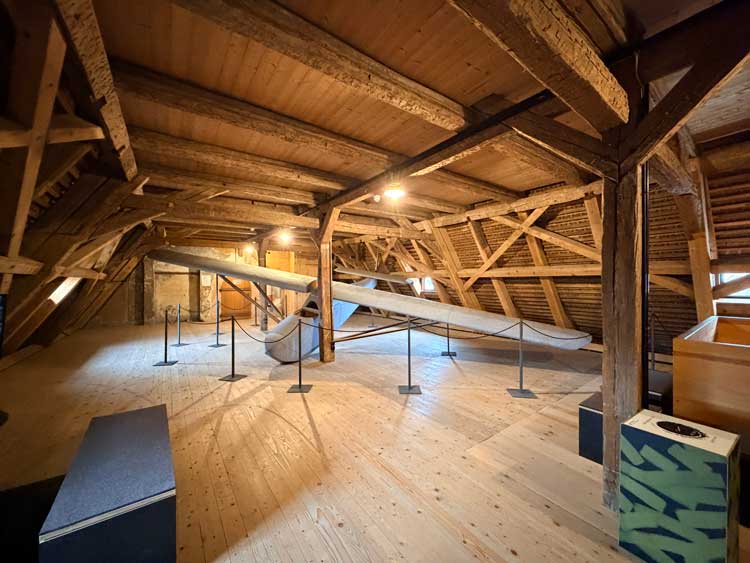
Colditz has created a fun way to see what it looked like back then. You can borrow a digital tablet at the castle today and hold it up to the rooms around you.
Augmented reality layers wartime life back into the spaces across five floors and a thousand years of history. The tablet is available in eight languages, and it is well-suited for school-age children and up.
Görlitz: Straddling Germany and Poland
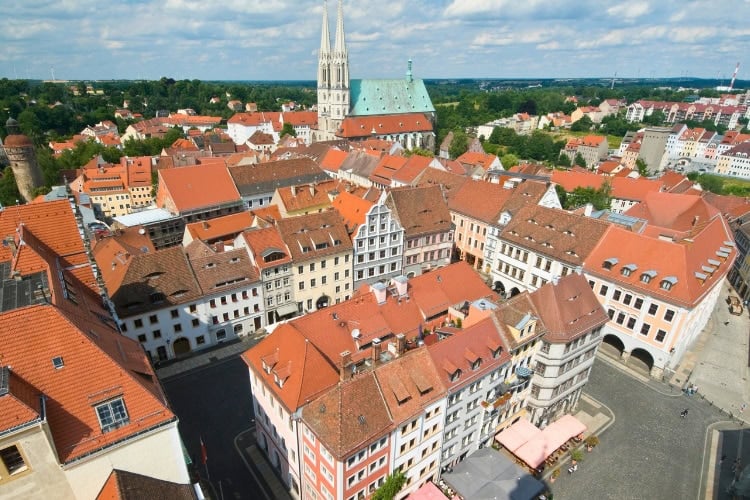
The following day brings us to Görlitz, a city of around 57,000 that is widely considered one of the most beautiful towns in Germany. With more than 4,000 protected buildings, it has the largest collection of historic architecture in the country.
Görlitz is bisected by the Polish border; its historic town center sits in Germany, while its eastern half became the Polish city of Zgorzelec at the end of the war. You can walk across the bridge in minutes and be in another country.
Movies Filmed in Görlitz
Film crews have used Görlitz for decades — The Grand Budapest Hotel, The Reader and Inglourious Basterds were all shot here. It is that kind of city: so cinematically intact it feels almost impossible.
A prosperous center of Jewish life and culture until 1945, the city had the only synagogue in Saxony to survive the Night of Broken Glass; today it serves as a cultural center.
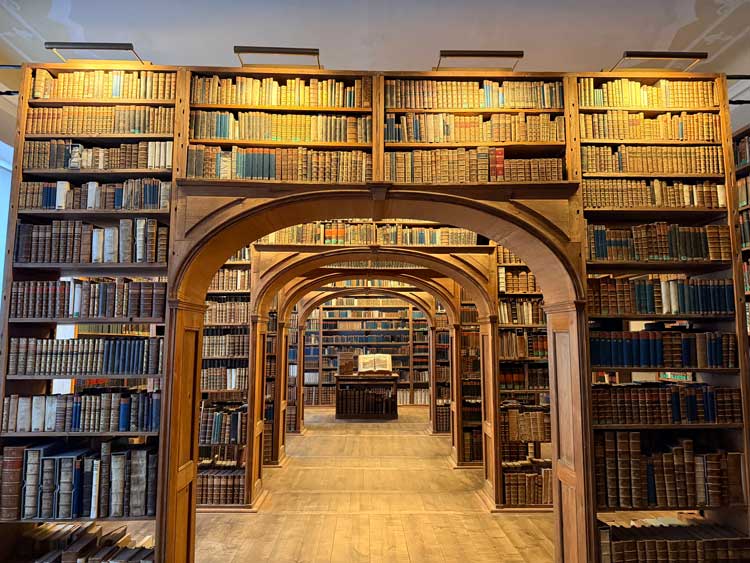
The city’s Baroque library in Görlitz holds books dating to the 12th century. Every corner turns up something extraordinary.
Where to Stay and Eat in Görlitz

We spend the night at the Hotel Tuchmacher, a beautifully restored historic property right in the old town. It is a perfect base for exploring on foot at the golden hour, when Görlitz empties of day-trippers and the streets feel almost entirely yours.
For dinner, we dine at the lovely Lucie Schulte restaurant. The food is delicious and beautifully presented. The poppy seed dessert is so good that I almost ask for a second helping.
Herrnhut: The Tiny Saxon Town Behind the Famous Moravian Star
Herrnhut, a small town of just 1,400 in Upper Lusatia, is a different kind of revelation. A UNESCO World Heritage Site since 2024, it is the birthplace of the Moravian Church, founded in the 18th century by Protestant refugees fleeing persecution in what is now the Czech Republic.
The Moravians established other settlements using Herrnhut as their blueprint, including Bethlehem, PA (USA), Gracehill (Northern Ireland/UK), and Christiansfeld (Denmark). The four settlements are now jointly recognized as a transnational UNESCO site. The Herrnhut community today numbers around 5,000 in the surrounding region.
The Famous Herrnhut Star
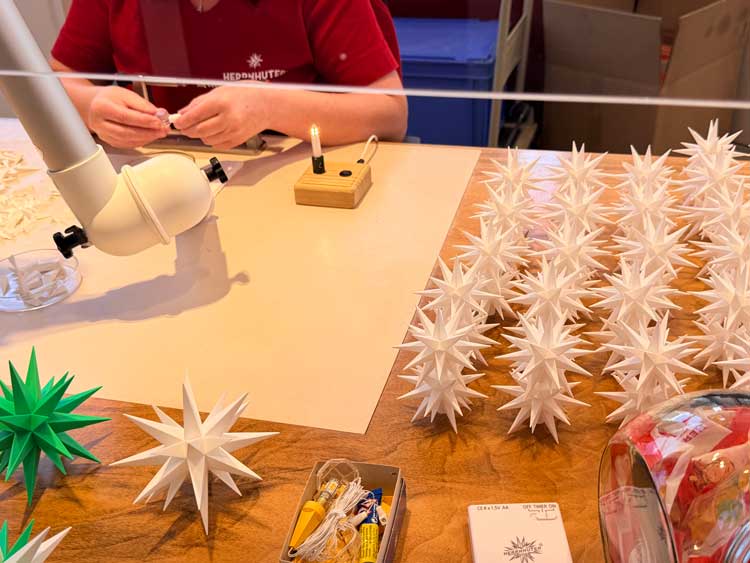
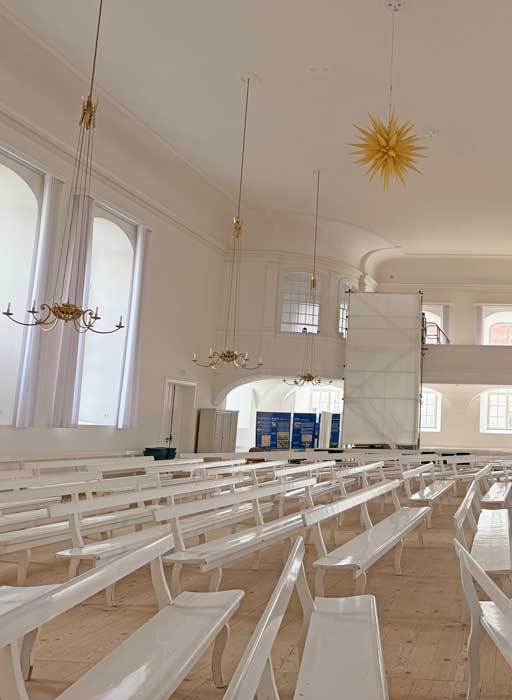
The Herrnhut Star was born here, too. The distinctive 25-pointed paper star was created in the 19th century by a teacher who used geometry lessons to keep students occupied during Advent.
Today, the manufacturer still makes them largely by hand, and visitors can watch the process. On our visit, I purchase a few of my own to take home. During the Christmas season, the Hernnhut Stars glow in windows across Germany.
Meissen Porcelain Manufactory: Where Europe’s Finest Porcelain Is Still Made by Hand
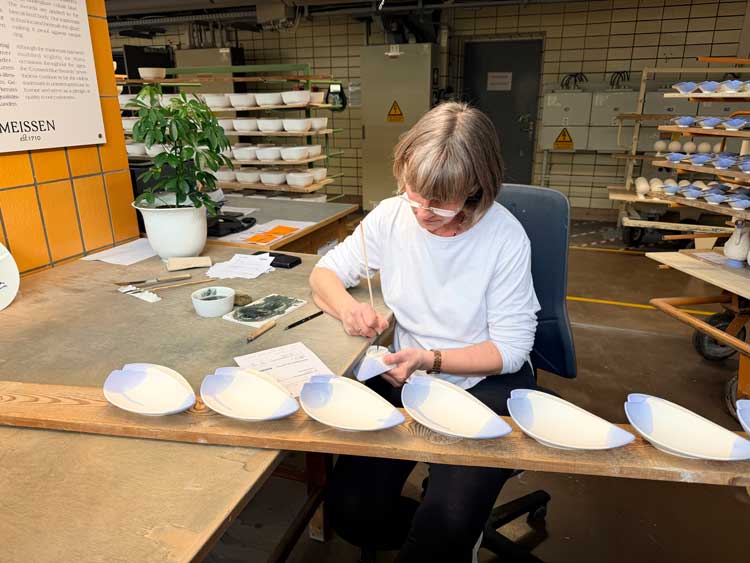
We end the day in Meissen, where European hard porcelain was invented in Dresden in 1708, and production was transferred here in 1710. The Meissen Manufactory still uses the world’s oldest continuously used trademark: the famous Crossed Blue Swords.
Painters can begin their training at 16, meticulously painting and producing the company’s beautiful porcelain. The manufacturer has more than 7,000 working molds. Every logo is still applied by hand.
The behind-the-scenes tour is an interesting two hours. We watch painters bend over pieces with brushes so fine they seem impossible, applying patterns replicated in this building for more than 300 years.
Dresden, Germany: A City That Refused to Stay Buried
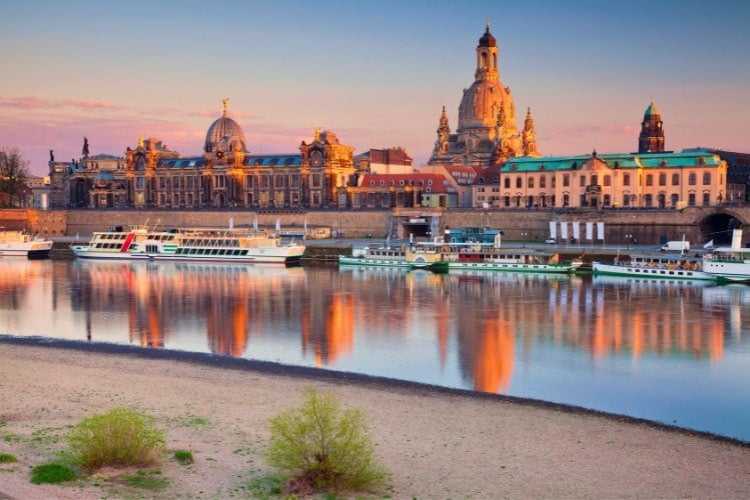
Later in the week, we reach Dresden, with a population of around 574,000, and the square, and that moment of reckoning.
We check into the Holiday Inn Dresden Am Zwinger, which is well-located for walking to all of the city’s major sites, with the Frauenkirche, the Zwinger, and the Royal Palace all within easy reach on foot.
Dresden Royal Palace
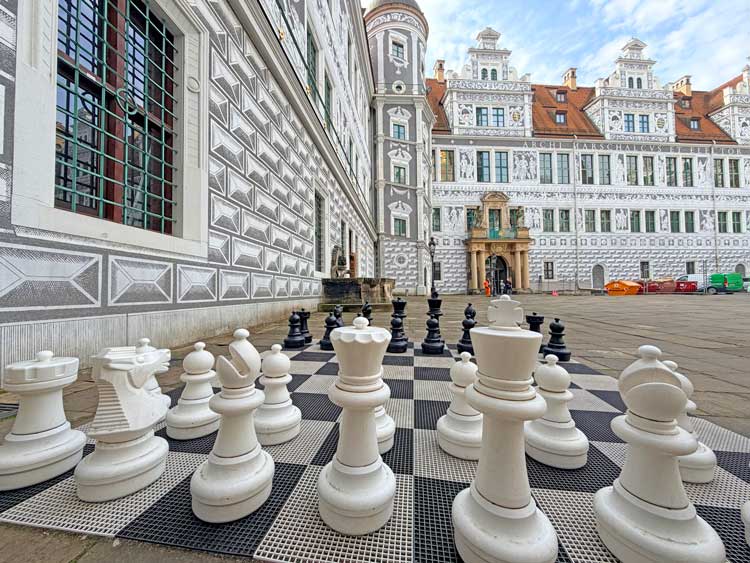
Our first stop is the incredible Dresden Royal Palace, which has been under reconstruction for 40 years. It is nearly complete, its Baroque state rooms finally restored to their full gilded splendor.
We walk through the new “Masks and Crowns” exhibition in the grand Festetage apartments — some of the last rooms to be finished — and the scale of what was lost and then reclaimed is almost overwhelming. The Dresden State Art Collections housed here are counted among the finest in the world.
Why Dresden Should Be on Every Traveler’s Bucket List
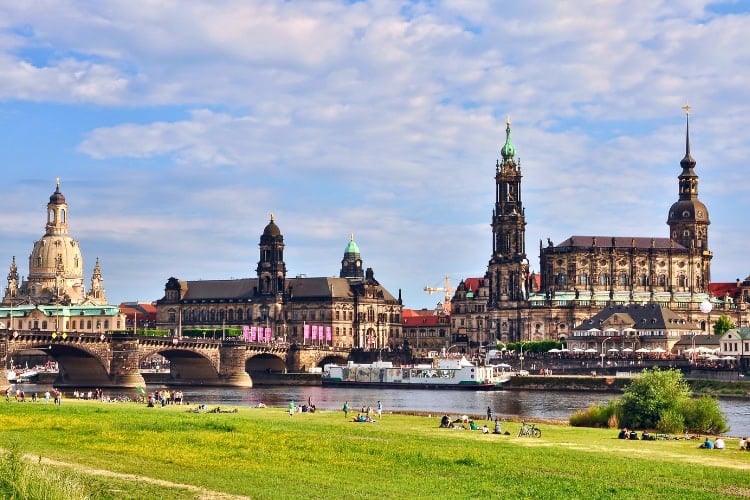
From destruction to reconstruction, Dresden is a stunning, vibrant city. Its old town today is a walk through the city’s most beautiful past. But it is not a museum. The outdoor patios are full. The restaurants are noisy.
Across the Elbe, the neighborhood known as Dresden’s New City buzzes with artists, young people, and alternative culture. There is a bike trail along the Elbe, a Saxon wine trail through vineyards, and enough green space to make a case for Dresden as an outdoor destination too.
But it is the Frauenkirche that stays with me. Not because it is the most spectacular thing I see in Saxony — though it may be. Because of what it represents.
Dresden is a city that refused to accept its own destruction. A community that fundraised and lobbied and fought for decades to reclaim something irreplaceable.
I came to Saxony expecting to be impressed. I didn’t expect to be moved. But that is what happens when you spend time in a place that has fought so hard and so successfully to become itself again.
Whatever brings you here, whether it’s Bach or Porsche, Colditz or Meissen, the Frauenkirche or a rainforest inside a zoo, you will leave with something you didn’t expect. That’s the best thing travel can do.
If You Go: Planning Your Trip to Saxony, Germany
Getting There
Most travelers fly into Frankfurt (FRA) or Berlin Brandenburg (BER) and connect onward. Both Leipzig/Halle Airport (LEJ) and Dresden Airport (DRS) have direct European connections. From Frankfurt, Leipzig is roughly 3.5 hours by train; from Berlin, Leipzig is about one hour, and Dresden is around two hours by Deutsche Bahn high-speed rail. The train network in Saxony is excellent, making renting a car optional for those sticking to the major cities, though a car is recommended for reaching smaller destinations like Herrnhut, Colditz, and Görlitz.
When to Visit Saxony
Saxony is a year-round destination. Spring (April–May) and early autumn (September–October) offer pleasant temperatures and fewer crowds. Summer brings festivals, including the Dresden Music Festival (May–June) and Leipzig’s celebrated Bachfest in June. Winter is magical: Dresden’s Striezelmarkt is one of Germany’s oldest and most authentic Christmas markets, and the Herrnhut Stars glowing in Görlitz’s old town during Advent are unforgettable. Saxony at Christmas is less crowded than other German destinations and more authentic than many travelers expect.
Saxony Travel Tips
Allow at least five to six days to cover Leipzig, Dresden, and the smaller destinations between them. Görlitz is about 1.5 hours east of Dresden by car and well worth an overnight stay. Meissen is an easy 30-minute drive or train ride from Dresden. Book Porsche factory tours well in advance — they fill quickly. For the Meissen Manufactory, the behind-the-scenes tour is strongly recommended over the standard visit.
For trip planning, visitsaxony.com is an excellent English-language resource.

- 9 Places to Experience Amazing Sea Life Up Close - September 15, 2026
- Beyond the Beaches: Sydney’s Thriving Arts Scene Awaits - September 13, 2026
- Quietcations: 12 Places to Step Into Nature and Recharge - September 10, 2026
Planning another trip soon? ✈️
Add GoWorldTravel.com as a preferred source on Google. Click the button below so our local guides, packing hacks, and hidden-gem itineraries always show up first when you search!
Add to Preferred Sources