
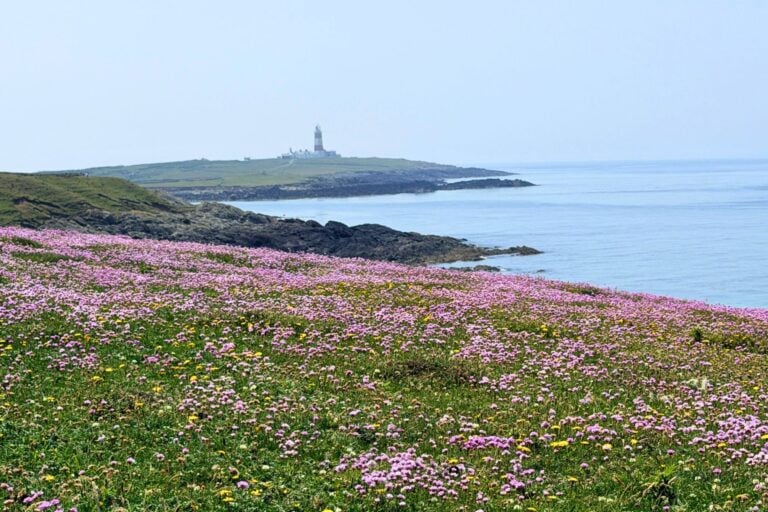
I’m following a narrow sheep path along the cliffs of Bardsey Island, and there is nothing between me and the sea but a hundred feet of air. Below, in the bay, eight gray seals are playing in the water. I can hear their grunts carrying up on the wind.
Aside from my friends, I haven’t seen another soul on this trail. There are no wifi bars in the corner of my phone. No hum of traffic. Just the sea, the sky, and the seals.
Bardsey Island (Ynys Enlli), Wales’s Most Remote Island
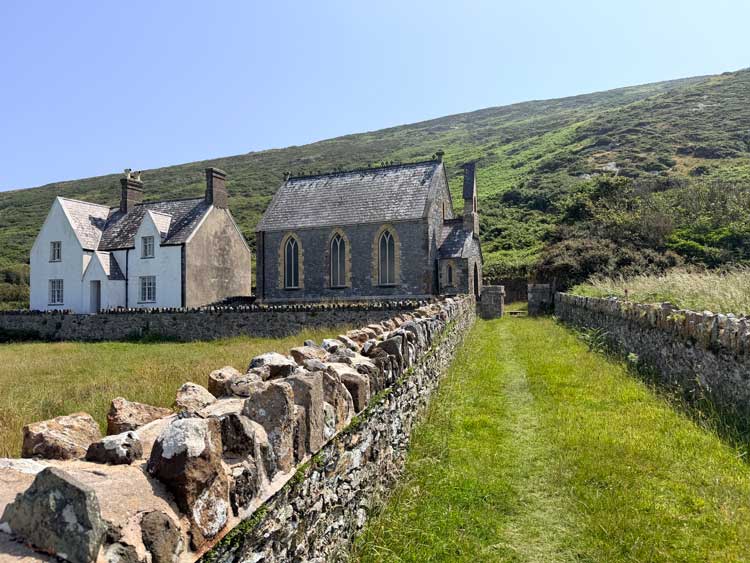
Only fifteen day visitors are allowed to visit Bardsey Island at a time, and today my friends and I are five of them. Ynys Enlli, to give it its Welsh name, is the most remote Welsh island open to the public, sitting two miles off the tip of the Llŷn Peninsula.
The island is barely a mile and a half long. It has its own small mountain, just 167 meters high, and its own long memory: some 20,000 saints are said to be buried here, and pilgrims once believed that three trips to Bardsey equaled one to Rome.
After exploring the island trails, I sit down on a sea wall overlooking the harbor and talk with David, a Welshman who has come out for a week’s vacation in one of the island’s rental cottages. He tells me he was up until one in the morning helping with bird banding, and that afterward he sat outside and watched the moon rise over Orion’s Belt.
Not many people from his village have ever made it out here, he says, even though it is right on their doorstep. He talks in a soft, rolling Welsh accent, unhurried, like a man who has nowhere else he needs to be.
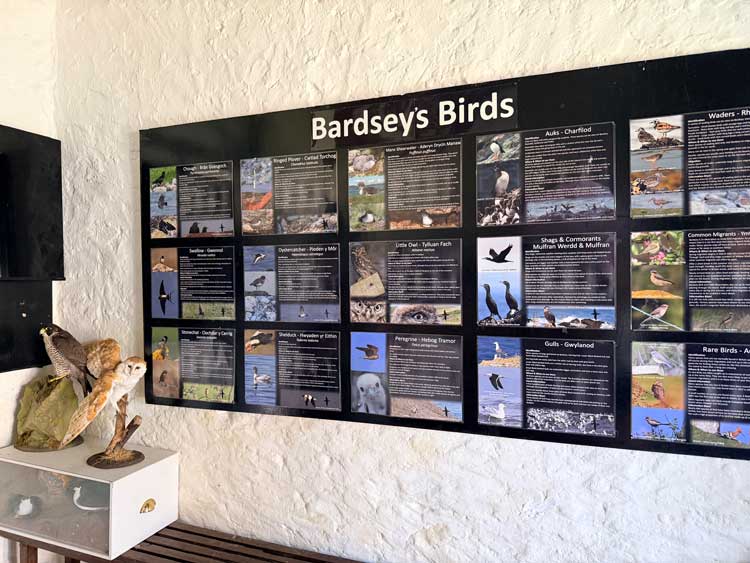
Like others, he was drawn to the island for its birding. Bardsey is one of Britain’s great birding sites. That was obvious as we came in by small boat; we passed thousands of birds in the air, in the sea and along the shoreline, including many puffins, razorbills, guillemots, fulmars, peregrines, and more.
The Bardsey Bird and Field Observatory, founded in 1953, is the only accredited bird observatory in Wales. A visit to their small island center displayed the latest bird sightings.
View my Bardsey Island video on Instagram
Planning a Trip to North Wales
I have come to Wales for five days with four friends, hoping to see some parts of Wales that are off the beaten path. I fly into Manchester from the US, and then we make the short drive across the border into Wales.
Wales is one of four nations that make up the United Kingdom of Great Britain and Northern Ireland, tucked between England and the Irish Sea, roughly half the size of the Netherlands. It has its own devolved parliament in Cardiff and its own language.
Everywhere we travel, we hear Welsh, which is the official language of Wales, alongside English. I love listening to the locals speak it to each other, then watching them switch instantly to English when they realize we’re visitors. School is taught in Welsh here. It is a beautiful living language.
The country is home to just over three million people, and a quarter of its land sits inside a national park or a protected area of outstanding natural beauty. Our trip lets us see some of that.
A Sheepdog Farm Above Bala
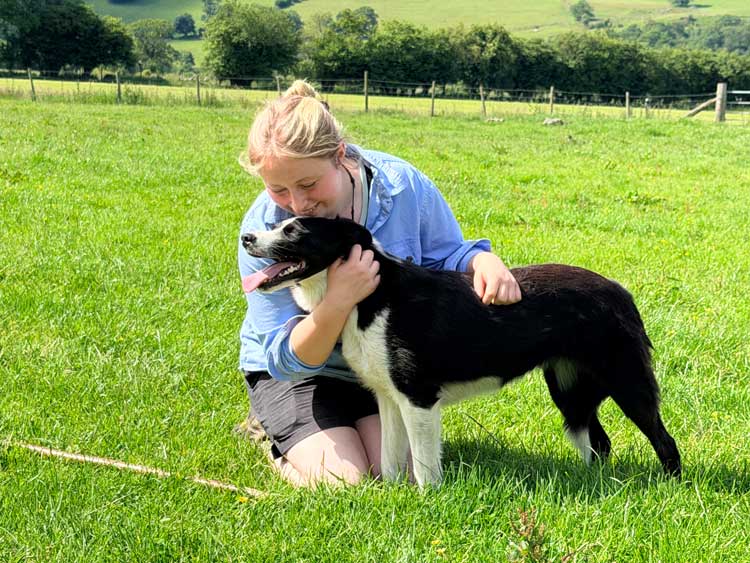
From Manchester, we drive across the border to Bala, a market town at the heart of Eryri, or Snowdonia National Park. We are headed to Pandy Farm Experience, where Erin McNaught greets us alongside Annie, one of her twelve border collies. Erin took over her family’s farm at eighteen. She is twenty-three now, the fourth generation to work this land and train its dogs.
She gives us a sheepdog demonstration with Annie, sending her out wide around a flock of sheep with a whistle and a word.
Her family raises Welsh mountain sheep, hardy animals whose lambs learn their home ground on the mountain from their mothers. Erin tells us her mother was the first woman to represent Wales in the sport’s national finals, a hard road in a sport still dominated by men. Afterward, we sit down to tea and homemade Welsh cakes while she tells us more about the farm’s history.
Glamping in Snowdonia National Park
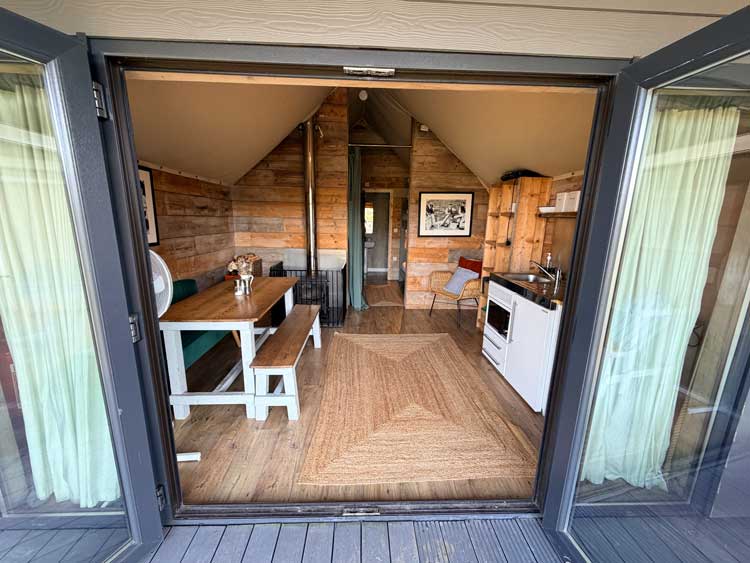
That night we stay at Llechwedd Glamping Pods, part of the Plas Weunydd estate in Blaenau Ffestiniog, a slate town wedged between the Moelwynion mountains and surrounded on all sides by Eryri, or Snowdonia National Park.
Each of us gets our own glamping pod. Each pod can sleep up to four people, with bunk beds and a small kitchen, and would be perfect for a family. The pods sit on the hill overlooking the old quarry works, a landscape still marked by more than a century of slate mining. It is a unique, striking place to fall asleep, half wild mountain and half industrial memory.
Biking the Mawddach Trail
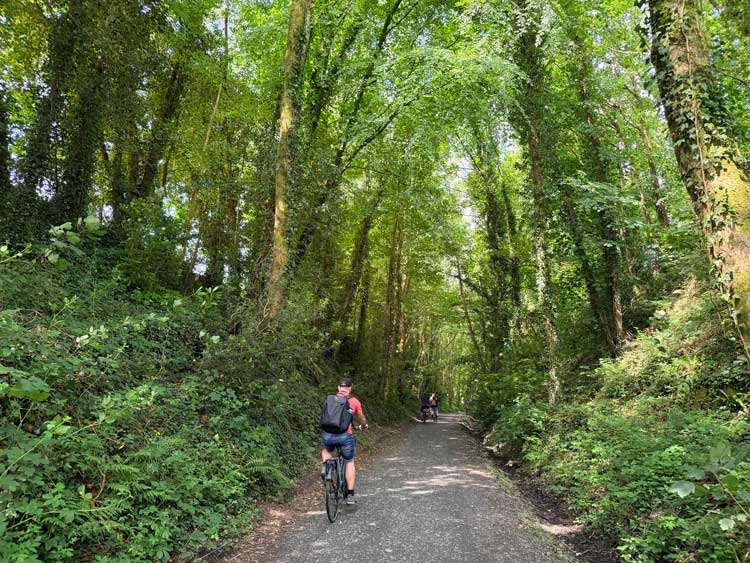
In the morning we head south to Dolgellau to bike the Mawddach Trail, a flat, largely traffic-free path laid over an old railway line along the Mawddach estuary in southern Snowdonia.
Owned and maintained by the Snowdonia National Park Authority, it’s wide enough for wheelchairs and walkers as well as cyclists, and it runs for about nine and a half miles between Dolgellau and Barmouth, though we only cover a stretch of it.
The trail slips in and out of a canopy of trees, opening now and then onto wide views of the estuary and the hills beyond.
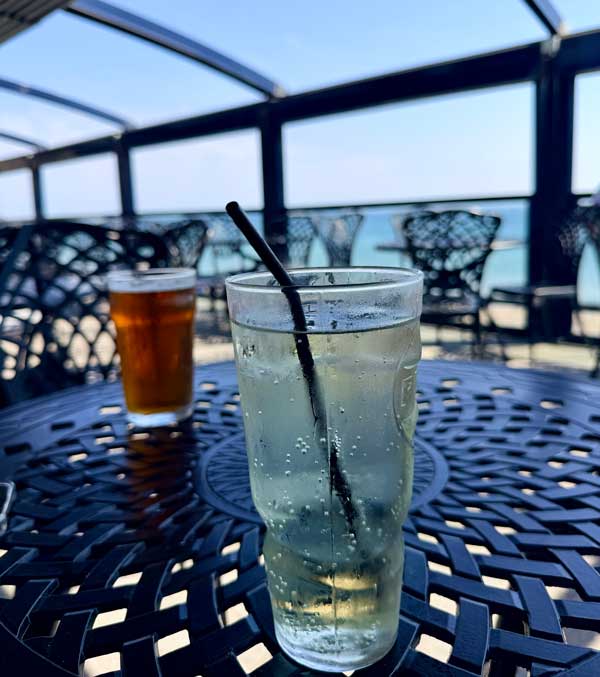
We stop for a cool drink at the Estuary Bar at the George III Hotel in Penmaenpool, sitting right on the banks of the Afon Mawddach. In my short time here in Wales, I have come to like their “lime and soda”, a simple, refreshing pub drink of soda water and a splash of sweet lime cordial, the kind of thing that tastes perfect after an hour on a bike in the sun.
Castell y Bere, a Welsh Castle Without the Crowds
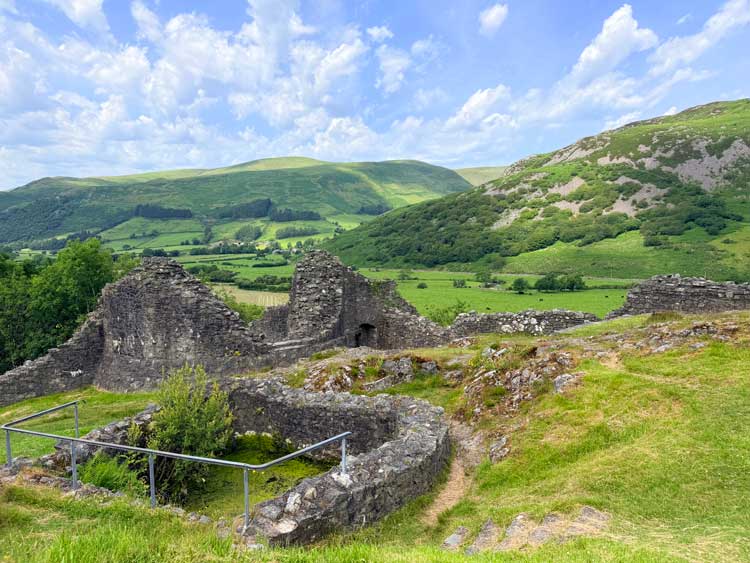
From there we drive to Castell y Bere, a ruined castle stretched along a rocky outcrop above the Dysynni valley. It was built in 1221, and it looks it: wild, remote, half swallowed by the hillside.
There is no crowd, just the wind and the shape of an old D-shaped tower that once guarded the southern border of Gwynedd. We have the whole place to ourselves, and we explore the ruins under a clear blue sky, lush green fields spreading out below us in every direction, the remnants of a vibrant past scattered across the hillside.
Welsh Gin and Sustainable Tourism at CAT
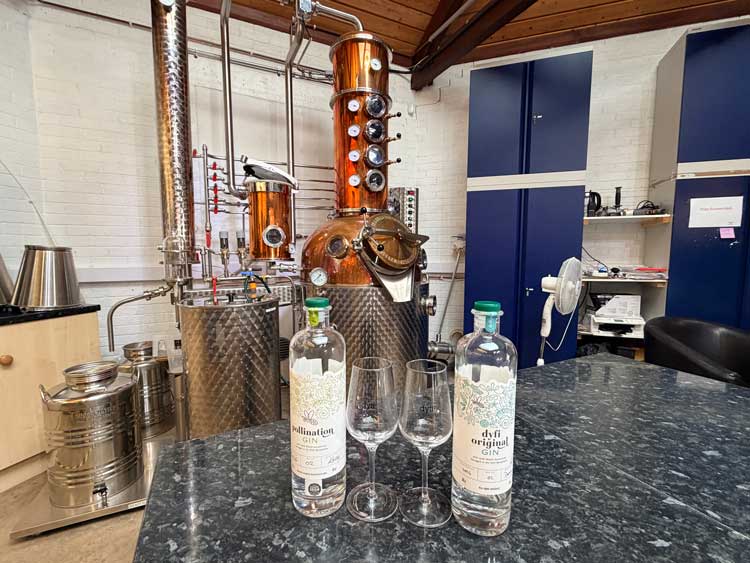
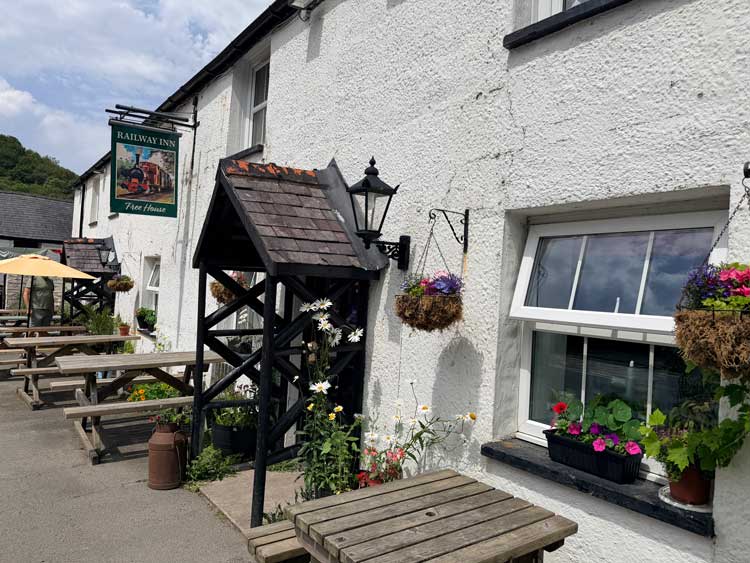
Lunch is at the Railway Inn in Abergynolwyn, a family-run pub in the heart of Eryri (the Welsh name for Snowdonia), before we continue to the Dyfi Distillery, a small-batch Welsh distillery. Brothers Danny and Pete Cameron founded it and run the place. Everything about it is tied to the surrounding landscape.
They forage their own botanicals, including elderflower, which they say they can trace back to the exact few square meters where it was picked.
Everything is harvested at peak quality, then snap frozen. It is one of very few distilleries anywhere doing this kind of hyper-local, foraged production. I’m so impressed by the different tastes that I buy a few small bottles to bring home.
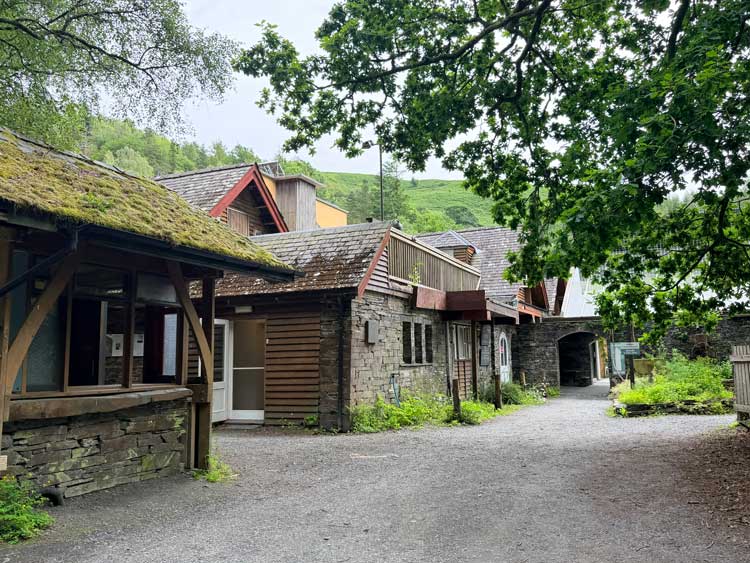
Just down the road is the Centre for Alternative Technology, or CAT, built on a former slate quarry back in 1973. What was once barren waste rock is now gardens, woodland, ponds, and award-winning environmental buildings, all powered by the systems it teaches visitors to build.
CAT runs a postgraduate school alongside short courses in everything from beekeeping to building a clay oven to a five-day course in constructing your own tiny house. We walk through a stretch of Celtic rainforest on the property, something I did not know existed in Wales until this trip.
A Scenic Train Ride and Fish and Chips in Barmouth
From Machynlleth, we swap wheels for rails, boarding the Cambrian Coast train for the short, scenic hour to Barmouth. It is one small example of how this trip keeps choosing lower-impact ways to move through the landscape, bikes and trains over cars wherever it can.
In Barmouth, we pick up fish and chips to go from The Mermaid, a popular local establishment, then carry them down to benches overlooking the beach. The seagulls are waiting, and one dives close enough to almost grab my food. You learn fast to guard your fish and chips around here.
A Historic Coaching Inn in Beaumaris
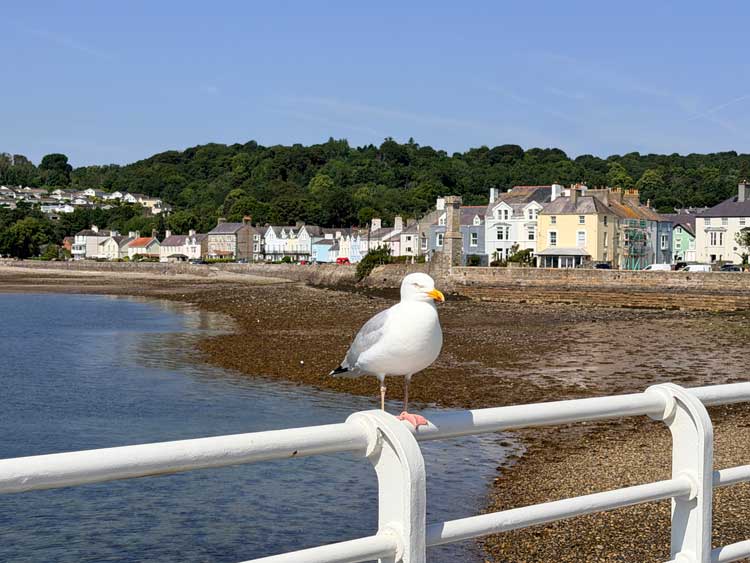
After our day on Bardsey, we cross to the Isle of Anglesey and the popular seaside town of Beaumaris, spending the night at the historic Bull’s Head Inn. Some of its timbers date to 1472.
Charles Dickens is said to have stayed here, and the low ceilings, log fire, and worn stone staircase make that history easy to believe. We settle into the lounge with a round of local ales before dinner, the kind of room built for lingering.
Beaumaris Castle
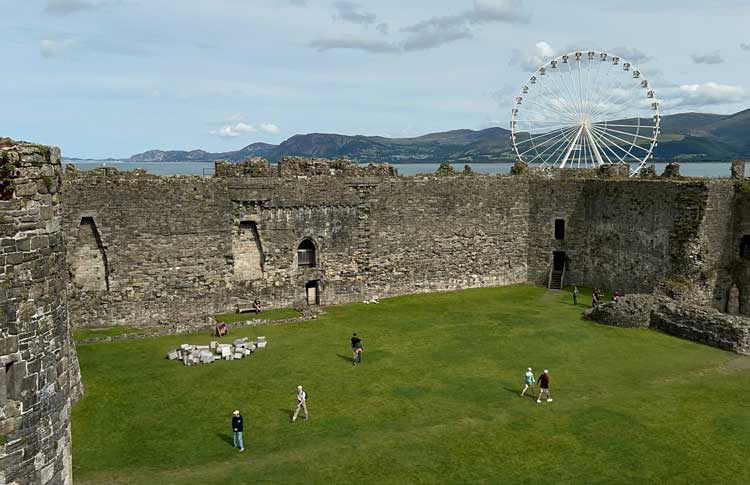
Beaumaris Castle looms over the town of Beaumaris, unfinished and strangely beautiful. It’s part of the Castles and Town Walls of King Edward in Gwynedd World Heritage Site.
The castle’s squat, symmetrical walls still tell the story of a fortress that never quite got finished, which is somehow part of its charm.
A Puffin Island Cruise on Anglesey
The next morning we board a Puffin Island cruise out of Beaumaris, a family-run outfit that has been doing this for years.
Puffins themselves only nest here for about three months of the year, so the name undersells what is really on offer: grey seals hauled out on the rocks, dense colonies of seabirds, and on our trip, a pod of dolphins that surfaces alongside the boat.
The Longest Place Name in Europe
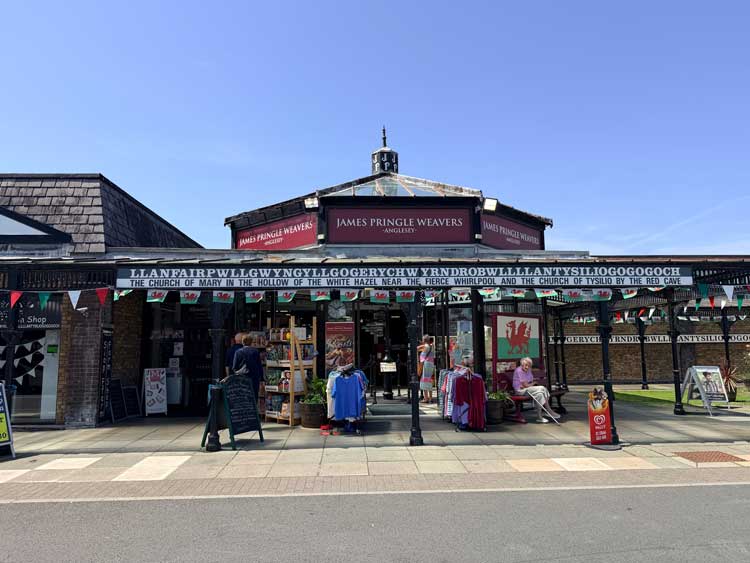
Back on land, we make the obligatory stop in Llanfairpwllgwyngyllgogerychwyrndrobwllllantysiliogogogoch, a village in Wales that is famous for having the longest place name in Europe.
Locals rattle off the name with ease, but it is well beyond our skill set. The name strings together a church, a hollow, a white hazel tree, a whirlpool, and a red cave. Trying to say it feels like its own kind of achievement.
Anglesey Sea Salt at Halen Môn
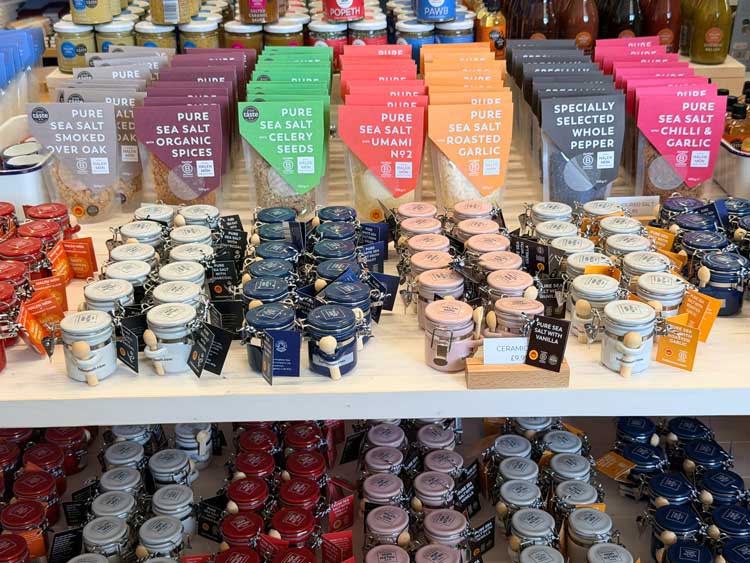
From there we visit Halen Môn, the only salt producer allowed to call its product Anglesey Sea Salt, a protected designation tied to this stretch of coast.
The company is family-owned, started by Alison and David Lea-Wilson, and it is one of the few salt makers anywhere that rinses its salt as part of the process, a labor-intensive step that shapes the large, delicate flakes it is known for.
Rob Jardine, who works in the shop, tells us he takes real pride in seeing the salt turn up on tables around the world, from Trader Joe’s shelves in the United States to kitchens in Italy. Tasting the salt straight, he says, is tasting the place it came from, and standing in the tasting room by the Menai Strait, I understand what he means.
A Night at Bodysgallen Hall
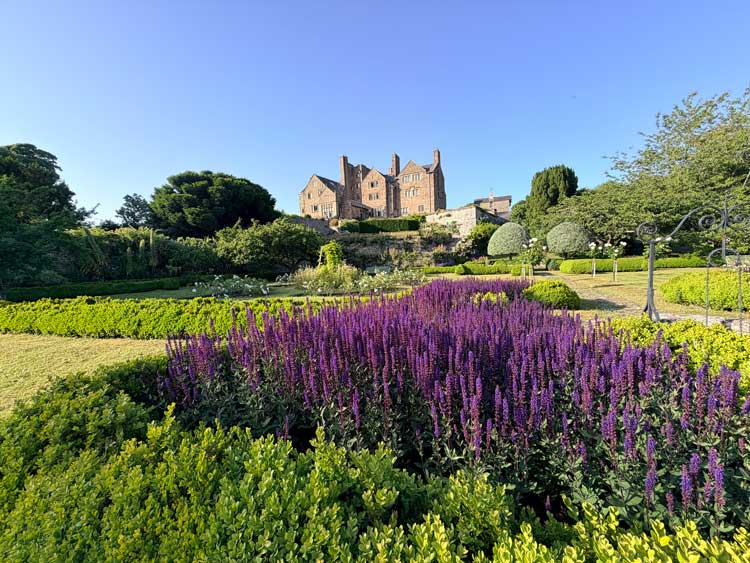
That night we drive to Llandudno and check into Bodysgallen Hall, and it turns out to be my favorite stay of the trip. Parts of the historic mansion date to the 1620s, including a thirteenth-century watchtower on the grounds, built originally to keep an eye on nearby Conwy Castle as it was being constructed.
The estate is now owned by the National Trust, one of Britain’s largest conservation charities, and every stay here helps fund the trust’s public work.
Watch my Bodysgallen Hall video on Instagram
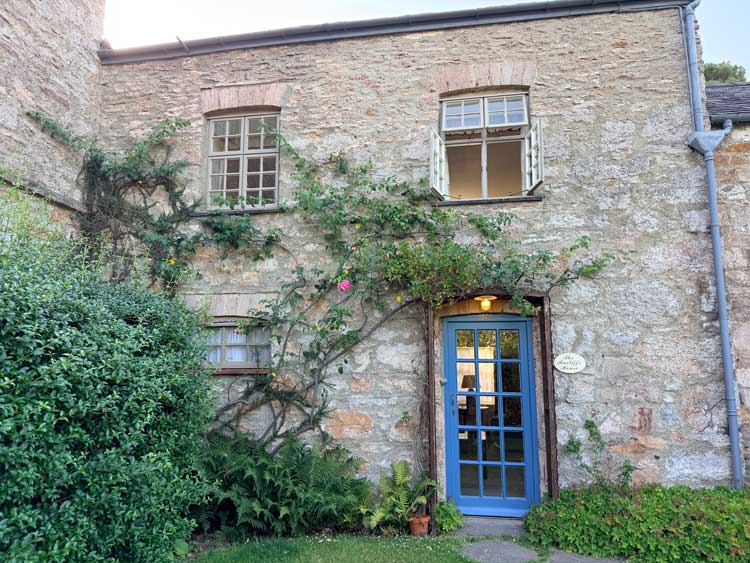
We spend the afternoon exploring the gardens and orchards, before settling in with drinks on the lawn overlooking the gardens. When night falls, I head to my unique accommodations, the Bailiffs House, a cozy cottage set around a courtyard garden with rambling roses climbing the stone walls.
Waking up there the next morning, inside a genuine piece of Welsh history, is one of the best parts of the trip.
Blacksmithing at Wernog Wood
On our last morning, before the drive back to Manchester Airport, we stop at Wernog Wood, a woodland craft center near Ruthin offering more than 30 different courses, from ceramics to wool dyeing to shoemaking, taught by working artists using locally sourced materials.
We meet Rich, a blacksmith, who gives us a short class and lets us try our hand at the forge. It’s fun, and Rich makes it easy with his teaching and assistance.
Courses at Wernog Wood are designed to work for complete beginners as well as more experienced hobbyists, ranging from single-day sessions to week-long courses in things like woodworking, jewelry, ceramics, leatherwork, and metalwork.
You can even stay onsite at one of their unique accommodations. We meet a young couple from England who have done just that; they are at the center to make their own wedding rings.
After our class with Rich, we each leave with a small hand-forged heart hook that we made ourselves, a lovely memento of our time in Wales.
Five days is not long, but Wales does not need long to make its case. I came looking for a place without crowds, and I found sheep farms and slate quarries turned glamping pods, a gin distillery that tracks its elderflower by the square meter, and an island where the only sounds are seals and wind. You just have to be willing to leave the main road to find them.
If You Go: Practical Tips for Visiting Wales
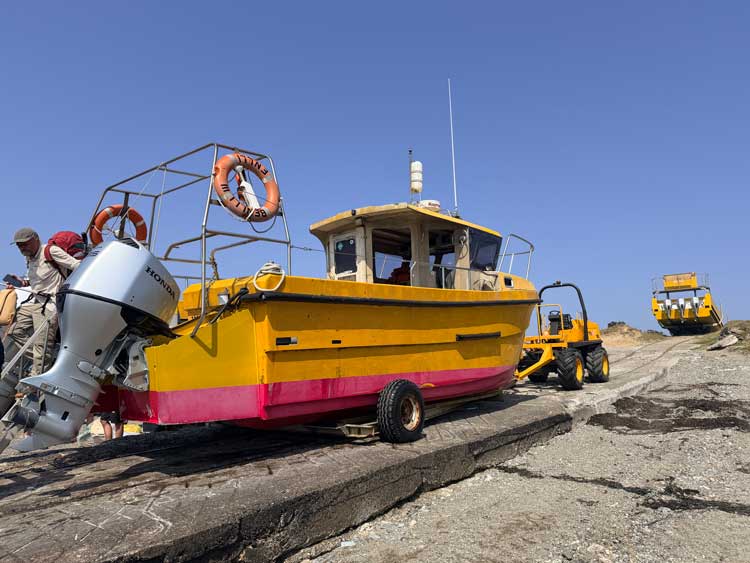
Getting to Bardsey Island takes a bit of planning. Boat trips are run by Colin at Bardsey Island Boat Company, and he does not take bookings by email or through the website. You will need to text him directly to reserve a spot; his number is listed on the site.
Since the crossing is weather dependent, it is worth waiting to book until you have a good read on the forecast. Check the site’s FAQ as well for where to park and meet the boat, since that meeting point is out of the way in its own right.
ETA Required for Visitors
Travelers from 85 visa-exempt countries and territories—including the United States, Canada, Australia, and European Union nations—require an Electronic Travel Authorisation (ETA) to visit the UK. The ETA lasts for two years, and permits stays of up to six months. It’s worth applying for well ahead of time since the requirements have shifted recently.
What to Bring
Pack for all kinds of weather rather than cold weather. We traveled at the height of summer and found it quite warm, with temperatures easily reaching into the 70s and 80s Fahrenheit, so do not assume you need to bundle up just because it’s Wales. That said, rain is always a possibility, so a waterproof layer and sun cream both earn their space in the bag, along with something warm for stargazing at night, since the National Parks here have some of the lowest light pollution in Europe.
Sensible, sturdy shoes matter more than anything technical, given the uneven trails, cobblestones, and castle ruins you will be walking. Remember that driving is on the left, and that rural roads in Wales tend to be narrow and hedge-lined. Carry some cash along with a card, since small farms, craft centers, and rural pubs do not always take cards reliably.
And if you are building your own version of this trip, leave some flexibility in the schedule, since several of the boat crossings and wildlife cruises depend on the weather.
For more information, see VisitWales.com

- 9 Places to Experience Amazing Sea Life Up Close - September 15, 2026
- Beyond the Beaches: Sydney’s Thriving Arts Scene Awaits - September 13, 2026
- Quietcations: 12 Places to Step Into Nature and Recharge - September 10, 2026
Planning another trip soon? ✈️
Add GoWorldTravel.com as a preferred source on Google. Click the button below so our local guides, packing hacks, and hidden-gem itineraries always show up first when you search!
Add to Preferred Sources