
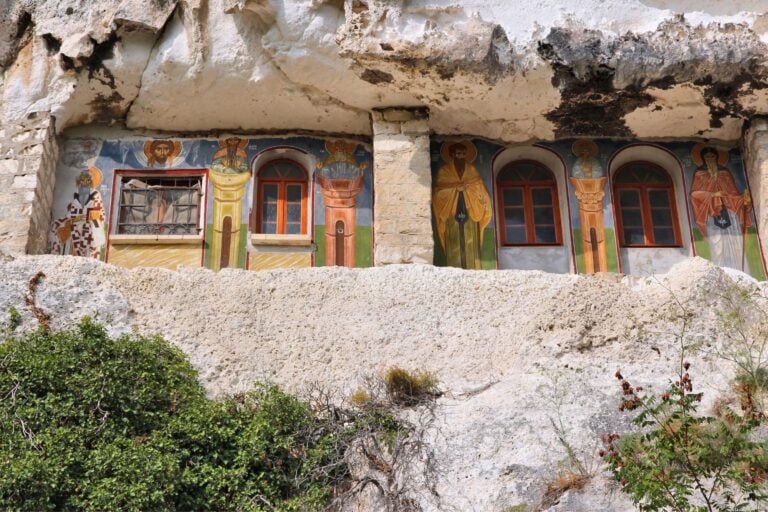

A day trip to the rock-hewn churches located near the village of Ivanovo, Bulgaria, was one of the tours available on my Danube River cruise. I quickly jumped at this opportunity for hiking and exploration.
A UNESCO World Heritage Site

Back in medieval times, it was apparently popular for monks to sequester themselves in cave churches that were often built high up in the mountain rocks.
Bulgaria’s rock-hewn churches are certainly an excellent example of this practice, and some of these are still preserved to this very day, primarily because of the amazing frescoes and artwork that are to be found inside.
As a result, these rock churches are now listed as a UNESCO World Heritage Site, and many tourists want to make the climb and see these unusual abodes for themselves.
An Ascent to the Rock-Hewn Church

I was certainly one of those interested and curious visitors, so I decided to make the rather steep and arduous climb up to the rock-hewn church that has been preserved and kept open.
It’s located high up on a sheer cliff face, so back in the day, the resident monk probably had to construct a painstaking wooden staircase along the rock face, hugging the side of the cliff, all the way up to his secluded destination.
However, such a staircase is no longer there, and it would be far too dangerous for use now anyway. So a series of rock steps has been built from the rock church parking lot (far below) all the way up to the actual cave church.
However, even these rock stairs are a rather challenging workout, for there are well over a hundred of them—and they’re very steep.
Therefore, an alternative route has also been constructed, and it has become the recommended way to go, so I took it.
This hiking trail took me from the parking lot, past some souvenir shops, and then on a well-worn path that eventually took me up the hillside to a rock platform and, finally, to the church entrance.
The climb was still steep, and the distance was somewhat longer, but it was a gentler ascent.
Best Bulgaria Tours & Excursions
Part of a Monastery Complex

There were about 40 rock-hewn churches in this monastery complex, with extraordinary 13th and 14th century frescoes displayed in some of them, but many of these churches have now fallen into decay.
However, there are still about 20 churches, chapels and relatively intact cells.
As I ascended the footpath, I was able to get a glimpse at a few cave churches that were still visible but no longer open to the public. I also passed caves that might have eventually been used for dwellings if the complex had grown even more.
Entering the Rock-Hewn Church

I soon arrived at a narrow opening to the rock-hewn church cave (where a fee is collected and a guided tour is available).
When I entered the church itself, it was the fabulous artwork on the walls and ceiling that immediately captured my attention.
There were many Biblical scenes preserved here, including a sketch of Christ carrying the cross, but a painting of the Last Supper especially enthralled me.
It blew my mind that this was actually painted here in this cave prior to Leonardo da Vinci’s famous painting being created.
Preserved but Not Restored

I also noticed that some of these ancient paintings had faded somewhat, and the rock walls and ceilings had some obvious cracks, chips, and noticeable deterioration.
It was then that I learned that this church was to be ‘preserved’ but not ‘restored,’ and this means that things must be kept in their original state.
This won’t be that easy to accomplish, for weather, storms and light exposure are slowly but surely taking a toll on the frescoes and the church itself.
I couldn’t help but think that this site then is a bit of a ‘time bomb,’ for it may eventually simply decay and be lost. Unfortunately, another concern in this area is the very real danger of a future earthquake.
A Panoramic View

As I walked through the small rock church, I arrived on its west side, where an opening provided me with a panoramic view of the area, allowing me to look all the way down to where I’d begun my hike. It was well over 100 feet/30 meters, virtually straight down.
Descending from the Rock-Hewn Church

I then walked back through the church, now very crowded with visitors, exited the fascinating cave dwelling, and then took the stone steps down from this precipice.
I had been told that these stone steps were much easier for a descent than an ascent, so this trip down wasn’t as challenging as the climb up had been.
Completing the Hike

This particular excursion was undoubtedly one of the highlights of my river cruise through Eastern Europe, from Hungary to Romania.
I was, indeed, fascinated by these rock-hewn churches, located in northeastern Bulgaria, within Rusenski Lom Nature Park— and I found them to be both inspirational and unique.
Need a hand planning your trip? Here are the sites and services we rely on most, from booking tools to travel products we love.
Inspire your next adventure with our articles below:
- Layers of Culture and History Await in the Interesting City of Sofia, Bulgaria
- Journey to Rila Monastery: A Magical Day Trip into Bulgaria’s Spiritual Heart
Author’s Bio: John M. Smith is a freelance travel writer and photographer who enjoys traveling the world and writing about his adventures. He has written weekly travel features for a group of community newspapers, presented several travelogues, and is the author of two major cycling books: “Cycling Canada” and “Cycling the USA”.
Want to discover more hidden gems and helpful travel tips? Join our free newsletter for the latest travel secrets and travel articles.
We are reader-supported and may earn a commission on purchases made through links in this article.

- Along the Gambia River: Markets, Crossings and Chimpanzees - September 14, 2026
- Kagawa, Japan Is the Udon Capital—Where to Eat Sanuki Noodles and How to Get There - September 14, 2026
- Inside the Vatican: An Exclusive Walk Through the Pope’s Private Corridors - September 14, 2026
Planning another trip soon? ✈️
Add GoWorldTravel.com as a preferred source on Google. Click the button below so our local guides, packing hacks, and hidden-gem itineraries always show up first when you search!
Add to Preferred Sources