
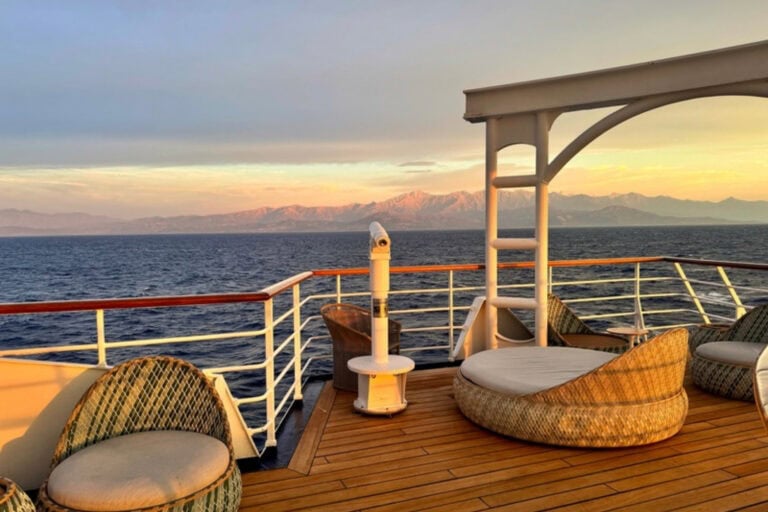
Before I fell asleep at night, I could feel the gentle movement under us and hear the quiet hum of the engine. The slight lilt of my bed reminded me that we were indeed in transit, between islands, and also on our own man-made island of sorts, floating in the Mediterranean.
When I had the opportunity to sail on the Wind Spirit, a small Windstar cruise ship that started in Barcelona and ended in Rome, I was intrigued.
It would not be the island hopping with which I was most familiar, in a kayak or a canoe between flat granite rock in Georgian Bay. But I would still be surrounded by water. Separated from the mainland, and enjoying competing shades of blue, sometimes with a thin grey strip for a horizon.
Rather than packing and unpacking on each island, I could hop from one island to the next. I could go from Mallorca to Menorca, Corsica and Elba, and my hotel would move with me.
Over a week, I came to relish our 440-foot floating island, with its four masts and an interior with a cool microclimate against the 35-degree European heat. Similar to an island, it had its own neighborhoods. There were indoor and outdoor restaurants, a spa, pool bar, lounge areas and a small pool and hot tub on deck.
It also had its own community. Our tour included about 130 passengers from 11 countries. In addition, there were 105 crew from about 18 countries, according to Captain Sam.
Mallorca
Our first Spanish island was Mallorca, the largest of the Balearics. Judging by Palma, our point of entry, this island feels distinctly cosmopolitan. There were busy markets, grand cathedrals, museums, shops and cafés stretching along its busy streets.
After the tranquility of the ship, and its comfortable air-conditioned climate, entering its commercial port, with a frenzy of traffic, heat and crowds, felt like diving into the thick of it. But there were distinctive counterpoints to our first impressions. For example, visiting its cathedral, the Old Town and enjoying a meal in a hidden garden. It had us exploring in a way that felt separate.
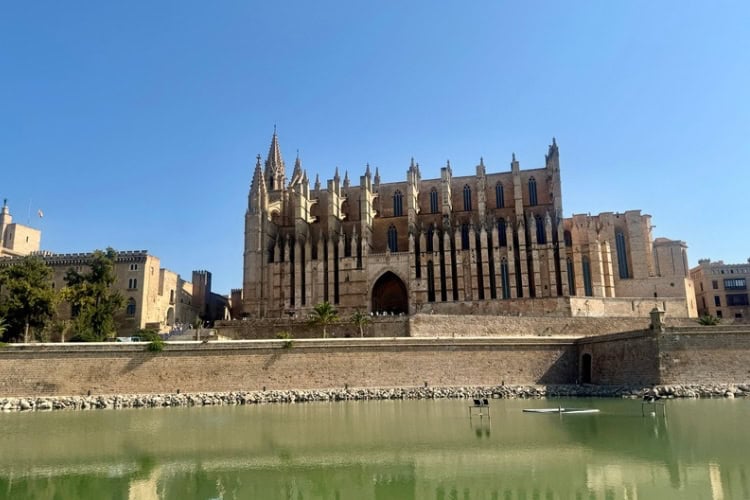
In the Old Town, we entered the Cathedral of Santa Maria, or La Seu. It’s a huge 14th-century Gothic cathedral whose renovation was overseen by Antoni Gaudí in the early 1900s.
While the church was crowded with other tourists, I stared up at its circular rose windows vibrant with colour. It felt like I had found a moment of stillness in an otherwise busy cathedral. With seven rose windows, including one with more than 1,000 glass pieces, it is a kaleidoscope of colour.
Palma’s food scene turned out to be another way to escape the busy streets. We entered the boutique hotel Can Bordoy through a stone archway into a courtyard. It led to the house and to the outdoor section of Botànic restaurant, in a large walled garden where orange trees, flowering shrubs and old stone create a welcome oasis.
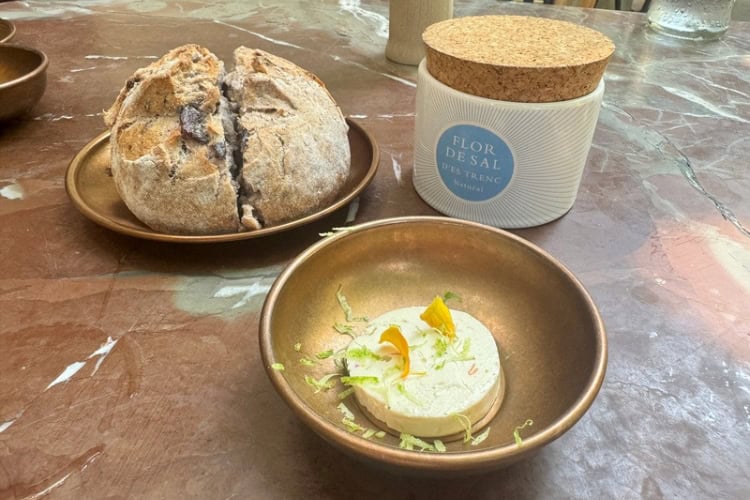
The former 16th-century mansion is alive with its history, while the food gives you a literal taste of the island. The olive sourdough bread was made with xeixa Mallorcan flour. The olive oil that we dipped it in tasted like liquid olives and the organic tomato salad with anchovy sorbet and tomato water was a feast of local tomatoes.
Menorca
By contrast, Menorca the next day had a very different rhythm. Rather than arriving at a busy port, Mahón, where we docked, was quieter. There were moored sailing yachts and fishing boats rather than mega cruise ships.
The entire island is a UNESCO Biosphere Reserve. Its port is the largest natural harbor of its kind in the Mediterranean. Once there, instead of needing to be shuttled into the Old Town, we walked a few minutes and then took a glass elevator into its historic center.
From nearby, we took a short taxi to Es Grau, a small fishing village with white-washed houses. Here we walked along a wooden footbridge into the heart of the Parc Natural de s’Albufera des Grau. Within the park is the Camí de Cavalls, a hiking trail that follows a 115-mile loop around the entire island.
Rather than looking inward, as we had done on Mallorca, we could look outward, following a short section of the trail as it wound past small coves and coarse sandy beaches, breaking for frequent swims that seemed irresistible in the midday heat.
Admittedly, I looked with some envy at the sea kayakers who had paddled out to the beaches that we had walked to. Walking feels so much more strenuous when it’s hot. But whether by boat or foot, Menorca always reminds you that you’re on an island.
A Day With No Islands
After two days on Spanish islands, we had no island to go to.
It was a day at sea, when we would travel about 260 nautical miles from Spain to France. Without a stopover to explore, the experience became the ship itself. We took art classes on board: sketching and making tile mosaics as a creative lens to process what we had been exploring off ship.
“It’s about being playful, having fun,” said our sketch instructor Bruce Anderson. While he was willing to pass out erasers as we worked, he didn’t really recommend them. “Because I like to go forward rather than backward,” he said.
As I drew, I tried to block my inner critic and put away the eraser as much as I could, trying to recreate on paper the land and water that we had been seeing, to be “creative and free,” as I was told.
I used vertical lines to create windows and building tops, and curved lines for domed roofs and the waves in the water.
I was using a visual language to depict what I was seeing on islands. It was a welcome counterpoint to constantly crafting written words as a career.
Tile-Making
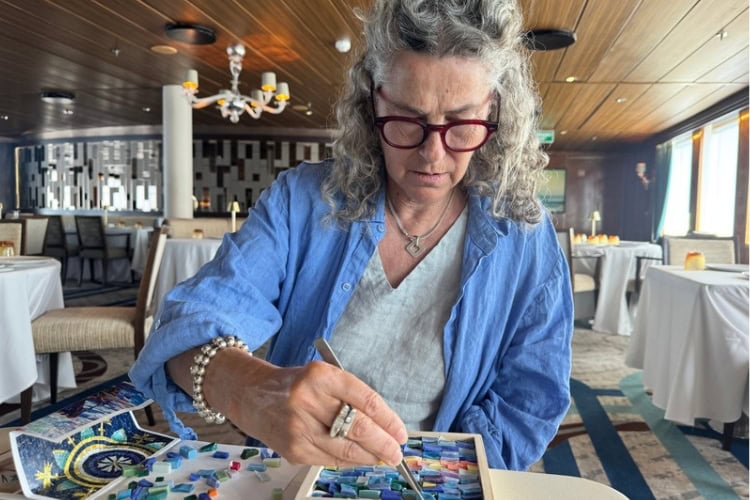
Later, in a Venetian tile-making workshop with Ruth Minola Scheibler, I learned that when you work with tiles, you are not just choosing colors and design. You consider the space between tiles, much like you consider pauses between sentences or consciously choosing to leave certain thoughts unsaid.
Even the subjects of our art- the sunsets and lighthouse, the darker blue of the water, the lighter blue of the sky, and the wispy clouds- helped us feel inspired by our setting.
As we moved along on our floating island, we often saw nothing but the horizon. At night, the sun dipped below it; in the morning, it rose above it. But sometimes we passed smaller islands, with the promise of a new one emerging when we woke up in the morning.
Bastia, Corsica
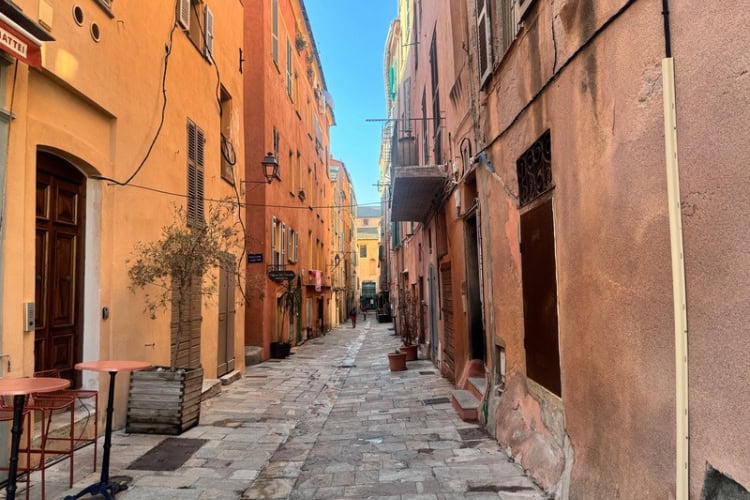
Photo by Diana Ballon
With a stop at Calvi one day and Bastia another, we explored two sides of Corsica. Calvi is like the Corsica you might see in a postcard. The citadel rose dramatically above the bay, and sailing boats moored off the coast, with mountains as backdrop. Along with a long beach, it is the image of an idyllic Mediterranean escape.
Bastia, by contrast, is a working city built around a natural harbor with more grit than polish. It does not have a citadel with the same dramatic outline against the sky. Nor does it have the long beach right next to the town.
But it does have beauty. The 15th-century Palais des Gouverneurs is painted in bright orange-ochre and there is the Église Saint-Jean-Baptiste with its twin bell towers rising over houses in the harbor. There is also an Old Port dominated by warm pastel colors like terracotta, soft peach and pale yellow.
Calvi, Corsica
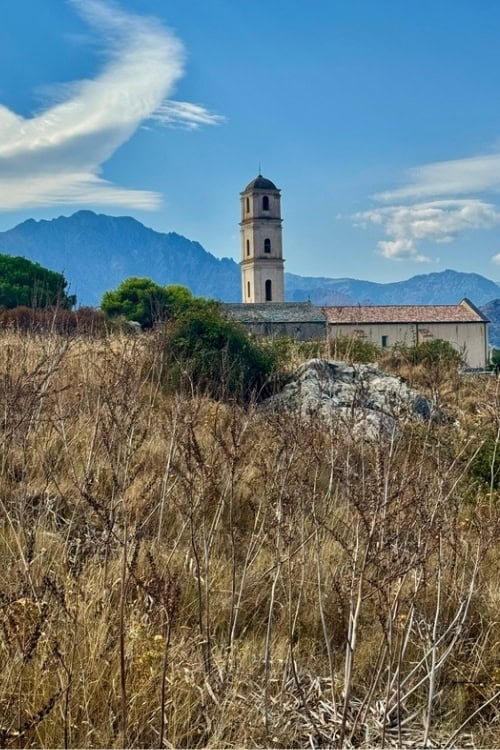
The differences are amplified by the excursions I took from the two ports. From Calvi, I took a Windstar tour through the surrounding mountain villages in the region of La Balagne.
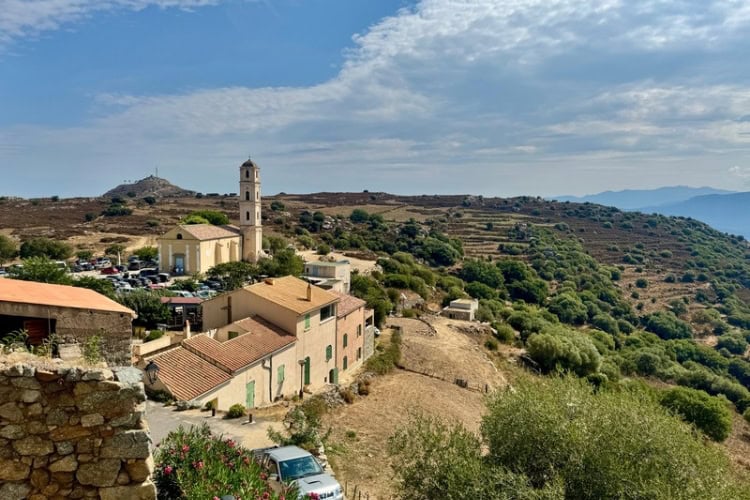
My favorite village stop was also the highest, Sant’Antonino. I fell for this village before we arrived. Unlike the more hidden laneways near the coast, it was plainly visible against the skyline as we drove along a winding road. A low stone wall on one side sometimes seemed to be all that kept our bus from the cliff face below.
On the other side of the road were many family tombs. They were like private mini mausoleums where people come to pay homage to loved ones, rather than at a communal graveyard.
Once we arrived, I wandered on foot through the town. It was a spiral labyrinth of stone houses built close together like a maze to protect locals from pirates and other invaders.
In Bastia, by contrast, the tour wasn’t so much about exploring mountain villages as experiencing what the land produces. At the Domaine Terra di Catoni, we tasted six wines along with traditional Corsican charcuterie. My favourites were its bone-dry whites, aromatic and minerally, a tribute to the terroir.
Elba As The Italian Playground
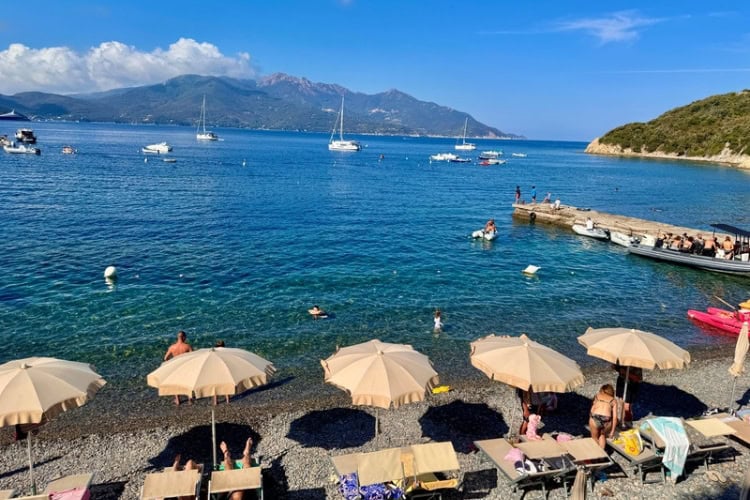
Elba seemed like a fitting final stop. After hopping from island to island, this was the island where I moved the most through the landscape. I traveled by e-bike from the port of Portoferraio to Enfola Beach on the northern coast. Once there, I traveled by kayak and swam through its clear water, with the reflection of the forests deepening the green in the water.
This island felt most like a nature destination. About half of the island is protected as part of the Tuscan Archipelago National Park. It is a place ripe for exploration beyond its port.
Although it was too hot for hiking, it was Italy in August after all; we could still admire its forested mountains, and the peak of Mount Capanne, the highest mountain on the island, rising more than 1,000 meters to the west. Its tip that day was slightly covered by wispy white clouds.
Along with the holm oak woods and chestnut groves, I loved the umbrella pines growing on the sides of mountains. Their wide, shaggy crowns looked as much like upside-down mops as umbrellas.
We were too far away to see the bright yellow metal baskets that people stand in, like open-air cages or cable cars up Mount Capanne. But with e-bikes, we had an unobstructed view down to the rocky coastline.
Enfola Beach is just one of about 200 beaches on the island. Like many beaches here, it is made of smooth, flat pebbles rather than sand. It looked like something from an Italian postcard, with families and couples lying under coloured parasols, the water lapping against the shoreline and kayaks pulled up against the shore.
A Return To Our Floating Island
The final night, my husband and I sat on reclining chairs on deck watching as Portoferraio twinkled with lights from the shore.
It was hard to believe that a week had gone by, and that the next morning we would be disembarking. I am grateful for our floating island, which had acted as a moving hotel, restaurant, art studio and gathering place.
Now home, some of my island memories are already beginning to blur, but not the experience. Nor the people we met, the friendships we formed and the many cultures we encountered while on board.
I won’t forget the Israeli woman I sketched the first day, nor discard the sketch she did of me. I was grateful to have the contact information for the lovely Australian couple I e-biked with on Elba. And I felt a bit sad to not have gotten to know better the mother and daughter from Oregon with whom I had enjoyed Corsican wine in Bastia.
It seemed fitting that on our last night we enjoyed dinner with the same Washington couple we met on the first night. There is so much pleasure in the unexpected. Despite the constantly shifting settings of an island-hopping experience, our floating island and its “residents” had become a special place all on its own.
Diana Ballon travelled on Windstar Cruises’ Masterpieces at Sea: Mediterranean Island Mosaic seven-night cruise aboard their Wind Spirit yacht. Their next cruise with the same itinerary, but in reverse (Rome to Barcelona) sails in October.
When to Go
While the air conditioning on the ship keeps everything comfortably cool, island visits are best experienced in fall or spring when there are fewer crowds, and the weather is also not quite so hot. Their next two cruises are in October, which would be a great time to travel.
Things to Bring
You can leave your tuxedos and fancy gowns at home. Although people do dress up in the evenings, the dress code is “casual elegant,” so nothing formal is required. Pack layers for unexpected weather and bring some Euros. Bring comfortable walking shoes for excursions, and don’t forget your sunscreen, sunhat, and bathing suit. There’s a small pool and hot tub on board and a watersports platform that you can use when the ship is moored in calm waters.
What to Know
Look into “all-in packages” versus standard ones. The all-inclusive packages include alcohol, Wi‑Fi and gratuities. Shore excursions are extra and can be costly. You can book Windstar excursions ahead or while on board. Or you can plan your own excursions. You will have a full itinerary of your trip detailing which days you are on each island and the times the ship arrives and departs.
Windstar operates many different ships, ranging from about 150 guests on the Wind Star and Wind Spirit (which we sailed on) to up to 350 guests on their larger ships. So, regardless of which cruise you’re on, you can expect a small-ship experience. Note that their larger fleets do tend to have bigger cabins, a larger fitness center, and additional restaurant options and amenities.
Need a hand planning your trip? Here are the sites and services we rely on most, from booking tools to travel products we love.
Inspire your next adventure with our articles below:
- How to Split a Luxury Yacht in Croatia and Pay Less Than Manhattan Hotel Rates
- Where the Rhine Meets the Moselle: My Week Aboard the New Riviera Resplendence
Author Bio: Diana Ballon is a health and travel writer focusing on fitness and active adventure for women 50 plus, which she has discovered can be experienced through small ship cruising. Her stories have appeared in many major North American publications, including The Globe and Mail, The Toronto Star, San Diego Magazine, Zoomer Magazine, Broadview Magazine, CAA Magazine, Canadian Cycling Magazine, Daily Hive, Travel Life Magazine, Cruise & Travel Lifestyles Magazine, Wander Magazine, Vacayou Magazine, vacay.ca and hotel-addict.com
Want to discover more hidden gems and helpful travel tips? Join our free newsletter for the latest travel secrets and travel articles.
We are reader-supported and may earn a commission on purchases made through links in this article.

- A Small-Ship Mediterranean Island-Hopping Cruise From Barcelona to Rome - September 24, 2026
- Strasbourg, France: Gothic Grandeur, Pretty Canals and German Heritage - September 23, 2026
- Why New Zealand’s Coromandel Peninsula Belongs on Your Itinerary: Whitianga and Cathedral Cove by Boat - September 22, 2026
Planning another trip soon? ✈️
Add GoWorldTravel.com as a preferred source on Google. Click the button below so our local guides, packing hacks, and hidden-gem itineraries always show up first when you search!
Add to Preferred Sources