

The twisted streets are lined by a city planner’s nightmare of buildings in a jumble of
architectural styles and conditions. Crumbling mansions that cling to memories of past glory days are neighbors to trendy shops. Bustling restaurants and small, offbeat museums.
One small section of the enclave has been a Jewish quarter since the 13th century. Another encompasses what many people consider to be the most beautiful square in the city, and perhaps in all of Europe.
This eclectic neighborhood in the heart of Paris has been called the Marais (“marsh”) since Roman times. The name described the swamp that was created by a fork of the Seine River. The marsh was drained in the 12th century to provide more living space as Paris grew, but the name – like the oozing mud that once covered the area – stuck.
Despite its colorful history and present-day attractions, much of the Marais is overlooked by many visitors to Paris. While some seek out the magnificent square named Place des Vosges, they often pass up the colorful side streets that surround it like a maze.
The King Who Made the Marais District of Paris a Fashionable, Favored Neighborhood

Image by Dreamstime.com
After being opened to habitation, the Marais district evolved quietly until 1612, when King Henry IV took up residence in the Place des Vosges. His presence transformed the neighborhood into a fashionable quarter favored by aristocrats, people of wealth and intellectuals.
Then came the Revolution. Many of the prestigious residents of the Marais quarter were imprisoned, or worse. The area surrounding the Bastille, whose storming sparked the uprising that changed France forever, fell into a state of decline.
In recent years, this trend has been reversed. What had deteriorated into a backwater
neighborhood once again became fashionable. Renovation has resulted in upgrading without upheaval. Most of the gracious 17th-century mansions, or “hotels” as they were called in the past, have been spared. Many have been converted into offices, shops and museums. Restaurants have opened and flourished.
The Marais District of Paris Has One Foot Planted In the Past, the Other In the Future

For the visitor to Paris, this preservation and transformation provide an opportunity to delve into the past while keeping one foot planted firmly in the present.
The natural focus of any sojourn into the Marais is the Place des Vosges. It was laid out in keeping with the design imposed by Henry IV, who envisioned the neighborhood as a splendid urban quarter fit for a King, with an elegant square at its center.
The setting is one of perfect symmetry. Identical mansions surround a grassy plot, their rose-colored brick walls topped by blue slate roofs. Restaurants and upscale art and antique shops fill the covered arcades that connect the buildings.
Now, however, instead of aristocracy, the vast lawn is a gathering place for all of the
people of Paris. Splashing fountains add a playful note. In the center of it all, a statue of Louis XIII grins out over the scene. Beneath his gaze and smile, children play, lovers hold hands and people of all ages promenade.
Museums, Small in Size but Large in Interest, Await Visitors to Paris’ Marais District

the Marais district since the 16th century. Image by Dreamstime.com
In keeping with its history and in a somewhat offbeat nature, the Marais is home to a number of enticing small museums. While these little gems can’t compete in size with the major attractions of Paris, they offer delightful introductions to people and pages of history, often lost in the glitter of better-known sites.
The biggest name from the past holds forth at the Picasso Museum. It’s housed in the Hotel Sale (“salt”), a 17th-century mansion that was built for a wealthy salt-tax collector.
While the exhibits include only a handful of Picasso’s better-known masterpieces, they comprise the largest collection of his works in the world under one roof. Also of interest are miscellaneous memorabilia that provide intimate glimpses into the man behind the fame, such as photographs of Picasso playing with his children and attending bullfights.
The house at No. 6 Place des Vosges, where Victor Hugo lived and worked for 15 years in the mid-19th century, is smaller and more intimate. There, he wrote several chapters of Les Misérables and other books. Among items on display are a number of Hugo’s illustrations for his novels, a bust of him by Rodin, and a stand-up desk at which the author created his literary masterpieces.
Other museums scattered about the Marais district attract visitors who have a special interest. Most important is the Carnavalet, an imposing 16th-century mansion that houses the Historical Museum of the City of Paris. Four centuries of the city’s past (15th-18th) are brought to life in paintings, models and furniture.
A diorama dated 1527 dramatically depicts the cramped, narrow streets of Paris in The Middle Ages. Shop signs from the 18th century, when few people could read, include a butcher represented by a rendering of a pig and a baker identified by a sheaf of wheat.
Among memories of the French Revolution are an itemized laundry bill for the royal family’s extravagant clothing and a rope ladder that some prisoners used to escape from the Bastille.
A very different page of history is turned in the Jewish quarter of the Marais, centered along the Rue des Rosiers (Street of Roses). The complex of narrow, twisting streets has retained its distinctive flavor for centuries.
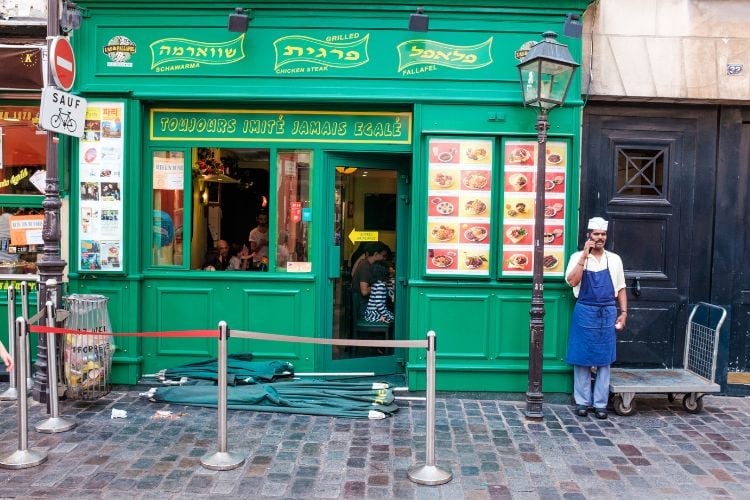
Kosher bakeries, butcher shops, and restaurants vie for attention with store windows filled with silver-plated menorahs and books written in Hebrew.
Elderly men sporting dark beards and equally dark suits, women wrapped in shawls and boys wearing skull-cap yarmulkes jostle for space on the crowded sidewalks with sightseers from around the city and the world.
Odors of fresh pickles, brisket of beef and other traditional treats mingle with the smells of falafel stalls, evidence of an influx of Jews from North African nations in recent decades.
This frenetic setting is far removed in atmosphere from the quiet elegance of the nearby Place des Vosges. This juxtaposition of unlikely attractions gives the Marais district its unique character, and provides reasons to include it on the “must see” list of more visitors to Paris.
For more information about France and the Marais district of Paris, log onto www.franceguide.info.

Planning another trip soon? ✈️
Add GoWorldTravel.com as a preferred source on Google. Click the button below so our local guides, packing hacks, and hidden-gem itineraries always show up first when you search!
Add to Preferred Sources