

I recently was enjoying a leisurely stroll along a path that leads through a treasure trove of various architectural styles, museum-quality displays of art and floral plantings which would make any gardener proud.
I was “Walking the High Line,” the elevated former railway which runs 30 feet above street level, down the west side of Manhattan, New York.
Along the way, it winds among a landscape of magnificent buildings that range from old to new, shabby to magnificent, uninspired to avant-gard, and which serve industrial, commercial and residential purposes.
New York City’s High Line Evolved from Death Avenue to an Art and Architectural Gem

Photo by Carlos Neto Dreamstime.com
Given the beauty of the setting, many people are surprised to learn that the streets over which the High Line ran in the past were known by the less-than-appealing nickname of Death Avenue.
For almost a century, trains of the New York Central Railroad plowed along Manhattan’s 10th and 11th Avenues, crossing streets, interrupting traffic and maiming and killing pedestrians along the way.
Those trains played an important role in feeding New Yorkers, delivering meat, groceries and dairy products.
A city ordinance passed in the 1850s stipulated that a person on horseback had to ride ahead of each train, waving a red flag and lantern to announce its approach, but the deaths continued.
Finally, in 1929, the railroad reached an agreement to move the tracks above street level, the High Line opened in 1934 and it continued to carry train traffic until 1980.
Since then, the byway has served as a peaceful 1.5-mile linear park through which people walk, rest and admire the beauty surrounding them.
The original tracks in places are punctuated by trees that have found them to be an unusual home for their roots.
New York’s High Line Traverses Fabulous Floral Displays

From spring to fall, vibrant floral displays add to the scene. The names of some plants I spotted on identifying signs – Autumn Bride, Hairy Alumroot, Japanese Forest Grass – are as colorful as the blooms they describe.
Intriguing Neighborhoods
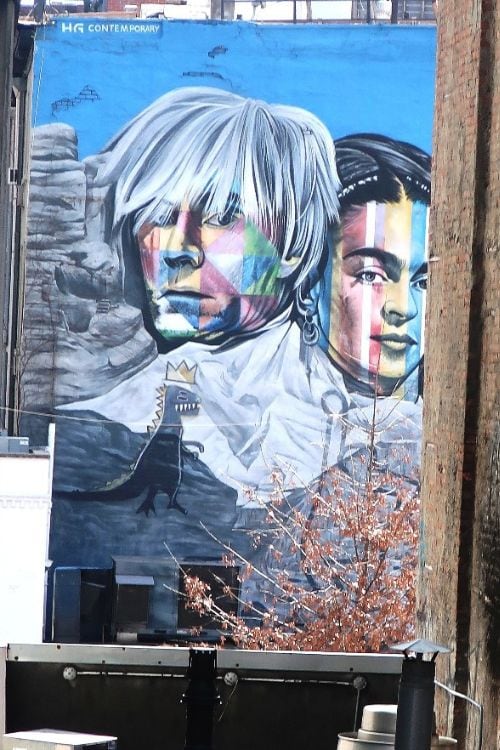
Equally intriguing and varied are the neighborhoods through which the route leads, each of which has its own distinctive attractions.
The Chelsea Arts District has been the city’s visual creation center for more than 130 years. It’s home to countless galleries that display a wide spectrum of works by both emerging and established artists.
Artwork also adorns the Chelsea Market building, which stands where the Algonquin Native Americans once traded freshly-killed game and crops.
Later, the High Line trains serviced the wholesale butchers who sold their meat along the streets beneath the tracks, and the stripped-down brick building that housed them remains to tell the story of that time.
Architecture Vies for Attention with Art Along New York City’s High Line

The IAC Building was designed by Frank Gehry, the world-famous architect known as a deconstructionist for his use of everyday materials to create complex, dynamic structures.
It’s divided into vertical sections that resemble a ship’s sails, set against a facade that brings to mind an iceberg.
The imaginative architecture provides a fitting backdrop for the art that decorates some structures and is displayed along the High Line pathway. The surprisingly excellent and eclectic gathering of works scattered throughout the park transforms it into a free outdoor gallery.
The sides of some buildings along the way serve as oversized painters’ palettes, exhibiting murals that cover a variety of genres and topics. One displays an oversized smiling mouth with pearl-like teeth.

I came upon whimsical sculptures with names like Secondary Forest, Fossil Psychic Stone Mimicry and Birth of an Island.
A Little Island with Big Surprises Greets Visitors to the High Line in New York City

Speaking of an island, a welcome surprise to many traversing the High Line is a nearby park, visible from the train track path, which is set upon a man-made enclave. The elevated park is supported above the water of the Hudson River by 132 concrete pot-shaped structures called tulips.
It offers walking paths, gentle hills, rolling lawns and a cornucopia of vegetation. That includes 35 species of trees, 65 kinds of shrubs and 270 different grasses and flowers that bloom at different times of the year. A “secret garden” is planted exclusively with white flora.
Adding to the allure is a surprisingly diverse list of other attractions that appeal to all ages. Visitors delight in the sounds of the Dance Chimes, are transfixed by the optical illusion of Spinning Discs located along the walkways and enjoy trying their hand at an Instrument for All.
More active guests are delighted by the opportunity to roll around in a Spun Chair, or take their turn using a jump rope or hula hoop.
Rounding out the choice of things to do and see are a small stage, a large amphitheater which offers a selection of shows and two concession stands. An audio tour leads through the park and provides an immersion in the history of the island, the Hudson River waterfront and the nearby Meatpacking District.
For more information, log onto thehighline.org and littleisland.org.

Planning another trip soon? ✈️
Add GoWorldTravel.com as a preferred source on Google. Click the button below so our local guides, packing hacks, and hidden-gem itineraries always show up first when you search!
Add to Preferred Sources