
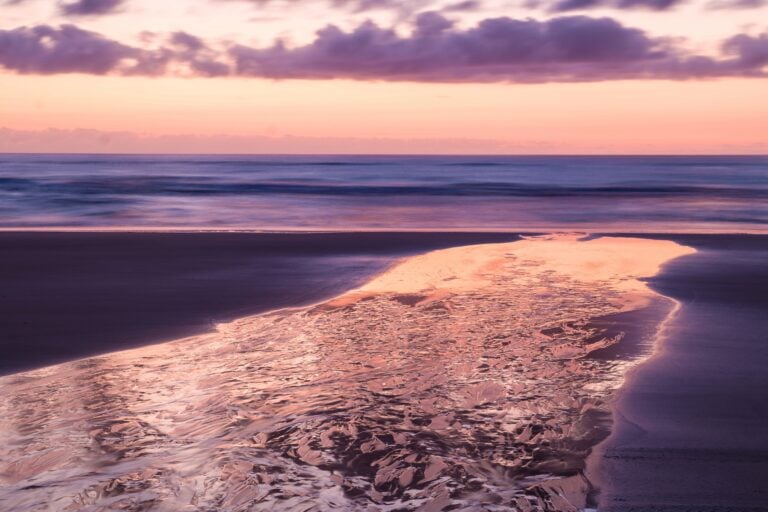

As our 4-wheel drive coach roller-coastered over bumpy dirt tracks. Meanwhile, Dave, our driver plus guide, lifted our spirits by announcing that the worst was over. We had crossed the width of the island and had nearly reached the 75-mile beach.
“Welcome to Fraser Island, folks, or K’gari as we now call it,” he started. “120 kilometers of uninterrupted sands and a highway on the sands like no other in Australia (the 75-mile beach being officially a National Highway). But don’t get entranced with the sand and seas, there’s plenty of wildlife to find as well.”
As soon as Dave finished his lines, the coach swerved onto an expansive golden beach, eliciting a lot of adrenaline-pumped ‘aahs’ from the passengers. Immediately thereafter, the interjections ran berserk. To our left, we could spot our first of many dingos, Australia’s largest and apex predator.
But that was not all. To our right, on the Coral Sea, we could spot at least half a dozen humpback whales bobbing up and down on the sapphire waters. It almost felt as if we had swerved right into an aquatic safari of migrating giants.
Dave stopped his coach and let us take it all in as we observed a couple of whales breaching far away on the horizon.
“Welcome again,” smiled Dave, “This is UNESCO world heritage listed K’gari, and the largest sand island in the world!”
Where is Fraser Island / K’gari?
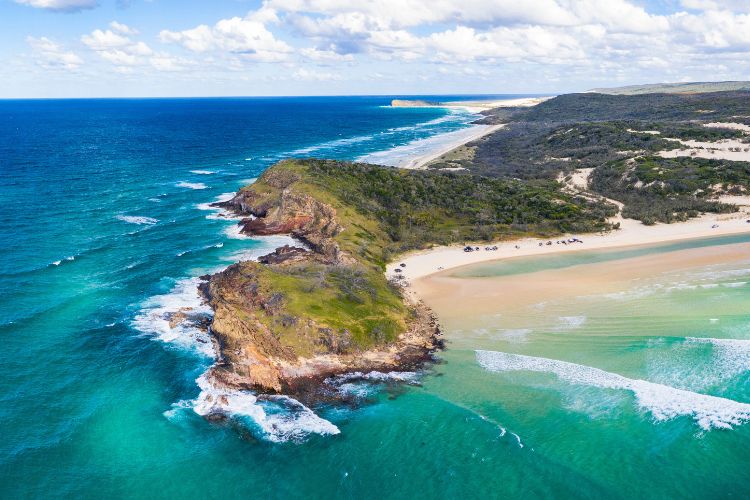
Firstly, where is Fraser Island? Or K’gari – ‘K’ being silent – in the local Aboriginal language of the Butchulla people. The island sits just beyond the southernmost tip of the Great Barrier Reef off the coast of Queensland.
Its nearest town on the mainland is Hervey Bay, the whale-watching capital of Australia. Hervey Bay is connected by flights from both Sydney (2 hours) and Brisbane (50 minutes). K’gari can also be reached via a 45-minute ferry from Hervey Bay.
There are only a handful of resorts on the island (though camping sites abound). If you are short of time, a trip to K’gari from Hervey Bay will make for your finest day trip on the continent.
If you have more time, the island is a paradise with unexpected wonders waiting to be explored.
Read More: Lord Howe Island, Australia: A Small Slice of Paradise for Nature Lovers
String of Sand Islands Like Nowhere Else on the Planet

Image by ampueroleonardo from Getty Images Signature via Canva
What sets K’gari apart from islands around the world is that it is composed entirely of sand dunes. It is unlike volcanic islands composed of volcanic lava, or continental islands joined to the mainland but disconnected with rising sea levels.
But K’gari is not alone. The world’s four largest sand islands are all clustered here, one after another. Moving north from the coast off Brisbane lies North Stradbroke Island (2nd), followed by Moreton Island (3rd), Bribie Island (4th) and finally culminating with K’gari (numero uno).
In contrast, the coast of Queensland alongside these islands has the same geological silicate constitution. This naturally raises the question, what led to this unique formation?
Over a million years ago, the highlands to the east of Australia were eroded by wind and water, the sand from which was carried into the Pacific.
Currents such as the East Australian Current that create the famous whale migration highway along eastern Australia (remember ‘Finding Nemo’?) carried these eroded sand particles to the north. Here, they started accumulating over thousands of years to create these large sand islands.
It is interesting to note that the continental shelf drops down dramatically just north of K’gari. Hence, there are no further sand islands north. However, there are apparently gigantic sand waterfalls tumbling down the continental shelf.
Best K’gari Tours & Excursions
Great Barrier Reef Connection

Another interesting formation – not out of coincidence – is the Great Barrier Reef starting just north of K’gari.
K’gari and its sandy cousins have successfully been trapping the sand particles for millennia. Otherwise, these would have continued north and muddied the waters, thereby reducing the chances of reef formation that requires sunlight.
The Great Barrier Reef, therefore, owes its origin to K’gari and the other sand islands.
Today, K’gari is a natural treasure with towering rainforests growing on its sands, the only place with this distinction. In addition, it has over 100 freshwater lakes, giving it the second-highest concentration of lakes in Australia after Tasmania.
Besides lakes, the kilometers of sand have become an aquifer, a gigantic sponge that contains 10 to 20 million megaliters of freshwater. That’s roughly 20 to 40 times the volume of Sydney Harbour contained in 125 kilometers of the sandy island.
Well, enough of geology and geography – let’s take a quick look at the most arresting attractions of K’gari.
Read More: 10 Must-Visit Islands of the Great Barrier Reef That Will Take Your Breath Away
The Purest Wild Dingos in the World

While Australia is itself an ark full of unique animals, these are mostly marsupials that evolved independently.
In comparison, the Dingo is considered to have been introduced by the early human settlers who crossed over from Southeast Asia. They brought with them the Asiatic wolf or the domestic dog. These animals proliferated in the grasslands of Australia and turned feral, becoming the dingo.
The dingo turned out to be an apex predator. It is often attributed to the decline of other predators on the mainland, such as the Tasmanian Devil and the now-extinct Tasmanian Tiger, or the thylacine.
Interestingly, Tasmanian Devils today thrive in Tasmania, their only haven. This is because the Dingo was unable to cross over when sea levels rose and cut off Tasmania.
Dingos are found all over the Australian mainland. However, these have interbred with dogs brought over by the Europeans over the past two centuries.
This is what makes the K’gari dingos special. Their genetic pool has remained pure since their arrival and evolution thousands of years ago.
Dingos, like wolves and wild dogs, hunt in packs. However, you may be able to see a few stray ones hanging out on the beach. There are strict rules for staying away from dingos, feeding them, or fondling them, due to past accidents.
They look like the golden neighborly dog, but dingos are still a feral species and it is prudent to keep your distance.
Read More: Life Lessons With Quokkas on Rottnest Island in Western Australia
The Maheno Shipwreck

Despite its natural abundance, perhaps the most recognizable hotspot on K’gari is a manmade one. That too is a fallout of the disaster.
On the eastern coast of the island lies the sunken, rusting, and rather eerie shipwreck of the SS Maheno. Once a luxury passenger liner built in 1905, the Maheno was repurposed as a hospital ship during World War I.
In 1935, while being towed to Japan for scrap, the vessel was caught in a cyclone and got beached on K’gari, where it still lies today. Its ruddy, rusting remains serve as a haunting yet captivating relic of maritime history. It also creates an incomparable backdrop for some amazing snapshots.
In whaling season (July to December), keep an eye out for migrating whales that often breach in these waters.
If you get the time, try scaling the sand dunes behind the beach. Here you will discover swamps and small but exquisite, freshwater lakes in different shades of blue.
The Pinnacles

Further beyond the Maheno shipwreck lies the Pinnacles. These striking natural formations of vibrant, multicolored sand cliffs of red, brown and yellow sands were sculpted over thousands of years by wind and rain erosion.
You can easily notice the sculpting of these rocks. Formation layers are horizontal from wind erosion and vertical from water erosion. The distinct reddish colors come from concentrations of iron in the sands.
The Pinnacles hold cultural significance for the Butchulla people, the Traditional Owners of K’gari. They have Dreamtime stories explaining the origin of the colored sands.
The Aboriginal story talks of a beautiful woman named Wuru who was promised to an older man but fell in love with a younger warrior.
When the jealous older man discovered their secret, he threw his boomerang at her. As Wuru called on the Rainbow Serpent for protection, the magical creature shattered the boomerang, scattering colored sands across the cliffs and forming the Pinnacles.
Talking of colors, you may also notice greyish black colored rocks strewn all over the island. These are known as coffee rocks due to their colors and were formed from the deposition of humus on the sands, compressed to form rocks over time.
The importance of coffee rocks lies in the fact that these rocks have formed bedrock deep within the sands in many parts of the island. This in turn has helped in the accumulation and storage of water over these slightly impervious rocks, further helping the water table and in the formation of the island’s perched lakes such as Lake Mackenzie (more of this later).
The Pinnacles are the farthest you can get to on a day trip. However, the island has other wonders to explore, such as the Indian Headland and the Champagne Pools, which would require a slightly longer stay at K’gari.
Elli Creek

As our coach returned from the Pinnacles, we stopped at Elli Creek, also on the 75-mile beach. Elli Creek is a serene natural oasis and one of the island’s most beloved attractions.
As the largest freshwater creek on the eastern beach, it pours a remarkable 4 million liters of crystal-clear water into the ocean every hour.
Visitors can enjoy a scenic boardwalk through banksia and pandanus that leads upstream to a gentle current. It is perfect for floating down the creek’s shallow, sandy bottom back to the beach.
Central Station

K’gari means ‘paradise’ in the local Butchulla parlance. The moniker is not hard to understand as you marvel at the scenic splendor of the island. But Paradise was not always undisturbed.
While the island today is a protected UNESCO World Heritage Site and part of the larger Great Sandy National Park, it was once a hub of sand mining and logging.
For decades, mining companies extracted mineral sands, particularly zircon and rutile, from the island’s dunes, causing extensive damage to the fragile ecosystem. It was only in the 1970s that sand mining was officially banned at Fraser Island.
Logging of the beneficial hardwood trees continued for two more decades until 1991. The biggest hub for logging is the Central Station, located in the lush rainforest of Pile Valley. It housed forestry workers, their families, and even a school, some of which can still be seen today as reminders of a not-so-distant past.
But the bigger draw here is the Wanggoolba Creek, located nearby, whose pristine waters often make it hard to realize this is a creek in the first place.
Look carefully – to first discern that this is actually too clear and transparent a stream – and a sandy way, and then look out for eels and fishes swimming in these clear waters.
The serene environment is further framed by towering satinay and brush box trees, creating perhaps the best rainforest experience on the island.
Also, keep an eye out for the large King ferns, with Fraser Island being one of the few places left to find these living fossils.
The creek holds cultural importance for the Butchulla people, who value it as a sacred and life-giving place and where, once, only birthing women were allowed.
Lake Mackenzie

Though studded with one attraction after another, the first among equals in K’gari is the stunning Lake Mackenzie, named after a Queensland-based surveyor from the early 20th Century.
The lake is famed for its incredibly clear, pure blue waters and dazzling white silica sand, which forms its pristine beaches.
It is entirely rain-fed, with water naturally filtered through the island’s sandy soil. The result is it exceptional clarity and softness, making it ideal for swimming, snorkeling, and relaxation.
Surrounded by lush rainforest, Lake Mackenzie provides a serene oasis contrasting beautifully with the island’s coastal dunes and beaches.
Unlike the golden 75-mile beach, the sands here are softer and bleached white. This is from the millennia of nutrient absorption from the sands by the surrounding forest, which has in turn leached the sands.
Already brimming with facts and factoids, our guide Dave showered us with more knowledge before letting us off to explore the lake.
Window, Barrage and Perched Lakes

He explained that there were three main types of lakes in K’gari. Window lakes are formed where the water table intersects the surface, so the lake is essentially an opening or “window” into the groundwater below.
Barrage lakes are formed when sand dunes act as natural barriers or “barrages,” blocking the flow of water in valleys or low-lying areas.
Perched lakes are the most common on the Island, such as Lake Mackenzie. These lakes are formed when organic material, like decayed vegetation and coffee rocks, creates a natural waterproof layer above the water table. This allows rainwater to collect and stay on top of the sandy substrate, creating a lake ‘perched’ atop sand dunes.
Facts aside, the smooth, talcum-like, bleached sands of Lake Mackenzie, along with its turquoise-colored waters, turned out to be the highlight of our trip, creating a perfect closure.
Towards the end of our trip, our coach headed back to the western coast, so we could take the last ferry close to the Kingfisher Bay Resort. We reflected on an enthralling day laced with information, facts, history and, of course, the incredible scenic wonders of K’gari.
A Bit About the Names

The island was named Fraser Island after Eliza Fraser, a shipwreck survivor. After her shipwreck, Eliza encountered the Butchulla people.
Her story described hostile encounters and captivity, which was widely sensationalized in the media back in Britain and Australia. Her tale became famous and led to the island being named Fraser Island in her honor.
However, modern perspectives recognize that her story was potentially fabricated, reflecting misunderstandings and biases of the time. This was an attempt to portray the Butchulla people unfairly so they could be removed legitimately and the island’s resources utilized by English settlers.
The official name change from Fraser Island to K’gari was announced in June 2023 by the Queensland Government. This change recognizes and honors the island’s Traditional Owners, the Butchulla people, and restores the island’s original indigenous name.
If You Go

- You will need to stay at Hervey Bay or you can book accommodation at a handful of resorts and accommodations on the island.
- You will need a 4WD to get around the island, with all roads except those near the resorts being unsealed.
- Stop at Hervey Bay, itself a destination, popular for whale-watching, for a couple of days at least. Whale-watching season runs from July to December and whale sightings are guaranteed.
- There are multiple tour operators running single and multi-day trips from Hervey Bay to K’gari and back. Book your spot in advance as these tours are very popular, especially if you are traveling during school holidays.
- Be dingo-safe – read about the dos and don’ts of watching dingos before you go.
- Grab a window seat if you are flying into or out of Hervey Bay. You can distinctly see the sand dunes and sand blows of K’gari besides the heart-shaped Lake Mackenzie.
Need a hand planning your trip? Here are the sites and services we rely on most, from booking tools to travel products we love.
Inspire your next adventure with our articles below:
Author Bio: Ayan Adak is a consultant by profession who loves traveling, and has been to nearly 30 countries. He likes writing about his travel experiences besides scribbling poetry, short stories and essays.
Want to discover more hidden gems and helpful travel tips? Join our free newsletter for the latest travel secrets and travel articles.
We are reader-supported and may earn a commission on purchases made through links in this article.

- Bukhara, Uzbekistan: The Silk Road City Where History and Art Thrive - October 20, 2026
- Hoi An, Vietnam: A Local’s Guide to the Ancient Town, An Bang Beach and Must-Try Dishes - October 20, 2026
- Why Cape Town’s Kloof Street Was Ranked the Coolest Street in Africa - October 20, 2026
Planning another trip soon? ✈️
Add GoWorldTravel.com as a preferred source on Google. Click the button below so our local guides, packing hacks, and hidden-gem itineraries always show up first when you search!
Add to Preferred Sources