

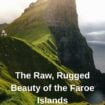
The wind blasted me as I neared the edge of the cliff. Leaning into the gust, I struggled to keep on my feet. Deciding that my safety was more important than another spectacular view, I reluctantly turned back.
I was in the Faroe Islands, an archipelago of 18 islands in the North Atlantic about midway between Norway and Iceland.
With more sheep (about 80,000) than people (about 50,000), the Faroe Islands, literally the “sheep islands,” are beautiful, bucolic, and peaceful, except for the occasional raging wind.
The islands are an awe-inspiring land of jagged rock pillars overlooking pounding seas, waterfalls cascading from hills and cliffs, fjords serrating green hills dotted with sheep, and grass-covered houses in quaint villages.
“If Ireland and Iceland had a baby, it would be the Faroes,” in the words of Michael Bennett, founder of the travel company Explorer X and one of my companions on this trip.
Return To The North Atlantic
I have been drawn to the rugged lands at the extremes of the earth — Antarctica, Iceland, northern Alaska, northern Scotland, the Canadian High Arctic, among others — since a trip in 1969 that ignited my passion for adventure in remote regions of the world.
On that trip, I drove my new Volvo, fresh from the factory in Sweden, from Copenhagen to the North Cape, the northernmost point in Europe, then down the northern fjords of Norway and back to the factory in Sweden to ship home to Pennsylvania.
I’m not sure what it is about these lands — dramatic, vast, even a bit scary — that appeals to me.
Perhaps it’s the sense that there is something bigger than myself, which takes me out of my head and reminds me that I am just a mere speck in the universe.
Whatever it is, the Faroes were the ideal place to once again experience this feeling of transcendence.
Return To Copenhagen

As a self-governing part of Denmark, the Faroes are especially easy to reach from Copenhagen, the starting point for my seminal trip in 1969. Before heading to the Faroes, I spent my one day in Copenhagen on a long, nostalgic walk revisiting hazily remembered sites.
My walk started at the Bryggen Guldsmeden, a hip hotel with brick walls and four-poster beds in a quiet neighborhood just across the river from downtown.
It took me through Christianshavn, a bohemian neighborhood less than a mile from my hotel, to Nyhavn, a historic 17th-century canal district with colorful buildings, classic wooden ships, and many restaurants lining the canal.
I continued to the Rosenborg Castle, a Renaissance castle that houses the Danish crown jewels.
Instead of taking a tour of the building, I opted for a leisurely stroll through the King’s Garden, a large park in front of the fortress, then on to Stroget, a long, car-free pedestrian shopping street, one of the first in Europe.
From there, I headed to Tivoli Gardens, a historic amusement park that opened in 1843 and is one of the oldest in the world.
By then, I was tired from jet lag and the more than four miles I had already walked. That, plus the $35 admission charge, dissuaded me from revisiting the fondest and most vivid memory of my earlier visit, so I headed back to my hotel. All in all, I had a full, nostalgic day.
But Copenhagen was merely the appetizer for the grand Nordic meal I was about to experience. The next day, it was on to the Faroes.
Five Days in the Faroes

Our five days in the Faroes kicked off in dramatic fashion, with a high-octane RIB (rigid inflatable boat) tour around Hestur Island.
The boat roared across the sound, then slowed down as it circled the island to give us a view of its many sea caves, including the world’s biggest sea grotto, etched into the 1,000-foot cliffs.
As we twisted on the large, choppy swells, I marveled at the sheep nonchalantly nibbling grass on the steep slopes, just a slight misstep away from plunging into the crashing surf below.
Over the next few days, we gawked at waterfalls, visited ancient churches, heard legends worthy of a Netflix series, and visited the home of a local family for dinner.
Over heaping platters of local salmon, lamb, roasted potatoes, and rhubarb crisp, Anna and Oli described their everyday lives, especially the challenges of raising and herding sheep in this rugged land.
We even took a helicopter from the main island of Streymoy to the tiny, westernmost island of Mykines. This wasn’t a tourist experience, but a regularly scheduled route run by Atlantic Airways, the national carrier of the Faroe Islands.
Since the purpose of our trip was to get an aerial view of the scenery, we didn’t get off in Mykines. If I ever have a chance to go back to the Faroes, I’ll spend a night or two in the tiny village on the island and visit the puffin colonies that populate the cliffs during the summer.
Hiking in the Faroes

The hikes we took were the ultimate highlight for me — an opportunity to be immersed in the majestic environment, rather than just gawk at it from a distance.
Truth be told, I was a bit anxious about the hikes. The challenge of keeping up with Michael and Kevin, our other traveling companion and Michael’s friend from his college days, both in their mid-40s, was daunting to this 83-year-old.
Our first hike, the most popular one in the Faroes, was to the iconic Kallurin lighthouse on Kalsoy Island, the site of the finale of the James Bond movie No Time to Die.
It’s not an easy hike — about an hour or more uphill on a muddy, rocky trail — but the breathtaking views from the lighthouse are worth the effort.
A huge massif of sheer basalt looms over the scene on one side, while on the other, a narrow blade of land with steep drop-offs juts into the ocean.
A potentially treacherous trail runs along the narrow ridge. If I were younger and nimbler, I might have braved the trail, but good sense and age-tempered wisdom won out over bravado and curiosity.
On this hike, I was closely accompanied by our guide, Samson, who helped me pick my way up the trail, leading me around especially muddy sections.
While I didn’t exactly keep up with my far younger companions, I did manage to stay within shouting distance of them for most of the hike.

Our other hike, to the Lake Above the Ocean on the island of Vagar, was so enjoyable that we did it twice.
The lake is sometimes referred to as the “floating lake” because it’s situated on the very edge of a cliff, about 100 feet above the ocean. Yet another spectacular waterfall spills from the lake into the ocean.
The first time, we hiked through a land reminiscent of northern Scotland on a relatively flat trail that runs to the cliff at the end of the lake.
It was drizzly and foggy, though, so we couldn’t see much. Again, I was accompanied by Samson, who made sure I didn’t twist an ankle on the rocky trail.
We gave it another try on our last day in the Faroes. This time I was on my own.
Michael and Kevin surged ahead while I followed doggedly behind. After a few minutes, I had the trail pretty much to myself.
This time, I almost made it to the end until the wind stopped me dead in my tracks.
Nonetheless, those couple of hours alone in that rugged landscape were exhilarating. I felt a sense of accomplishment from the effort and awe at being immersed in the lonely beauty of this harsh land.
It was the perfect manifestation of the passion that has driven me for much of the past 20 years — a true adventure, accessible to an aging traveler who continues to thirst for challenging, transcendent journeys off the beaten track. I’m still not too old for adventure.
Read More: Travel Insurance After 60: The Essential Guide for Retired Travelers
Faroe Islands Travel Details
Round-trip airfare between Copenhagen and the Faroe Islands on Atlantic Airways is about $350.
In Copenhagen, I stayed at the Bryggen Guldsmeden for about $250 per night. In Torshavn in the Faroes, we stayed at the Hotel Hafnia and the Hotel Foroyar. Both hotels are about $250 a night.
In Torshavn, we ate at Aarstova, The Tarv Grillhouse, and HAPS. For a dinner with locals, see heimablidni.fo/en.
Don’s trip was organized and partially hosted by Explorer X.
Inspire your next adventure with our articles below:
- Northern Lights and Ancient Rites: A Viking Cruise Through Nordic Wonders
- The Ultimate Arctic Adventure: See Seals, Hear Inuit Throat-Singing and Steer Clear of Calving Icebergs
Need a hand planning your trip? Here are the sites and services we rely on most, from booking tools to travel products we love.
Author Bio: Don is an award-winning travel writer. After a 40+ year career as an organizational psychologist, consultant, and academic, he transitioned to travel writing with the publication of his National Geographic book, Riding the Hulahula to the Arctic Ocean: Fifty Extraordinary Adventures for the Seasoned Traveler (with Shannon Stowell, 2008). The Wall Street Journal called this book, “ One of the best travel books to cross our desk this year…A wonderful – and inspiring – read.” Don specializes in writing about transformational travel and adventure travel for 60+ travelers.
Want to discover more hidden gems and helpful travel tips? Join our free newsletter for the latest travel secrets and travel articles.
We are reader-supported and may earn a commission on purchases made through links in this article.

- Exploring Nanjing, China: 48-Hour Trip That Changed My Perspective - October 13, 2026
- Buzzing into Sustainability: How Hotels Are Embracing Beekeeping Initiatives - October 13, 2026
- The Perfect Bay Area Day Trip: Why Sausalito Should Be Your Next Weekend Escape - October 13, 2026
Planning another trip soon? ✈️
Add GoWorldTravel.com as a preferred source on Google. Click the button below so our local guides, packing hacks, and hidden-gem itineraries always show up first when you search!
Add to Preferred Sources