
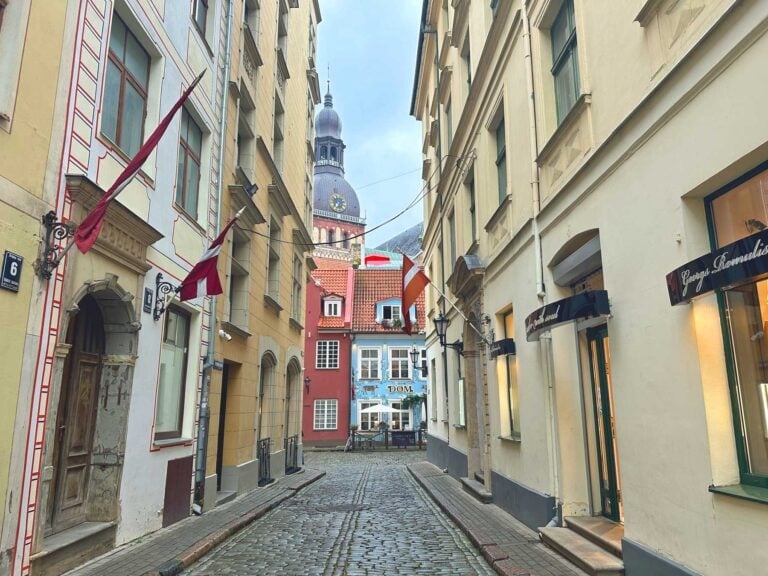

It’s 6 PM in early autumn, and the streets of Old Town Riga are bustling. Diners fill outdoor patios lined with colorful flower boxes, and the sound of laughter floats past me in the cool evening breeze.
With no destination in mind, I just want to explore. The Latvian capital is fascinating with its tidy UNESCO World Heritage Old Town, 800-year-old history and Hanseatic roots.
I’m also hoping to learn some history of my own.
A Lost Family
My grandfather was just 14 when he fled Riga during WWI. As German forces invaded Latvia, his family left their countryside farm behind, joining thousands of refugees streaming away from the fighting.

His family headed to Riga, where they lived during the school year. But as they crossed the river into the city, Germans shelled the bridge.
My grandpa fell into the water. By the time he got to the other side, his family was gone. He waited for days, then weeks, trying to find them. But he never saw them again.
When he arrived in America as a 22-year-old refugee, he was still alone in the world, having lost his country, family and language to the sorrows of war.
But I’m here now, and I want to understand, to learn more about this tiny nation of 1.87 million.

As my feet follow one cobblestone street after another, turning down tidy alleys and then across wide town squares, I wonder if my grandfather once walked these same streets.
This trip is a chance to see the city he once called home—and to learn about the country and culture that was part of him.
Where is Latvia?

One of three Baltic Countries in Northern Europe, Latvia is a thriving member of the European Union. Riga, the country’s capital, has an enviable location on the Gulf of Riga, where the Daugava River meets the Baltic Sea. The country struggled against invaders for centuries, from the Swedes to the Russians and Germans.
And yet, against all odds, Latvian culture has outlasted them all.
Riga, Latvia: A Hidden Gem in Europe
As a travel journalist, I’ve traveled all over Europe, and I quickly see how much Riga has to offer.
This often-overlooked corner of Europe has medieval old towns and gilded palaces, world-class restaurants and cutting-edge museums, and stunning architecture that rivals anything in Prague or Vienna.
Yet somehow, wonderfully, it remains blissfully uncrowded.
Seeing Riga through a Local’s Eyes

Early in my travels, I learned that one of the best ways to experience a destination is with a local guide. Guidebooks tell you what to see. Locals tell you what it means. And that transformation—from tourist to temporary insider—can turn a good trip into an unforgettable one.
I meet Andra, my local guide, the next morning. When I share my family story with her, I know she understands what this trip means to me. With a gleam in her eye, she nods, and we set out.
Riga is very walkable, and it’s easy to explore Old Town on foot. Riga’s UNESCO World Heritage Old Town is an architectural time capsule; its charming cobblestone streets are lined with buildings that speak to centuries of prosperity and hardship.
As we follow the narrow, winding streets, Andra brings the city’s 800-year history to life with stories that no guidebook could capture. She shares not only the past but also what it means to Latvia today.
St. Peter’s Church

We start our visit at St. Peter’s Church, built in 1209. A rooster vane stands atop the iconic Lutheran Church, a powerful Latvian symbol symbolizing the break of dawn and the triumph of light over darkness.
The church is one of the best places to get a panoramic view of the city. We purchase tickets for an elevator ride to the top of the tower. There, we’re greeted with a 360-degree view of the city and the Daugava River.
We can see how the city spreads out in layers: the medieval old town, the Art Nouveau district beyond, and the modern city in the distance. I soak it all in, thinking of the past, while taking in the Riga of today.

National Library of Latvia
From the tower, we have an excellent view of the famous National Library of Latvia, a modern architectural marvel designed by Latvian-American Gunnar Birkerts, which opened in 2014.
Andra tells me the library’s shape was inspired by Latvian legends of the Glass Mountain and the Castle of Light, which symbolize wisdom rising above darkness—a concept this small country has faced time and again.
Riga Dome Cathedral

The Riga Dome Cathedral, with its imposing brick facade, is our next stop. The stately cathedral is the seat of the Archbishop of the Latvian Evangelical Lutheran Church. It has one of the world’s largest pipe organs, and the cathedral offers 20-minute organ concerts almost every day at 12:00.
I take a seat at the back of the church and listen. The Concerto Piccolo at the Riga Dome Cathedral is unexpected magic. The organist, a very talented young woman, fills the vast space with beautiful music, which reverberates off the ancient stone walls.
Outside the cathedral, life fills Dome Square, the largest square in the Old Town. I have always loved European town squares, and this one is the vibrant heart of the city.
House of the Black Heads

Another place we visit is Riga Town Hall Square, a popular spot where the famous landmark, the House of the Black Heads, has stood for centuries. As a member of the Hanseatic League from the late 13th century onward, Riga became a major center of trade and wealth.
The original building was built in 1334 as a warehouse, a meeting and celebration place for merchants. Bombs destroyed the building in the Second World War, but it was fully rebuilt in 1999. Today, it’s a museum and event venue.
In My Family’s Footsteps

Old Town Riga is a vibrant place, carefully preserved yet fully alive. Even as modern life swirls around me, I can see echoes of the past — including my own family’s.
When family members are missing or lost, it leaves a hole that can ripple through generations. For my grandfather, the hole left by the loss of his family and culture was a wound that never healed.
After coming to America, he became a US soldier and served for the rest of his career. During WWII, he was stationed in England repairing Air Force planes that flew missions over Europe—fighting the same enemy that had invaded his homeland.
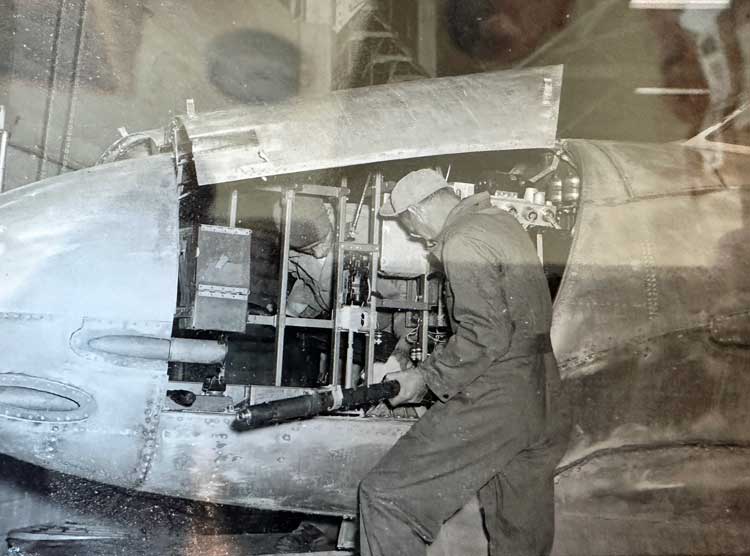
He married a quiet Swedish-American girl and they raised three children in Southern California – American kids who knew nothing of the cobblestone streets of Riga, the melodic sounds of Latvian or the power of the Daugava River.
My mother says she sometimes wondered why she had no grandparents on her dad’s side, no cousins or aunts and uncles. These people lived on in her, but they were a mystery.
WWII and then the Cold War kept my grandfather from his homeland. He never knew what happened to his family.
But I know now…at least a little bit.
A Latvian genealogist I hired found that most of his family survived the war and went on to have long lives in Latvia. Where they were during the war years remains a mystery, and the search for present-day relatives continues, but I’m beginning to connect the dots.
Today, I’m walking in their footsteps.
Our Lady of Sorrows Church

When we step into Our Lady of Sorrows Church, my journey becomes deeply personal.
My grandfather and his four siblings were baptized at Our Lady of Sorrows Church, a lovely Catholic church in Old Town built between 1783 and 1785. Today, it’s a white, pseudo-Roman-style church, its steeple the color of a soft blue sky.
Walking into this intimate place that once meant so much to my grandfather’s family, I feel the weight of each step. I’m walking the same aisle, touching the same floor stones they once touched, and seeing the same walls.
I feel a connection across generations that I’ve never experienced before. This isn’t just history—this is my history. My family’s story unfolded within these walls.

Andra stands at the back, giving me space, but I wave her over. Pulling a folded paper from my pocket, I ask her to read the names of our Latvian family aloud. As she reads them slowly, names I’ve only seen written come to life in their native tongue.
My grandfather was here, where I’m standing, a child in the arms of his parents, before the world wars that would shatter this region and force him to flee. The church had survived. The baptismal font remained. The traditions endured.
Standing there, I feel the weight of displacement—what it must have meant to leave this behind, knowing you’d never return.
But as we walk back out into the sunshine, I see the beautiful Latvia of today – a strong people who have endured and preserved their homeland.
There’s lightness in my step as we walk to lunch. I’m here. They were here. And somehow, that’s enough.
Petergailis Restaurant

After such a weighty experience, I’m glad when we head to Petergailis Restaurant on Skārņu Street. I love the restaurant’s whimsical décor, as it’s filled with hundreds of porcelain roosters and chickens, referencing the iconic rooster vane that stands atop St. Peter’s Church.
As fun as the décor is, the food is even better. While dill and caraway seeds may be some of the most expressive spices in the Latvian pantry, local cuisine is less about surprising taste explosions and more about the fresh quality of the dishes, so delightfully prepared. It is the first of many excellent meals I will have in Riga.
Art Nouveau District

The afternoon’s highlight is the Art Nouveau District, where Riga’s architectural prowess becomes undeniable. Riga boasts over 800 examples of Art Nouveau architecture, the highest concentration in the world. The street named Alberta iela is particularly stunning.
As we walk, Andra points out details I would have missed entirely—the symbolism in the decorative elements, the differences between various architects’ styles, the way certain buildings reflected Latvian national identity through their design.
I stand on the street, neck craned upward, marveling at the decorative faces, flora, and mythological creatures that adorn every surface. This isn’t just architecture; it’s sculpture on a massive scale.
My grandpa would have been almost a teen when many of these buildings were constructed, when Art Nouveau was the height of modernity. He would have walked these streets when they were new and fashionable. Now they’re historical treasures.
Uncrowded Streets

And here’s what makes it magical: we have the streets practically to ourselves. In Paris or Prague, a comparable architectural treasure would be swarmed with tour groups and influencers jostling for the perfect shot.
Here, Andra and I can stand in the middle of the sidewalk, taking photos at my leisure, absorbing the artistry without anyone rushing us along.
The Riga Art Nouveau Museum

To learn more about Art Nouveau, we visit the Art Nouveau Museum (Alberta iela 12), located in the former home of Latvian architect Konstantīns Pēkšēns, who designed this beautiful building with its grandiose central spiral staircase. The interiors reflect the home as it was in 1903, and it feels like we’re time-traveling to Riga’s golden days.
Dinner at Kaļķu vārti
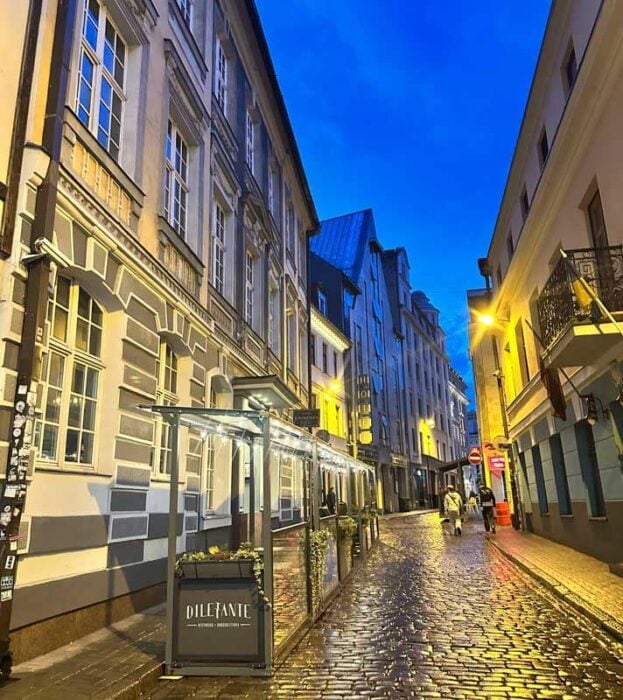
It’s dusk when I head to dinner at Kaļķu vārti on Jauniela Street for another excellent meal. The restaurant’s cozy space feels both historic and contemporary, a fitting summary of my day. Afterward, I walk back to my hotel on quiet, lamplit streets, savoring the serene magic of a European capital that still feels like a secret.
Day Two: Rivers, Markets, and Melodies
Sunday morning brings me to two addresses that aren’t in any guidebook—places where my grandpa and his family lived before WWI. Andra and I drive about 20 minutes from Old Town and find that one building is a stunning Art Nouveau structure from 1911.
Though the paint has faded, I peek through the entrance door window and discover the interior has been restored to its original Art Nouveau glory.

Standing outside, I try to imagine their daily life a century ago. These buildings survived wars, occupations, and the passage of time. My grandfather never returned, but I’m here now, completing the circle he couldn’t.
Riga Central Market

The Riga Central Market snaps me back to the present. Housed in repurposed German Zeppelin hangars, the market is a sensory feast. This isn’t a sanitized tourist market—this is where locals shop. Grandmothers haggle over produce, families stock up for the week, and chefs select ingredients. I love being part of this vibrant slice of modern-day Riga.
Kolonāde and the Daugava
Now we’re exploring today’s Riga. Lunch at Kolonāde on Brīvības laukums offers excellent food and people-watching, with modern Latvian cuisine that reinterprets traditional ingredients through contemporary techniques.

A Daugava River cruise gives me a different perspective. From the water, Riga’s architecture tells its own story—medieval church spires giving way to Soviet-era buildings, then to sleek modern developments.
For an easy way to experience it, try RigaCruises: Canal and Daugava River Cruise. Their comfortable boats, expert captains, and audio guides make it a smooth and scenic way to see the city.
World-Class Cuisine at 3 Chefs

Dinner at 3 Chefs, a Michelin Guide restaurant on Torņa Street, is the culinary highlight of my trip. The tasting menu showcases hyper-local ingredients—foraged mushrooms, Baltic fish, heritage grains, and wild herbs—in dishes that are both innovative and deeply rooted in place.
Day Three: Palaces and Perspective

Monday takes me beyond Riga to explore the surrounding region. A 90-minute drive brings me to Bauska Castle, at the confluence of the rivers Mūsa and Mēmele.
It consists of ruins of a 15th-century Livonian Order castle and a 16th-century ducal residence. Touring this massive fortress, I learn how this strategic location made the castle a prize worth fighting for.
Rundāle Palace

Then comes the day’s crown jewel: Rundāle Palace, which is about an hour’s drive from Riga. Built between 1736 and 1740 as the summer residence of the Duke of Courland, this Baroque masterpiece was designed by Francesco Bartolomeo Rastrelli, who also designed Saint Petersburg’s Winter Palace. The gilded halls, the elaborate plasterwork, the gleaming parquet floors—every room seems more spectacular than the last.
I explore it without crowds. No guards hurrying me along. I can stand in each room as long as I want, absorbing the details, imagining the balls that once filled these spaces with candlelight and music.
The French gardens outside are equally magnificent. I walk the paths slowly, savoring the improbable peace of exploring one of Europe’s grand palaces practically alone.
This is the moment I fully understand Riga’s—and Latvia’s—appeal. Here is a country with the history, culture, and beauty to rival anywhere in Europe, yet without the overwhelming tourism that has diminished the experience of visiting so many other destinations.
The Weight of History

On my last night in Riga, I walk through the Old Town as sunset paints the medieval buildings in golden light. My mind moves between all I’ve experienced, the treasures of today and the stories of the past.
Earlier, I’d visited the Museum of the Occupation, where the weight of Latvia’s 20th-century struggles was impossible to ignore. The exhibits document successive Nazi and Soviet occupations, deportations, resistance, and losses.

Latvia’s history is complex and often painful. Forced into the Soviet Union, the country declared independence in 1990 after the Singing Revolution, the Baltic peoples’ peaceful revolt against the occupying regime. Today, Latvia is a member of the European Union, NATO, and the Schengen area.
My grandfather must have carried memories of Latvia all his life, but he never spoke Latvian with his children and never found his family.
Now I understand the depth of all he lost—and what I’ve gained by returning. I haven’t found any descendants yet, but what I have found matters: a connection to this special place and culture, to the roots that shaped me.
Riga, A City for Everyone

But this article isn’t just for people with Latvian ancestry. It’s for anyone seeking authentic European experiences, anyone wanting to discover a city that hasn’t been overrun by tourism.
Latvia today is impressive. The population is highly educated; nearly everyone I meet in Riga speaks English with ease, and people are genuinely friendly and welcoming. This is a modern, forward-thinking nation that makes travel effortless while retaining its distinctive character.
You don’t need a family connection to appreciate Art Nouveau architecture, enjoy uncrowded museums, savor excellent restaurants, or marvel at Rundāle Palace.
My personal connection certainly deepens the experience. But even without it, Riga stands as a European treasure well worth discovering.

If You Go: Practical Tips for Your Riga Adventure
Stay in Old Town: Stay in Old Town if you can. It’s easily walkable and puts you in the heart of everything. Recommended hotels are Dome Hotel Riga, Neiburgs, Wellton Riverside or Grand Palace, Kempinski.
How to Get to Riga: Riga International Airport connects to most European capitals with short, frequent flights. I flew Air Baltic from Rome, and it was about a three-hour flight.
Get a local guide: A local guide can bring Riga’s history to life in ways a guidebook never could. Seeing the city through Andra’s eyes—understanding not just what I was looking at but why it mattered—made all the difference. You can reach her here: Tourist Guide Riga.
Enjoy the restaurants: From traditional Latvian fare to Michelin-starred innovation, Riga’s food scene impresses. Don’t miss the rye bread, smoked fish, and wild mushrooms. For Vegans, don’t miss these 10 Top Vegan Cafes in Riga
Take day trips: Rundāle Palace is essential. On my next trip, I hope to see Jūrmala, Gauja National Park, and medieval towns like Sigulda and Cēsis, which I’m told are easy trips from Riga.
Visit the official Latvia Tourism site for more information.
We are reader-supported and may earn a commission on purchases made through links in this article.

- 9 Insider Tips I Wish I’d Known Before My First European Adventure - October 7, 2026
- Seaplanes, Porcupines and Hidden Lakes on Quebec’s Explorer’s Route - October 6, 2026
- The Family Reunion Hack That Eliminates All the Planning Stress - September 30, 2026
Planning another trip soon? ✈️
Add GoWorldTravel.com as a preferred source on Google. Click the button below so our local guides, packing hacks, and hidden-gem itineraries always show up first when you search!
Add to Preferred Sources
Great story. I focused on the family connection. Sandy and I took some of our kids and grandkids to Lithuania in search of our roots: grandmother a peasant, grandfather a land owner. Our grandfather’s family grave was well maintained so l left a note under a lantern. About 3 months later I received an email from Skirma, the granddaughter of my grandfather’s brother. She lives outside Chicago and, from no relatives in the US, she now has dozens. A journey of years to reach this point.