
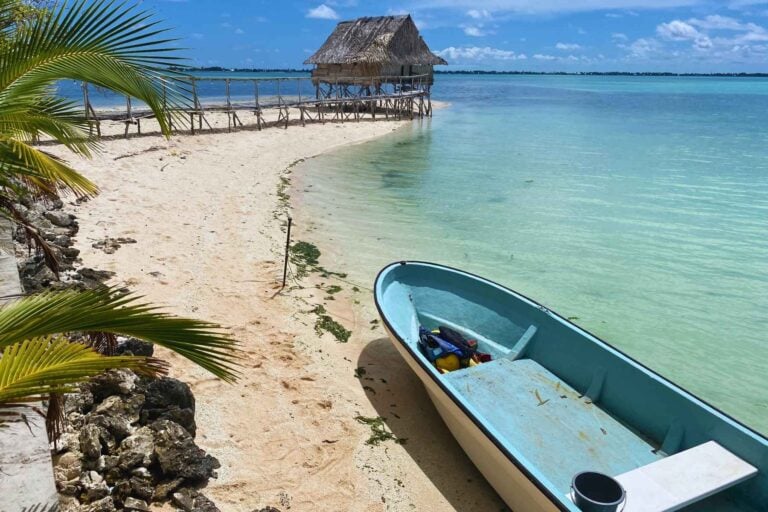
When a work opportunity came up for me to visit Kiribati, I learned very quickly how little is known about the tiny Pacific island nation.
Pronounced “Kiri-bas”, with the “ti” pronounced as an “s” in their language, the Micronesian country is made up of 33 islands total, though the nation’s population of 130,000 reside on only 20 of the islands.
They are so spread out that it proudly claims the title of the only country to cover all four hemispheres on Earth.
One-of-a-Kind Geography
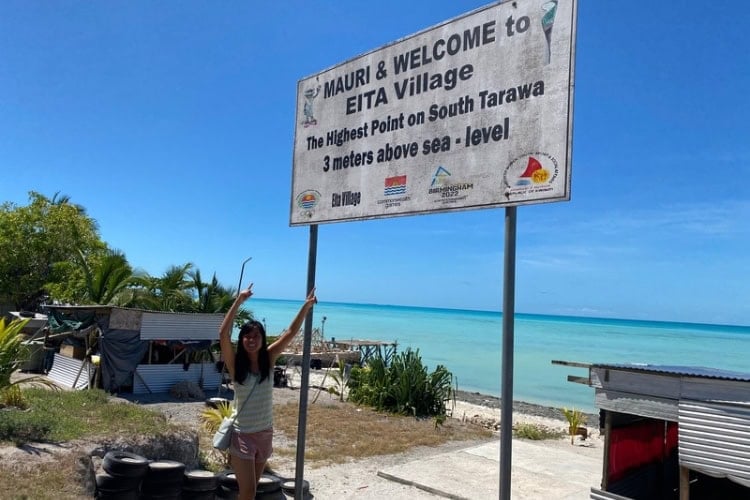
One of the most striking factors that I noted upon arrival was the capital’s unique geography and how it impacts nearly everything. The Tarawa atoll is essentially a V-shape, and is split up between North and South Tarawa.
The airport sits at the intersection, and boats are required to pass between the two sides. South Tarawa is where nearly half of the population resides, and is a series of islets totaling 30 kilometers in length.
With the majority of larger businesses and offices based on one end of the skinny strip or another, location means everything.
Due to the isolation of the country, very few foreigners and visitors, and a lack of infrastructure, there are only a handful of restaurants and accommodation choices.
Even then, those housing options are often booked up by long-term guests, such as Chinese construction workers, or frequent visitors, like Nauru Airlines’ pilots and flight attendants.
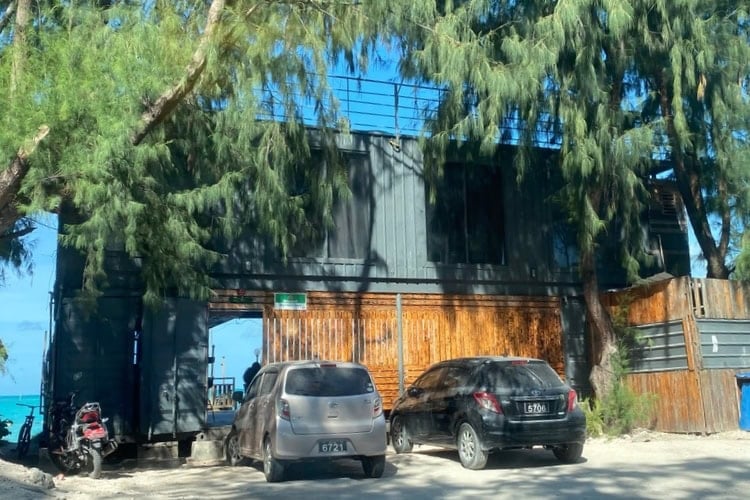
The limited land space and resources also mean that people need to get creative with what they have. Three repurposed shipping containers (affectionately dubbed “the container bars”) are popular evening haunts right on the beach.
A local motel is not only somewhere to sleep for the night, but also a car rental agency, key copy office, and occasionally, a temporary embassy.
Changing with the Tides

Kiribati is ranked third in terms of the world’s countries with the lowest average elevation, only preceded by the Maldives and Tuvalu.
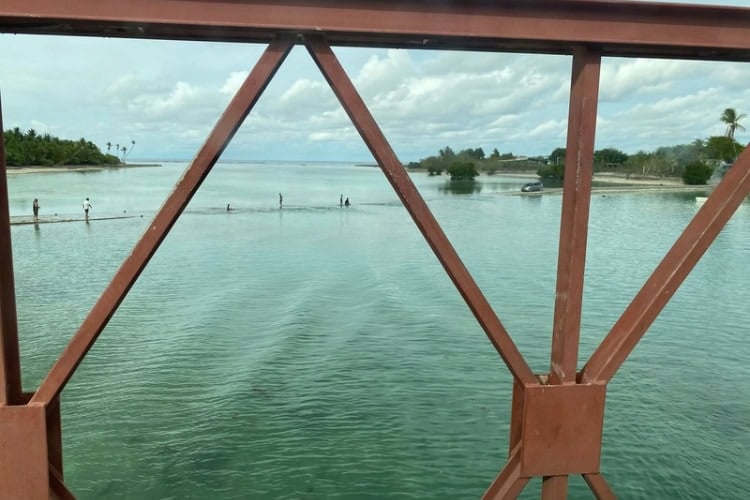
Shallow waters surround the atoll, and the entire country is sensitive to climate change and the slightest movement in sea level. One morning, I spotted fishermen stranded in shallow embankments waiting for the high tide to come in and bring out their boats.
Just before crossing a bridge another afternoon, I saw a row of trucks parked on the side with all the drivers seemingly napping. Before I could ask someone what they were doing there, I saw a parallel bridge that was fully underwater.
Then I understood – the truck drivers were waiting for low tide to be able to cross over the bridge.
The closest point between North and South Tarawa is only about 100 meters apart, but the way to cross it changes depending on the tide.
During high tide, a wooden motorboat takes passengers for $0.50 AUD ($0.30 USD). During low tide, though, it’s possible to walk across, taking care not to step on the coral or starfish along the way.
Like much of the Pacific Islands, the weather is hot and humid year-round, so much of the infrastructure takes advantage of this climate. Maneabas are open shelters found everywhere from schools and university campuses to community centers and churches.
Buias are thatched-roof homes, using only local materials, and are built on both land and over water. Kiakias are between the two, size-wise, for people to find shelter from the heat.
Sometimes, though, its effects are inescapable. A fellow i-matang (a foreigner), Amy, told me about how she and her husband had purchased a chicken so they could have eggs regularly.
However, the heat was too much, and the chicken went from laying six eggs a day to one.
Transport Safety and Road Rules
Getting around Tarawa is no easy feat. There is only one road that runs up and down South Tarawa, and the speed limit is 40 kph.
With dozens of speed bumps and curves in the road, and the never-ending stream of drunkards and children, it is nearly impossible to cross from one end to the other in less than an hour.
The average width of South Tarawa is 450 meters, which means everyone and everything are practically on the main road, which intensifies the traffic flow.
The other road hazard is the number of stray dogs wandering aimlessly. An acquaintance, Nakano, shared a story about how one time, his flight was delayed in landing at the Tarawa airport because stray dogs were on the runway.
The pilots had to loop around four times while airport workers drove onto the runway to shoo away the dogs. A colleague, Tietie, chimed in that a government agency had been created a while ago to hunt and kill stray dogs.
However, as it turned out, the employees realized if they were too efficient, they’d put themselves out of work, and so, they intentionally worked slowly to remain employed.
While families do own cars, it is common to borrow or share cars, as they’re infrequently imported. There are no official car rental services or taxis.
When I asked an acquaintance, Rooti, how her children get to school, she said that for the 10 primary schools in South Tarawa and seven secondary schools, there are only three school buses.
Oftentimes, children will hitch rides with open truck beds up and down the atoll.
Motorcycles are fairly common and add an extra variable to the traffic scene in Kiribati. The one road in Tarawa has one lane going in each direction, and when a vehicle stops on the road to turn, inevitably, a row of cars end up waiting.
Impatient motorcyclists so frequently pass the waiting cars from the left or the right that it became a hazard, as they couldn’t see which direction the first car was turning and would get hit.
As a result, the one unspoken road rule is that when a vehicle turns on its blinkers, every single car behind it follows suit, so motorcyclists know which side is safe to pass on.
Another aspect I noted with amusement was the wide range of headgear worn by the motorcyclists.
A friend, Temeura, explained that while the government did finally make it a legal requirement to wear helmets, they didn’t include an explanation of why or the specifics of what type of helmet.
Consequently, many drivers use bicycle helmets or Chinese construction helmets, without chin straps fastened, resting loosely on top of their heads.
Be Careful What You Eat
When I first mentioned to friends in Fiji that I’d be traveling to Kiribati for work, nearly every first reaction was, “Eat tons of fruits and vegetables before you go!”
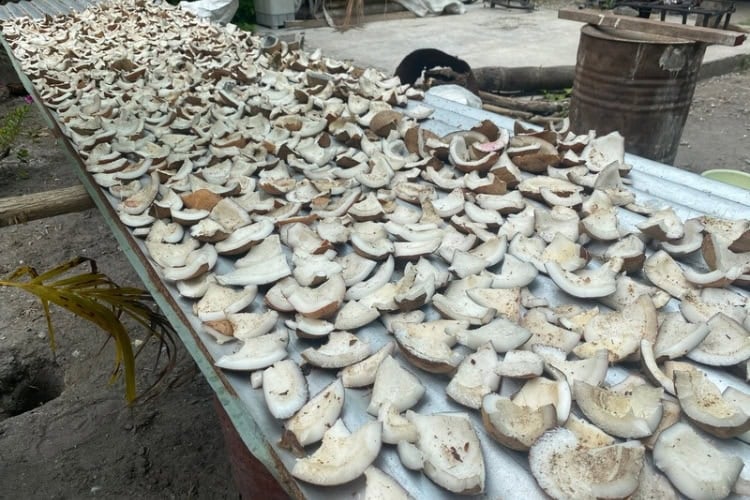
While I did find a sprinkling of vegetable dishes at two Chinese restaurants, which evidently come from their own Chinese farms set up recently in Tarawa, and the rare, and very overpriced, piece of fruit, the options in Kiribati are, indeed, limited and revolve primarily around rice and fish.
Not all fish, however, are safe; the next thing people warn foreigners new to Kiribati about is ciguatera. This type of food poisoning comes from reef fish eating ciguatoxins, and can’t be detected in any way beforehand.
The symptoms in humans are severe, including hot and cold sensation reversals, nausea, headaches, and even hallucinations, and I heard more than a few stories of people who suffered for weeks.
To top it all off, the toxins stay in one’s body forever, and future consumption of any type of fish can trigger the effects again.
It affects animals as well. A colleague’s uncle shared that he once put out some fish, which, unbeknownst to him, contained ciguatoxins, and his kitten had snuck a few bites.
It started to act strangely, then fell down some stairs, and within minutes, it had died.
As my eyes grew bigger and bigger listening to these stories, grateful for the first time for my seafood allergies, I asked a nearby fisherman, with the help of a translator, if it’s possible to avoid eating the wrong fish.
He raised his eyebrows – their way of saying ‘yes’ – and explained that as larger fish eat smaller fish, and larger predators eat those fish in return, the ciguatoxins accumulate.
Thus, the general idea is to only eat fish smaller than the length of your wrist to your elbow. Fish that live farther out from the shoreline, such as tuna, are also safer than those closer to the shore, like albacore.
The intense portions of rice with every meal, combined with sweet bread and syrupy drinks, also have consequences. When I met up with a friend working with a medical NGO, he spoke about the high rate of diabetes in the region, particularly in Kiribati.
I once watched, during lunch, as a coworker finished an entire glass of condensed milk diluted with just a little water.
As the NGO friend explained, locals even add sugar to the drinking water to cover the faint traces of saltiness that still remain after the desalination process.
A Set of Unique Traditions and Ceremonies
I had to learn very quickly about some of the customs and traditions in Kiribati in my time there to make sense of what was going on around me. My first full day in Tarawa was a Thursday, and with some colleagues, we visited a government ministry office.
Given the floral nature of the tropical Pacific region, I was stunned to find everyone wearing black from head to toe. After our meeting, I pulled aside my colleague to ask if someone had just died.
As it happens, different days of the week have different dress codes. On Monday, everyone wears black and white. On Fridays, it’s most typical to wear mauri wear, the traditional Kiribati dress, which often has embroidered names on the front.
On Thursdays, though, it’s customary to don all black in honor of all the female victims of domestic violence.
In the evenings, the maneabas are often packed with community members hunched over, and I assumed for the first few nights they were chatting along the coconut wireless, their version of gossiping via ‘the grapevine’.
However, a friend, Christian, pointed out that they were playing Bingo, a Kiribati favorite. Evidently, for $10 AUD ($6.27 USD) per card, the Bingo winners stand to win prizes such as food vouchers or even a car.
On my penultimate evening, we were invited to a welcome reception for a new government official.
The festivities started on Pacific time (i.e. an hour and a half late) at a massive maneaba, decked out with Kiribati flags and long tables running alongside either side packed with dishes that each department or group contributed.
As international guests, my colleague and I were placed alongside other VIPs, Chinese and Australian Embassy representatives, at the front right next to the guest of honor and the podium facing the hundreds of attendees.
The ceremony itself included some standard elements – a few speeches, the national anthem – but also many unusual ones. Like the food contributions, each department or group was responsible for providing the evening’s entertainment.
Many prepared traditional dances, with rows of men and women twisting and shaking their hips and wrists, clad in their colorful wraps and flowers behind their ears.
Unexpectedly, some attendees got up to spray perfume under the dancers’ arms, from perfume bottles that materialized out of nowhere. Between the whooping and cheering, other attendees scattered powder around the dancers’ feet.
A colleague, Tek, later explained they’re ways of cheering on the dancers and supporting them through the performances.
Some of the departments opted to sing, karaoke-style, with a mixture of country songs from the US, 90s ballads, or Kiribati traditional songs.
During the presentation of the three cakes to the guest of honor, attendees took turns dancing with them, swinging them around, and shimmying through the seated rows before passing them onto others.
I was certain that at least one of the cakes would slide out of their hands onto the floor, but it was clearly no one’s first time, and they gracefully returned all three to the table intact.
When the ceremony finally ended and the dinner could commence, I was surprised to see that the potluck array of dishes was only for the attendees.
The VIPs were instead directed to another smaller table, similarly packed with food but catered from restaurants.
I helped myself to several slices of fried breadfruit, kamwaimwai (a boiled coconut syrup), and large slabs of pork from the massive roast pig, a standard main course at Kiribati receptions of any kind.
Pieces of History All Around
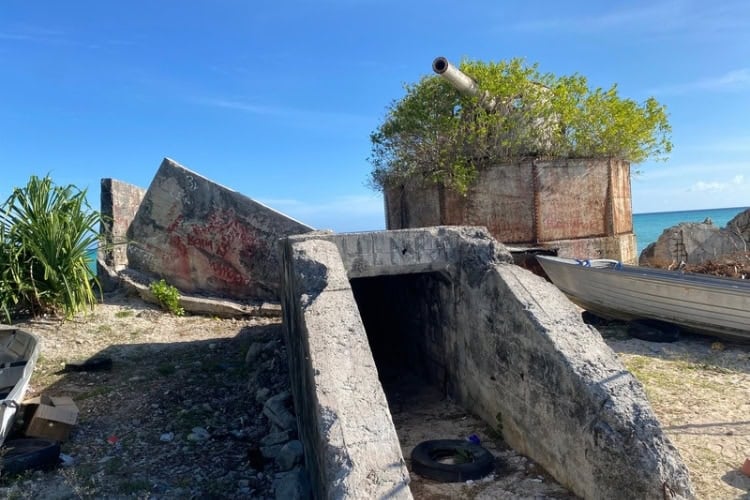
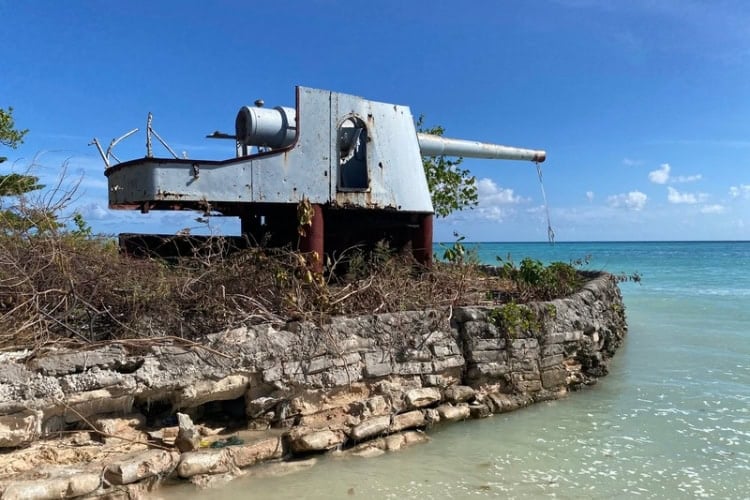
The South Pacific isn’t the first region to come up in a conversation about World War II, but was, in fact, home to many battles. The Battle of Tarawa was just a few days long in 1943, between the US and Japan, but it was one of the bloodiest in the war.
Traces can still be found around Betio, the far side of the Tarawa atoll, such as a number of large defensive guns which people can freely climb on.
Although I didn’t have time to go diving, friends reported seeing a submerged Sherman tank off the coast. Next to one defense gun is an exploded bunker where a Japanese general was reportedly killed.
A colleague went kayaking once farther out from shore and spotted UXO (unexploded ordnance) shells in the water.
On one of the outer islands, Abeiang, World War II left another type of legacy. During the many airdrops by the US, where boxes of primarily food would fall from passing planes, locals assumed the strange, square-shaped soap was cheese and ate it.
While some families on the island came to understand that it wasn’t consumable, it still happens to this day.
A colleague shared an anecdote about a teenager who was munching on a bar of soap recently and had to be rushed to the hospital, much to her parents’ chagrin.
The historical remnants don’t apply to just World War II. In Kiribati, it is polite to say “chulo” when passing in front or between people, with a slight bow of the head.
This dates back to the European missionaries who first arrived in the region centuries ago, only to be too tall for many of the Pacific-islander-height roofs.
They had to bow their heads to enter the huts, often muttering about the doors being “too low”, and this phrase was interpreted as a sign of respect.
Through the last day of my trip, I chuckled to myself every time I heard or used it, reflecting on the fascinating evolution and unique nature of history and culture in the country.
If You Go
Direct flights go to Kiribati from Fiji, Nauru, the Marshall Islands, and Hawaii, USA. Nearly 100 nationalities may visit without visas – check the Kiribati Ministry of Foreign Affairs website for the most updated information before you go.
Book your accommodation in advance, as there are limited options and spaces. For Western conveniences and standards, try Utireirei Hotel, Betio Lodge, or The George Hotel.
Create a Facebook account, or at the very least, have Facebook Messenger readily accessible. It’s the primary form of social media, and is commonly used in place of a website to promote a business, an event, or to get in touch with someone.
Travel insurance is essential for any trip, offering peace of mind and protection. Explore options with SafetyWing or SquareMouth to find the coverage you need.
Inspire your next adventure with our articles below:
- World Travel: Don’t Miss These 15 Bucket List Destinations
- 10 Must-Visit Islands of the Great Barrier Reef That Will Take Your Breath Away
Author Bio: Annie Elle is originally from Los Angeles, though she has lived overseas since 2011. She’s worked in various aspects of international education in over a dozen countries and traveled to over 100 countries. Annie enjoys playing pickleball and exploring new foods and art forms in her free time.
Want to discover more hidden gems and helpful travel tips? Join our free newsletter for the latest travel secrets and travel articles.
We are reader-supported and may earn a commission on purchases made through links in this article.

- Travel Guide to Japan - September 29, 2026
- Laos for Backpackers: Vientiane, Vang Vieng and Luang Prabang on a Slow-Travel Route - September 29, 2026
- Exploring Nanjing, China: 48-Hour Trip That Changed My Perspective - September 29, 2026
Planning another trip soon? ✈️
Add GoWorldTravel.com as a preferred source on Google. Click the button below so our local guides, packing hacks, and hidden-gem itineraries always show up first when you search!
Add to Preferred Sources