
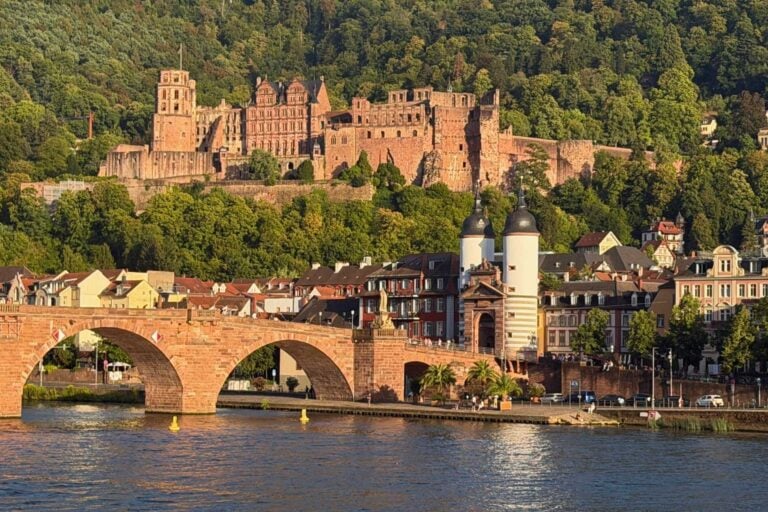
I channeled my father while strolling through the picturesque streets and winding alleys of Heidelberg. He was born and raised in the Black Forest area of Germany until he and his family moved to the U.S. during WWII.
Being back in the country brought back many wonderful memories of him, his quaint (and occasionally off-color) German expressions, the foods from his homeland that he loved to share with my brothers and me, and his characteristically methodical German way of doing things.
On a recent, long-overdue return trip to my father’s homeland, I opted to explore the city of Heidelberg. This well-known town, which is located about 50 miles south of Frankfurt and situated along the Neckar River, had been on my shortlist for some time.
Pictures I had seen along with my father’s descriptions of the place provided the impetus for this visit. The town had obviously left a positive impression on him when he had gone there so many years ago. And now I know why.
Heidelberg’s Charms Are Many
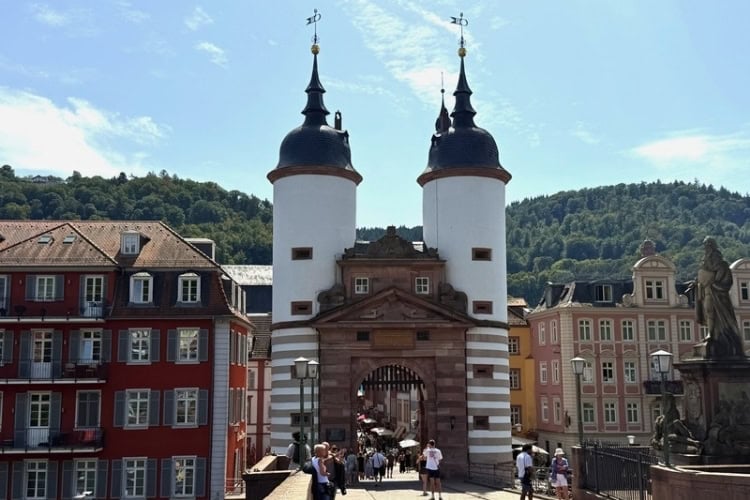
Heidelberg is often regarded as Germany’s most beautiful town. It’s known as the city of romance and the home of philosophers and poets. And its university, which is the oldest in the country, is highly esteemed in the world of academia.
In person, Heidelberg was even more beautiful than I had anticipated and it didn’t take long before I was completely smitten. The city oozed charm from its every pore, with its medieval architecture, breathtaking scenic views, and old-world ambiance.
Explore Heidelberg Castle
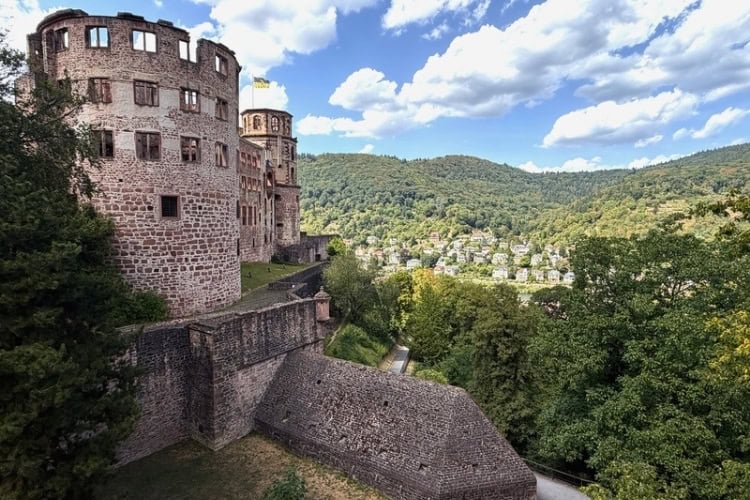
The Old Town is the heartbeat of Heidelberg, and it’s where you’ll find many of the city’s historical sights. The foremost attraction is Heidelberg Castle. You can’t miss the red sandstone ruins of this once grand palace, as its silhouette overlooks the town from a lofty peak, like a sentinel guarding its domain.
Funicular and Guided Tour
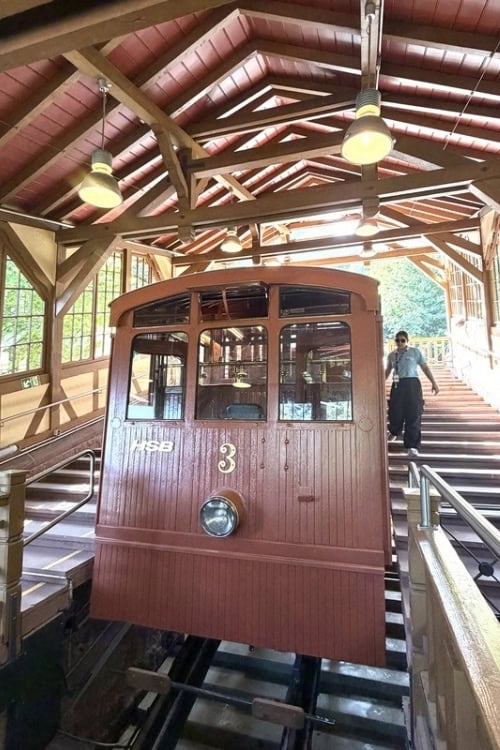
You can walk up to the castle or take the funicular as I did. This railway is popular with tourists, as it offers a fun mode of transportation with spectacular views. It departs from the Old Town and in minutes you’ll arrive at the Castle station.
It’s possible to explore the castle on your own; however, a guided tour will greatly enhance the experience and provide background information about its lengthy history. My guide, Dr. Daniel Vuynovich, was extremely knowledgeable about not only the castle, but all things Heidelberg, as he proceeded to show me around the city.
Learn About the Castle’s History
The castle was first constructed around 1300 and used as a royal residence for Prince Rupert III. Until the Thirty Years’ War, it boasted one of the most resplendent collections of Renaissance-style buildings in the Holy Roman Empire.
Flash forward to the late 17th century when the palace was attacked several times and eventually destroyed by the French in the Nine Years’ War. Repairs were made, but then in 1764, it was damaged again by lightning strikes. And the once magnificent residence was almost completely burned out, leaving it in ruins.
In the 19th century, though, the ruins became the “paragon of the Romantic mood” and were promoted to National Monument status. The castle’s imposing edifice and famous garden, which was never completed, became shrouded in myth and legend. And the remains offer hints at the breathtaking scale of this place.
My guide explained that the castle is not a coherent structure, as over time, prince-electors continued to add various palaces in the style of the day.
Be Wowed by the Architecture
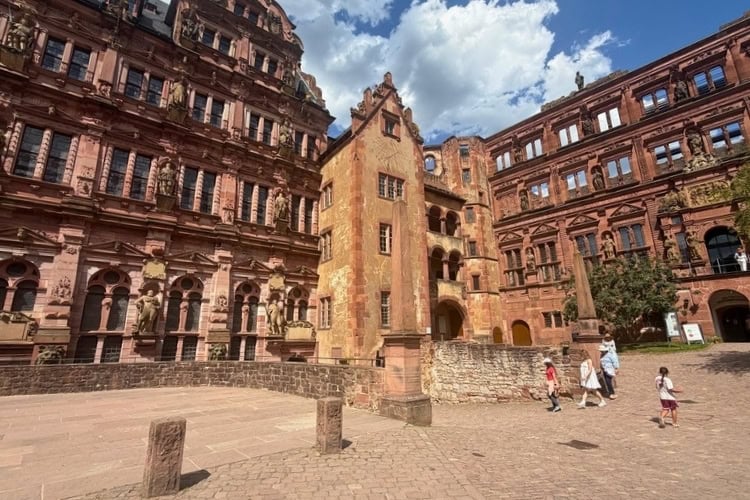
Upon entering the cobbled palace courtyard via a bridge gatehouse and tower, you’re met by an awe-inspiring slate of architecture. It’s one of those “wow” moments that make you stop in your tracks and just take it all in.
There are two ostentatious palaces with heavily decorated facades. One has larger-than-life figures that represent the ancestors of the palatine prince-electors, while the other has glassless windows in its upper stories that appear to jut into the sky. The two buildings are connected by the stunning Hall of Glass.
This courtyard, I was told, becomes a stage for theatrical productions during the Heidelberg Castle Festival in summer. This is one of the most traditional open-air festivals in the region and is a cultural highlight.
You Won’t Believe the Size of the Heidelberg Tun
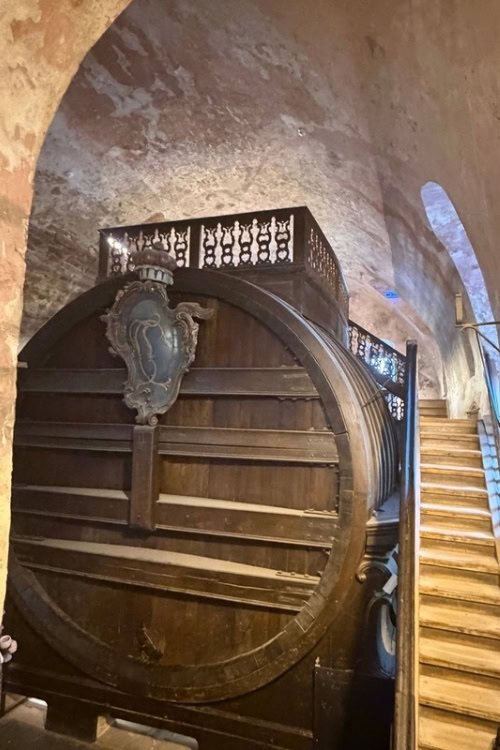
Inside the castle and not to be missed is the Heidelberg Tun, a ginormous wine barrel built in 1751. It required 130 oak trees to construct, measures 26 feet in diameter, and holds 60,500 gallons. Supposedly, it’s the largest in the world and was used for celebrations and parties held by the prince-electors. There’s even a dance floor on top of it.
When it came time to cleaning the barrel, children would climb inside it, as they were the only ones small enough to get through the opening. And they had to have a rope attached to them so they didn’t get lost in there.
My guide pointed out a painted, wooden figure near the barrel named Little Perkeo. Story has it that he was a court jester brought by Prince-Elector Carl Philipp at the start of the 18th century to provide entertainment for the court society. And he was famous for his ability to hold his liquor. He now stands guard over the massive barrel.
Check Out the Apothecary Museum
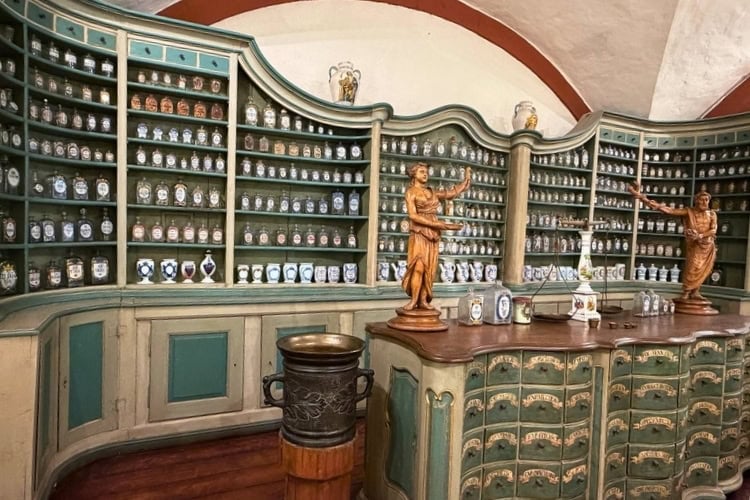
Also inside the castle is the German Apothecary Museum. I find pharmacy museums interesting, as they offer insights into the history of this ancient industry.
In this museum, there are numerous exhibits showing how natural substances from plants were used to heal various ailments in the Middle Ages and later. There are also preserved interiors of apothecaries from the 17th through 19th centuries with painted cabinets, Baroque and elegant designs, and containers of glass and colorful ceramics. And then there’s an apothecary tower, complete with a lab and its equipment.
After your visit to the castle, you can continue onward up the mountain via the older funicular, which takes you to the town’s highest point at more than 1,800 feet. Here you’ll find more panoramic points, nature trails, outdoor sculptures, a children’s play area, restaurant, bar, and hotel.
Visit Historic Churches in the Old Town
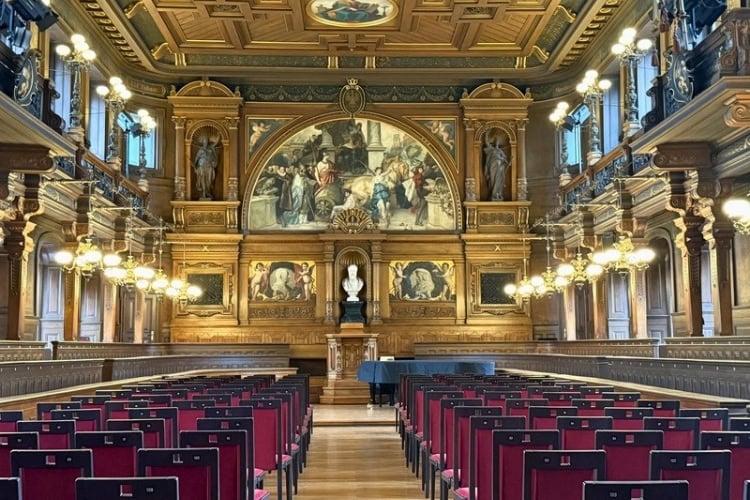
Churches abound in Heidelberg and the Heiliggeistkirche, or the Church of the Holy Spirit, has the distinction of being the most famous and the largest in the city, with a history that dates back to 1398. This impressive Romanesque and Gothic-styled landmark is located in the Old Town’s Marktplatz, or Market Square.
The present church is the third actual one on this site. It was reconstructed in the early 1700s after the earlier church burned to the ground.
Throughout history, the Heiliggeistkirche has been used by both Catholics and Protestants and sometimes both faiths used it at the same time. To do this, a partition was put in place so both could conduct services without disturbing each other. The Catholic Mass was celebrated in the choir and Protestant services in the nave. In 1936, the partition was removed and since then, the church has been strictly Protestant.
The exterior of the church has notable details, like a twin-towered façade of red sandstone, the statues of cardinal virtues, and handsome carved doors with cherubs and other carvings.
Inside, you’ll find a three-nave hall with a triumphal arch and a forest of columns. Though the church used to be decorated with magnificent altars, sacred images, and organs, these objects were removed and destroyed during the Reformation Period, which began in 1517. It does, however, have several paintings and stained glass windows. And it also contains the tomb of the builder of the church choir, Elector Ruprecht III.
Tower Views and Hercules
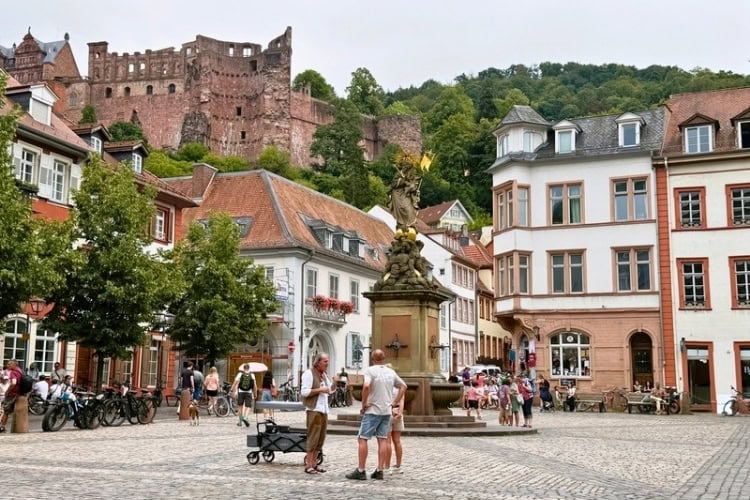
After your visit, climb the 204 steps to the tower for great views of the town, Heidelberg Castle, and the river. Then spend some time strolling around the Market Square, checking out the shops and cafes. Look for the famous fountain with the intricate Baroque-style figure of Hercules. It serves as a reminder of the immense efforts required to rebuild the city after its almost total destruction in the War of the Palatinate Succession (1688–1697).
St. Peter’s Church is the oldest surviving church in the Old Town and it has served as the church of the University of Heidelberg since the late Middle Ages. It, too, is an important landmark, known for its Baroque-style architecture and spectacular tower characterizing the cityscape.
And then there’s the Jesuit Church, another beautiful Baroque-style church. With its white façade and high ceilings, this church is known for its peaceful and serene atmosphere, which is well-suited for quiet reflection.
Heidelberg Student Jail
Heidelberg University’s Student Jail, the Studentenkarzer, is a definite must-see in the Old Town. It’s proof positive that college students acting stupid isn’t anything new, but rather a behavioral trend with a long history.
Starting in 1823 and continuing until 1914, the Student Jail housed young scholars at the prestigious university who got themselves in trouble with the rules. Common infractions included carousing, rabble-rousing, and antics like freeing the pigs of the town’s farmers—the latter was apparently a popular pastime. Of course, such activities were often fueled by booze. As for penalties, the typical sentence was a few days in jail unless it was a more serious offense, which could mean additional time.
Those who ended up here were put in attic rooms designed to keep them off the streets till they learned their lesson. The miscreants, however, were still expected to go to classes and lectures during the day, then promptly return to their rooms afterwards. Conveniently, there was a special door at the jail that would allow them to easily enter and exit the university building.
These young men slept and studied in their small quarters, which consisted of an iron bed, wooden desk, and a chair or two. Though the atmosphere sounds drab and depressing, it was nothing of the sort. There was a party feel to the place, as the inmates were with their pals and probably viewed their time in the jail as a rite of passage and badge of honor.
Jailhouse Graffiti Walls
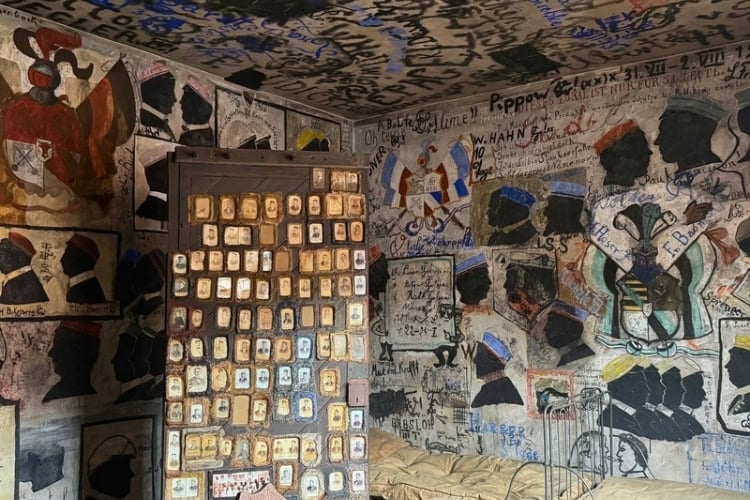
The men also spent time decorating their surroundings. Dull, blank walls became canvases for their works of graffiti, which remain to this day. Everywhere you look, you’ll see cartoon-like drawings, poems, family and fraternity crests, pictures, students’ names, and silhouettes—the latter of which are each topped with the colored cap that was part of the university uniform at the time.
The Student Kiss Tradition

For insight into a fun Heidelberg tradition, head to Café Knösel, the oldest chocolate shop in town. Founded in 1863, this place became a favorite meeting spot for Heidelberg society, as well as a popular gathering destination for students, due to its ties to a German fraternity.
The young men would frequent the café, hoping to catch the eye of a pretty young lady, who was in Heidelberg, most likely attending finishing school and on the hunt for a husband. Such a young man would then order a piece of cake for the lady and typically have it given to her governess or private tutor, who was always accompanying her.
After getting the proper permission, the two could meet in a separate room in the café, where they could get to know one another. Parents, however, got wind of this courting ritual and put a kibosh to it because of the students’ reputation for drinking and other wild behavior.
Love Notes Wrapped in Chocolate
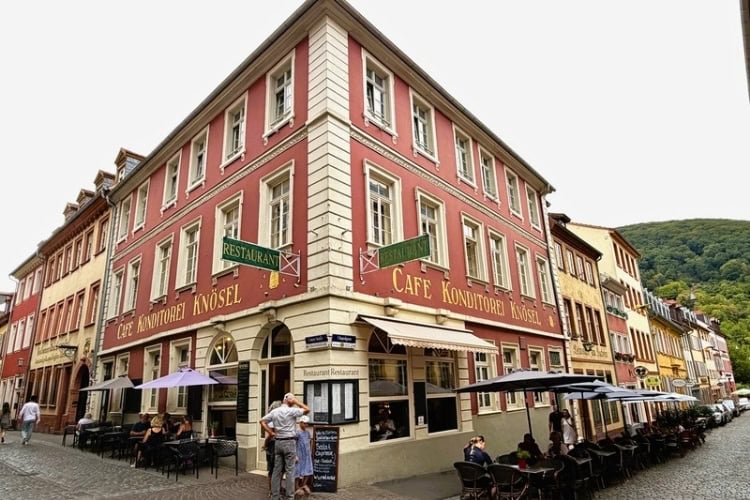
Enter the Studentenkuss, or Student Kiss, a chocolate treat that allowed the young men and women to message each other discreetly. The students would write their name, where they came from, and what they were majoring in on a piece of paper, fold it, and put it behind the chocolate confection, which was then wrapped up. Obviously, the owner of the shop and his wife were in on this intrigue, probably because they felt sorry for the young people.
When the governess wasn’t looking, the student would sneak the chocolate inside the woman’s bag or leave it on the table so the woman could make eye contact with the man. Once home, she would find the message. And later, she might pretend to drop her handkerchief on the street when she saw him so that he would pick it up and they could speak together. By using his first name, the young woman would appear to be friends with the young man, so her governess would think it was okay for them to communicate.
Today, you can purchase a Student Kiss as a sweet remembrance of Heidelberg. They’re easy to find, as they’re wrapped in a bright red box adorned with a silhouette of a student in a cap and a young woman—just about to kiss.
The Philosopher’s Way
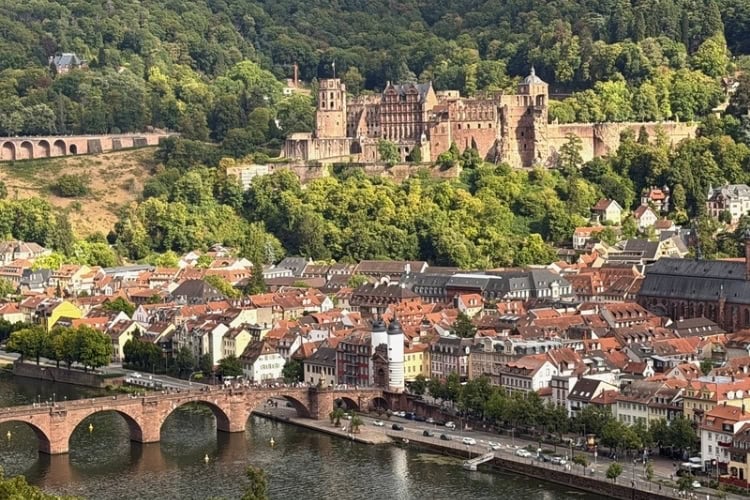
For stellar views of the city, hike the Philosopher’s Way. This path takes you across the Neckar River, using the Old Bridge from the Old Town. The bridge’s real name is the Carl Theodor Bridge, named after the man who had it built, but everyone in Heidelberg calls it the Old Bridge.
The Iconic Old Bridge
The original structure, which was wooden, dated back to 1284, but it didn’t last, as high water and ice destroyed it. Subsequent bridges were built, but also fell prey to the same elements. Enter Prince Elector Carl Theodor, who constructed the first stone bridge on the site in 1786. Unfortunately, on one of the last days of WWII, German soldiers used explosives to render it and the other bridges in Heidelberg impassable.
Thanks to a campaign to collect donations, work to rebuild the bridge began a year later and it was inaugurated in 1947. This notable structure boasts nine red sandstone arches that span the river. It’s framed by the surrounding mountains, which makes for a stunning setting. For broader river perspectives and castle views nearby, read Where the Rhine Meets the Moselle: My Week Aboard the New Riviera Resplendence.
Rub the Bronze Monkey
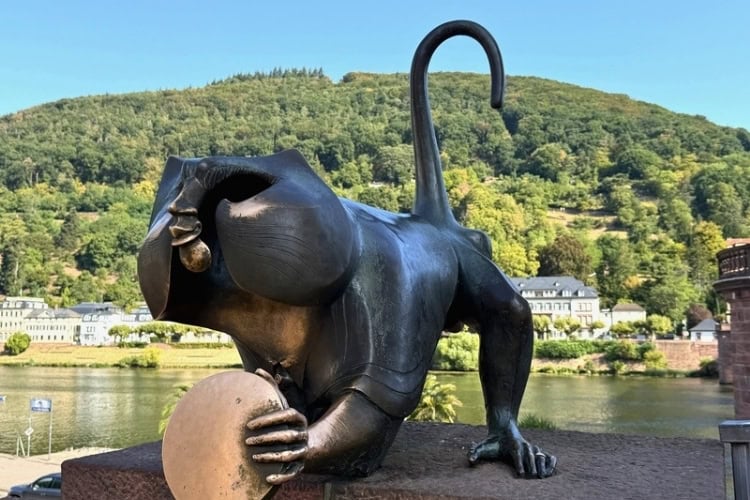
Along with several statues on the bridge, there’s a bronze monkey. Though there’s been a monkey at the spot as far back as the 15th century, the current statue has only been around since 1979. It’s said to be good luck and rubbing its mirror will supposedly bring you money, while rubbing his fingers will ensure you return to Heidelberg. And rubbing the little bronze mice next to the monkey will bring you fertility. I promptly rubbed the first two areas and left the third one alone!
The Philosopher’s Way is a winding trail with various monuments, busts and memorials of professors and poets, remains of several monasteries, as well as a Celtic hill fort that dates back to the 4th century BCE. Stop at the Philosopher’s Garden, where you can sit on one of the benches and contemplate all those who came there looking for inspiration. You can’t get lost, as there are blue blazes painted on buildings, walls, and trees, and signs along the way.
Though you can walk up the Philosopher’s Way as previously mentioned, you can also do it the way I did—in reverse—and take a taxi to the starting point. This route made more sense to me, considering that it was beastly hot the day I planned this activity. Despite the heat, I was able to truly enjoy the experience and appreciated the panoramic points, offering incredible photo opps for lasting memories of Heidelberg.
If You Go
Getting There
The closest international airport is Frankfurt Airport in Frankfurt am Main. From Frankfurt, plan on about an hour via train or bus to get to Heidelberg. You can compare train times and fares from Frankfurt Airport to Heidelberg on Omio. Heidelberg is also easy to reach by public transportation from other cities, with many bus and train connections.
Where to Stay
Base yourself in the Old Town of Heidelberg, where many of the attractions and landmarks are located. Heidelberg has accommodation for all tastes and budgets, from hotels and guesthouses to inns and hostels.
- Hotel zum Ritter St. Georg puts you on Hauptstraße, steps from Market Square and the Church of the Holy Spirit, in one of the Old Town’s most historic buildings.
- Die Hirschgasse Heidelberg is a 20-suite boutique hotel across the river near the Philosopher’s Way, set in a former student dueling tavern with castle views from its terrace.
Getting Around
You won’t need a car, since you can walk almost everywhere within the Old Town.
The HeidelbergCard is the most economical way to explore the city. It’s the official tourist city pass, issued by the Heidelberg Convention and Visitors Bureau, and it bundles the city’s essential travel services and attraction entries into one card. It comes in one, two and four day versions, and there’s also a dedicated family pass.
Tours
A guide makes the castle’s long, tangled history much easier to follow. This private Old Town and castle walking tour is led by local guides and covers the Old Bridge, Market Square and the university. Choose the 2.5 hour option if you want to go up to the castle courtyard and see the Heidelberg Tun.
Need a hand planning your trip? Here are the sites and services we rely on most, from booking tools to travel products we love.
Inspire your next adventure with our articles below:
Want to discover more hidden gems and helpful travel tips? Join our free newsletter for the latest travel secrets and travel articles.
We are reader-supported and may earn a commission on purchases made through links in this article.

unique destinations and experiences to share with her readers and listeners. She’s an avid
explorer who welcomes new opportunities to increase awareness and enthusiasm for places,
culture, food, history, nature, outdoor adventure, wellness and more. Her travels have taken her
to nearly 100 countries spanning all seven continents, and her stories appear in numerous print
and digital publications.
- Heidelberg, Germany: Castle Ruins, Old Town Charm and the Philosopher’s Way - October 13, 2026
- Inside Split Rock Lighthouse: Shipwrecks, Keepers and a Clifftop Beacon - October 4, 2026
- Why Pittsburgh Is One of America’s Most Compelling City Breaks - October 1, 2026
Planning another trip soon? ✈️
Add GoWorldTravel.com as a preferred source on Google. Click the button below so our local guides, packing hacks, and hidden-gem itineraries always show up first when you search!
Add to Preferred Sources