
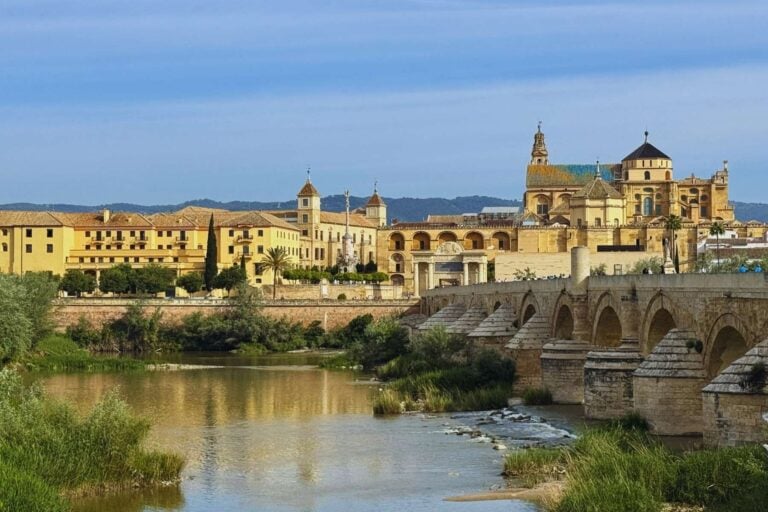

You’ll probably get lost while wandering around the pretty whitewashed streets of Córdoba’s historic old town, but don’t panic. It’s part of the allure of one of Spain’s most charming towns.
Córdoba Heats Up!

Located among rolling hills on the banks of the Guadalquivir River, Córdoba lies in the heart of the Andalucian plains. It can get hot here, very hot, which is why you won’t see many locals out and about during the midday hours.
They’re wisely inside, though the inevitable tourists can be found roaming the nearly deserted streets, often with a dazed expression. This could be the result of the blazing heat or because they’ve gotten turned around in the rabbit warren of pathways.
Or it could be because they’re in awe of this enchanting place. Speaking from experience, it’s most likely a mix of all of the above.
Roman Roots Run Deep
Córdoba has the distinction of being one of the best-preserved old towns in Europe. It’s a UNESCO World Heritage site in its entirety, with significant Roman roots. Many of the influential Roman elite retired here, and they developed Córdoba as the capital of its region.
During my stay here, I saw a number of physical reminders of the Romans’ footprint in the town, from the Córdoba Roman Bridge over the Guadalquivir River and its defensive tower to a number of notable mosaics and gardens created in the Roman style.
Moorish History Is Alive and Well

After the Roman Empire collapsed, it was the Moors who really put Córdoba on the map, eventually making it the largest and most prosperous city in the world. The Moors created a center of learning by gathering the knowledge of prior civilizations together, as opposed to purging all the brainpower from these societies.
It’s also important to mention that during this time, Christian, Islamic, and Jewish cultures coexisted peacefully.
However, this all changed in the 13th century when Córdoba was conquered by the Christians, and its days as a political and cultural capital came to an end.
Churches and convents were planted throughout the city to erase its Islamic past, and the Moors who did not convert to Christianity were persecuted and expelled.
The Mosque-Cathedral of Córdoba Is the Top Attraction

Like the Romans, the Moors also left their mark on the town. The Mosque-Cathedral of Córdoba, or the Mezquita as it is commonly called, is Córdoba’s most iconic landmark.
And for good reason, as it’s regarded as one of the world’s most impressive works of Islamic architecture. It also has the distinction of being the only mosque-cathedral in the world.
The mosque, which dates back to AD 784, went through several expansions over the years, as different caliphs added new wings and enhancements. The result is a mixture of architectural styles superimposed on one another.
Christian and Islamic Cultures Combine

Much later, in the 16th century, Spain’s King Carlos I ordered a Christian cathedral to be built right in the middle of the mosque, along with several dozen chapels around the peripheries. In doing so, the central part of the mosque was destroyed.
Before entering this esteemed building, I spent time basking in its lovely courtyard and orange grove, which emitted an intoxicating aroma. I then headed through the grand archway, as I admired the bell tower with the minaret encased in it.
Due to the lines and limited time, I was unable to climb up to the top of the tower, but I hear it boasts sublime vistas.
The Mosque-Cathedral Is an Architectural Marvel
Once I stepped inside, I found myself in an immense prayer hall. Size-wise, it’s a whopping 155,000 square feet. I imagined the sight of 20,000 people praying, side by side. I passed through what seemed like an endless series of striped red brick and white stone arches laid out in a repeated geometrical format.
I was told these arches are suggestive of a forest of date palms.
The arches rest on columns, 856 to be exact, made of marble, granite, and jasper. They are different sizes, as they came from recycled material collected at various Roman sites.
To get the ceiling high enough to give the place a sense of openness, the Moors came up with the idea to create a double-tiered symmetrical construction. Taller columns served as the base for shorter ones on top. Quite ingenious!
The pivotal point in this hall is the horseshoe-arched mihrab or prayer niche, which identifies the wall that faces Mecca. The arch is lavishly decorated with glittering gold mosaic cubes and, up above, is the dazzling dome.
As for the cathedral, my guide pointed out the different styles, including Gothic, Baroque, and Renaissance. He mentioned that the altar is marble, and the pulpits are also marble with mahogany wood. The choir is a work of art, too, with its rich mahogany stalls.
Best Cordoba Tours & Excursions
Explore a Fortress and a Palace at the Alcazar
Another site that combines Roman and Arabic architectural elements is the Alcazar of the Christian Monarchs, which dates back to 1328 AD. Over the years, it served as both a fortress and a palace, and was once the headquarters of the Spanish Inquisition.
The building is remarkable in size and boasts stone walls, towers, Gothic-style cupolas, a Baroque chapel, courtyards, grand gardens, water features, and more. Also notable is the Hall of the Mosaics, where lavish Roman mosaics are displayed around the walls.
Walk the Roman Bridge for Great Views

For more Roman flavor, I made my way to the aforementioned Córdoba Roman Bridge. Built in the 1st century BC, the bridge straddles the Guadalquivir River and has sixteen arches. I recognized this landmark, as it was featured in the famous TV series, “Game of Thrones.”

At one end of the bridge is the stalwart Calahorra Tower, which dates back to the 12th century and was used to protect the bridge. At the other end, you’ll see the Mezquita.
I decided to walk across the bridge in both directions to get each of these memorable views. Nearby, on the banks of the river, is a medieval water mill, originally built to carry river water up to the palace via an aqueduct. Another ingenious invention!
Tour the Remaining Synagogue In the Jewish Quarter

Córdoba’s Jewish Quarter is the historic center of the city. Though many Jewish people once dwelt here, today, there are very few Jews living in the town. However, their influence can be seen in the architecture, along with the sole remaining synagogue.
The synagogue, which no longer functions religiously but is open to the public, is among the top three best-preserved medieval synagogues in all of Spain. It was constructed in 1315 and was in use until the Jews were expelled from Spain.

I entered through the temple’s courtyard and into the main hall. I immediately noted a staircase, which I was told led to the women’s area, as women sat separately from men when they attended services.
The main hall is a small, rectangular-shaped room with decorative arches and walls with plant-like motifs and inscriptions.
After 1492, the building served as a hospital, a hermitage, and an infant school. It was declared a National Monument at the end of the 19th century.
Read More: From Gaudí to Granada: 16 Incredible Things to Do in Spain
Visit the Picture-Perfect Street of the Flowers

In the heart of the Jewish Quarter is Calleja de las Flores (Street of the Flowers), one of the city’s most famous streets. In season, it’s usually full of flowers that spill over the wrought iron balconies and hang from pots on the walls.
From here, I got a peek-a-boo view of the Mezquita’s bell tower, which further enhanced the scene. This street is a magnet for tourists and their cameras, so I recommend visiting it either very early or much later in the day.
The Royal Stables Are a Must for Horse Lovers

If you’re an equestrian aficionado, you’ll want to stop by the Royal Stables, a UNESCO World Heritage Site, and home to the famous Andalusian horses.
But even if you’re not, like me, you’re still probably going to want to check out the place because of its rich history, and to get a look at the stunning creatures in residence.
Felipe II founded the stables in 1570 as the place to breed the Andalusian Horse, a pure Spanish thoroughbred. Regarded as one of the greatest breeds of horse ever to exist, this thoroughbred became a very popular riding horse and a symbol of the Spanish Empire.
They are known for being strong and agile, possessing an elegant presence.
Córdoba is the birthplace of this horse, and visiting the Royal Stables offers visitors the opportunity to see these impressive creatures up close. I was able to watch them during a training session while soaking up the ambiance of the building’s Renaissance architecture.
Marvel at the Equestrian-Flamenco Show

These stables are also renowned for their equestrian show, which combines traditional music, Flamenco dance, and dressage. I found this show to be exceptional.
Witnessing the harmony between these stunning, graceful horses and their riders, as well as the way the Flamenco dance blended with the equestrian movements, was one of the highlights of my stay in Córdoba.
Fiesta of the Patios Is a Beloved Event

In many Spanish towns, festivals take center stage at various times of the year. For Córdoba, spring is festival season. One of the city’s most beloved events is the Fiesta of the Patios, which occurs over twelve days at the beginning of May.
Fortunately, my stay coincided with this time period, so I was able to experience this special festival.
The event is a tradition that began in 1918 but was interrupted by the Spanish Civil War, then reintroduced in the 1950s. It’s a seminal part of the city’s cultural heritage and an expression of identity within the Cordovan community.
Patios are a Showcase for Artistry

The patio houses are communal or family dwellings that share a patio and are located within the city’s historical quarter. Residents spend much time and effort each year to decorate these spaces with vibrant flowers and plants – real ones, never artificial.
There is a competition involving strict criteria with regard to floral variety, natural lighting, care of the flowerpots and beds, etc., with prize money awards in different categories.
The patios are open and free to the public during the festival for visitors to admire the beauty and skill involved in these creations. Some of the patios even host traditional singing, flamenco guitar playing, and dancing.
I encountered big lines to enter the patios, but it was so worth the wait. Each is unique and stunning in its artistry. I was in awe of the arrays of brilliantly hued flowers and the amazingly creative compositions. It was a feast for my senses!
Need a hand planning your trip? Here are the sites and services we rely on most, from booking tools to travel products we love.
Inspire your next adventure with our articles below:
- A Guide to Gaudí in Barcelona: The Unique and Bizarre
- Seville Seduction: Why Spain’s Most Passionate City Will Steal Your Heart
Want to discover more hidden gems and helpful travel tips? Join our free newsletter for the latest travel secrets and travel articles.
We are reader-supported and may earn a commission on purchases made through links in this article.
unique destinations and experiences to share with her readers and listeners. She’s an avid
explorer who welcomes new opportunities to increase awareness and enthusiasm for places,
culture, food, history, nature, outdoor adventure, wellness and more. Her travels have taken her
to nearly 100 countries spanning all seven continents, and her stories appear in numerous print
and digital publications.
- Explore the Epicenter of Navajo Culture at Canyon de Chelly - October 24, 2026
- Heidelberg, Germany: Castle Ruins, Old Town Charm and the Philosopher’s Way - October 13, 2026
- Inside Split Rock Lighthouse: Shipwrecks, Keepers and a Clifftop Beacon - October 4, 2026
Planning another trip soon? ✈️
Add GoWorldTravel.com as a preferred source on Google. Click the button below so our local guides, packing hacks, and hidden-gem itineraries always show up first when you search!
Add to Preferred Sources