
Norway is home to stunning fjords, polar bears, the Aurora Borealis, and the Midnight Sun. There aren’t many places on Earth that can compare to the tranquility found in Longyearbyen, the world’s northernmost inhabited location.
However, people only stay there for an average of 7 years before moving on.
Although the sun does not set for four months in the summer, it does not rise for four months in the winter either. It’s no surprise that these unusual natural phenomena are attracting an increasing number of tourists who want to experience the sun for 24 hours.
If geography isn’t your thing, Norway is located in Northern Europe, in the Scandinavian region. The official language is Norwegian, and the official currency is the Norwegian krone (NOK).
Well, is it just me, or would it be wonderful if the days were a little longer? So, let’s find out when is the best time of year to witness this natural phenomenon in “the land of the midnight sun.”
How Does Midnight Sun Occur?
The short version: Earth’s axis tilts toward the sun during summer in the Northern Hemisphere, and above the Arctic Circle (66°33′ N), that tilt is extreme enough to keep the sun above the horizon around the clock. The farther north you go, the longer it lasts.
Norway’s prime midnight sun destinations span a wide range of latitudes, which means the season length varies dramatically by location. In the Lofoten Islands, the midnight sun runs from around May 25 to July 18. In Tromsø, it lasts from about May 18 to July 25. Further north at the North Cape, it stretches from mid-May to the end of July. And at the far extreme, Svalbard sees 125 consecutive days of uninterrupted daylight, from April 20 to August 22.
For most travelers, early June through mid-July is the sweet spot — the longest days, the most reliable weather, and the peak of the midnight sun experience across all the main destinations.
Where to Go

Tromsø
Tromsø is Norway’s Arctic capital, well-connected, culturally rich, and surrounded by stunning coastal scenery. It’s the easiest entry point for first-timers: international flights land here year-round, the infrastructure is solid, and the summer scene is genuinely lively in that particular Norwegian way, where people seem to understand instinctively that endless light is something to celebrate rather than sleep through.
The city sits on an island in the middle of a fjord, ringed by mountains that turn amber in the late-night light. It’s the kind of place where you can sit on a cafe terrace at midnight, watch the sun hover just above the peaks, and feel like you’ve genuinely gotten away with something.
For activities, the options are excellent. Guided midnight sun fjord tours take you through dramatic Arctic landscapes, with professional photographers on board to help capture the golden light. Midnight kayaking around Håkøya island lets you paddle through the fjords with birdlife all around you. Small-group campfire evenings on the outer islands combine the beach bonfire experience with 24-hour daylight in a way that doesn’t feel contrived. And for hikers, Tromsø’s backyard mountains offer extraordinary conditions on long summer nights, with panoramic views over the fjords.
The Lofoten Islands

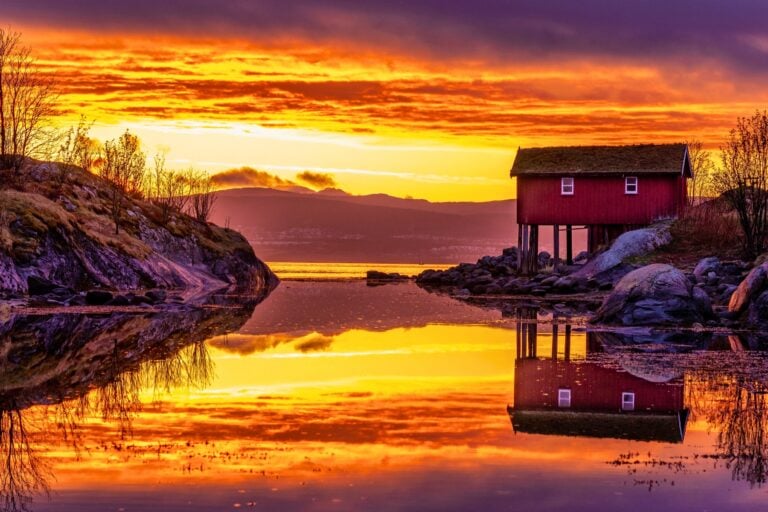
If Tromsø is the accessible option, Lofoten is the cinematic one. The light here is extraordinary, and for several weeks each year the midnight sun transforms the islands into nothing but light, light and even more light. Jagged peaks, traditional red fishing cabins reflected in glassy water, white sand beaches glowing gold at 1am — Lofoten is where photographers and hikers go when they want the midnight sun at its most dramatic.
The midnight sun season in Lofoten runs from late May to mid-July, with the Lofoten Islands experiencing about six to seven weeks when the sun does not dip below the horizon. The most iconic hike is Reinebringen at Moskenesøya, a more demanding climb but one that rewards with views unlike almost anything else in Norway. For something less strenuous, the peaks at Hoven on Gimsøy offer sweeping views that are just as memorable.
On the water, midnight fishing trips and kayaking departures from Svolvær, Henningsvær and Ballstad are popular with good reason. There is something genuinely absurd about casting a line or paddling through a fjord at 2am in broad daylight, and absurd in the best possible way.
One practical note: traditional fisherman’s cabins over the water, known as rorbuer, are extremely popular during midnight sun season. Book four to six months ahead for June and July visits.
North Cape (Nordkapp)
North Cape is the punctuation mark at the top of mainland Europe, a 307-meter cliff rising straight out of the Arctic Ocean. Standing at Europe’s northernmost accessible point as the sun circles the horizon at midnight creates one of travel’s most powerful moments, and it’s one of those places where the drama of the setting does most of the work for you.
At the North Cape, the midnight sun can be seen from approximately May 14 to July 29, one of the longest windows on mainland Norway. The site itself gets busy in peak season, but the surrounding area of Magerøya island is far quieter and worth exploring. The nearby town of Honningsvåg makes a good base.
Svalbard
This is the deep end of the midnight sun experience, and it knows it. At 78 degrees North, closer to the North Pole than to mainland Norway, Svalbard offers the most extreme midnight sun experience available to tourists. For 125 consecutive days, the sun never sets. In Longyearbyen at midnight, the light has a mid-afternoon quality in polar summer, flat and bright and slightly surreal, unlike the warm golden glow you get further south on the mainland.
The main town, Longyearbyen, is the world’s northernmost settled community, and it has an atmosphere that reflects that fact. People who live there tend to be there by choice, drawn by the extremity of the place. Organized excursions here include glacier hikes, boat expeditions into the fjords, and wildlife safaris in search of polar bears, reindeer and Arctic foxes.
That brings up the one safety point worth taking seriously. In Svalbard’s wilderness, polar bears are a genuine presence, and locals carry firearms when venturing outside town. Guided tours are the sensible choice for anything beyond the main settlement. Guides are trained, they know the routes, and they make the whole experience considerably less nerve-wracking.
Other Countries with Midnight Sun
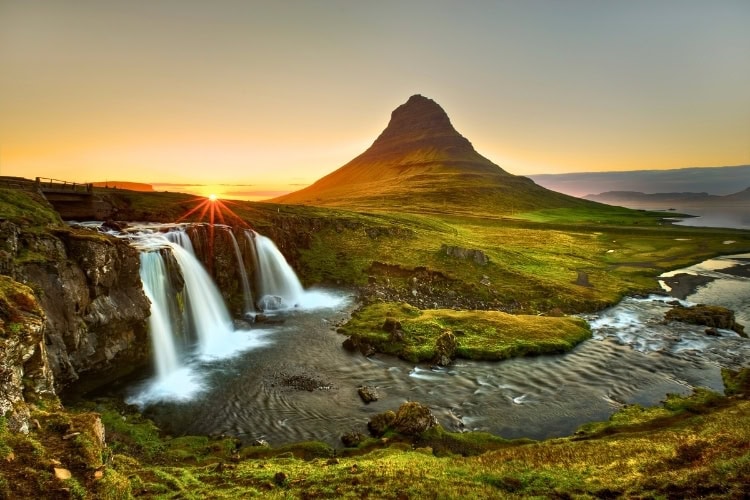
Norway is the most accessible place to experience this phenomenon, but it isn’t the only one. Sweden’s most popular midnight sun destination is the town of Abisko. In Finland, the phenomenon reaches Rovaniemi and extends across Lapland further north. And in Iceland, Akureyri is a well-regarded base for experiencing it. For most travelers, though, Norway hits the right combination of scenery, variety and infrastructure to make it the first choice.
If You Go
Getting There: Book flights to Tromsø (TOS) or Oslo (OSL) with onward connections north on CheapOair.
Getting Around: Renting a car is one of the best ways to explore Norway’s fjords and coastal roads at your own pace. Compare options and book in advance at Discover Cars.
Where to Stay: Accommodation in Tromsø, the Lofoten Islands and Svalbard fills up fast during midnight sun season, especially traditional rorbuer cabins in Lofoten. Book early on Booking.com.
Tours and Experiences:
- Tromsø: Midnight Sun Fjord Adventure with Seaside Lunch — a guided minibus tour through Arctic fjord country with a professional photographer on board and a seaside lunch to close out the experience.
- Tromsø: Midnight Sun with Campfire — a small-group evening on the outer islands with a beach bonfire and 24-hour Arctic daylight as your backdrop.
Travel Insurance: Remote Arctic areas like Svalbard make solid coverage worth having. Compare plans at Squaremouth or explore nomad-friendly options through SafetyWing.
Sleeping in the Midnight Sun: Hotels and guesthouses in Tromsø, the Lofoten Islands and Svalbard typically provide blackout curtains, and many offer eye masks as well. Bringing your own is still a good idea. Beyond the curtains, a few things help: keep caffeine in check in the hours before you want to sleep, limit screen time, and be realistic about your energy levels. Taking short naps when you need them is smarter than pushing through. Exhaustion has a way of turning magical into overwhelming faster than you’d expect.
What to Pack: Summer in the Arctic is mild by polar standards, but temperatures drop on the water and at elevation. Svalbard can be genuinely cold even in late July, so layers are non-negotiable regardless of when you travel.
Need a hand planning your trip? Here are the sites and services we rely on most, from booking tools to travel products we love.
Inspire your next adventure with our articles below:
- Northern Lights and Ancient Rights: A Viking Cruise Through Nordic Wonders
- 15 Fun Facts About Longyearbyen: Norway’s Arctic Frontier
Want to discover more hidden gems and helpful travel tips? Join our free newsletter for the latest travel secrets and travel articles.
We are reader-supported and may earn a commission on purchases made through links in this article.

- 10 Balkan Dishes You Need to Try, According to a Local - October 15, 2026
- The World’s Best Theme Parks, From Record Coasters to Fairy Tale Forests - September 30, 2026
- Why So Many Travelers Are Flocking to Lake Bled in Slovenia - August 31, 2026
Planning another trip soon? ✈️
Add GoWorldTravel.com as a preferred source on Google. Click the button below so our local guides, packing hacks, and hidden-gem itineraries always show up first when you search!
Add to Preferred Sources