
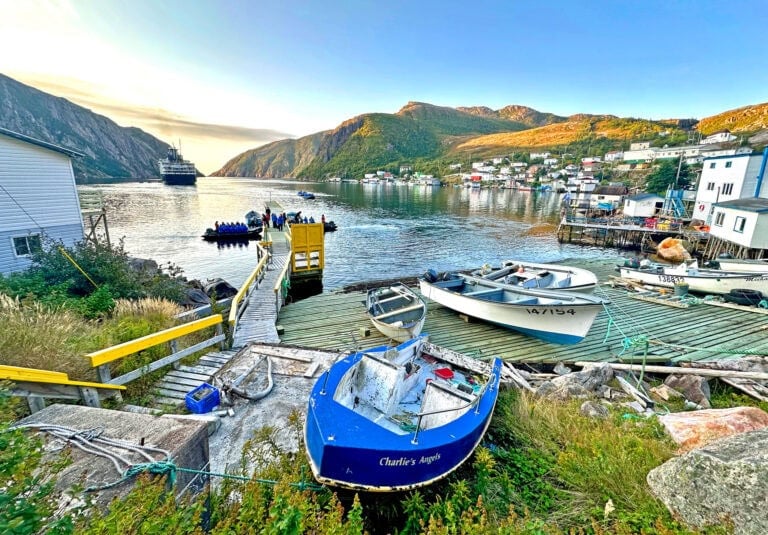

I stood in the mud room of the Ocean Endeavour, pulling on my assigned boots and zipping up my waterproof coat. In minutes, I would climb down into a zodiac with a dozen other travelers and motor toward a remote cove where two moose had been spotted on the hillside.
This was expedition cruising, and I would spend the next 12 days exploring Newfoundland with my friends Pat and Jennifer, aboard Adventure Canada’s Ocean Endeavour
What makes an expedition cruise so special? Unlike traditional cruises with their Broadway shows and poolside activities, expedition cruising is about authentic connection, with places, people, and stories you simply can’t access any other way.
This was my introduction to Adventure Canada, a family-run travel company that has specialized in small-ship expedition cruises for over 35 years, and it would prove to be unlike any journey I’d ever taken.
The Beauty of Expedition Cruising

Expedition cruising isn’t for everyone. It’s for the flexible and curious, the kind of traveler who understands that plans can change at a moment’s notice, and that’s perfectly okay.
Weather rules everything on these voyages, and our expedition leader, Dave Freeze (one of Adventure Canada’s co-founders), made that clear from day one. A storm could cancel a landing. Fog could shift our itinerary. And we’d embrace it all.
Each morning, we were awakened by the sounds of a harmonica and singing in the local Newfoundland dialect over the intercom. It was Adventure Canada’s charming way of greeting the day, and it set the tone perfectly.
At our daily briefings, Dave and the expedition team would outline the day ahead, though even those plans could change with the wind, waves, or wildlife sightings.
The ship itself became our floating base camp. Before each zodiac excursion, we’d gear up with our assigned boots, coats, and life jackets, equipment that stayed with us for the entire voyage.
The zodiacs were our key to accessing remote regions and tiny towns that massive cruise ships could never reach. They allowed us to zip into quiet bays, land on rocky shores, and get close enough to spot moose on hillsides.
Why Newfoundland? A Coastal Land Best Seen by Sea

Newfoundland, the massive island that forms the eastern part of Canada’s province of Newfoundland and Labrador, juts into the North Atlantic Ocean off the country’s east coast.
It has always been a coastal land where the sea was the main highway. Even today, many communities remain accessible only by boat or helicopter. This makes circumnavigating the island one of the best ways to truly experience it—you’re traveling the way Newfoundlanders have for centuries.
As we sailed around the coast, we met local people who welcomed us into their communities with open arms.

Newfoundland’s character is shaped by isolation, resilience, and an extraordinary warmth that makes strangers feel like family. The people here have a vocabulary all their own, with words like ‘swarve’ (to wander aimlessly) and ‘mauzy’ (drizzling, gray weather), and they have a charming habit of answering yes by breathing in while saying it.
What makes this journey particularly special is visiting towns and villages that are often too small or remote for conventional tourism. We visited communities of 60 to 500 people, fishing villages perched in stunning fjords, places where everyone knows everyone, and where visitors are events worth celebrating.
Our Journey: 10 Unique Destinations
So, what did we see on our cruise around Newfoundland? Here are some of the highlights.
St. John’s

Our journey began and ended in St. John’s, Newfoundland and Labrador’s colorful capital. The jellybean row houses lining the harbor are iconic, and the city has a vibrant energy that sets the stage for the adventure ahead.
St. Pierre and Miquelon

Our first stop was one of the most surprising: St. Pierre and Miquelon, an actual French territory just off Newfoundland’s southern coast. These islands don’t just feel like France—they are France, complete with French governance, French citizens, and the euro as official currency.
Walking these streets felt like stepping into a different continent. We used euros, heard the melodic sounds of French everywhere, and grabbed fresh pastries from authentic French bakeries—all while being closer to North America than Europe.
The colorful waterfront and old bootlegging history gave the islands a unique character. We even stumbled upon a film crew shooting an episode of the Canadian detective show Saint-Pierre, a moment that felt perfectly in keeping with the unexpected nature of expedition cruising.
Miawpukek First Nation

In Conne River, we visited the Miawpukek First Nation, a vibrant indigenous community of 892 people. They welcomed us with a mini-powwow featuring local dancers, then fed us an incredible meal of moose stew, chicken, or lentils, along with salad and bread with local berry jam.
At their community center, we browsed local arts and crafts, and I couldn’t resist buying a pair of handmade earrings. The Adventure Canada fiber program offered Caribou Tufting with ladies at the powwow, and there was a touching moment when we learned that one of the instructors teaching traditional crafts had been a toddler at Adventure Canada’s first powwow here 30 years ago.
François

François (pronounced Fran-sway) is the kind of place that makes you believe in the resilience of the human spirit. Fewer than 60 residents call this fishing village home, and only four children attend the school.
There are no roads in or out—just boat or helicopter access. Residents get around on ATVs, navigating the rocky terrain of this stunning fjord setting.

The community hosted us for brunch at their community center, serving fish cakes made from salted cod, baked beans, coleslaw, molasses cookies, and tea.
Little Garia Bay

Little Garia Bay is uninhabited except for summer campers, making it ideal for zodiac tours and hiking.
After landing, marine biologist Alexa Meyer showed us tiny shells and explained the creatures that once inhabited them, while naturalist Jenny Knowles introduced us to Labrador tea and other local flora.
Gros Morne National Park

We based ourselves in Woody Point (population 281), a charming town in the heart of Gros Morne National Park, a UNESCO World Heritage Site celebrated for its geology.
This is one of the few places on Earth where you can see both oceanic crust and the Earth’s mantle exposed, a mind-boggling feature that draws geologists from around the world.
We walked through Woody Point’s Registered Heritage District, visited the Discovery Center, and hiked trails with Parks Canada interpreters who explained how plate tectonics created this remarkable landscape.
Our lunch of fish and chips at Merchant Warehouse Retro Café was exactly what we needed after exploring, and coffee at Galliot Studios gave us a perfect break before our afternoon adventures.
We also explored Trout River (population 508), a rural fishing village on the park’s southeastern coastal edge. The Eastern Point Trail offered stunning views of the village and its bay, a perfect day for hiking. At the Legion building, we enjoyed a Taste of Place lunch prepared by a local chef.
Red Bay

Our circumnavigation took us beyond the island of Newfoundland to Labrador, the vast mainland portion of the province that borders Quebec.
Red Bay, a UNESCO World Heritage Site, commemorates the 16th-century Basque whaling era. We braved swells to zodiac over to the historic site and learned about the whalers who worked in these remote waters centuries ago.
Fish and chips at Whaler’s Restaurant provided delicious fuel for our explorations.
British Harbour

Back on the island of Newfoundland, British Harbour is a place that time has gently set aside. This remote inlet was once home to a fishing village, but due to its isolation, the town was relocated as part of the government’s resettlement program.
Today, only one resident remains year-round. The autumn colors were gorgeous as we wandered through the peaceful settlement and took zodiac tours of the harbor. It was a poignant reminder of how Newfoundland’s outport communities have evolved and, at times, disappeared over the decades.
Trinity

The town of Trinity looks like something straight out of a movie set. Founded in the 16th century, it’s one of Newfoundland’s oldest settlements, and several buildings have been designated as Registered Heritage Structures.
We were lucky to visit during the fall festival, which gave the town (population around 100 in winter) an extra boost of energy and celebration. Walking the streets of Trinity felt like stepping back in time, and it was the perfect final stop before returning to St. John’s.
We had planned to visit L’Anse aux Meadows National Historic Site, the Viking settlement that proves Norse explorers reached North America 500 years before Columbus.
But a storm with winds and waves so high forced us to skip it, a perfect example of how expedition cruising requires flexibility.
Why Adventure Canada Made This Journey Extraordinary

Adventure Canada was founded in 1987 by two brothers, Matthew and Bill Swan, along with their friend Dave Freeze. Their vision was simple: take people to the parts of the world that were mostly dark at night from space—places like the Canadian Arctic, Eastern Canada, and Greenland.
The company has now passed to the second generation, and the family-run feeling remains at the heart of everything they do.
What made our journey so special was the crew and the specialists on board. We had birding experts, a marine biologist, cultural specialists, and locals from Newfoundland and Labrador who shared their stories, music, and deep knowledge of these communities.
Taste of Place: Food as Connection

One of Adventure Canada’s signature programs is Taste of Place, and our Newfoundland circumnavigation was their first voyage built around this concept. Every day, we experienced authentic local dishes that connected us to the land and people.
We tried partridgeberry and bakeapple preserves, fish cakes made from salted cod, Jiggs Dinner (a traditional boiled dinner), molasses desserts, moose stew, and split pea soup.
At one memorable meal onboard, locals from Woody Point joined us for supper. The ship’s dining room became a place where food, music, and conversation wove together into something larger than any single ingredient.
Tony Oxford, one of our Newfoundland cultural ambassadors, explained that if there were ever a food shortage, Newfoundland would do well. Wild berries, baked apples, seal, seabirds, fish, moose, homemade pickles, wild mushrooms—the people here have always practiced what they call ‘household production,’ caring for their own needs from the land and sea.
Life Aboard the Ocean Endeavour
The Ocean Endeavour was built in 1982, and our circumnavigation was Adventure Canada’s final sailing aboard her before transitioning to newer vessels.
Adventure Canada now operates two newer ships purpose-built for expedition cruising: the Ocean Victory, which accommodates 186 passengers and features all ocean-view cabins, most with balconies, and the compact Ocean Nova, built in Denmark in 1992 specifically for Greenland’s icy waters, carrying just 78 guests for a more intimate experience.
The Ocean Endeavor carried 199 of us, creating an intimate community. Each evening, we’d gather for what Adventure Canada calls ‘sharing time’ before—not dinner, but ‘supper’ in Newfoundland parlance. Guests would share their unique experiences from the day, and then we’d learn about tomorrow’s plans.
Long May Your Big Jib Draw

There’s a Newfoundland saying: ‘Long may your big jib draw.’ It’s a wish for good fortune, borrowed from sailing terminology, and it captures the generous spirit we encountered everywhere we went.
As I think back on those 12 days circling Newfoundland with Pat and Jennifer, what stands out isn’t just the dramatic landscapes or the UNESCO World Heritage Sites. It’s the people—Tony singing songs his ancestors sang; the residents of François feeding 199 strangers with genuine pride; the expedition team waking us with harmonica songs each morning.

This is what expedition cruising offers that conventional travel cannot: access to places and people who welcome you not as tourists, but as fellow travelers on this shared journey around a remarkable island.
When you travel with a smaller ship, gear up in your boots and coat, climb into a zodiac, and zoom toward a remote cove, that’s when you understand what ‘expedition’ really means.
Would I do it again? In a heartbeat. And Newfoundland, with its stunning coastlines, resilient communities, and generous people, will continue to welcome travelers who want to see the world the way it was meant to be seen: slowly, authentically, and by sea.
Long may your big jib draw, indeed.
If You Go
How to Get There
The Newfoundland Circumnavigation cruise begins and ends in St. John’s, Newfoundland and Labrador. St. John’s International Airport (YYT) offers connections from major Canadian cities, including Toronto, Montreal, and Halifax, as well as some U.S. cities. Most travelers will need to connect through one of these hubs.
Plan to arrive at least a day before your cruise departure to account for any travel delays and consider staying an extra day or two in St. John’s after the cruise to explore this capital city.
What to Pack
Adventure Canada provides essential gear for zodiac excursions—you’ll be assigned boots, a waterproof coat, and a life jacket for the duration of your trip. However, you should bring layers for varying weather conditions.
Newfoundland’s climate can be unpredictable, with temperatures ranging from cool to mild even in summer and fall. Pack a warm fleece or sweater, rain pants, comfortable walking shoes for onshore explorations, a hat, gloves, and sunglasses.
Binoculars are invaluable for wildlife spotting. Casual, comfortable clothing works for shipboard life, and there are no formal nights.
Who Should Go
Adventure Canada expeditions are ideal for curious, easygoing, reasonably fit, and healthy individuals. The company accommodates various physical abilities and interests on shore, but you should expect walking on uneven ground and boarding zodiacs via a flight of stairs.
These trips are best suited for adventurous souls seeking comfortable accommodations and good food, who understand that deviations from the expected itinerary are part of the adventure. What matters most is flexibility, a sense of curiosity, and an appreciation for authentic cultural experiences.
Where Does Adventure Canada Sail?
Adventure Canada travels to some of the most remote and inspiring regions on Earth, with a focus on the Arctic, Atlantic Canada, Greenland, and North Atlantic Europe. Their expeditions take travelers to remarkable places, including Nunavut, Newfoundland and Labrador, the Northwest Passage, Greenland’s dramatic coasts, and Scotland’s far-flung isles.
With a long history in these regions, they also venture farther afield to international destinations like the Galápagos and Japan, continually seeking new opportunities that reflect their commitment to exploration, cultural connection, and environmental stewardship.
For More Information
Visit www.adventurecanada.com to explore all of Adventure Canada’s expeditions, view detailed itineraries, check availability, and book your own adventure.

- The Family Reunion Hack That Eliminates All the Planning Stress - September 30, 2026
- 10 Days in Portugal: A Mother-Son River Cruise Along the Douro - September 29, 2026
- 9 Places to Experience Amazing Sea Life Up Close - September 15, 2026
Planning another trip soon? ✈️
Add GoWorldTravel.com as a preferred source on Google. Click the button below so our local guides, packing hacks, and hidden-gem itineraries always show up first when you search!
Add to Preferred Sources