

Cave tours are high on my list of fun and fascinating adventures. And I’ve taken many of them over the years, from Mammoth Caves and Wind Cave to Kartchner Caverns and Carlsbad Caverns. Wherever I travel, I always seek them out, as I never tire of exploring nature’s underground wildernesses.
Location and History

My latest tour was of Lake Shasta Caverns in California. Located 25 miles north of Redding, in the foothills of Mt. Shasta, these caves are more than thousands of years old. According to the lore of the Wintu Indian tribe, these subterranean chambers have been known since antiquity.
A group of men consisting of a land surveyor and Baird fish hatchery workers was the first to actually find the caves in August 1874. The party of explorers included Livingstone Stone, Myron Green, Dick Hubbard, and others, and was helmed by local guide, Dr. George Silverhorne.
I imagined the strenuous physical activity involved in this pursuit and pictured the men dangling from a rope fifty feet in height before descending into a dark, eerie abyss. You might think the unknown would have given them pause, but it was, in fact, the opposite.
According to the written account of this venture, the men vied among themselves as to who would go first, and when each man took his turn, he eagerly grabbed the rope and swung off without hesitation. No fear in these guys. Just primal curiosity.
Richardson Leaves His Mark

Four years later, James A. Richardson, also a Baird employee, descended into what is now called the Cathedral Room and made the first known inscription in the cave. His inscription, “J.A. Richardson” and the date, is still clearly legible on the wall where he wrote it using carbide from his miner’s lamp.
Very few people, other than a handful of rugged and determined spelunkers, saw the caverns in the ensuing years. They made the arduous climb up the mountain, then inched their way through the cave’s steep, narrow fissures to see the incredible formations.
Construction of a Show Cave

Flash forward to the 1950s, when the idea of creating a “show cave” (a cave made accessible to the public for guided tours) became a reality, and the wheels were set in motion for this development to occur.
A road was eventually built from I-5 to Lake Shasta and another across the lake to access the new cave entrance. This manmade entrance was created via a tunnel burrowed into the mountain, using “low-yield” dynamite so as not to damage the caverns.

The caves were adapted for visitors to include pathways and railings, and strategically installed lighting along the trails and formations. Finally, in 1964, the caverns were officially opened to the public as a natural attraction.
The crowds came in droves. Today, approximately 70,000 people a year visit the caverns.
Lake Shasta Takes Center Stage on a Boat Ride
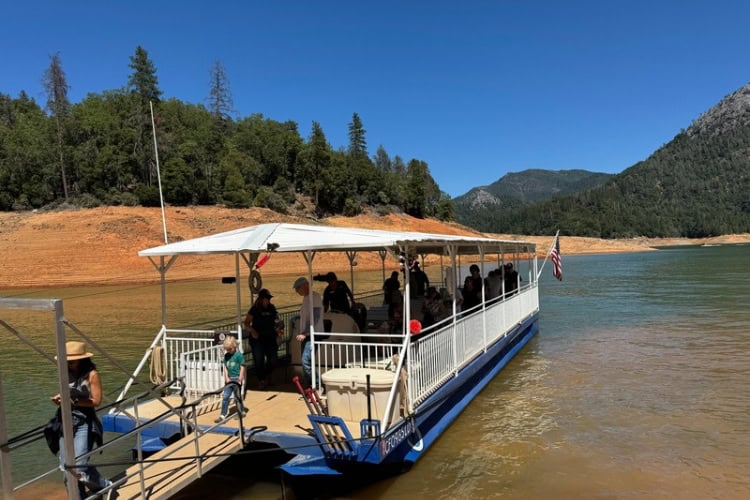
It’s interesting to note that Lake Shasta Caverns has the distinction of being the only “show cave” in the U.S. that can be accessed by boat. The company uses two catamarans to transport visitors across Lake Shasta.
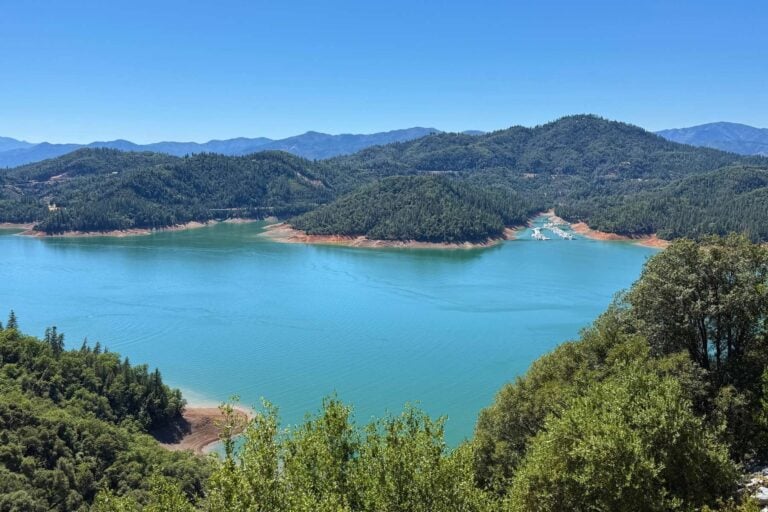
The fifteen-minute boat ride offered stunning vistas of the lake and surrounding mountains. It also enhanced the journey to the caves, while building up my anticipation.
Once ashore, a bus was waiting to take us to the cave access area. The caverns are located 900 feet above the lake. Our driver provided commentary about the surroundings as we headed along the winding road up the mountainside. The route allowed for sublime views of the lake from various junctures.
Visitor Instructions

At the top, our guide greeted our group and gave information and instructions about the tour. Most importantly, she emphasized the need to practice cave conservation and abide by the “no touch,” “take nothing but pictures,” and “leave nothing but footprints” principles.
The Discovery Room

The first area of focus was the Discovery Room, so named because most of the formations found in the cave were discovered here. Our guide explained about each formation and how it’s created.
We saw plenty of stalactites and stalagmites, which can easily be distinguished by remembering that the former has a “c” for ceiling because they grow top down, while stalagmites have a “g” for ground, as they rise up from the cave floor.
Fascinating Food-Like Formations

Some of the stalactites we saw were tubular stalactites, or “soda straws.” These start off as small drops of water, which deposit rings of calcite at the same place. Over time, the rings form a tube. I noticed that one of the soda straws grew long enough to touch the floor of the cave.
There were also drapolites or “cave drapery,” which occurs when water slides down the surface of a wall and leaves tiny fin-like forms. As they grow larger, the laws of gravity pull, stretch, and straighten them so they appear like curtains. Our guide called them “cave bacon,” another very apt description.
Another formation, calcite rafts, looks like pieces of thick and chunky ice. The nickname for these, we were told, is “peanut brittle.” Still another, helictites, or tubular branch-like stems, made me think of clumps of spaghetti.
I wondered why I was getting hungry and then realized there were quite a few food-related descriptions for cave formations.
Flowstone in the Thompson Room

In the Thompson Room, the focus is on flowstone. This formation is made when lots of water leaves calcite-like sheets along the floors and walls of a cave.
One of the flowstone areas in this room grew over a ledge of bedrock, creating a canopy with teeth. The nickname for this one is “jaws.” Steven Spielberg would love it!
The Dome Room Is an Acoustic Marvel

The Dome Room is eighty feet in height and yes, it’s dome-shaped. Our guide mentioned that these characteristics allow for excellent acoustics, making it an ideal place for underground concerts, which do occur.
A return visit to catch one of these performances is on my list. It would definitely be a unique setting to hear music in.
We also saw cave columns. These form when a stalactite and a stalagmite meet each other and hitch themselves together. They come in all different sizes, from small to ginormous.
A great example of “cave bacon” was on full display in the Crystal Room. And there was plenty of cave coral, too, known familiarly as “popcorn.” Movie time, perhaps?
Cathedral Room
The highlight of the tour was the Cathedral Room. With a height of 125 feet, it’s an impressive space. Our guide directed our attention to Richardson’s inscription. It’s remarkable it’s still here, clear as day.
Everyone then took a seat on the convenient viewing platform to appreciate all the wonders surrounding us. Darkness descended as a spectacular light show began. The lights shone on and off the formations, basking them in colorful hues. It was an enchanting, immersive finale!
Learn More: www.lakeshastacaverns.com
Need a hand planning your trip? Here are the sites and services we rely on most, from booking tools to travel products we love.
Inspire your next adventure with our articles below:
- Mammoth Cave National Park: An Underground Wonderland Beneath Kentucky
- Beautiful Elephanta Caves and A Day of Sightseeing in Mumbai, India
Want to discover more hidden gems and helpful travel tips? Join our free newsletter for the latest travel secrets and travel articles.
We are reader-supported and may earn a commission on purchases made through links in this article.

unique destinations and experiences to share with her readers and listeners. She’s an avid
explorer who welcomes new opportunities to increase awareness and enthusiasm for places,
culture, food, history, nature, outdoor adventure, wellness and more. Her travels have taken her
to nearly 100 countries spanning all seven continents, and her stories appear in numerous print
and digital publications.
- Why Pittsburgh Is One of America’s Most Compelling City Breaks - October 1, 2026
- Delve into the World of Hoops at the Naismith Memorial Basketball Hall of Fame - September 29, 2026
- The Alaska Park Where Brown Bears Catch Salmon in Midair - September 28, 2026
Planning another trip soon? ✈️
Add GoWorldTravel.com as a preferred source on Google. Click the button below so our local guides, packing hacks, and hidden-gem itineraries always show up first when you search!
Add to Preferred Sources