
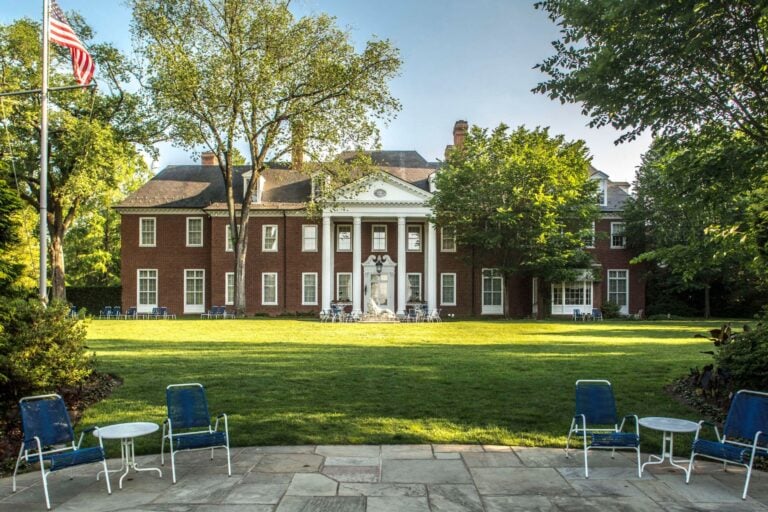

Azaleas spilled over the garden walls in pinks and purples, heavy with spring. Somewhere between the scent of blooming dogwood and the crunch of gravel beneath our feet, we left behind the suburban swirl of Washington, D.C.
We stepped into another world, another time—the curated, eccentric elegance of Hillwood Estate.
My wife, Nataliya, and our kids, Nicole and Alex, were ready to tour a mansion, garden, and museum.
“This place looks like it was built for a princess,” Nataliya said, pausing in front of the grand entrance framed with marble and ivy.
“It sort of was,” I said. “Or at least for someone who collected the things of a czarina.”
An Heiress and Her Homes

Marjorie Merriweather Post, heiress to the Post cereal fortune, didn’t do things by halves. By the time she purchased this estate in the 1950s, she had already lived in some of the grandest homes in America, including Mar-a-Lago, which she had built in the 1920s as a winter retreat. Yes, that Mar-a-Lago.
When she bought what’s now Hillwood in 1955, it was called “Artemis,” after the Greek goddess of the hunt. But Marjorie had grander ideas—she renamed it Hillwood and spent two years redesigning it to hold not just guests, but history as well.
She called it her “home in the capital” and intended it, quite deliberately, to become a museum after her death. Even the lighting and temperature control were planned with the future in mind—Marjorie installed museum-grade systems and labeled many objects herself.
We were in the entry hall, where sunlight streamed through tall windows and landed on glossy parquet floors. It was a quiet kind of grandeur—tasteful, not imposing, with portraits on the wall, columns holding up a balcony, and a grand staircase folding up to the second floor. Once we turned into the formal rooms, the scale and opulence ramped up.
Russia in the Drawing Room

Courtesy Hillwood Estate, Museum & Gardens, photographed by Erik Kvalsvik
The Russian collection alone is worth the visit. Marjorie had a fascination with Imperial Russia, and through a combination of timing, wealth, and influence, she acquired one of the largest collections of Romanov-era decorative arts outside of Moscow.
In one room, Fabergé eggs glinted behind glass—delicate, enameled, and as improbable as they appear in textbooks. A golden samovar, intricate as filigree, stood near the fireplace.
“So wait,” Nicole said, leaning toward a case of jeweled cigarette holders, “these belonged to Russian royalty?”
“Many of them, yes,” Nataliya said. “Marjorie started collecting during the Soviet liquidation of the Romanov estates.”
“Soviets needed cash and she had it,” Alex added.
Best Washington DC Tours & Excursions
East Meets West

Around the corner, we entered the Japanese collection. Stark, calm—a contrast to the glittering Russia room. Sliding doors framed a meditative garden scene, and a set of lacquered boxes lined a low display case.
A pair of intricately painted folding screens hinted at seasonal transitions, and a rare ceramic incense burner sat beside delicate tea implements, each arranged with reverence for balance and line. A finely embroidered kimono hung in a quiet alcove, its silk glinting faintly under the lights.
“She appreciated craft,” Nataliya said.
“And she had the budget for it,” I added.
A Theater, a Nook and Time on the Mantle

One of Hillwood’s quirkiest treasures is its private theater—a small Art Deco gem where Marjorie screened films for guests.
The red velvet chairs gleamed under soft lighting, and even the walls had flair: gold-leaf detailing, vintage sconces, the quiet glamour of an era that treated entertainment as an event.
From there, we wandered into more intimate corners such as the breakfast nook with its Art Deco framing and sunny disposition.
The dining room was regal but warm, the heavy wooden table fully set with fine china and crystal, candelabras and 12 stately chairs upholstered in red and gold. On the mantel stood a series of ornate clocks, all ticking in elegant disagreement.
One of the more curious clocks on the dining room mantel was a French Empire-era piece shaped like the bust of an African woman, her eyes moving with time. The craftsmanship was intricate, the mechanism remarkable.
“These are serious clocks,” Alex said.
“Imagine setting them,” Nicole said. “You’d probably need a degree.”
“Same with the table,” Nataliya said. “Imagine setting that.”
We learned that a special exhibition was coming in February 2026: Clocks: Artistic Interpretations of Time. It was to be a look at both Hillwood’s extensive historic clock collection and how artists reinterpret time today. Marjorie’s love of horology ran as deep as her appreciation for decor.
“A good excuse to come back,” I said.
“All in good time,” Alex quipped.
Among the Gardens

Courtesy Hillwood Estate, Museum & Gardens, photographed by Erik Kvalsvik
Outside, the gardens were in spring bloom. Tulips clustered near the greenhouse, while azaleas and rhododendrons painted the edges of winding paths. The French parterre stretched out in perfect symmetry, its hedges trimmed with an almost mathematical precision.
We wandered through the Japanese-style garden, where moss softened the stones and a small waterfall trickled into a koi pond. Nataliya paused to photograph a cluster of irises near the wooden bridge.
We visited the rose garden—not yet in bloom but pruned and promising—and peeked into the greenhouse, where orchids and tropical plants thrived in glassy silence.
The greenhouse was like a museum devoted to the many kinds of orchids.
“I don’t think I’ve ever seen this many orchids in one place,” Nicole said.
“Or this variety,” Alex added.
This greenhouse and these gardens weren’t just showpieces—they supplied fresh orchids, camellias, and roses for the breakfast nook and dining room all year long.
“Makes me feel like we’re not doing enough with our garden,” Nataliya said.
We found a bench near the cutting garden. The scent of damp earth and just-opened flowers lingered in the air.
“You think she sat here?” Nicole asked.
“I’ll bet she did,” Alex said.
“With tea and a sun hat,” Nataliya added.

Setting Sail with Sea Cloud
As we wandered the gardens, we came across the dacha, or “summer home,” like a little Russian-style cabin. Inside, we discovered a small exhibition tucked behind the doors: Setting Sail: The Story of Sea Cloud.
It turned out Marjorie also owned a yacht—not just any yacht, but the largest private sailing ship in the world when it launched in 1931.
The Sea Cloud was outfitted with gold fixtures, Baccarat crystal, and Louis XIV-style furnishings. She lived aboard it for months at a time, crossing the Atlantic and entertaining royalty and diplomats at sea.
“She basically had a Versailles on the water,” I said.
When World War II broke out, since Marjorie had no son to fight in the war, she loaned the Sea Cloud.
We lingered over black-and-white photographs of Marjorie posing on deck, her hair perfectly coiffed against wind and sea spray.
A Legacy of Layers

Courtesy Hillwood Estate, Museum & Gardens, photographed by Erik Kvalsvik
Hillwood wasn’t just a showcase of wealth, though it certainly was that. It was the mirror of a woman who moved between empires and eras with poise and purpose.
She entertained diplomats, collected centuries and curated her own legacy down to the lighting. Even now, scholars and curators sift through Hillwood’s archives, exploring its treasures not just as decoration, but as documents of a turbulent century.
As we left, the azaleas rustled softly behind us in the breeze, pink and purple petals catching the last of the afternoon sun.
We stepped back through the gates and into the present, already discussing plans to return for the Shape of Time exhibit next year … if only to synchronize our watches.
If You Go

Courtesy Hillwood Estate, Museum & Gardens, photographed by Erik Kvalsvik
Hillwood Estate, Mansion, and Gardens is a great place to spend time during a trip to Washington, DC. It feels a bit like a little piece of Europe tucked away in America’s capital.
Parking is free, and the easiest way to visit is to drive. Guided tours are offered for both the gardens and the mansion, each lasting approximately one to one and a half hours.
You can have lunch or dinner in the café, or bring your own picnic lunch, as many people did on the sunny day we visited. There are lounge chairs, tables, and lots of open green space to spread blankets and enjoy a leisurely picnic between guided tours.
From the back porch, look around and you’ll see a view of the Washington Monument in the distance between the trees.
Inspire your next adventure with our articles below:
Author Bio: Eric D. Goodman is the author of seven books and more than 100 published short stories and travel stories. His latest, Faraway Tables, is a book of travel-centric poetry that recently became an Amazon number one bestseller in the “contemporary poetry” and “poetry about places” categories. Learn more about Eric’s travels and writing at EricDGoodman.com
Want to discover more hidden gems and helpful travel tips? Join our free newsletter for the latest travel secrets and travel articles.
We are reader-supported and may earn a commission on purchases made through links in this article.

- Along the Gambia River: Markets, Crossings and Chimpanzees - September 14, 2026
- Kagawa, Japan Is the Udon Capital—Where to Eat Sanuki Noodles and How to Get There - September 14, 2026
- Inside the Vatican: An Exclusive Walk Through the Pope’s Private Corridors - September 14, 2026
Planning another trip soon? ✈️
Add GoWorldTravel.com as a preferred source on Google. Click the button below so our local guides, packing hacks, and hidden-gem itineraries always show up first when you search!
Add to Preferred Sources