
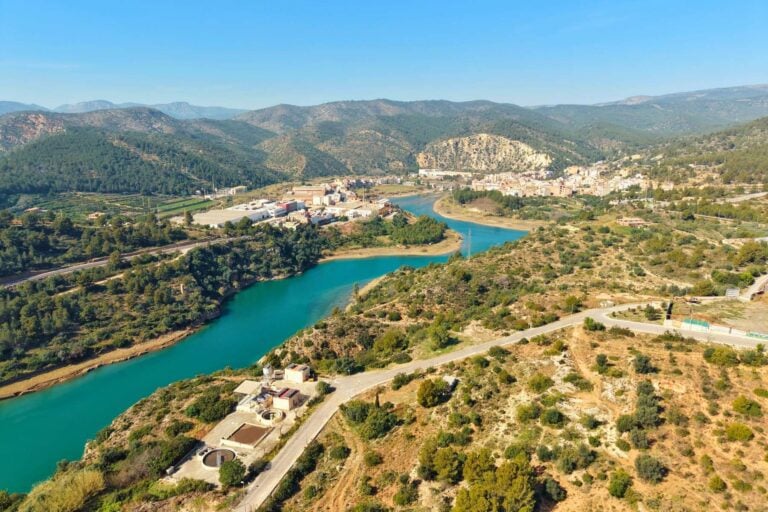
In inland Castellon, Espadan-Mijares invites travellers to discover a destination where nature can be experienced in two unforgettable ways: by looking closely at the life that moves through its forests, rivers and rocky cliffs, and by looking up to the sky when night falls.
Some journeys begin with a pair of binoculars. Others begin under a blanket of stars. In Espadan-Mijares, both experiences come together in a territory where birding and astrotourism have become two of the great highlights of inland tourism.
Between the Sierra de Espadan and the Mijares River, this landscape offers reservoirs, rivers, forests, farmland, ravines, rocky areas, viewpoints and quiet villages. By day, it is a privileged setting for observing birds in different habitats. By night, it becomes a natural balcony from which to contemplate the sky, the constellations and the ancient legends written among the stars.
Birding in Espadan-Mijares: Nature Through Binoculars
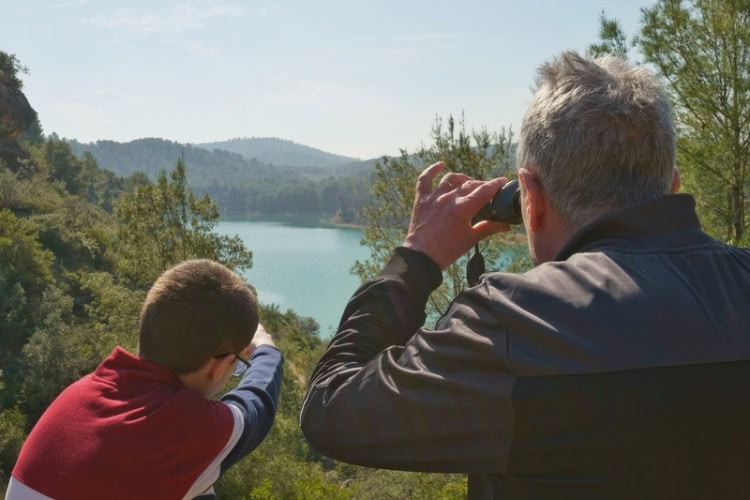
Espadan-Mijares offers many opportunities for those who enjoy birdwatching. The destination has developed five ornithological observation points with interpretive panels located in different habitats, including reservoirs, rivers, forests, crops and canyons, allowing visitors to discover some of the most common and representative species of the area.
The best time for birdwatching in Espadan-Mijares is spring and summer, when bird activity is especially intense. However, early autumn is also a particularly interesting season, as large birds of prey and other soaring birds can be observed during their migratory passage from elevated points.
This makes the destination ideal not only for expert birders, but also for families, photographers, nature lovers and travellers who want to experience the landscape in a slower and more attentive way.
Five Birding Spots, Five Ways to Discover the Territory
The birding route through Espadan-Mijares connects five observation areas: Fuente del Arquet in Ribesalbes, La Roca del Molino in Vallat, Fuente el Canton in Fanzara, Camino de l’Engolidor in Tales and Buitrera in Torrechiva. Each point reveals a different side of the territory and a different way of understanding its biodiversity.
In Ribesalbes, around Fuente del Arquet, the Mijares River and nearby reservoirs provide suitable habitats for waterfowl. The Sitjar Reservoir, the largest in the area, together with Vallat and Benitandus reservoirs, offers opportunities to observe herons, egrets, cormorants, grebes, ducks and different species of gulls.
In Vallat, at La Roca del Molino, the quality of the waters of the Villahermosa, Mijares and Veo rivers attracts birds that feed in the current or along the riverbanks, such as wagtails and moorhens. Swallows, martins and swifts fly above the water searching for insects, while riparian forests provide shelter for woodpeckers, golden orioles and other woodland birds.
In Fanzara, the experience changes. The urban environment and the farmland around the village become a habitat for species adapted to human settlements and agricultural landscapes. Sparrows, swallows, martins and swifts nest in roofs and balconies, while tits, serins, goldfinches and hoopoes add colour to a village already known for the murals of MIAU Fanzara.
In Tales, the Camino de l’Engolidor leads into the forest world of the Sierra de Espadan, where pine woods alternate with holm oak and cork oak forests. Here, birding becomes a walk through deep shade, ravines and Mediterranean vegetation, with species ranging from booted eagles and tawny owls to wrens, warblers, robins, jays and small woodland birds.
In Torrechiva, the Buitrera observation area focuses on rocky cliffs and rupicolous birds. These vertical landscapes, shaped by rivers and tectonic forces, are home to species adapted to nesting and resting on rock faces, including vultures, eagles, crag martins and other birds linked to open mountain environments.
A Destination for Watching, Listening and Slowing Down
Birding in Espadan-Mijares is more than identifying species. It is a way of travelling with patience. A way of stopping beside a river, listening to the movement of the forest, watching the flight of a raptor over the mountains or waiting for the sudden blue flash of a kingfisher.
The variety of habitats makes the experience rich and accessible. In a single getaway, visitors can move from reservoirs to rivers, from farmland to forests and from villages to rocky cliffs. Each landscape has its own rhythm, its own birds and its own atmosphere.
For photographers, it is a territory full of natural scenes. For families, it is an educational experience in the open air. For birdwatchers, it is a destination where Mediterranean biodiversity can be enjoyed throughout much of the year.
Astrotourism: When the Sky Becomes the Journey
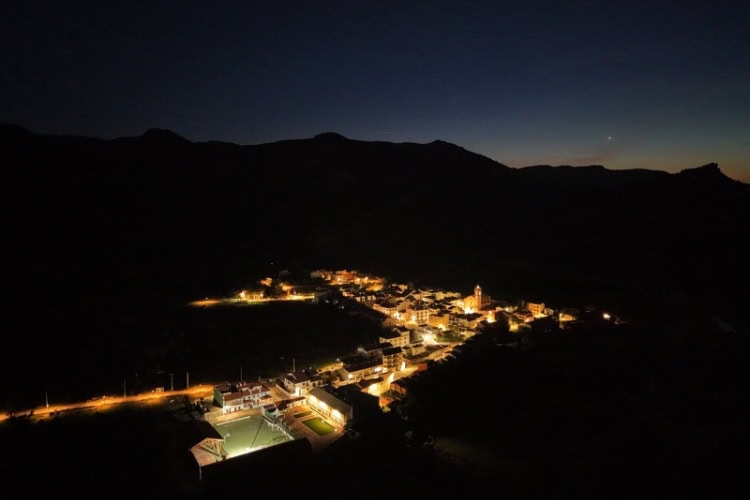
When the sun sets, Espadan-Mijares reveals another of its great treasures: the night sky.
The destination’s astrotourism guide highlights the special value of observing the stars in places with low light pollution, such as the Sierra de Espadan. On clear nights, visitors can enjoy the fascination of the celestial dome and observe hundreds of stars with the naked eye.
Astrotourism in Espadan-Mijares is not just about astronomy. It is also about emotion, silence and storytelling. It is about standing in the mountains, far from the noise of the city, and feeling that the journey continues above, among constellations, myths and ancient legends.
Five Astronomical Observation Points
Espadan-Mijares offers five astronomical observation points: Castillo del Buey Negro in Argelita, Mirador del Castillo de Ayodar, Fuente de la Masa in Fuentes de Ayodar, El Castellet in Toga and the Hermitage of Santa Barbara in Torralba del Pinar.
Each location opens a different window to the sky. Some are linked to castles and viewpoints. Others are set in quiet mountain surroundings, ideal for contemplating the stars, identifying constellations or simply enjoying the atmosphere of the night.
At Castillo del Buey Negro, visitors are invited to discover the legend of Orion, with Canis Major, Canis Minor, Taurus and the Pleiades. The route connects astronomical observation with mythology, turning the night sky into a story that can be read with the eyes.
At the Mirador del Castillo de Ayodar, the guide introduces the legend of Cassiopeia, Cepheus, Andromeda, Perseus and Cetus, transforming the observation point into a place where mythology and astronomy come together.
At Fuente de la Masa, the focus turns to Scorpius and Sagittarius, two constellations that bring the summer sky to life. The legend of Scorpius explains the eternal pursuit between Scorpius and Orion, with one appearing on the horizon as the other disappears.
At El Castellet, in Toga, the visitor can explore the legend of Ursa Major, popularly known as the Big Dipper, together with Ursa Minor, Draco and Corona Borealis. This is a perfect setting to speak about orientation, the North Star and the role of the sky as a guide for travellers, sailors and explorers.
At the Hermitage of Santa Barbara, the sky opens to the legends of Cygnus, Delphinus and Leo. Cygnus is also known as the Northern Cross, Delphinus is considered one of the smallest and most beautiful constellations, and Leo includes Regulus, one of the brightest stars in the night sky.
The Stars as a Cultural Experience
One of the most attractive aspects of astrotourism in Espadan-Mijares is the way astronomy is presented through stories. The constellations are not only points of light. They become hunters, queens, animals, heroes, monsters, crowns and ancient guides.
This approach makes the experience especially suitable for all audiences. Children can discover the sky through legends. Adults can reconnect with the wonder of looking up. Photography lovers can enjoy night landscapes. Travellers can end the day with an experience that is peaceful, educational and memorable.
The result is a kind of tourism that does not need noise or speed. It only needs darkness, silence and a clear sky.
Two Experiences, One Destination
Birding and astrotourism represent two complementary ways of discovering Espadan-Mijares.
Birding teaches visitors to observe the small details of the landscape: the flight of a heron over the reservoir, the song of a warbler in the forest, the movement of swifts above a village or the silhouette of a raptor in the sky.
Astrotourism invites them to do the opposite: to look beyond the landscape and discover the immensity above it. To follow Orion, search for the Big Dipper, identify Scorpius or simply let the night become part of the journey.
Together, these two experiences turn Espadan-Mijares into a destination for curious travellers. A place for those who want to feel nature both by day and by night. A place where the mountains are alive with birds and the sky is alive with stars.
Inland Tourism with Soul
Espadan-Mijares is a destination that rewards those who take their time. Its villages, trails, rivers, forests and viewpoints invite visitors to travel slowly, to observe more carefully and to connect with the territory in a more authentic way.
Here, inland tourism is not only about escaping from the coast or finding a quieter place. It is about discovering another rhythm. A rhythm marked by birdsong in the morning, mountain light in the afternoon and constellations at night.
For those who travel with binoculars, with a camera, with children, with friends or simply with the desire to disconnect, Espadan-Mijares offers a different way to experience Castellon: natural, peaceful and deeply memorable.
Because some destinations are seen.
Others are observed.
And some, like Espadan-Mijares, are discovered twice: once under the flight of birds, and once under the light of the stars.
Espadan-Mijares awaits you. To observe it. To contemplate it. To experience it naturally.
More information: visitespadanmijares.com

Want to discover more hidden gems and helpful travel tips? Join our free newsletter for the latest travel secrets and travel articles.
We are reader-supported and may earn a commission on purchases made through links in this article.

- Darwin, Australia’s Northernmost Capital, Combines Vibrant Markets, Waterfront Life and Access to Kakadu and Litchfield - October 25, 2026
- Paarl: South Africa’s Secret Winelands Escape Where You Can Stay in Historic Wine Tanks - October 25, 2026
- A Quest for the Best Frango Assado in Portugal’s Algarve - October 24, 2026
Planning another trip soon? ✈️
Add GoWorldTravel.com as a preferred source on Google. Click the button below so our local guides, packing hacks, and hidden-gem itineraries always show up first when you search!
Add to Preferred Sources