
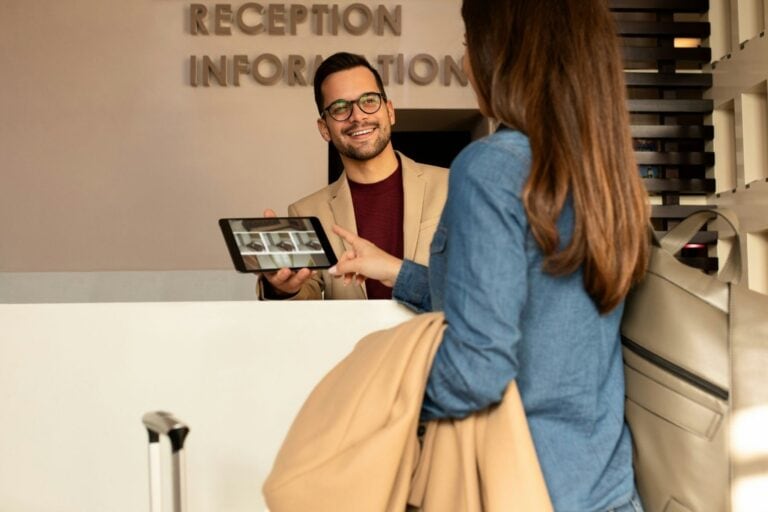
For many hoteliers, the search for hotel PMS software begins with a simple need: to understand what sits behind the daily rhythm of reservations, check-ins, housekeeping, billing, and guest communication.
A property management system is no longer just a back-office utility. In modern hospitality, it has become one of the central tools shaping service quality, team coordination, and the property’s commercial health.
- The right PMS supports both operations and guest experience.
- The wrong one creates friction that staff and guests feel immediately.
- The best choice is rarely the one with the longest feature list, but the one that fits the hotel’s real operating model.
Why PMS Matters More Than Ever in Hospitality
A hotel runs on timing, visibility, and consistency. Guests may only see the polished side of the experience, but behind every seamless stay is a system keeping room status aligned, rates updated, payments recorded, and service teams informed. That is the real role of hotel PMS software today.
- It helps front office teams manage arrivals and departures.
- It gives housekeeping clearer information on room status.
- It supports management reporting and revenue oversight.
- It creates a more connected workflow across departments.
Years ago, many hotels viewed a PMS as a digital replacement for manual ledgers and reservation books. Today, the expectation is much broader. Owners and operators want live data, cleaner reporting, smoother integrations, and stronger control over the guest journey from booking to checkout.
This shift is especially visible in luxury and lifestyle hospitality, where guest expectations are higher and operational mistakes are more expensive. But it matters just as much for boutique inns, serviced villas, and independent properties trying to operate with leaner teams.
What a Hotel PMS Actually Does
At its core, a hotel PMS is designed to organize the daily operation of a property. It serves as the operational heartbeat, connecting reservations, room inventory, guest profiles, rates, charges, and status updates into a single working environment.
Core functions that most properties rely on
- Reservation management
- Check-in and check-out processing
- Room assignment and room status control
- Billing, folios, and payment tracking
- Rate and availability updates
- Guest profile storage
- Housekeeping coordination
- Reporting for occupancy, revenue, and operational trends
These are the basics, but their real value depends on execution. A PMS should not only store information. It should help staff move more efficiently and make fewer mistakes during busy service periods.
For example, a strong system reduces the need for repeated calls between the front desk and housekeeping. It helps staff see what is ready, what is occupied, and what requires attention. It also gives managers a cleaner view of performance without waiting for end-of-day summaries.
The Difference Between Features and Real Value
One of the biggest mistakes hotel buyers make is evaluating systems only by features. A sales presentation may sound impressive, but real value comes from how well the system performs under pressure.
- Can the team learn it quickly?
- Does it reduce repetitive manual work?
- Is it clear during peak arrival periods?
- Can managers find the information they need without digging?
- Does it support service consistency rather than slow it down?
This is where many hotel PMS systems reveal their true strengths or weaknesses. A platform may offer dozens of tools, but if the interface is clumsy or the workflow does not match the hotel’s operation, staff will work around it instead of with it.
That creates operational leakage. Small delays, missed notes, poor room coordination, and billing inconsistencies can quietly erode both guest satisfaction and team confidence.
What Luxury Hotels Need from a PMS
Luxury hospitality has a different relationship with software than standard accommodation. In premium properties, technology should support personalization and precision without becoming visible or intrusive. The guest should feel remembered, not processed.
A luxury-oriented PMS should help teams deliver:
- Accurate guest history and preferences
- Faster and more discreet check-in handling
- Better coordination between the rooms division and guest services
- Clean communication around arrivals, VIPs, and special requests
- Reliable billing without awkward corrections at departure
Luxury operations also tend to involve more complexity. There may be room upgrades, connected services, dining charges, transportation arrangements, spa bookings, or tailored guest notes that matter deeply to the overall stay. A PMS that cannot support these details creates service gaps that are felt immediately.
This is why PMS for hotels in the upper-upscale and luxury segment should be assessed not only on administrative efficiency, but also on how well they support experience delivery.
Why Simplicity Still Matters
Hospitality software conversations can become overly technical, but many operators are really asking a more practical question: Does this system make daily life easier? That question matters across all segments, especially for independent owners and smaller properties.
A small hotel PMS should not feel like an oversized enterprise platform with unnecessary complexity. It should help lean teams stay organized, keep room inventory accurate, and manage guest communication without creating a training burden.
- Smaller properties often need speed more than depth.
- Managers may wear multiple hats and need quick visibility into their work.
- Training time is limited, so ease of use matters greatly.
- Simpler workflows often lead to better staff compliance.
In many cases, smaller hotels benefit most from systems that are intuitive, mobile-friendly, and operationally clean. They may not need every advanced module, but they do need reliability, clarity, and enough flexibility to grow.
How to Evaluate a PMS the Right Way
When owners compare options, it helps to move past branding and focus on operating reality. The best evaluation process is grounded in daily hotel scenarios, not only product demonstrations.
Questions worth asking during selection
- How easy is it to train a new front desk employee?
- Can the system handle room moves and upgrades smoothly?
- Is the housekeeping view practical and clear?
- Are guest notes visible in a useful way?
- How clean is the folio and billing process?
- What reports are available for owners and managers?
- Does support feel responsive and hospitality-aware?
These questions reveal more than abstract feature lists. They show whether the system understands the environment in which hotels actually work: shift changes, late arrivals, special requests, payment disputes, maintenance needs, and constant coordination between people.
A good PMS should create fewer handoff problems between departments. It should also support stronger management discipline by making the right information easier to access in real time.
Common Mistakes Hotels Make with PMS Adoption
Even a strong system can fail if implementation is rushed or expectations are unclear. Hotels sometimes underestimate how important setup, process design, and team training are to long-term success.
Frequent adoption mistakes include:
- Choosing based only on price
- Ignoring staff usability during demos
- Overcomplicating permissions and workflows
- Failing to standardize operational procedures
- Treating training as a one-time event
- Assuming the software alone will fix process issues
Technology works best when paired with clear operational habits. If guest notes are entered inconsistently, billing procedures vary by shift, or room status updates are delayed, even an excellent PMS will appear weaker than it really is.
That is why owners should view a PMS as both a software decision and a management decision. The platform provides the structure, but leadership creates the consistency that makes the structure effective.
What Good PMS Performance Looks Like Over Time
A successful PMS does not just impress during installation. Its true value appears over months of daily use. The best outcomes are often visible in small but meaningful ways.
- Fewer front desk delays during busy check-in windows
- Cleaner communication between departments
- More accurate room readiness visibility
- Better reporting for revenue and occupancy decisions
- Stronger guest profile continuity
- Less manual correction work at checkout
Over time, these improvements influence much more than operational tidiness. They affect labor efficiency, guest trust, review quality, and management confidence. In a competitive hospitality environment, those gains matter.
A property management system should never be seen as just another software expense. It is one of the operational foundations of a hotel, shaping how information moves, how teams perform, and how guests experience the property. The right system brings structure without rigidity and control without making service feel mechanical.
For owners, operators, and B2B hospitality buyers, the smartest approach is to look past the noise and evaluate a PMS by one standard above all: does it help the hotel run better in real life? When the answer is yes, the PMS becomes more than a platform.
It becomes a quiet but essential part of the hotel’s service culture, commercial stability, and long-term growth.
Want to discover more hidden gems and helpful travel tips? Join our free newsletter for the latest travel secrets and travel articles.
We are reader-supported and may earn a commission on purchases made through links in this article.

- Exploring Nanjing, China: 48-Hour Trip That Changed My Perspective - October 13, 2026
- Buzzing into Sustainability: How Hotels Are Embracing Beekeeping Initiatives - October 13, 2026
- The Perfect Bay Area Day Trip: Why Sausalito Should Be Your Next Weekend Escape - October 13, 2026
Planning another trip soon? ✈️
Add GoWorldTravel.com as a preferred source on Google. Click the button below so our local guides, packing hacks, and hidden-gem itineraries always show up first when you search!
Add to Preferred Sources