
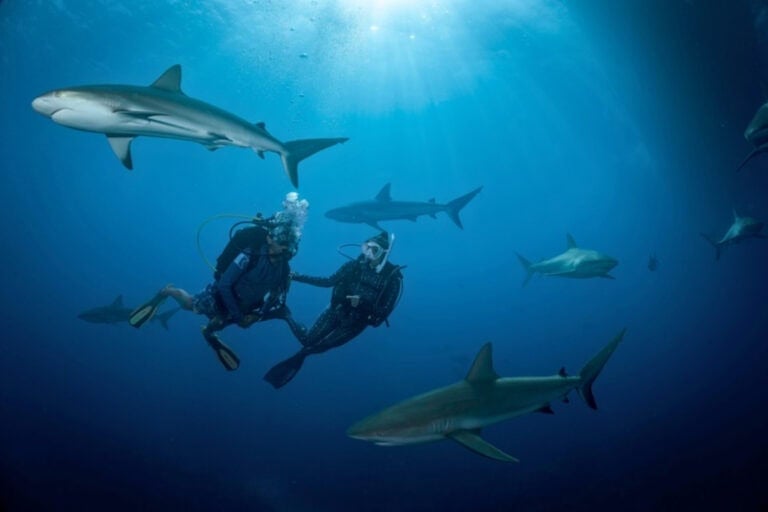
They weren’t big sharks, but there were a lot of them; they had sharp teeth and they were coming very close. I was diving off New Providence Island in The Bahamas and seeing what these islands are known for: shark encounters. It was exciting if a little disconcerting.
The Bahamas consist of about 700 islands (about 30 populated). While often lumped in with the Caribbean, this country with a population of 403,000 is technically in the Atlantic Ocean. The Bahamas are known for white sand beaches and pirate history, and Nassau is only a one-hour flight from Miami.
Like many people, I was passing through Nassau. People often find themselves in the Bahamian capital while on cruises or on their way to one of its many resorts. I was en route to the Sivananda Ashram for a yoga retreat but didn’t want to miss diving while there.
I wound up bookending my yoga retreat with dives. I dove with Sandals Royal Bahamian my first full day in The Bahamas, and with Stuart Cove’s the day before I flew home. Here’s what you need to know when deciding on your Nassau dives.
Unlimited Diving at Sandals
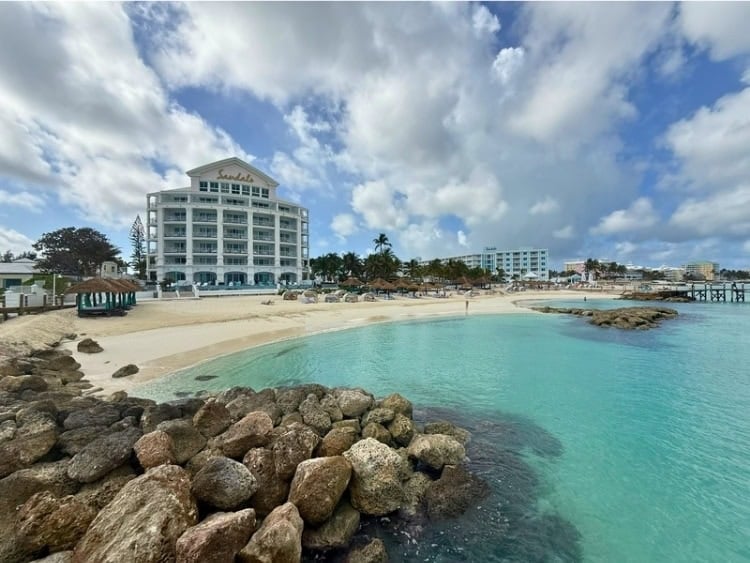
The strange thing about diving in Nassau is that there aren’t many dive shops. Sandals and Stuart Cove’s are the only two official PADI (Professional Association of Diving Instructors) options. Founded in 1966, PADI is the preeminent worldwide scuba training organization.
Sandals’ 17 resorts all include two tanks per day for PADI-certified guests, depending on availability. This is a big draw, as diving is an expensive hobby. Sandals is also a leader in dive education, having awarded more than 140,000 PADI certifications to its guests in Jamaica, Saint Lucia, Antigua, Grenada, Barbados and The Bahamas. Staying at Sandals for a couple of nights during your Nassau stopover could be an excellent diving value.
Diving with a PADI Pro
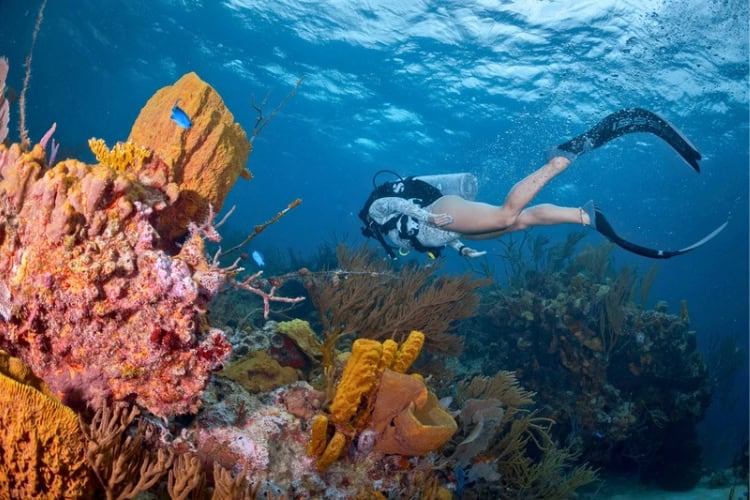
While I wasn’t staying at Sandals, the Royal Bahamian hosted me on a dive as a visiting journalist during my first afternoon there. That day, the other people on the dive boat were doing their first open water dives to receive their initial certification. Everybody was excited and a little scared of being tested on underwater skills like clearing their flooded masks, recovering a dropped regulator and underwater navigation.
Lucky for me, Erica Wedepohl, PADI territory director for Latin America and the Caribbean, was also aboard. The two of us swam off together while the new divers practiced their skills. Erica is a super experienced instructor trainer, so I was happy to have her navigating and pointing out eels and other fish.
Erica oversees a lot of PADI accounts, but raves about Sandals’ highly trained staff. “They have their own course director so they can train their own people to have very high levels of certification,” she said. “They have really nice dive boats and nice equipment.” I concur, having felt well looked after on the Sandals boat.
Stuart Cove’s
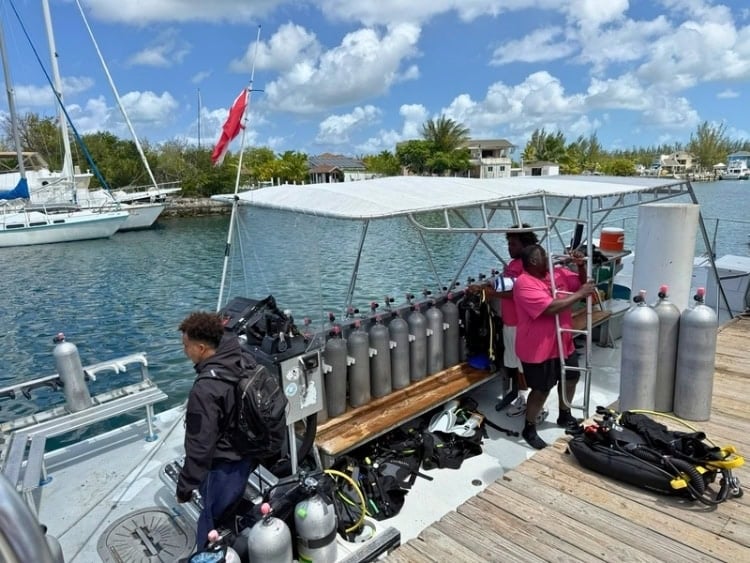
I’d only planned to dive at the beginning of my trip, before heading to the yoga ashram. But after a few days, I couldn’t resist ditching a yoga session for more dives.
Stuart Cove’s is by far the most famous diving operation on New Providence Island. The dive shop offers two-tank dives in the mornings and afternoons, night dives if six or more divers sign up, and shark dives. My two-tank dive cost about $185 plus $58 for gear rental and included transfers from a hotel or cruise ship.
It’s a busy operation. The line for gear was long and every seat on the boat was filled—we were tank-to-tank, so close that I kept ramming into my neighbors as I tried to suit up. Our dive boat, Black Coral, was flat with no sides. This made it easy for divers to step off, but we got smacked by every wave as we rode out to sea on a chilly morning.
The conditions were so windy and choppy that our guides told us to jump in, descend, and meet on the bottom of a site called Heineken Wall. My favorite part was the end of the dive, when an enormous pewter-colored remora circled us, apparently considering attaching the suction disc on the back of its head to a diver, since no sharks or rays were immediately available.
We had better visibility at the second dive spot, Mike’s Reef, which also featured shipwrecks. We swam inside these small ships covered with coral and sea plants and were startled by huge Goliath groupers popping out of dark nooks. It was my first experience with wrecks, and I loved it.
To Chum or Not to Chum
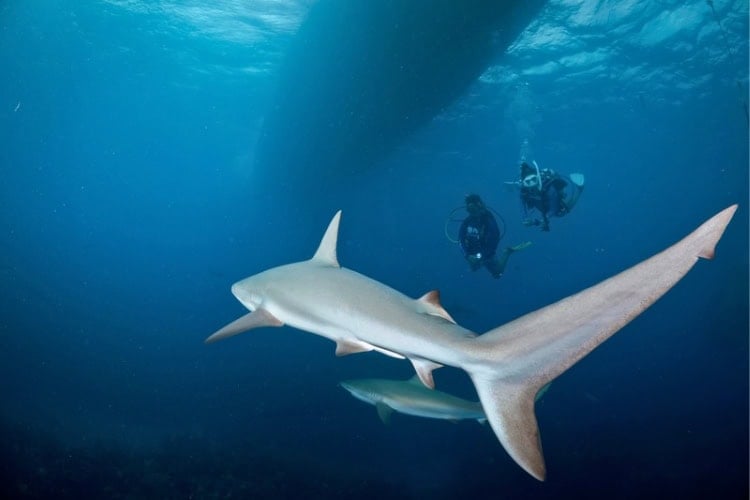
Originally, I’d planned to dive with Sandals, but not with Stuart Cove’s, because Sandals doesn’t chum for sharks. Chumming—throwing chunks of fish and blood into the water to intentionally attract sharks—is a common but controversial practice in some parts of the world, including The Bahamas. Proponents say that it’s a harmless way to give tourists a thrill; some of us figure it will teach sharks to associate people with food, just like feeding stray cats or throwing whole chickens to alligators.
“We always want to protect sharks,” Erica told me. “We obviously want to protect our divers and their safety. So PADI doesn’t really have an official stance, but those are the two priorities for us as opposed to just a thrill.” When I ask her whether chumming makes sharks equate people with food, she diplomatically says there’s no scientific evidence: “But it does make you wonder.”
An experienced diver I met on the boat was stoked to have six sharks right in front of him at Mike’s Reef, some within a few feet. When I asked him why they were coming so unusually close, he said, “They feed them.” He barely managed to restrain himself from adding, “Duh.”
Do You Want to Get Sharky?
One thing I’ve learned in two and a half years of diving is that most divers really love sharks. While my non-diving friends assume that no one would want to enter “shark-infested” waters, many divers dream of up-close encounters with Jaws.
Shark attacks on humans in The Bahamas are rare—only about 34 reported since 1580—but when they happen, they make the news and freak everybody out. A paddleboarder was fatally bitten right off the Sandals Royal Bahamian beach in 2023, and two tourists got badly chomped when they jumped off a yacht in Bimini Bay in 2025.
During a drive through Nassau, Lawrence, a paramedic who moonlights as a taxi driver, reassured me about the unlikelihood of a shark bite. A diver himself, he worked on Jaws Beach, the fourth Jaws installment, which was filmed near New Providence Island in 1987. He’s only seen one shark bite during his years in the medical field.
I saw my fill of sharks on a regular dive with Stuart Cove’s. But those who want a toothier dive can sign up for a shark-focused trip where divers gather in a circle on the sea floor as a professional shark feeder distributes fish. Serious aficionados can take expensive and exclusive workshops where they learn to feed or photograph Caribbean reef sharks.
The eponymous Stuart Cove himself is a famous shark wrangler for the movies. His work on “For Your Eyes Only” earned him enough to buy his first dive boat and get his dive shop going.
Any diver will love the beautiful water of The Bahamas. But if you’re a shark enthusiast, this place is for you.
If You Go

Nassau is the main international entry point into The Bahamas. If you are just transiting through, I recommend the affordable, friendly and shockingly fuchsia-colored Da Big Pink and White Palace.
If you want to get scuba certified, you can do your e-learning session and pool dives at home, then do your open water test dives in the glorious warm waters of The Bahamas. Sandals is an excellent option for this route. Non-certified people can try out diving by enrolling in a three-hour Discover Scuba Diving course.
Nassau also has lots to do topside. Notable cultural attractions include the National Art Gallery of The Bahamas, the Heritage Museum of the Bahamas and the straw market. If you’re looking for a yoga retreat, Sivananda Ashram Bahamas has extensive programming or the chance for individual retreats on Paradise Island, a five-minute boat ride from Nassau.
For more, read Paradise Found: Island-Hopping Through Bahamas’ Treasures.
Need a hand planning your trip? Here are the sites and services we rely on most, from booking tools to travel products we love.
Inspire your next adventure with our articles below:
- Beneath the Surface of Bali: Why the Island Remains One of Asia’s Most Rewarding Dive Destinations
- Diving in Barbados: How I Went from Snorkeler to Certified Diver
Author Bio: Teresa Bergen writes about water adventures, eco, vegan and sober travel. She’s on a mission to kayak or SUP in every US state and Canadian province—and other countries, too, when she gets the chance. Teresa is the author of Sober Travel Handbook and Easy Portland Outdoors.
Want to discover more hidden gems and helpful travel tips? Join our free newsletter for the latest travel secrets and travel articles.
We are reader-supported and may earn a commission on purchases made through links in this article.

- 7 Crowd-Free British Autumn Getaways Beyond the Cotswolds - September 18, 2026
- From Gouda to The Hague: Why These 4 Dutch Cities Are Perfect Amsterdam Alternatives - September 18, 2026
- Inside Slovenia’s Charcoal Country: Kilns, Forest Villages and a Living Craft - September 17, 2026
Planning another trip soon? ✈️
Add GoWorldTravel.com as a preferred source on Google. Click the button below so our local guides, packing hacks, and hidden-gem itineraries always show up first when you search!
Add to Preferred Sources