
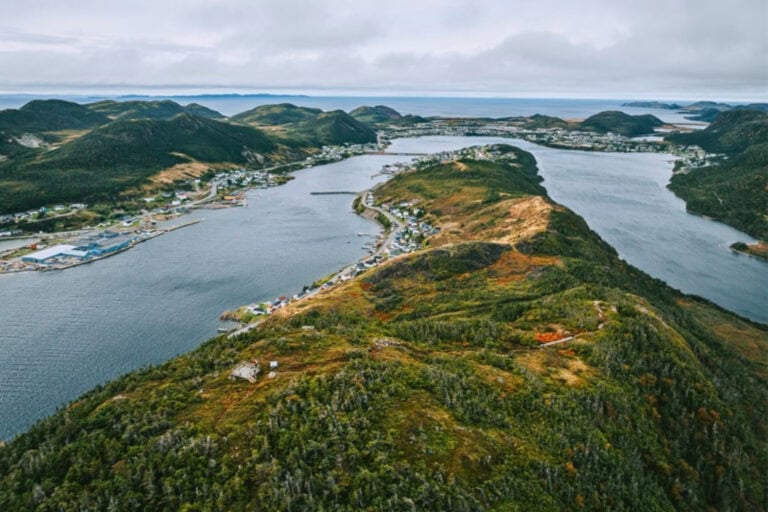
The song, really, says it all. You’re here, “on the edge of the Atlantic,” the singers on stage intone in a sweeping, soaring melody. “At the start of a moment,” they say. “On an island in between.” A place of wonders, they could have added. Where, it seems, everything is possible, from reeling in a shark to being totally surprised by a sneaky whale.
I’m sitting in the Joseph R. Smallwood Arts and Culture Centre, watching a performance of Come from Away. The Tony Award-winning musical has spread so much joy, from Broadway to four years running in London’s West End. And around the world: from Seattle to Toronto to Melbourne in Australia.
Now, it’s playing in Gander, the tiny little town featured in the play. Where locals opened their hearts and homes to 7,000 “plane people” aboard 38 big aircraft forced to land here exactly 25 years ago, on September 11, 2001.
More on that below, on spending time with the actual folks featured in the show. But first—a little more on those other, many wonders. So much encountered on a two-week road trip, crisscrossing the central parts of Newfoundland.
A Little Background
Often referred to as “the Rock,” for its rugged yet picturesque terrain, Newfoundland is truly a place apart, in all the best ways. The island portion of Canada’s easternmost province (formally called Newfoundland and Labrador, or NL) didn’t join the country until 1949. But settlement here dates back hundreds of years, with continuously populated communities founded all the way back in the 1600s.
For a great deal of that history, many of the fishing villages here were accessible only by boats and ships. With remoteness comes culture, and character. Newfoundland has its own accents and dialects, small quirks and big stories. Bathed in so much song (and dance).
Many visitors don’t stray far from the eastern and western coasts of the island, the areas most accessible to cruise ships and closest to the two largest airports. On this trip, I’m headed right to the middle. Visiting areas even many Newfoundlanders haven’t seen. With a new discovery around every turn.
A Very Big Catch
“They hunt these edges, like fish highways,” says guide Bryan Oram, showing me the bottom of the sea on his sonar unit. “Sharks will zig and zag that chum slick, and end up at the boat.”
This morning, one of my first on the trip, I’ve climbed aboard his boat, motoring out into Bonavista Bay so far that the land has disappeared on the horizon. Oram’s outfit, The Shark Co., operates with a scientific research license. Strictly catch-and-release, they “spaghetti tag” each of these big fish they catch, in the service of education and conservation. When found, the data the tags provide is invaluable. “They’ve found tagged sharks as far away as Spain,” he explains.
Patience is a virtue. But not a difficult one, rocking on these salty waves. First, we drop the chum (the bait) into the water. Then, we wait. Seabirds, including kittiwakes, gannets, and shearwaters, glide overhead. As we chat quietly, Oram notes we should watch, and listen. “We’ll hear the drag on the line,” he says.
And we do. As I grab the rod, Oram and his father, Alec, carefully instruct me how to bring in the big fish. Pull up slowly, then reel down fast. My arms ache. I clench my teeth. It’s like trying to pull in a Volkswagen.
Soon, we have him at the side of the boat, a blue shark with coloring so bright, it’s like a flash of neon. Oram expertly applies the tag, and releases the fish swiftly. Fin and swishing tail disappear beneath the dark waters. Next stop, Spain? Perhaps.
“The wow factor,” Oram says, “is getting to see the shark so close.” I couldn’t agree more. The adrenaline runs strong, for many hours afterward. A once-in-a-lifetime catch.
One Sneaky Whale
Part of the fun of this road trip? Seeing some of the most remote—and breathtaking—villages on the island. And I’ve never spent time in a place quite like Harbour Breton (HB).
Even for other Newfoundlanders, HB is a bit remote. To reach this community of about 1,500, you need to navigate south off the island’s main artery, the Trans-Canada Highway, which bisects Newfoundland. Then, travel a little more than two hours. The journey is more than scenic, curving through craggy hills and windswept meadows and endless forest, before descending at a steep angle toward the coast.
And the postcard-perfect fishing village is definitely worth the drive. Picture it: the main town curling around the crescent of a protected cove, boats motoring by, with happy little homes climbing the slopes all around. The pace was mercifully, wonderfully slow.
Led by a guide named Steve Perry, we enjoy a little recreational cod fishing, and attend an evening concert with updated versions of sea shanties. (Part of the annual Tradition by the Sea Festival.)
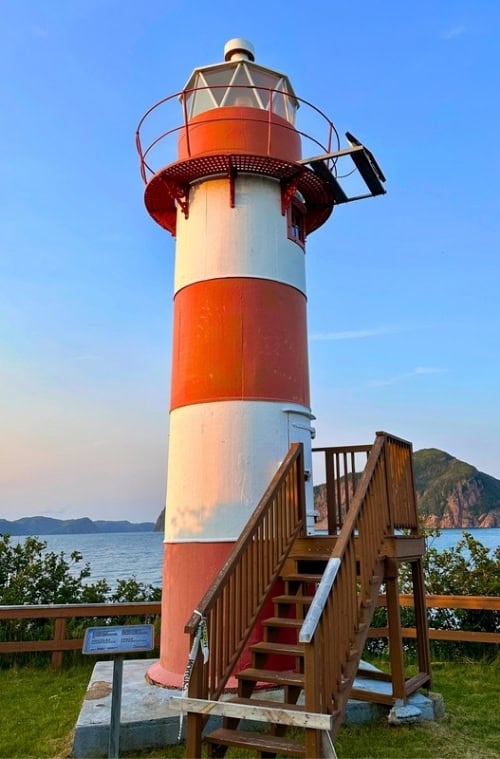
In the late evening one day, we take a pleasant stroll out to the local lighthouse. It’s that magical moment of the daylight, when the sunset just begins to fade. Vibrant auburn, giving way to creeping shades of amaranthine.
And then, as we approach the water, a surprise splash. A minke whale surfaces just off the edge of the land, seemingly close enough to touch. A little spout, as he seems to hang around for a moment or two, before diving down and continuing on into the encroaching night. Energy seems to pass between us before he departs. A mere moment, but one I’ll never forget.
Rapids and a River of Salmon
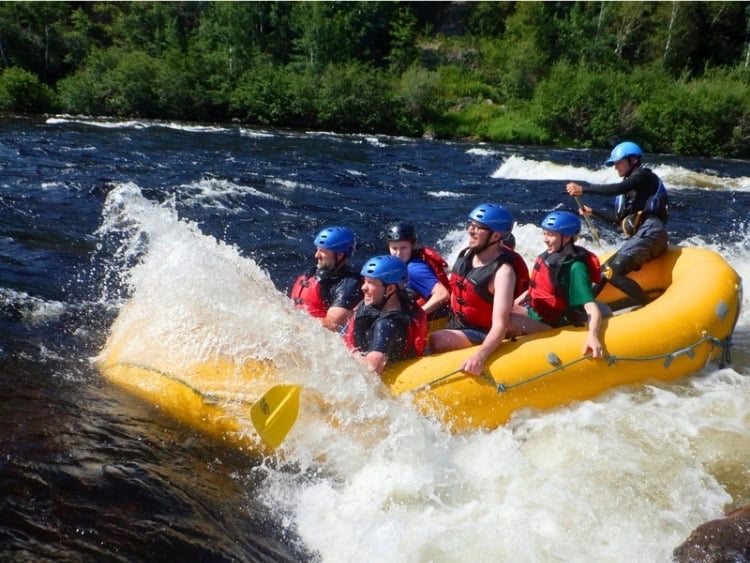
This is a wide-ranging road trip. All the charm and quirk and natural loveliness, hard to encapsulate in words. I fished off the dock and stayed in a geodesic dome with a company called Hare Bay Adventures.
In Grand Falls-Windsor, a larger town, I took photos of the namesake cataracts, and watched rafters plunge through the raging white water. Plus, salmon leaping up a ladder at the Salmonid Interpretation Centre.
Where Flying Boats Once Ruled the Atlantic
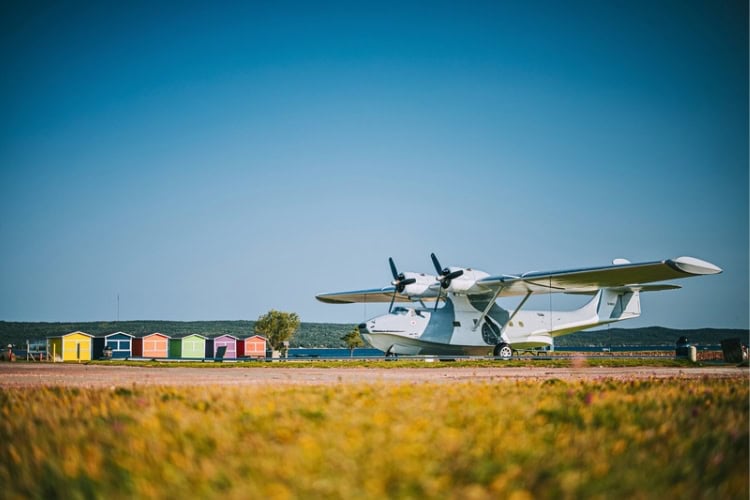
And in nearby Botwood, a place with a population of (less than) 3,000, I met Winston Churchill. And Teddy Roosevelt. Plus, Bob Hope, to boot. Not in the flesh. But their photos and stories.
“Little, tiny Botwood started seeing the superstars of the day,” says Lisa Hemeon, the town’s lead for heritage, tourism and special events, as she tours me around the truly impressive Botwood Flying Boat Museum. “We would see these powerful people walking around town, and take them for tours up the river.”
At the dawn of trans-Atlantic air travel, in the 1920s, ‘30s, and ‘40s, flying boats—buoyant fixed-wing planes with the hull of waterborne craft—were key in ferrying people across the ocean. Because its long harbour remained mostly free of ice and fog, year-round, Pan Am chose Botwood as a primary refuelling base. And the British Overseas Airways Corporation (BOAC) even built a small village here, complete with restaurant, bar and cabins for its passengers.
The museum weaves narratives not just about the famous, but also unsung heroes, including the truly heroic story of Adele Jenkins. She was an air hostess (as they were known at the time) who rescued many after a crash.
Botwood’s Open Air Gallery
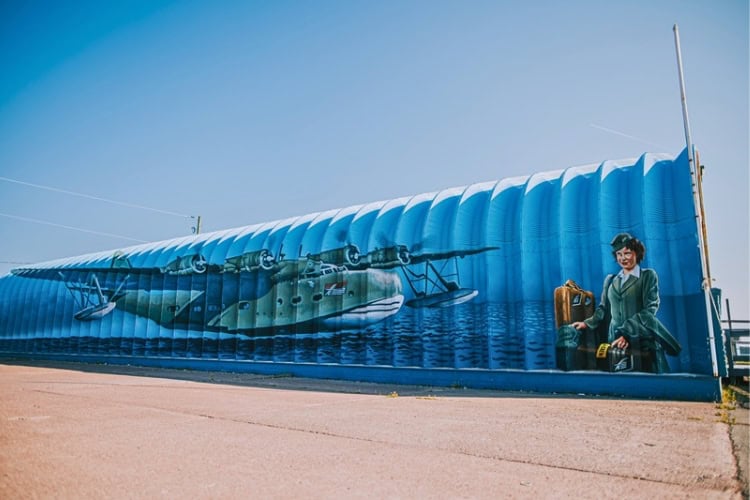
Proceeding back into the daylight, Hemeon drives me around Botwood’s other claim to fame: murals.
Some 18 walls here have been transformed into works of art, turning the town into the province’s largest outdoor art gallery. Huge, colorful, and sometimes fantastical. And most, entwined with the town’s history, from the Indigenous Beothuk people, to depictions of abundant sea life, to railway workers and firefighters. With a rather amazing backstory attached to the creation of each one. (Footnote: Botwood has such standing in this world of outsized artwork that they’ve hosted the Global Mural Conference.)
Fits Like a Glove
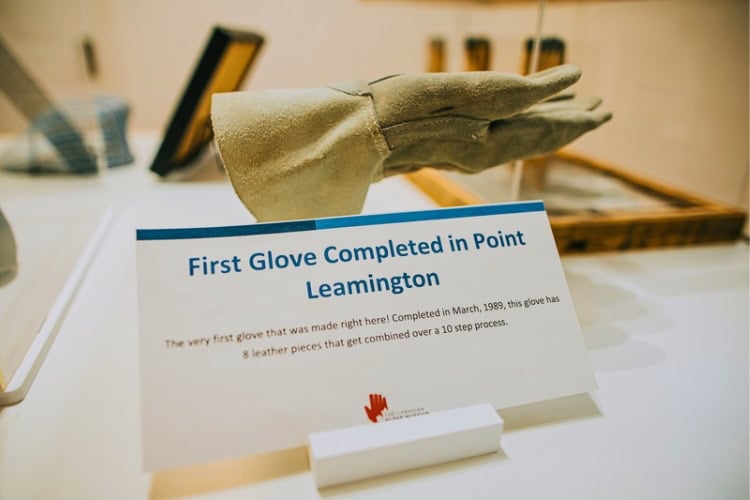
On any road trip, it’s the surprises that you remember the most. And the Canadian Glove Museum was a totally unexpected delight. Located just up the road from Botwood in Point Leamington, it’s attached to a factory owned by a company called Superior Glove that employs about 150 people, and makes 3,000 different types of gloves.
Guide Tammy Stride notes that it was always the dream of the company’s president to open a museum like this. So a few years ago, they did. She walks me through the displays, which are open to the public and free of charge. They exhibit everything from beaver skin gloves worn by fur traders, vintage leather hockey gloves, and a well-used 1950s baseball catcher’s mitt.
Plus, pairs actually worn by a variety of celebrities, including Marilyn Monroe, Audrey Hepburn and Elvis Presley. As well as hardy gloves that made it to space, on the hands of the famous and charismatic Canadian astronaut, Chris Hadfield.
Perhaps just as fascinating: a tour of the factory itself. Station by station, employees explain what they’re doing, from cutting patterns to making yarn. Everyone has a smile and a joke. One employee tells me she helped with some of the designs. “Oh, I had a hand in it,” she says, with deadpan delivery. And what’s next, I ask? “Oh, we’ve always got something up our sleeves.” Like I said—a true delight.
Gander
Come From Away

And then, back to Gander, on one of the last days of this great Central Newfoundland road trip. In so many ways, seeing Come from Away on its home stage is the culmination of everything I’ve experienced along the way. The musical centers around the warmth and kindness of the local people—something I encountered at every turn of the road.
Dinner With the Flynns
Before attending the show, I’m invited to dinner with Derm and Diane Flynn at their house in nearby Appleton. “People are intrigued we open our homes to strangers,” Derm tells me. “We’ve had them come from all over—Japan, Ireland, Australia.”
During the days the “plane people” were in town, the couple had unexpected guests sleep on their pullout couch. They gave others hot showers, meals, a drink from the whiskey bar in their basement. Much of this is depicted in the play.
We feast on crab, scallops, plus cod they caught themselves. And the Flynns reminisce. “It was an all-out effort from everyone, to help the thousands who dropped from the sky.”
The Airport That Built a Town
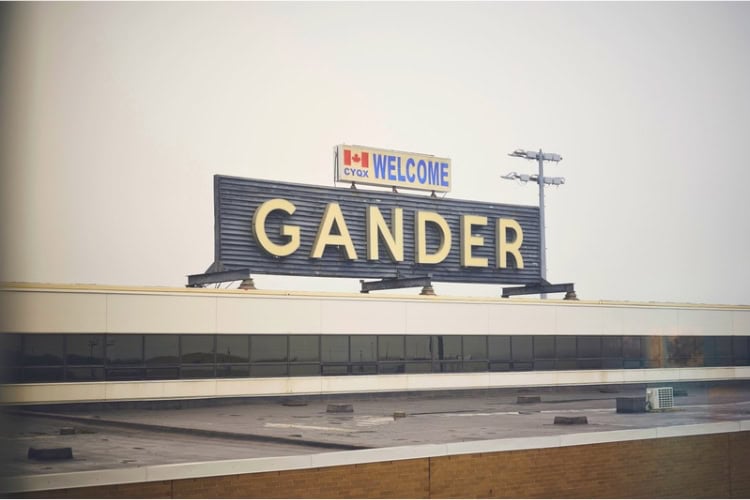
Before heading to the theatre, I take a tour of the airport (code: YQX), where guide Rhonda Lane tells me that the runways came first, and the town grew up around them. The airport was once the largest in the world, based on the size of the tarmac. And still has one of the longest runways. “Anything can land here,” she says. It was even an alternate landing spot for the space shuttle.
Key in the Second World War, YQX became the main refuelling airport for trans-Atlantic planes headed over the ocean. Its terminal is a masterpiece of mid-century modern design, and has been recently restored to its former glory. I marvel at the massive mural, “Flight and its Allegories,” that looms over everything. “They wanted the terminal to be a little luxurious,” she says. “Remember when you had to dress up to fly? That was the era.”
Lane was working at the airport on that fateful day in September, and tells many dramatic stories. Which all come to life when I situate myself in my seat for Come from Away.
After an introduction from an air traffic controller who was on duty on 9/11, the band strikes the first chords. From there, it’s a rollercoaster of emotion. Laughs, and tears. All the more significant, because I’m watching it all unfold with some of the people who were actually here, that day. A sanguine and spectacular perfect finish to my visit to the heart of Newfoundland.
If You Go
When to visit: Summer and early autumn are the best seasons in Central Newfoundland. Moderated by its seaside and boreal location, temperatures are pleasant, with sunny days the norm.
How to get there: Gander (YQX) receives regional flights, as well as a direct year-round route from Halifax and seasonal nonstops from Toronto and Montreal. The closest international airport is in the provincial capital, St. John’s, where seasonal flights on WestJet connect Newfoundland with London, Paris, Dublin and other major destinations.
Good to know: Getting “screeched in” is a rite of passage for visitors, to become unofficial Newfoundlanders. It involves a public invocation, a shot of rum, and a smooch on the lips…for a frozen cod. A super-fun and absolutely unmissable part of any visit.
More trip planning resources are available at Adventure Central.
Read Before You Go: For the full story behind the musical, pick up The Day the World Came to Town by Jim DeFede, the nonfiction account of the 38 planes and 7,000 strangers that inspired Come From Away.
Need a hand planning your trip? Here are the sites and services we rely on most, from booking tools to travel products we love.
Inspire your next adventure with our articles below:
- Halifax, Nova Scotia, Canada: Exploring a City of Many Contrasts
- 5 Reasons Québec City Captivates: Château Frontenac, Old Québec and Festival Spirit
Author Bio: Tim Johnson has visited 153 countries on all seven continents, always in search of a good story. He contributes regularly to National Geographic Travel, the Toronto Star, the Globe and Mail, Reader’s Digest, Financial Review (Australia) and the Vancouver Sun, and also writes for CNN Travel, the New Yorker, National Geographic, Bloomberg, BBC Travel, the Daily Beast, the Telegraph (London) and many others.
Want to discover more hidden gems and helpful travel tips? Join our free newsletter for the latest travel secrets and travel articles.
We are reader-supported and may earn a commission on purchases made through links in this article.

- 10 Essential Tips for Surviving Major Flight Disruptions - October 22, 2026
- Helicopter-Access Hiking at Durrand Glacier Chalet in British Columbia’s Selkirk Mountains - October 22, 2026
- An Artist’s Safari: Seeing the Soul of the Wild in Black and White - October 22, 2026
Planning another trip soon? ✈️
Add GoWorldTravel.com as a preferred source on Google. Click the button below so our local guides, packing hacks, and hidden-gem itineraries always show up first when you search!
Add to Preferred Sources