

We are reader-supported and may earn a commission on purchases made through links in this article.
Canoeing in Alaska
Flarks and strangs, pingos and palsas. They’re words I don’t know, but that I’m beginning to speak here on Alaska’s Noatak River. Here, on this bucket-list Alaskan adventure, my canoe paddles bite into the water and the afternoon breeze kicks up through low willows.
The pingo, I’ve learned, is kind of like an ice bubble that was blown long ago by a glacier. It is visible for miles, and the 70-foot hill of it glows like a black light at a really, really good party.
Every landscape here in Alaska speaks two languages, words that only fit with this massive Arctic landscape. When a wolf howls near our camp at 1:30 a.m., its lonely cry echoing off four or five different mountains, I have to figure he’s speaking the other language of this place, the one this land keeps mostly to itself.
This is the language I’ve come here to learn.
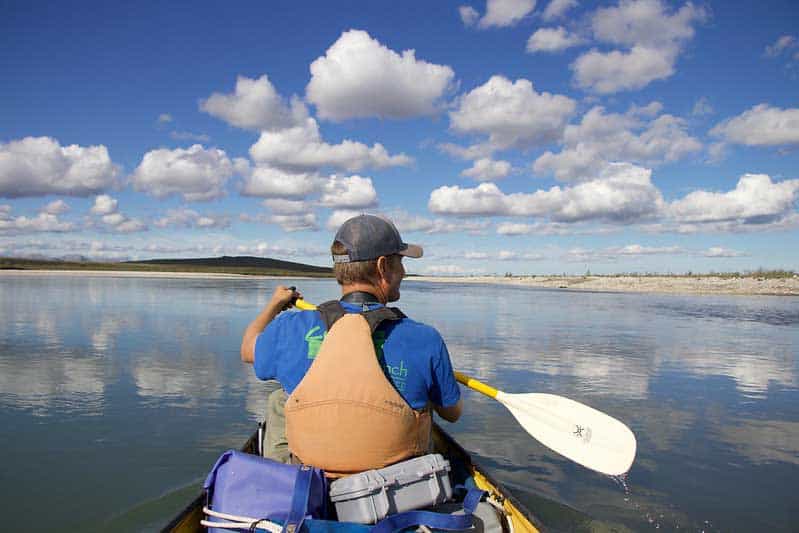
The Noatak River
The Noatak River flows from a watershed gathered around the sharp double peaks of Mt. Igikpak, rising 8,500 feet (2,591 m) in the Brooks Range, somewhere around 67 degrees north latitude.
It’s above the Arctic Circle, which means that tonight the sun won’t set, but around the time the wolf starts howling, the sky will take on a pale-blue glow, a gentle color that somehow reminds me of seashells on wild beaches.
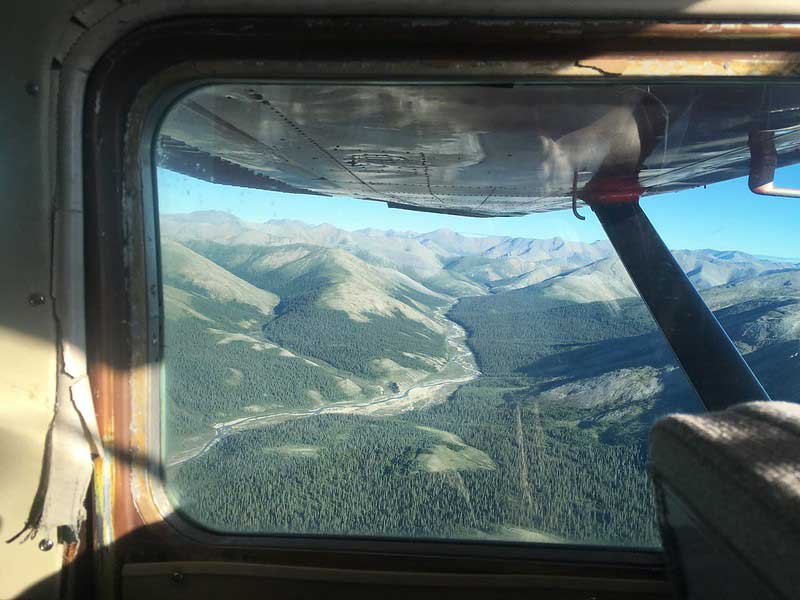
How to Get to the Noatak River
It’s not easy to get to the Noatak, which is part of its beauty. You have to fly to Fairbanks, Alaska’s second-largest city, then switch to a small plane for the trip to Bettles — a small lodge, a few houses and a long runway in the middle of nowhere.
Then switch again to a floatplane for the final hour or so of threading through the Gates of the Arctic, more than 8 million acres of protected wilderness.
Alaska Discovery, one of the oldest adventure travel companies in the state, runs trips on the Noatak twice a year, and they have this down pat.
Our guides, Jeff and Mo, have that air any good river guide does: pure competence wrapped in absolute relaxation. You know these people bandage their cuts with duct tape and laugh while they do it.
The National Park Service describes the Noatak as “one of North America’s largest mountain-ringed river basins with an intact ecosystem.”
That’s government language, and what it translates to, as we slide the five canoes into the Noatak’s silty current, is that the untouched mountains roll away around us, covered with tundra getting ready for winter.
The bearberry is popping a bright shade of magenta, the river banks are littered with white flowers the size of pinheads, and each night, horsetails — which look like bamboo grown by a seriously demented bonsai artist — make a perfect bed for the tents.
The river is mostly Class I and II water — flat or just enough current to make paddling a little easier as our string of canoes starts to spread out.
There’s a lot of talk between boats at first, running commentary on the scenery and on lives left behind, but it doesn’t take long for the river’s silence to take over.
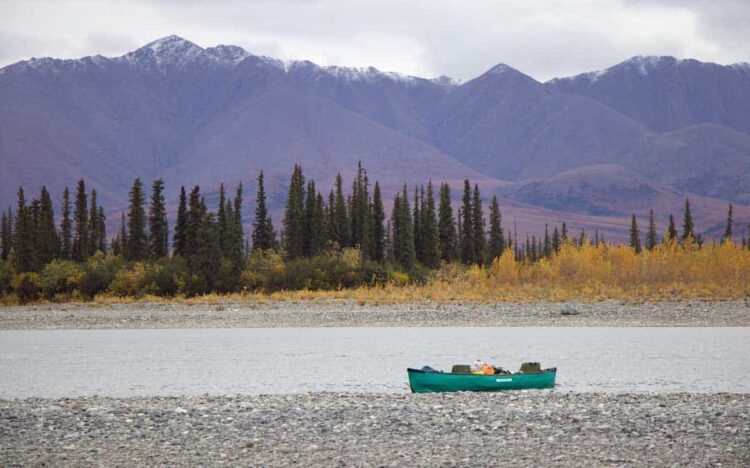
A Beautiful Afternoon on the Noatak River
By early afternoon, whispers seem loud, and we’re looking for ways to muffle even our paddle strokes.
It’s not an unusual group for this kind of trip: highly educated (three nuclear physicists) and very well-traveled (me, the travel writer, has been fewer places than any of the other nine people).
Most of them have chosen this trip because Alaska Discovery is part of Mountain Travel Sobek, and they’ve been on adventures with them around the world.
But the real draw is the Arctic itself. There’s something about the way the sun slants, still blazing, long after the rest of the world has gone to bed.
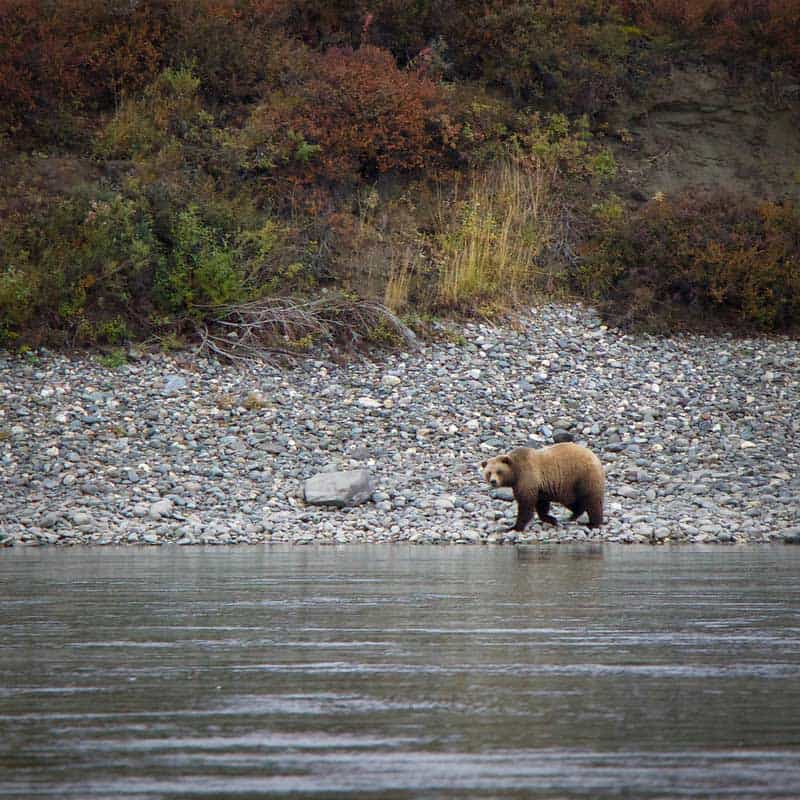
It lights the tundra a shade of gold that matches the shade of fur I’ve seen on the backs of the barren-ground grizzly bears when they are fat with fish.
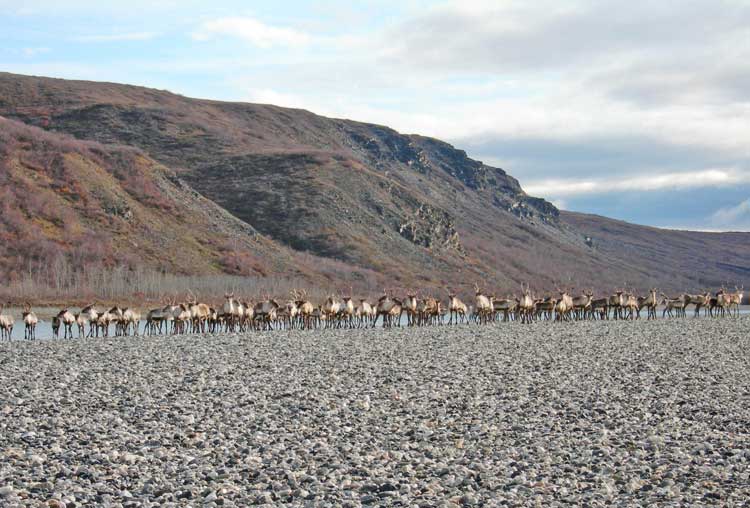
We’ve all been to the Arctic before, we all know we’ll be back, so over lunch on a gravel bar covered with caribou tracks, we talk about the other Arctic rivers Alaska Discovery runs—the Hulahula, the Kongakut, the Sheenjek—and think ahead to other summers.
What is it about being this far north? Paul says it’s because the Arctic is always exotic, Milt says, “the light, the animals, a vista not choked with trees. Endless, empty vistas.”
Other Sides of the Arctic
But it’s anything but empty here. On a day when I stay behind in camp while everybody else goes for a hike — the trip alternates paddling days and hiking days, giving us a chance to see as many sides of the Arctic as possible.
I listen, looking for a key to deciphering the landscape’s own language, and discover just how full this place is.
The low and constant drone of the insect buzz is like a platform of sound, holding up the warbling cry of a red-throated loon, followed by the splashes of the bird running on water.
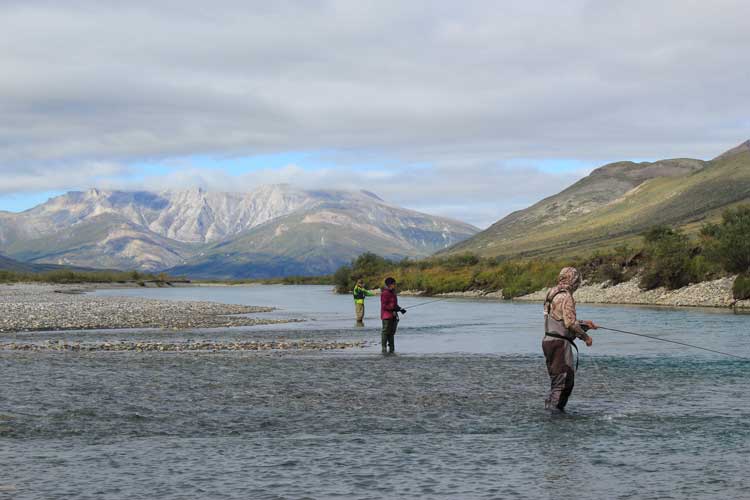
Wildlife in the Arctic
A brown butterfly, the edges of its wings lined in the color you see in old barns right before they fall down, stops to check out my river-dirty socks, while a raven kwocks past in flight, a black streak against the yellow mountains.
Everything is trying to pull a last bath of sun-drenched nutrients from the impossibly blue sky.
Along the river, I spy spotted sandpipers and Arctic ground squirrels. Dall sheep browse the cliff opposite, and about an hour ago, something very large — bear? caribou? moose?
There are signs of all three on the muddy riverbank— charged across the river, out of the water, and was gone before I could even stand up.
When the hikers come back, they’re breathless: “The musk ox was so close we could smell him.”
Kind of a horsey smell, they say, as Mo, who turns out to be a genius with a four-burner camp stove, starts dinner.
Already we’ve been on the river long enough, in this different world, that when Mo and Jeff start peering at a faulty gas valve, lighter in hand, nobody worries.
“I guess what calls me back,” Eliot says, as we gather a dessert of Arctic blueberries that have a fine, gently bitter taste, “is that the Brooks Range makes me feel small, insignificant. I think we need that.”
In the evening’s endless twilight, the physicists spend an hour or so measuring the river temperature.
One’s high-tech thermometer says 57 degrees; another’s says 59, so there’s a long discussion of the discrepancy.
Misconceptions about the Arctic
When most people think of the Arctic, they think of snow and ice and polar bears, but that’s only the tiniest fraction of things.
We all have very warm clothes with us, but at camp each morning, we’re in T-shirts, and there’s a run on sunscreen.
I get the deepest tan of my life up here, and I have raccoon eyes from keeping my sunglasses on every waking hour.
Before we turn in for the night, the mountains now glowing like beating hearts, the river offers up a present better than a lullaby: the fresh tracks of a bear cub, following its mother.
Mom’s tracks are about five inches across, which means she’s a pretty big bear. The cub’s are smaller than my dog’s.
In the morning, canoes are back in river, the sunlight making our river-washed clothes sparkle like Vegas lounge singers. I dip my hands into the cold water and watch a sandhill crane, its long legs like a kite streamer, fly past.
After four days of paddling, my arms feel stronger than ever, and the stroke techniques that seemed almost alien at the beginning of the trip are pure reflex now. We eat the miles of the river like a fine banquet.
“I don’t know what day it is, or how long we’ve been out here, and I don’t care,” Jan tells me after we make camp. “I just want to be right here, take all this in.”
I look up and see Eliot — an international health consultant — and two of our three nuclear physicists making the careful evening trash fire.
Enough IQ points to start a new country, and these three guys are standing over burning food wrappers, smiling like kids on their first campout.
The last night, we’re on the shores of our takeout lake, everybody both dreading and anticipating tomorrow’s arrival of the plane south.
We’ve been 10 days without the sounds of the modern world, and the loudest sound we’ll hear tonight are the cackling loons, calling to each other across the lake’s shores.
I climb out of my tent around 2 a.m., and the moon, which rose full and an unlikely shade of red, splitting the cleft between two mountains a few hours ago, has not so much gained altitude as it has skittered around the sky like a pinball.
It makes me wonder if there’s enough food left that I could just hang out here on the lake for another week, gather the delicate shells that litter the lakeshore like very fine origami and watch how much the family of ducklings grows in the late summer light.
Swimming Caribou
And in the morning, yet another reason to stay: After we’ve packed up and are sitting on the beach, Eliot suddenly whispers urgently: “Swimming caribou.”
Five of them, coming a half-mile or more across the lake, led by a female and her calf. All five swim at a steady speed, the massive antlers on the two males rising three feet or more above the surface of the water.
I don’t know how long we watch them. We are all almost afraid to breathe, for fear it will disturb the magic.
Finally, the female and her calf come ashore. They shake themselves like very big dogs, and we hear her snort as she scrambles up the low hill to the tundra plateau beyond.
A final lesson in the language of the place. A final reason for our response to be “thank you,” in any language we can think of speaking.
If You Go
Alaska Division of Tourism
www.travelalaska.com
Inspire your next adventure with our articles below:

Nice Article!!
Very informative. Thanks for sharing.
Loved your myth-breaking post on the Arctic. I’m a budding travel blogger from India, apart from river paddling, what other attractions are there for a family to enjoy?